
JUMP TO A SECTION
The question usually starts the same way: a neighbor two streets over got a new roof out of nowhere, or a phone alert mentioned hail somewhere in Macomb County, and now you are standing in the driveway squinting at your own shingles wondering if you missed something. The honest answer is that you cannot settle it by looking, and you should not have to guess. The National Weather Service and NOAA both keep public records of reported storm events, including hail, and pulling your own address against those records takes a few minutes and beats speculation every time.
This is a lookup walkthrough, not a damage inspection. Confirming a storm passed near you is step one. Whether that storm actually damaged your specific roof is a separate question, answered by a ground-level check and, ideally, a free professional inspection.
01 / THE SHORT ANSWERHow to find out if hail hit your address
Two public tools do most of the work. The NOAA Storm Events Database lets you search reported hail, wind, and other severe weather events by county and date, with the reported location and hail size for each entry. The National Weather Service office that covers southeast Michigan, based near Detroit and Pontiac, also publishes local storm reports for specific events, often with a plotted map of exactly where each hail or wind report came from. Between the two, you can usually confirm whether a storm was reported anywhere close to your street on the date in question, and roughly how large the hail was reported to be.
02 / THE PHYSICSWhy hail is hyper-local, and a neighbor's roof means nothing on its own
Hail forms inside individual thunderstorm cells, and those cells are narrow compared to the ground they pass over. A hail core moving through Macomb County can drop damaging stones on one subdivision and taper to nothing a mile away, sometimes within the length of a single street. Wind direction, the storm's exact track, and how a cell weakens or strengthens as it moves all shape a footprint that has nothing to do with municipal boundaries or even which side of a road you live on.
That is why a neighbor's brand-new roof is not evidence about yours, in either direction. It could mean the same cell clipped your block and missed your specific roof line by a few hundred feet. It could also mean a different, earlier storm damaged their roof and the timing is coincidental. The only way to know what happened at your address is to check the record for your address, and then check your own roof.
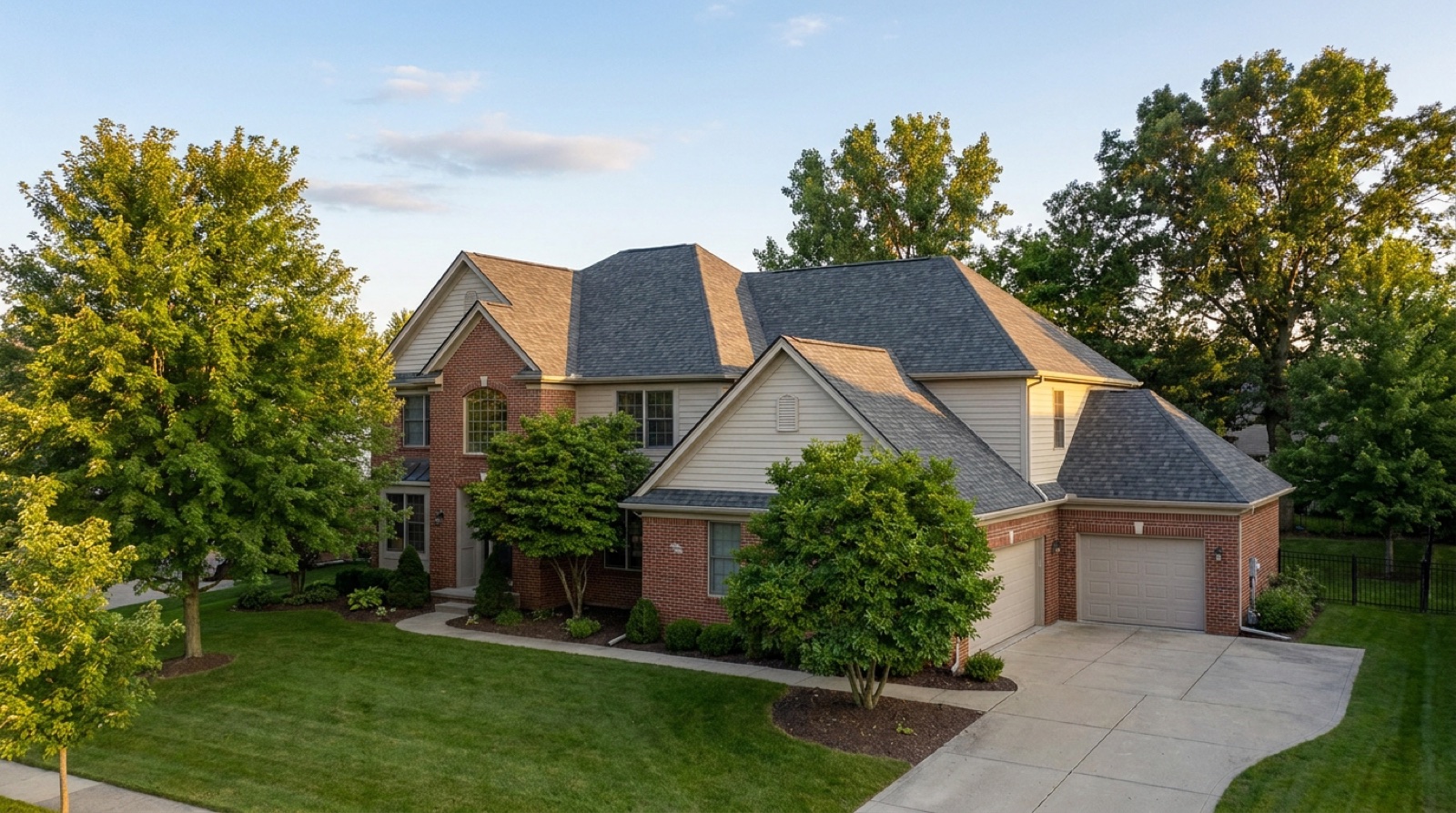
03 / THE LOOKUPChecking the NOAA Storm Events Database
NOAA's National Centers for Environmental Information maintains the Storm Events Database, a searchable public archive of severe weather reports going back decades, including hail, thunderstorm wind, and tornado entries. To check your date, search by state (Michigan) and county (Macomb), narrowed to the date or date range you have in mind. Each hail entry typically lists a begin time, a nearby location or landmark, and the reported hail size, usually described against a familiar object like a quarter or a golf ball.
Read the location field carefully. Reports are tied to the nearest reporting point, not necessarily your exact street, so a report a few miles off does not rule your address in or out on its own. What it gives you is a confirmed date and a general area, which is the starting point for the rest of the check.
04 / THE MAPReading NWS local storm reports for southeast Michigan
The National Weather Service office responsible for southeast Michigan, serving the Detroit and Pontiac area, publishes local storm reports for significant weather events, often within hours of the storm passing. These reports are frequently plotted on a map showing each individual report point for hail size, wind gust, or damage, layered over the region. For a storm you remember by date, searching the office's storm report archive for that day can show you a visual spread of exactly where hail was reported relative to your township.
This is often more useful than the database search alone, because you can see clustering. If your subdivision sits inside a cluster of quarter-size or larger hail reports, that is a strong signal the storm reached you. If the nearest report is several miles away with nothing plotted near your home, the storm likely weakened or shifted before it got to your street, though it does not fully rule out a lighter, unreported hit.
Reported hail sizes in these databases come from trained spotters, law enforcement, and the public, not from a sensor on every roof. A storm can produce damaging hail on your street that nobody happened to report. Absence of a nearby entry is not proof nothing happened; it just means the lookup step is inconclusive and the ground and roof checks matter more.
05 / THE LIMITSWhat a confirmed storm record does and does not prove
Finding a hail report near your date and location confirms a storm was there. It does not confirm your roof was damaged, and it does not tell you how large the hail was when it reached your specific shingles. Reported hail size is measured or estimated at one point in a storm's path, and hail size can vary within the same event as it travels. Treat a confirmed nearby report as a reason to look at your roof carefully, not as proof of damage in itself.
The reverse is also true. Not finding a report near you does not mean nothing hit your house. It means the record is inconclusive, and the honest next step is the same either way: a physical check of the roof, gutters, and soft metals around the property. Our guide on checking your roof for storm damage from the ground covers what a homeowner can safely look for without a ladder, and our collateral hail damage indicators guide covers the softer, easier-to-spot clues elsewhere on the property, like dented gutters, air conditioner fins, and window screens, that often show hail impact more clearly than shingles do from a distance.
A weather database can confirm a storm happened. Only a roof-side look, ideally a professional one, can confirm what that storm did to your house.
06 / THE NEXT STEPWhat to do once you have your answer
If the records confirm a storm reached your area, especially one with quarter-size hail or larger reported nearby, that is worth a free inspection even if nothing looks obviously wrong from the ground. Macomb County has recent history with storm damage at scale: the county was included in federal disaster declaration DR-4757 after the severe wind storms of August 2023, and damage from events like that is not always visible without someone on the roof and in the attic.
If the records come back inconclusive, do not treat that as a clean bill of health, and do not treat a lack of a nearby report as reason to skip a look. Pair the lookup with the ground-level and collateral-damage checks linked above, and if anything there raises a question, an inspection settles it either way. We document what we find with photos, and if the roof is fine, that is exactly what we tell you. You can start from the storm damage estimator, get a repair ballpark with the cost calculator, or browse more of the post-storm library in our guides index.
- The NOAA Storm Events Database and NWS local storm reports for the Detroit and Pontiac area both let you check whether hail was reported near your address on a given date.
- Hail is hyper-local; a neighbor's new roof or a nearby report neither confirms nor rules out damage at your specific address.
- A confirmed record means look closer, not automatically damaged; an inconclusive record does not mean automatically fine.
- Pair a storm-record check with a ground-level roof check and a look at collateral damage indicators around the property.
- Macomb County was included in FEMA disaster declaration DR-4757 after the August 2023 wind storms; a free inspection is the only way to get a real answer for your roof.
Questions we hear most
Search the NOAA Storm Events Database by state, county, and date for reported hail near you, and check the National Weather Service Detroit/Pontiac office's local storm reports for a plotted map of the same event. Both give you a general area and reported size, not a guarantee for your exact roof, so pair the lookup with a physical check of your property.
Not necessarily. Hail falls from narrow storm cells that can damage one street and miss the next entirely, and your neighbor's roof could also reflect a different storm date. The only way to know about your own roof is to check the storm record for your address and then look at your own shingles, gutters, and soft metals.
Not automatically. Hail reports depend on someone seeing and reporting the storm, so a gap in the record does not rule out a real hit. If you have any reason for concern, such as dented gutters or a recent storm you remember locally, a free inspection is the only reliable way to know.
- NOAA National Centers for Environmental Information, Storm Events Database. ncdc.noaa.gov/stormevents
- National Weather Service, Detroit/Pontiac forecast office: southeast Michigan forecasts, warnings, and event records. weather.gov/dtx
- FEMA, disaster declaration DR-4757-MI, Michigan severe storms of August 2023 (Macomb County designated). fema.gov/disaster/4757