
JUMP TO A SECTION
It usually starts with a dumpster. A contractor's yard sign goes up two doors down, a crew tears off the old shingles in a day, and suddenly you are standing in your own driveway wondering whether the same storm that hit their roof also hit yours. It is a reasonable question, and it deserves an honest answer instead of a guess based on proximity. The short version: a neighbor's new roof is a reason to check your own, not proof of anything about it. Hail and wind do not respect property lines, and they do not treat every roof on a block the same way even when the same storm passed directly overhead. By the time three or four houses on a street have new roofs, it is tempting to treat the pattern itself as the evidence, but a pattern of reroofs tells you a pattern of contractor activity, not a guaranteed pattern of damage at every address in between.
This is about interpreting a neighbor's reroof correctly, not about identifying damage on your own roof. For that, pair this with a ground-level check and verifying the storm actually reached your address in the public weather record.
01 / THE SHORT ANSWERDoes a neighbor's new roof mean yours was hit too?
Not necessarily, and not automatically no either. A neighbor's reroof tells you a storm damaged their roof enough to justify replacement, and that they hired someone to fix it. It does not tell you what the same storm, or a different one entirely, did to your roof a few hundred feet away. Roof age, pitch, orientation to the wind, and the material on the roof all change how much damage the same hailstone or gust does, which is exactly why identical storms leave very different marks house to house. Two houses built by the same developer in the same year, on the same street, can still end up with different outcomes once one roof has been reroofed more recently or faces a different compass direction than the other.
It helps to separate two questions that get blurred together in driveway conversation: did a storm reach my street, and did that storm damage my specific roof. A neighbor's new roof only ever speaks to the first question, and even then only loosely, since it does not say which storm or which date. Answering the second question requires looking at your roof, which is the part a yard sign two doors down cannot do for you no matter how convincing it looks from the sidewalk.
02 / THE PHYSICSWhy one storm treats a whole block unevenly
Hail forms inside individual thunderstorm cells that are often narrow compared to the ground they cross, and the core of damaging stones can taper off within the length of a single street. Straight-line wind gusts behave similarly: a downburst can funnel hard through one gap between houses or trees and lose most of its force by the next lot. So even within a single storm event, two roofs a few hundred feet apart can see meaningfully different peak hail size or wind speed simply because of where each one sat relative to the storm's exact path.
Layer a second storm on top of that and the picture gets murkier still. Southeast Michigan sees more than one hail or wind event across a season, and a neighbor's damage could just as easily trace to a storm weeks or months before the one everyone is currently talking about. A sign in a yard and a new roof next door tell you a job happened. They do not date-stamp which storm caused it, and they say nothing about your own address on any date.
Wind damage follows a related but slightly different pattern. A straight-line gust does not fall from directly overhead the way hail does; it moves horizontally, accelerating and losing energy as it threads between houses, trees, and other obstructions. Two rooflines a stone's throw apart can face a completely different effective wind load in the same event depending on which way each house is turned and what stands upwind of it. That is part of why a wind-driven reroof next door tells you even less about your own exposure than a hail-driven one does; the geometry of a single lot can matter as much as the storm itself.
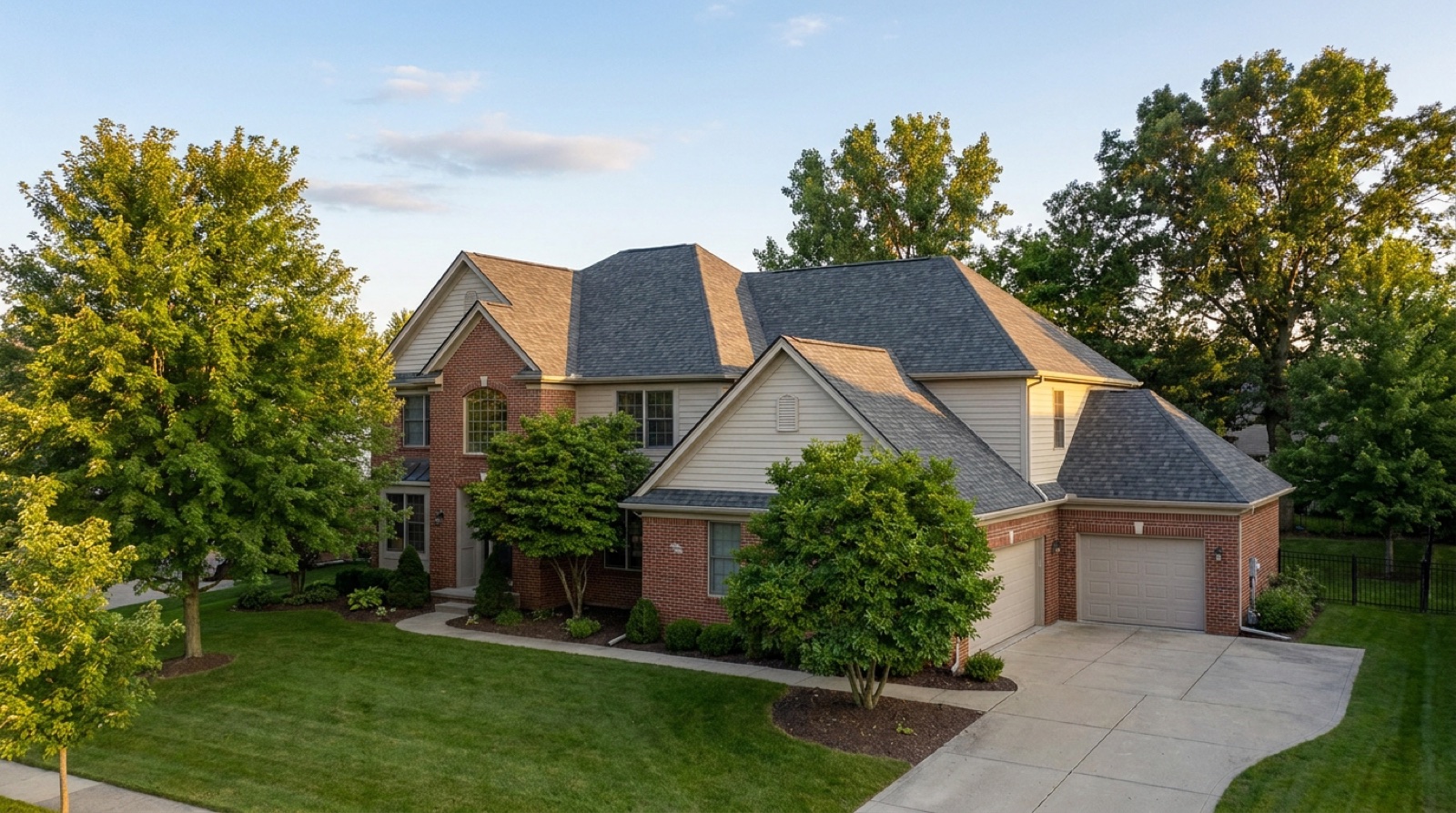
03 / THE VARIABLESWhat actually differs from one house to the next
When two neighboring roofs come through the same storm with different outcomes, it is rarely random. A handful of concrete factors usually explain it.
- Roof age. A shingle roof nearing the end of its rated life is more brittle and more easily cracked or bruised by the same hail impact that an newer roof would shrug off.
- Pitch and slope orientation. A steeper roof, or one angled away from the direction hail or wind was traveling, takes a more glancing hit than a shallow roof facing the storm head on.
- Material tier. Basic three-tab shingles bruise and crack more readily than heavier architectural or impact-rated products, so identical hail can mark one roof and barely mark the other.
- Tree cover and structures. Mature trees, a neighboring garage, or even a fence line can shield one roof from wind-driven hail while a more exposed roof next door takes the full force.
- Exact storm track. The narrow, shifting core of a hail-producing cell can simply pass a few hundred feet to one side of your roof and directly over the next one.
| FACTOR | WHAT IT CHANGES | WHY OUTCOMES DIFFER NEXT DOOR |
|---|---|---|
| Roof age | How brittle the shingle mat is | Older shingles crack and bruise more easily under the same impact |
| Pitch & orientation | The angle hail or wind actually strikes | A shallow roof facing the storm takes a harder hit than a steep or angled one |
| Material tier | How much force the surface absorbs | Basic shingles mark more visibly than heavier or impact-rated products |
| Tree cover & structures | How much of the storm actually reaches the roof | A shaded roof can be partly shielded while an exposed one takes the full force |
| Storm cell track | Where the damaging core actually passed | A narrow hail core can cross one lot and miss the next by a few hundred feet |
None of that means your roof is automatically fine just because it is older, steeper, or better shaded than a damaged one next door. Age in particular cuts both ways: an older roof is also closer to the point where ordinary wear and a real storm hit can be hard to tell apart without someone trained to look. The honest read on your roof has to come from looking at your roof, not from comparing yard signs.
04 / THE PRESSUREThe sign that shows up right behind the storm
There is a predictable pattern after any notable hail or wind event in Macomb County: yard signs multiply within days, and door knockers follow close behind, often pointing at the neighbor's new roof as their opening line. That pressure is designed to make you feel like you are the last house on the block without a claim in progress. A real storm does not need a sales pitch to prove it happened, and a legitimate local roofer does not need to stand on your porch pointing at someone else's dumpster to get you to look at your own roof.
The canvassing playbook tends to follow a familiar script: a knock within days of the storm, a gesture toward the reroof up the street as proof this is happening to everyone, and a push to get on the roof and sign paperwork the same visit, sometimes before you have even called your insurer. None of that is inherently proof of a scam, but the sequence itself, urgency plus a neighbor reference plus a same-visit signature, is exactly the pattern worth slowing down for. A roof that genuinely needs attention will still need attention next week, after you have had time to verify the storm record and get a second, unhurried opinion.
Be cautious with anyone who leads with the neighbor's roof, pushes you to sign paperwork on the first visit, or cannot name a local address you could drive to. Our full breakdown of the red flags, and how a legitimate local roofer behaves differently, is in our storm chaser guide.
05 / THE READWhat a neighbor's roof does and does not tell you
Treat a neighbor's reroof as a prompt, not a verdict. It is a fair reason to go check the public storm record for your own address and date range, which our guide on verifying a storm hit your house walks through using NOAA and National Weather Service reports. It is also a fair reason to do a careful ground-level check of your own shingles, gutters, and soft metals, since some hail and wind marks are visible without a ladder.
A neighbor's dumpster is a reason to look at your own roof. It is not a substitute for looking at your own roof.
What it should not do is push you into a decision. Not toward assuming you are fine because your roof looks similar to theirs from the street, and not toward assuming you must have damage because someone nearby did. Both assumptions skip the one step that actually answers the question. Consider two common scenarios side by side: a homeowner sees a neighbor's new roof, assumes theirs is fine because nothing looks obviously wrong from the driveway, and skips a look entirely, only to find a slow attic leak two winters later that traces back to the same storm everyone else already addressed. Another homeowner sees the same reroof, panics, and signs with the first door knocker who shows up, without ever confirming a storm reached their address at all. Both outcomes come from treating a neighbor's roof as the answer instead of as the prompt to go find one.
06 / THE REAL ANSWERGetting an answer for your own roof, free
The only way to know what a storm did to your specific roof is to have it inspected, and ours is $0 with no obligation. We check the shingles, flashing, gutters, soft metals, and the attic side of the deck, and we photograph everything we find. If the roof is fine, that is exactly what we tell you, even if the house next door just got a new one. If there is damage, we document it clearly enough to support a conversation with your insurer, and our storm and insurance claims guide covers what that process looks like and what no contractor can honestly promise about a claim outcome.
Macomb County has a real recent storm on the books worth knowing about regardless of what your neighbor's roof looked like: the county was included in federal disaster declaration DR-4757 after the severe wind storms of August 2023. If your roof has not been checked since an event like that, or since whatever storm has your neighbors reroofing, a free look settles it either way. Start from the storm damage estimator, run a repair ballpark on the cost calculator, or see our full published ranges on the pricing page.
One more practical note: an inspection does not commit you to anything. If we get on the roof and the attic and find nothing wrong, we tell you that plainly, in writing, even though we would rather find a job. If we do find storm damage, you get clear photos and a written scope before any decision about repair versus replacement, and the same storm damage service overview covers what that path looks like from documentation through the finished repair. Either outcome beats guessing based on someone else's dumpster.
- A neighbor's new roof proves a storm damaged their roof; it does not prove anything about yours.
- The same storm can leave very different marks house to house because of roof age, pitch, material, tree cover, and the storm cell's exact narrow path.
- Yard signs and door knockers tend to multiply right after a storm and often point at a neighbor's roof as a pressure tactic; a legitimate local roofer does not need that pitch.
- Verify the storm record for your own address and do a ground-level check of your own roof rather than reading anything into a neighbor's dumpster.
- The only reliable answer for your roof is a physical inspection, and ours is $0 with no obligation.
Questions we hear most
No. A neighbor's reroof confirms a storm damaged their roof, not yours. Roof age, pitch, material, tree cover, and the narrow path of a hail-producing storm cell all mean two nearby roofs can come through the same event very differently. Check your own roof and your own storm record rather than assuming based on theirs, and be equally cautious about assuming you are automatically fine just because you have not seen obvious damage from the driveway.
Yes. Hail falls from narrow thunderstorm cells and straight-line wind gusts can funnel unevenly around trees and structures, so peak hail size or wind speed can vary meaningfully within a few hundred feet. Roof age, pitch, and material tier compound that further, so a neighbor's damage and your roof's condition can both be real and still look completely different.
Start with a ground-level look at your shingles, gutters, and soft metals, and check the public storm record for your address and the date in question. The only way to get a definitive answer is a physical inspection, and ours is free with no obligation, covering the roof, flashing, gutters, and attic side of the deck with photos of everything we find, whether that turns out to be nothing or a documented repair.
- FEMA, disaster declaration DR-4757-MI, Michigan severe storms of August 2023 (Macomb County designated). fema.gov/disaster/4757
- NOAA National Centers for Environmental Information, Storm Events Database. ncdc.noaa.gov/stormevents
- National Weather Service, Detroit/Pontiac forecast office: southeast Michigan forecasts, warnings, and event records. weather.gov/dtx
- Manufacturer technical and warranty literature for the major asphalt shingle lines: GAF (gaf.com), Owens Corning (owenscorning.com), and CertainTeed (certainteed.com).