
JUMP TO A SECTION
Every roof problem looks like a weekend project until you are standing on the roof looking at it. Some genuinely are, and there is no reason to pay a repair bill for a job you could safely do from a ladder in twenty minutes. Others look identical from the ground and are exactly how a small problem turns into a much larger one: a missed step in the repair sequence, a sealant used where a real flashing detail was needed, or a homeowner on a pitch and surface they should never have been standing on in the first place. This guide sorts the common jobs into three honest categories, green, yellow, and red, so you can make that call before you climb up, not after. It sits alongside our full roof repair service page, which is the place to start once a job on this list lands past the DIY line.
01 / THE SHORT ANSWERWhat is genuinely safe to do yourself
The safe DIY zone is smaller than most home-improvement content suggests, and it is bounded by two things: how the roof is shaped and how far you would fall. A single-story ranch with a low, walkable pitch and dry, mild weather is a completely different risk profile than a steep two-story roof over a walkout basement, even though both are "just a roof." The jobs below are grouped by that same logic, not by how complicated the repair sounds on paper.
is the Macomb County range for a professional repair, and larger or complex repairs can run higher. A free inspection tells you honestly which category your problem falls into, with no obligation to book anything.
One more framing point before the list: none of this is about skill. Plenty of homeowners are perfectly capable with tools and ladders. The line we are drawing is about consequence. A mistake on a ground-level gutter job costs you a redo. A mistake on a steep roof, or one that traps water behind a badly sealed flashing joint, can cost you a ceiling, an attic full of wet insulation, or a fall. That asymmetry is the entire reason this guide exists.
02 / GREEN LIGHTWhat a capable homeowner can reasonably do
These are the jobs where the downside of a mistake is small, the tools are ordinary, and the working conditions do not require you to be on a steep or wet surface for long. Even here, the ground rules matter: dry roof, calm weather, a properly footed extension ladder, and a second person nearby who knows you are up there.
Clearing gutters and checking the drip line
Pulling leaves and granule buildup out of gutters, confirming downspouts drain away from the foundation, and looking for obviously bent or pulled-away gutter sections is straightforward ladder work that does not put you on the roof surface itself. It is also one of the cheapest ways to prevent a bigger problem, since a clogged gutter backs water up under the shingle edge during heavy rain.
Sealing a single exposed nail head
An isolated nail head that has backed out or was never covered by the course above is a small, well-understood fix: a dab of proper roofing sealant over the head, applied from a stable stance on a low-slope, walkable roof. It is a fifteen-minute job, not a repair project, and our roof sealant guide covers which product actually belongs on a job this small versus the products that do not.
Replacing one accessible, low-slope shingle
A single damaged shingle on a shallow, easily reached slope, one you can stand on flat-footed without roof jacks, is within reach for a homeowner who is comfortable with a pry bar and a few roofing nails. The method matters more than the tools: the shingle has to be woven in under the course above it so water still runs over every seam, not laid on top of the gap. If that sequence sounds unfamiliar, this is a job worth watching a professional do once before attempting it yourself, because a shingle nailed in the wrong spot or laid the wrong direction creates a new leak path rather than closing one.
Visual inspection from a ladder
Walking the perimeter with binoculars or climbing a ladder to eye-level with the eaves to look for curling, missing granules, or lifted shingle edges costs nothing and tells you a great deal. This is also the best way to decide whether anything below actually needs attention, DIY or otherwise, before you commit to any repair at all.
- The roof surface is dry and the forecast is clear, not "probably fine."
- The slope is genuinely walkable without roof jacks or a harness.
- You are working from a properly footed ladder, not standing on gutters or window frames to reach.
- Someone else knows you are up there and checks in.
- The job has one clear step, not a sequence of dependent repairs.
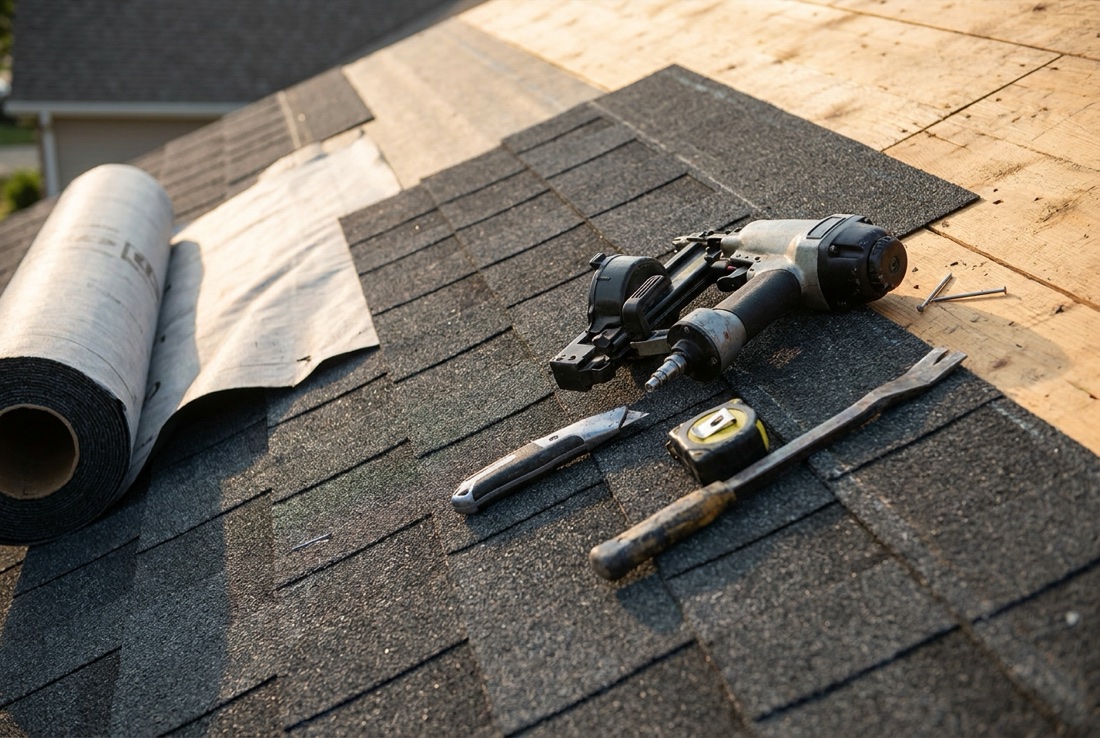
The tool list for genuine green-light work is short on purpose: a stable extension ladder set at the right angle, work gloves, a pry bar for lifting shingle tabs, roofing nails sized for a single-course repair, and roofing-grade sealant rather than general-purpose caulk. If a job starts calling for a saw, a pneumatic nailer, or a harness, that is usually a sign the job has quietly moved out of this category and into the next one, not a sign you need to buy more equipment to keep going.
03 / YELLOW LIGHTDepends on the roof, the weather, and your comfort
These jobs are not automatically off-limits, but they carry real conditions that change the answer from house to house. If any of the caveats below do not clearly apply to your roof, treat the job as red instead.
Temporary emergency tarping
Covering an active leak with a tarp to stop water intrusion until a permanent repair can be scheduled is reasonable in daylight, calm weather, on a low pitch, weighted down properly rather than nailed through good shingles. It is not reasonable in the dark, in wind, or on a steep or icy roof, and it is never a substitute for the actual repair. If the roof or the weather does not meet those conditions, that is exactly what emergency roof repair and 24/7 tarping service exist for.
Caulking around a vent boot as a stopgap
A bead of sealant around a cracking pipe boot can buy you a few weeks if the boot is just starting to show its age and the rest of the roof is sound, but it is a stopgap, not a fix. Boots fail because the rubber dries and splits, and caulk over a splitting boot does not stop movement underneath it; it just delays the moment you notice it failed again. Treat this as a bridge to a scheduled repair, not a repair in itself.
A single flashing touch-up, not a rebuild
Re-bedding a small, already-installed piece of step flashing that has come slightly loose, with the correct sealant and without removing surrounding shingles, is a narrower job than most homeowners assume and one that experienced DIYers occasionally handle correctly. Rebuilding a flashing detail from scratch, at a chimney, a valley, or a wall intersection, is a different job entirely and belongs in the next section. The distinction is whether you are touching up existing metal or replacing it.
Moss, algae, or light debris removal with the right method
Brushing loose debris and light growth from a shingle roof by hand, working downslope with a soft brush and never a pressure washer, is a reasonable weekend job on a walkable roof. The wrong method is where this goes sideways: pressure washing strips granules and drives water under the laps, and scrubbing upward against the shingle tabs lifts and cracks them. If the growth is established rather than a light dusting, that is usually a case for a professional soft wash rather than a ladder and a stiff brush.
Resetting a satellite dish or antenna mount
A dish or antenna base that has worked loose but is still sealed with intact flashing can sometimes be re-tightened and re-sealed without removing anything, and that is a fair yellow-light job on a low, dry roof. It stops being a homeowner job the moment the mount has to come off entirely, since removing and resetting the base means re-flashing the penetration underneath it, and a lag bolt driven straight through unflashed decking to hold a dish steady is exactly the kind of shortcut that turns into a ceiling stain a few storms later.
04 / RED LIGHTWhere DIY consistently goes wrong
These are the jobs where the failure pattern is well known: not because homeowners lack the tools, but because the roof itself, the height, or the consequence of a mistake removes the margin for error. Our guide on when it is unsafe to walk on your own roof goes deeper on the pitch and surface questions that apply to every item below.
Anything on a steep or brittle roof
Steep pitches need roof jacks, harnesses, and crew experience moving on an angled surface, full stop. Aged, brittle shingles are a separate hazard even on a shallow roof: shingles that have lost their flexibility crack under foot traffic that a newer roof would shrug off, turning a simple walk-across into new damage.
Flashing rebuilds at valleys, chimneys, and walls
A valley, a chimney, or a wall intersection is where multiple roof planes and materials meet, and it is where a large share of real leaks originate. Rebuilding that detail correctly means understanding how water is supposed to travel across it, in what order the metal and shingles overlap, and how far up the wall the flashing needs to run. Sealant smeared over a failing flashing joint does not fix the geometry underneath it; it just hides the problem until it reopens, usually somewhere new.
Any repair that requires opening up the decking
If a leak has reached the point where the wood deck underneath is soft, delaminated, or rotted, the job is no longer a shingle repair. Replacing decking means understanding what the surrounding structure can safely support while a section is open, tying the new sheathing in correctly, and re-establishing the water barrier over it before anything closes back up. This is structural work, not a patch.
Chasing a leak you cannot see the source of
Water rarely drips straight down from where it entered. It runs along the underside of the deck, follows a rafter, and shows up on a ceiling several feet from the actual hole. Guessing at the entry point and patching the spot below the stain is one of the most common DIY failures, because it treats the symptom while the real opening stays open. Tracing the true path usually means checking the roof and the attic side together, which is exactly what a professional inspection is built to do.
Anything two stories up or over an occupied space you cannot safely fall clear of
Height changes the calculation on its own, independent of pitch. A fall from a single-story eave and a fall from a two-story roofline are not the same event, and ladder setup, tie-off points, and rescue plans are part of professional roofing work for exactly that reason.
Falls are consistently one of the most common sources of serious injury in home repair and construction work, according to OSHA. That risk does not scale down just because the job looks small from the driveway. If a task on this list requires you to be on a steep, wet, or aged roof for more than a few minutes, it belongs to a professional, not because you lack the skill, but because the margin for error on a roof is thinner than it looks from the ground.
Weather is its own red flag, independent of the job. A repair that would otherwise be reasonable, even a green-light one, stops being a good idea in wind, on a frosted or dew-covered roof, or with a storm closing in, because the margin that made it safe evaporates along with the dry surface. If the roof is actively leaking during weather like that, the right move is not to climb up and improvise; it is to call for emergency tarping and let a crew stabilize the roof once conditions allow it to be done safely.
05 / THE PAYOFFWhy the honest line is worth knowing
We would rather tell you which jobs on your roof are genuinely fine to handle yourself than sell you a service call for a fifteen-minute fix. That is not generosity; it is how trust gets earned in a trade where a lot of companies would rather every job look complicated. The homeowner who calls us after correctly identifying that their problem is a red-light job, not a green-light one, is exactly the call we want, because the roof gets fixed once instead of twice.
A good repair should come with a reason it will hold, whether you do it yourself or hire it out. If you cannot explain why the fix stops water from getting in, you have not finished the job yet.
The reverse also matters: a homeowner who attempts a red-light repair and gets it wrong usually does not save money. A tar-smeared flashing joint or a shingle nailed in the wrong spot has to be undone before the correct repair can go in, and undoing bad work costs more than doing it right the first time would have. Our handyman versus roofer guide covers the same tradeoff for jobs you are considering handing to someone other than a licensed roofer, and the questions worth asking before you do.
| ZONE | WHAT IT COVERS | THE LINE |
|---|---|---|
| Green | Gutter clearing, one exposed nail head, one shingle on a walkable low slope, ground and ladder inspection | Dry, calm, low pitch, one clear step |
| Yellow | Emergency tarping, boot caulk as a bridge, a small flashing touch-up, light moss or algae brushing | Only if the conditions and scope stay narrow |
| Red | Steep or brittle roofs, flashing rebuilds, decking repair, untraced leaks, two-story height | Consequence of a mistake is a ceiling, an attic, or a fall |
If your job lands anywhere in yellow or red, or you are simply not sure which column it belongs in, a free inspection settles it with photos, not guesswork. We will tell you plainly if the fix is small enough that you could have handled it yourself, and if it is not, you get a written price before anyone starts. Repairs in Macomb County run $350 to $3,200, and you can get a quick ballpark from the instant estimator or see the full published ranges on our pricing page before you decide.
One last practical note on timing: a yellow or red-light problem rarely gets cheaper by waiting. A boot that is caulked as a bridge, or a flashing joint that is only touched up rather than rebuilt, is still on borrowed time, and scheduling the real repair while the roof is stable is easier than doing it after the next storm forces the issue. Booking an inspection before a job becomes an emergency is the version of DIY judgment that actually saves money.
- Green-light jobs are ground-level or low-slope work with one clear step: gutter clearing, a single nail head, one accessible shingle.
- Yellow-light jobs depend entirely on conditions staying narrow: emergency tarping, a boot-seal bridge, a small flashing touch-up, light growth removal done the right way.
- Red-light jobs are steep pitches, flashing rebuilds, decking repair, untraced leaks, and anything two stories up; the consequence of a mistake there is the whole reason to call a pro.
- A wrong DIY attempt on a red-light job usually costs more than hiring it out from the start, since bad work has to be undone before the real repair can begin.
- A free inspection tells you honestly which zone your problem is in, with no obligation and a written price if it needs a repair.
Questions we hear most
Ground-level and low-slope work with one clear step: clearing gutters, sealing a single exposed nail head, or replacing one shingle on an easily reached, walkable slope in dry, calm weather. Anything that requires roof jacks, a harness, or working near a valley, chimney, or wall flashing detail is past the safe DIY line.
Call a pro once the job involves a steep or brittle roof, a flashing rebuild rather than a small touch-up, decking that is soft or rotted, a leak you cannot trace to its true entry point, or any work more than one story up. Those are the jobs where a mistake tends to cost more than hiring it out would have, and where a fall is a real risk.
Roof repairs in Macomb County run $350 to $3,200, and larger or complex repairs can run higher. If a DIY fix did not hold, we inspect what happened, tell you honestly what it will take to correct it, and give you a written price before starting. A free inspection is the fastest way to find out.
- OSHA, Ladders (safe use and setup guidance). osha.gov/ladders
- OSHA, Fall Protection in construction and residential work. osha.gov/fall-protection
- Manufacturer technical and warranty literature for the major asphalt shingle lines: GAF (gaf.com), Owens Corning (owenscorning.com), and CertainTeed (certainteed.com).
- Michigan Department of Licensing and Regulatory Affairs (LARA), residential builder licensing and the public Verify a License lookup. michigan.gov/lara