
JUMP TO A SECTION
Shingles are the roof's finish surface, but they are not the only layer standing between your house and the weather. Underneath every shingle course is an underlayment, either asphalt-saturated felt or a newer synthetic sheet, fastened directly to the deck as a secondary water barrier. Most days it is invisible and irrelevant, because the shingles above it are doing all the work. The day wind tears a section of shingles off the roof, that underlayment stops being a backup plan and becomes the entire roof for that section, and it was never engineered to hold that job indefinitely. The honest question after a storm is not whether the exposure is a problem. It is how long the exposure can run before it becomes a bigger one, and that answer depends on what kind of underlayment is up there, what the weather is about to do, and how much of the deck is showing.
01 /What underlayment is built to tolerate
Underlayment exists for exactly this scenario: a moment where the primary shingle surface fails locally and something underneath needs to shed water until a repair happens. Manufacturers build in a margin for that, which is why underlayment is a genuine water-resistant membrane and not just a wrapping paper. But every product's installation guidance frames that margin in days, not seasons. It is meant to survive a construction delay or a storm-to-repair window, not to serve as a permanent roof surface through a Michigan summer of UV and a Michigan winter of freeze and thaw.
That margin is also not uniform across the exposed area. Underlayment relies on overlapping courses, each sheet lapped over the one below it, so water is shed downhill the same way shingles shed it. Where a storm tore shingles away cleanly and left a full underlayment course intact with its laps undisturbed, that section can genuinely handle some rain. Where the tear-off pulled at the underlayment too, or where the exposed area sits right at a seam between two courses, the margin is much thinner or gone entirely, because a seam with no shingle cover above it is exactly where felt and synthetic sheets are weakest.
Not every exposed underlayment situation is the same emergency. What matters most is whether the exposed section still has intact, overlapped underlayment beneath it, or whether the deck itself is showing. A free inspection tells you which one you have, with photos of exactly what is exposed.
02 /Felt vs synthetic: different degradation clocks
The two common underlayment types age at meaningfully different rates once they are left uncovered, and knowing which one is on your roof changes how much slack you actually have.
Asphalt-saturated felt
Traditional felt, still common on older Macomb County reroofs, is asphalt impregnated into a paper or fiberglass mat. It sheds water reasonably well when new, but sunlight dries out the asphalt saturant over time, and the material becomes brittle and prone to tearing and curling at the edges. Felt exposed to direct sun and wind degrades faster than synthetic sheets, and its water resistance drops off as it dries and cracks, not gradually so much as it simply stops holding a seal at the weak points first.
Synthetic underlayment
Newer synthetic underlayments, woven polymer sheets that have largely replaced felt on new installs, are built with UV inhibitors and are more tear resistant, which is why manufacturers rate many of them for a longer temporary exposure window than felt. That is a real advantage during an active storm response, but it is still a rated window, not an open-ended one, and every manufacturer's own installation literature caps it well short of a full season.
03 /Sun, wind, and time: what actually wears it out
Three forces do almost all the damage to an underlayment left uncovered, and they do not act at the same speed. UV exposure is the slowest but most total: constant sunlight breaks down the material at the molecular level, which is why manufacturers rate exposure windows in the first place and why the same underlayment left bare through a cloudy week and a sunny week does not age the same amount. Wind is faster and more physical, working at the edges of the tear-off area and any loose lap, prying and flapping the sheet until a corner lifts, and a lifted corner is a new entry point that did not exist the day the storm hit. Repeated freeze and thaw cycles, the same mechanism that builds winter ice dams, are the third force, and they are brutal on any material that has already been softened or torn, working moisture into small cracks and widening them with every cycle.
None of that happens on a fixed calendar, which is exactly why a scare-countdown number would be dishonest. A well-lapped synthetic sheet through a mild, overcast week is in a very different place than felt through a week of sun and wind. What is consistent is the direction: every day of exposure moves the material further from its rated tolerance, never back toward it, and the forecast for the days immediately ahead matters as much as the days already passed.
04 /Once water reaches the deck
Underlayment failure is the warning stage. What happens after water gets past it is the reason the warning matters. The deck beneath is almost always plywood or OSB, and neither material has any waterproofing of its own. Wood absorbs water on direct contact, and the damage does not require a dramatic leak to begin; slow, repeated wetting from an underlayment that is barely holding is enough. Each cycle of soaking and drying pulls the wood fibers apart a little more, and the strength loss is cumulative and largely invisible from above, because the shingle side of an affected deck can still look fine while the underside is softening.
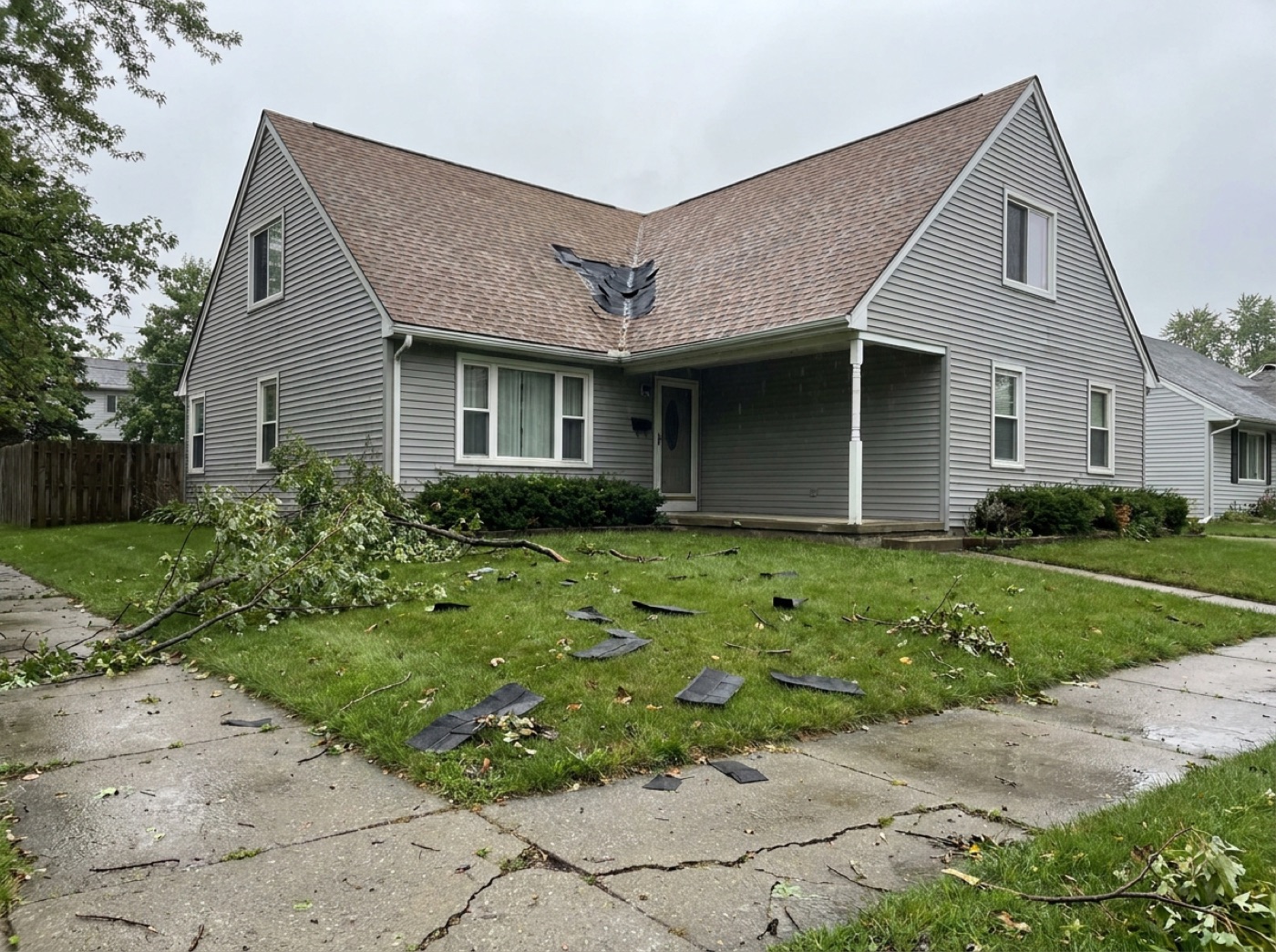
The first visible sign inside the house, a ceiling stain or a musty attic smell, typically shows up well after the decking has already been absorbing water for some time, because the water has to saturate the wood and find a path along a rafter before it drips somewhere visible. That lag is the trap: a homeowner who waits for interior evidence before calling anyone is, by definition, waiting until the deck has already been wet for a while. Rot that reaches the point of soft, spongy sections during a later inspection is the end state of exactly this process, and it is the difference between a repair priced in the standard $350 to $3,200 range and a job that also has to include deck replacement, priced per sheet.
05 /The honest urgency framework
Two variables decide how urgent an exposed underlayment situation actually is, and neither one is how dramatic the hole looks from the driveway.
What is actually exposed
Intact, well-lapped underlayment with no visible tears carries real margin. Underlayment that is torn, lifted at a corner, or missing at a seam has very little margin left, whatever type it is. Bare deck, whether because the underlayment tore away with the shingles or was thin at that spot to begin with, has none at all and should be treated as an active exposure regardless of what the sky looks like right now.
What the forecast is about to do
A dry stretch buys real time even over marginal underlayment, time that is better spent getting a professional look than waiting anxiously. Rain in the near-term forecast, especially wind-driven rain that can push water sideways under a lap that would otherwise shed straight-down flow just fine, changes the calculation immediately, and it is the single biggest reason the same-looking hole in the roof can be routine on one week and urgent the next.
If the exposed area is bare deck, or underlayment you cannot confirm is intact, and rain is coming within the next day or two, that is the scenario 24/7 emergency tarping exists for. Tarping stops the water the same day; the permanent repair gets scheduled once the roof is dry and safe to work. Call (586) 300-1746 any hour for active exposure.
Combine the two variables and the framework gets simple: good underlayment plus dry weather can wait for a scheduled inspection this week. Anything bare, uncertain, or facing rain in the short term deserves a same-day call. If you genuinely do not know which situation you have because you cannot tell from the ground what is under the gap, that uncertainty is itself the reason to get it looked at rather than guess wrong in either direction.
06 /Temporary protection, and what to do right now
If the exposure is real but not an emergency, the useful move is documentation, not a ladder trip. Photograph the affected slope from the ground, wide enough to show the whole area and, if your camera allows it, zoomed in on the gap. Do not climb up to inspect it yourself; an area with damaged underlayment or exposed deck is exactly the wrong spot to put your weight, and it does not tell you anything a professional inspection will not tell you more safely.
If the exposure is active, meaning water is already finding its way past the underlayment during rain, that is when a tarp earns its keep. A properly installed tarp is a genuine, if temporary, waterproof layer, buying the time needed to schedule the real repair without the deck continuing to absorb water in the meantime. It is not a fix, and we do not present it as one; it is a stopgap that stops the bleeding until the permanent work happens.
From there, a free inspection settles the question for good. We check what is exposed, whether the underlayment nearby is still sound, and the attic side of the deck, with photos of everything found. If it is a straightforward repair, Macomb County jobs like this typically run $350 to $3,200, and larger or more involved work, including any deck replacement, can run higher. If the storm was significant, our guide on how storm damage compounds over time lays out why waiting on marginal exposure rarely pays off, and our first 72 hours after storm damage guide covers the documentation worth doing before any repair starts, in case insurance ever becomes part of the conversation.
Underlayment was designed to buy you time after shingles fail, not to replace them. The only honest question is how much time you actually have left, and that depends on what is under the gap and what the sky is about to do.
A missing shingle and exposed underlayment often arrive together, and if that is your situation our missing shingles after a storm guide walks through what the loss pattern itself tells you about the rest of the roof. You can start either path, tarping or a scheduled repair, from the storm damage estimator, get a same-day ballpark with the cost calculator, or see what a full inspection covers on our storm damage service page. Our published ranges match the same numbers on our honest pricing page.
- Underlayment is a genuine secondary water barrier, but every manufacturer rates its uncovered exposure in days, not seasons.
- Synthetic sheets generally outlast felt when left exposed, but both have a limited, time-boxed tolerance, not an open-ended one.
- Sun, wind, and freeze-thaw cycles each degrade exposed underlayment differently; none of them move the material back toward its rated margin.
- Once water reaches bare decking, wood absorbs it immediately with no waterproofing of its own, and interior stains usually show up well after that process started.
- Urgency depends on what is exposed and what the forecast is about to do, not on how dramatic the hole looks; active exposure with rain coming means 24/7 emergency tarping now, tarping only.
Questions we hear most
There is no single safe number, because it depends on the underlayment type, whether its laps are intact, and the weather ahead. Manufacturers rate uncovered exposure in days, not seasons, for a reason. Intact underlayment through a dry week carries real margin; bare deck or damaged underlayment with rain coming does not, and deserves same-day attention.
Generally, yes. Synthetic sheets are more tear resistant and typically rated for a longer temporary exposure window than asphalt-saturated felt, which dries out and becomes brittle in direct sun. Both are time-limited, though, and neither is meant to serve as a permanent roof surface.
Most straightforward repairs in Macomb County run $350 to $3,200. If the exposure went on long enough that the deck underneath needs replacement, that work is priced per sheet in addition to the repair, and a free inspection is the only way to know which situation you actually have.
- FEMA, disaster declaration DR-4757-MI, Michigan severe storms of August 2023 (Macomb County designated). fema.gov/disaster/4757
- Manufacturer technical and warranty literature for the major asphalt shingle lines: GAF (gaf.com), Owens Corning (owenscorning.com), and CertainTeed (certainteed.com).
- Building Science Corporation, published research and information sheets on moisture movement, air leakage, and roof assemblies in cold climates. buildingscience.com