
JUMP TO A SECTION
A shingle does not go missing on its own. Wind gets under a free edge, the seal strip lets go, and the tab either tears loose or is carried off the roof entirely. What is left behind is the interesting part. A missing shingle is a hole in the roof's outer skin, and whatever is directly beneath it, whether that is synthetic underlayment doing its job or bare wood decking with nothing over it, is now the only thing standing between your attic and the weather. This guide walks through how to read what a missing shingle actually tells you, why it rarely stays a single-shingle problem, and how to judge the urgency honestly instead of guessing.
01 /What a missing shingle actually exposes
Asphalt shingle roofs are a layered, overlapping system on purpose. Each course of shingles overlaps the one below it, so water always has a shingle surface to run across on its way to the gutter, never a straight path down to the deck. When a shingle is torn away, that overlap breaks at exactly that spot. Depending on the roof, what is now exposed is either the felt or synthetic underlayment installed under the shingles as a secondary water barrier, or, if the underlayment tore away with the shingle or was never installed with enough overlap at that point, the bare wood deck itself.
That distinction matters because the two situations carry very different risk. A good synthetic underlayment is designed to shed water on its own for a period of time, so a missing shingle over intact underlayment is a problem that needs attention but is not necessarily an emergency in dry weather. Bare decking has no such design margin. Plywood and OSB decking absorb water directly, swell, and begin to lose strength the longer they stay wet, and repeated soak-and-dry cycles are what eventually lead to soft spots and rot that cost far more to fix than the missing shingle ever would have.
Rain running into the attic through an exposed deck is an emergency, not a scheduling question. We offer 24/7 emergency tarping to stop the water the same day, tarping only, followed by a scheduled permanent repair. Call (586) 300-1746 any hour for active exposure.
02 /Reading the loss pattern
Before anyone gets on a ladder, the pattern of what is missing tells its own story from the ground with a good pair of binoculars or a zoomed phone photo. A single tab gone near a ridge or a hip, with the surrounding field intact, usually means one weak seal bond failed in a gust that the rest of the roof shrugged off. A whole course stripped along one edge of a slope points to a wind event strong enough to overpower an entire row of seal bonds at once, which is a different scale of problem than a single tab. Shingles missing in scattered, unconnected spots across several different slopes usually means the storm hit the whole roof, not just one weak point, and every other shingle near those gaps deserves a second look.
That last row is not a coincidence. Roof edges, ridges, and corners see the highest wind suction in any gust, the same way the corner of a tarp flaps hardest in a breeze while the center stays still. Shingle manufacturers reinforce those zones with extra fasteners for exactly this reason, and it is why missing shingles cluster at eaves, rakes, and hips far more often than in the middle of a plain field. If your loss pattern matches that shape, treat it as expected wind behavior, not bad luck, and check those same zones on every slope even where nothing looks obviously wrong yet.
03 /Why one missing tab usually means more than one tab
A shingle that tore completely off the roof was, by definition, hit by wind strong enough to break its seal bond entirely. That same gust almost certainly passed over the neighboring shingles too, at a slightly lower intensity or a slightly better angle, and broke their seal bonds without quite finishing the job of removing them. Those shingles are still nailed down and still look normal, but the adhesive strip that used to lock them to the course below is compromised. A seal, once broken, rarely re-bonds reliably on its own, particularly once dust and grit have settled into the gap. Our guide on lifted shingles after a storm covers exactly how that seal failure works and what it means for the next ordinary wind.
This is the reason a roofer who finds one missing shingle will usually want to check the whole slope, not just replace the one gap and move on. The visible loss is the evidence that a wind event strong enough to cause hidden, non-visible damage happened here. Treating the missing shingle as an isolated cosmetic fix, without checking whether its neighbors lost their seal too, is how a homeowner ends up back on the phone after the next windy week wondering why a second and third shingle just went.
04 /How urgent this really is, honestly
The honest answer is that urgency depends on two things: what is exposed, and what the weather is about to do. A missing shingle over intact, well-lapped underlayment during a stretch of dry weather is a real problem that deserves a call this week, but it is not the kind of thing that requires anyone to climb onto a wet roof in the dark. The same missing shingle over bare decking, with rain in the forecast within the next day or two, is a different situation entirely and is exactly what 24/7 emergency tarping exists for.
The mistake we see most often is homeowners applying the same urgency level in both directions. Some panic over a single tab that is genuinely a routine, inexpensive repair. Others sit on real bare-deck exposure for weeks because nothing has visibly leaked into the ceiling yet, not realizing that decking can be quietly absorbing water and losing strength the entire time before a stain ever shows up indoors. If you cannot tell from the ground which situation you have, that uncertainty itself is the reason to get it looked at rather than guess in either direction.
05 /Underlayment or bare deck: what is actually underneath
Underlayment is the layer installed across the entire deck before a single shingle goes down, either traditional asphalt-saturated felt or a newer synthetic sheet, with an ice and water membrane at the eaves in Michigan's climate. It is designed as backup protection, not a finished roof surface, but a well-installed synthetic underlayment can genuinely shed light rain for a period of time if a shingle above it is missing. That is the best-case version of a missing shingle: annoying, worth fixing soon, but not a five-alarm event by itself.
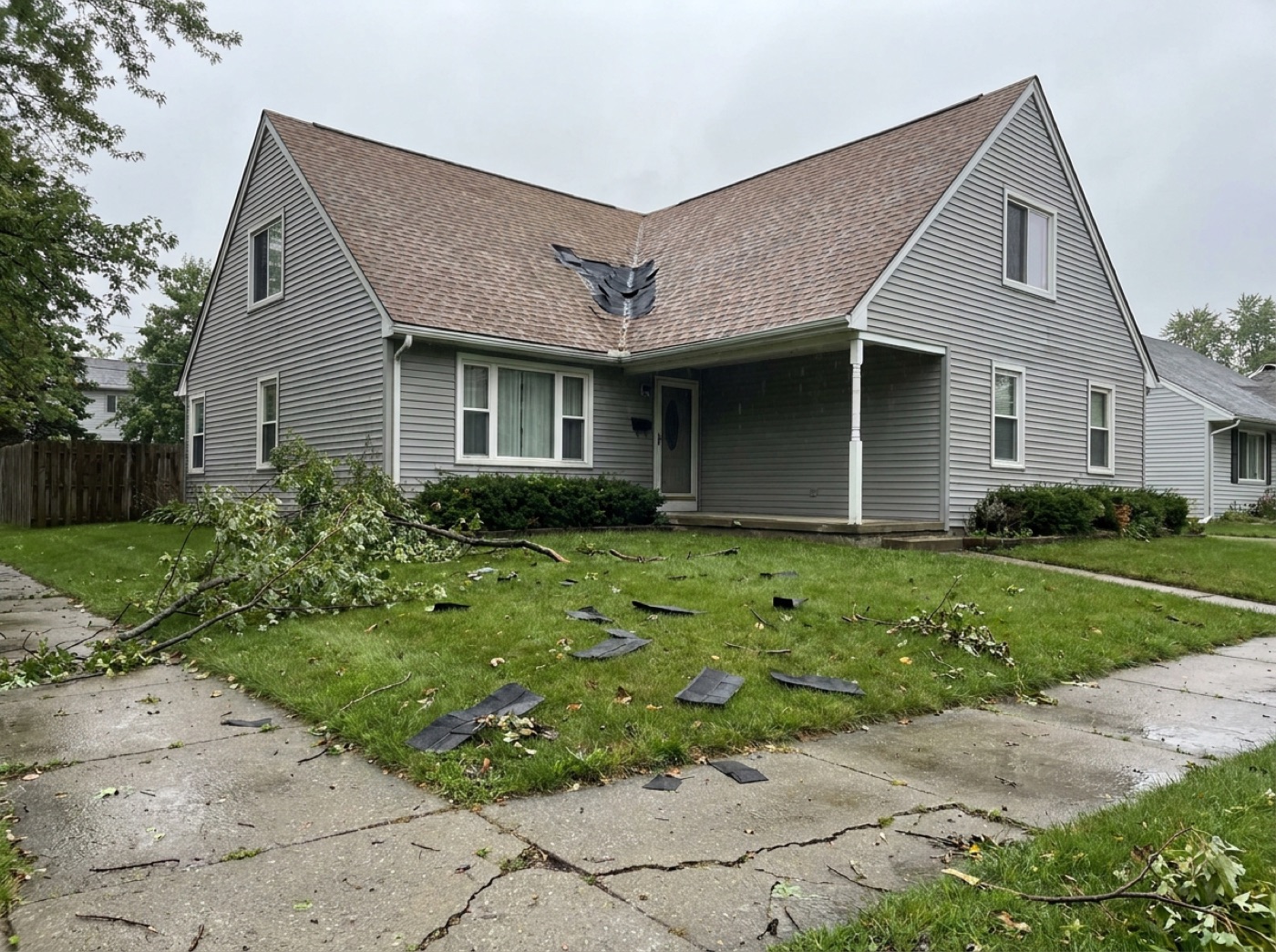
Bare deck is a different story. If the underlayment tore away along with the shingle, or a prior repair never restored it properly, or the missing section sits at a seam where two rows of underlayment meet, the raw plywood or OSB deck is exposed directly to rain. Wood decking has no waterproofing of its own. It absorbs water on contact, and repeated wetting and drying cycles are what eventually cause the soft, spongy sections that show up during a later reroof tear-off. Our companion guide on exposed underlayment after a storm goes deeper on how to tell the two situations apart and what each one calls for.
06 /What to do right now
Start from the ground. Photograph the missing area from a distance, wide enough to show the whole slope, then zoom in on the gap itself if your camera allows it. Do not climb onto the roof to inspect the hole up close; a missing shingle means the surface around it may already be compromised, and it is exactly the wrong spot to put your weight. If it is actively raining and you can see water entering the attic, that is the moment to call for tarping, not to wait and see. If the weather is dry and nothing is visibly leaking, the right next move is a scheduled, professional look rather than a ladder trip on your own.
From there, our free inspection covers the missing area, the surrounding courses on that slope, the flashing, and the attic side of the deck underneath, with photos of everything found. If it turns out to be a simple, localized repair, that is exactly what we will tell you, and Macomb County repairs typically run $350 to $3,200, with larger or more complex work running higher. If the storm was significant enough to reach the scale of Macomb County's recent disaster history, including the wind event that led to federal disaster declaration DR-4757 in August 2023, insurance may cover the repair, and documentation from the first 72 hours makes the biggest difference in how smoothly that goes; our first 72 hours after storm damage guide walks through exactly what to capture. We can document the loss and can meet your adjuster on site, but no contractor can promise how a specific claim will be decided, and the full process is covered in our storm and insurance claims guide.
A missing shingle is not the damage. It is the part of the damage you happened to be able to see from the driveway.
Whether this turns out to be one shingle or the first visible sign of a larger wind event, the same free inspection answers it either way. You can start from the storm damage estimator, or get a same-day ballpark on repair scope with the cost calculator before anyone sets foot on a ladder. Our storm damage service page covers what a full storm inspection includes, and our published ranges are the same ones shown on our honest pricing page.
- A missing shingle exposes either underlayment, which can shed rain for a while, or bare decking, which absorbs water immediately and has no waterproofing of its own.
- The loss pattern is a clue: isolated tabs, a stripped course, or scattered gaps across several slopes each point to a different scale of wind event.
- One missing shingle almost always means neighboring shingles took the same gust and may have broken seals without being torn off yet.
- Urgency depends on what is exposed and the coming weather, not on how the gap looks from the driveway; bare deck plus rain in the forecast is a same-day call.
- Active leaking into the attic means 24/7 emergency tarping now; everything else is a free, photo-documented inspection, typically $350 to $3,200 if it is a repair.
Questions we hear most
It depends on what is exposed underneath and what the weather is about to do. A missing shingle over intact underlayment during a dry stretch can wait for a scheduled inspection this week. The same gap over bare decking with rain coming is an active exposure risk and is what 24/7 emergency tarping is for.
Usually, yes. Wind strong enough to tear one shingle completely off the roof typically breaks the seal bonds on neighboring shingles too, even when they are still nailed down and look fine. A full slope check catches those weakened shingles before the next ordinary wind finishes what the last storm started.
Most localized shingle repairs in Macomb County run $350 to $3,200, with larger or more complex sections running higher. The only way to get an exact number is a free, on-site inspection, and if the repair turns out to be smaller than expected, that is what we will tell you.
- FEMA, disaster declaration DR-4757-MI, Michigan severe storms of August 2023 (Macomb County designated). fema.gov/disaster/4757
- Manufacturer technical and warranty literature for the major asphalt shingle lines: GAF (gaf.com), Owens Corning (owenscorning.com), and CertainTeed (certainteed.com).
- Building Science Corporation, published research and information sheets on moisture movement, air leakage, and roof assemblies in cold climates. buildingscience.com