
JUMP TO A SECTION
We are not going to argue this with a countdown clock or a scare tactic, because we do not need to. The case for not waiting on storm damage is a physical one, not an emotional one. A roof that was hit by wind or hail is left with specific, describable weaknesses: seals that no longer hold, shingle mats that are bruised instead of intact, granules missing in patches, maybe a small puncture no one has noticed yet. None of those weaknesses fix themselves. Each one is acted on by ordinary weather, the kind Macomb County gets dozens of times a year, and each ordinary event makes the original weakness a little bit worse. This guide walks through four separate mechanisms, in plain terms, so you can see why the roof at month three of waiting is not the same roof it was in week one, and why that matters however you decide to proceed.
01 / THE SHORT ANSWERYes, and here is why in physical terms
Storm damage gets worse over time because a damaged roof no longer behaves like an intact one when ordinary weather returns. A seal that used to hold a shingle flat now lets wind get underneath it. A shingle mat that used to shed granules evenly now has bare patches where the asphalt is exposed straight to the sun. A hairline puncture that used to keep water out now lets a small amount wick into the deck every time it rains. None of these are dramatic failures on day one. They are small openings that widen with each freeze, each gust, and each rain, on a timeline measured in weeks and months rather than minutes.
That timeline is the whole point of this guide. The next four sections walk through the four mechanisms in order: broken seals, bruised mats and granule loss, small punctures, and freeze-thaw cycling. Each one starts small and compounds. Waiting does not usually turn a fine roof into a bad one overnight. It turns a repair into a bigger repair, and a bigger repair into a replacement, on a schedule set by the weather rather than by any deadline we are inventing here.
02 / THE SEALSBroken seals invite the next ordinary wind
Asphalt shingles hold themselves flat with a factory-applied seal strip, a thin band of adhesive activated by sun and heat that bonds each shingle to the course below it. That bond is what keeps a shingle from lifting in wind that would otherwise get underneath it. A storm strong enough to break that seal, whether through direct wind uplift or the shock of a hail impact, leaves the shingle physically intact but no longer glued down. From the ground, and often even from the roof, a broken seal with the shingle still lying flat can be nearly invisible.
That is the trap. An intact-looking shingle with a broken seal needs far less wind to lift than an undamaged one, because the bond that used to resist uplift is simply gone. A gust that an intact roof would shrug off without effort can catch the edge of an unsealed shingle, lift it, and let wind get underneath. Once one shingle lifts, it can pry at the seal of the shingle above it, and the problem spreads outward from the original damage instead of staying contained to it. What started as a handful of broken seals after one storm can become a much larger area of lifted, loose shingles after two or three ordinary wind events that a fully sealed roof would never have noticed.
This is also why a roof can look fine in still weather and then lose shingles in a wind event that seems unremarkable on the news. The visible failure is not really caused by that day's wind. It is the delayed result of a seal that broke weeks or months earlier and was never reset by a repair. A free inspection after a storm is largely a seal check, walking the field by hand to feel for shingles that lift or shift under light pressure, which is often invisible from a photograph.
There is a second layer to this that most homeowners never see: once a shingle is loose enough to flap in wind, the repeated flexing works on the nail holes that hold it down. Every up-and-down cycle enlarges the hole around the fastener slightly, the same way bending a paperclip back and forth eventually loosens the bend past the point of holding its shape. A shingle that started with a merely broken seal can end up with an enlarged, weather-worn fastener hole a few wind events later, and an enlarged fastener hole is a direct path for wind-driven water rather than a cosmetic issue. None of this shows up as a new hole appearing out of nowhere. It is the same original weak point, worked on repeatedly, until the roof's ability to shed water at that spot is meaningfully different from where it started.
03 / THE MATBruised mats shed granules, then the sun takes over
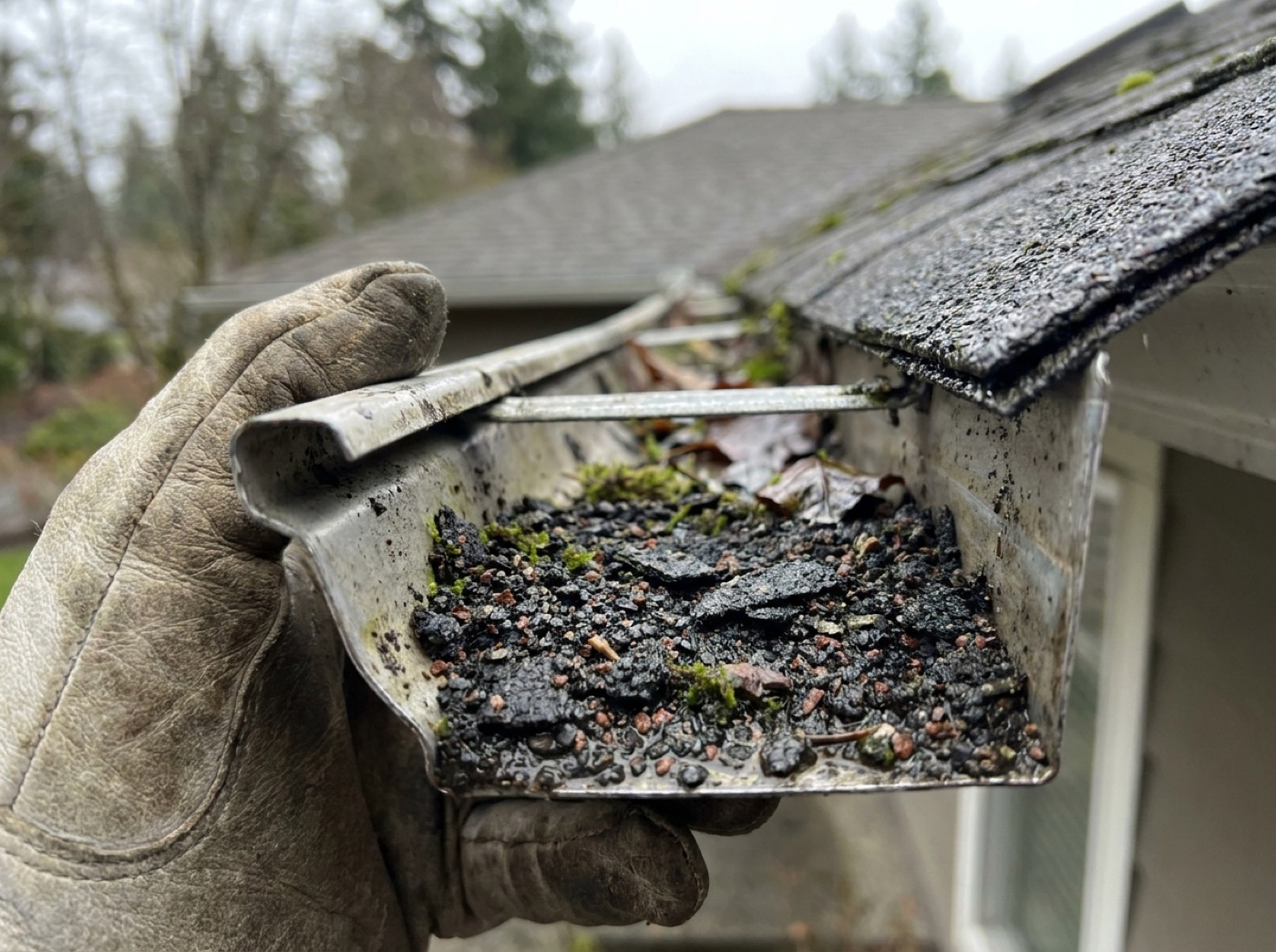
A hail strike that is significant enough to matter does not usually punch a hole through a shingle. It bruises the fiberglass mat underneath the granule surface, fracturing the mat's fibers without necessarily breaking all the way through. On the surface, that bruise often knocks loose the mineral granules embedded in the asphalt right at the impact point, leaving a small bare spot where raw asphalt is exposed instead of protected by granules.
That bare spot is where the second mechanism starts. Granules exist for a reason beyond appearance: they shield the asphalt layer from direct ultraviolet light, which otherwise dries out and embrittles asphalt over time. A patch of shingle that has lost its granules loses that shield exactly where the mat is already weakest from the bruise. UV exposure accelerates the asphalt's aging at that specific spot, and a mat that was already fractured underneath becomes more brittle and more prone to cracking through completely as the months pass, especially through a Michigan summer with long hours of direct sun.
The visible sign homeowners usually notice first is granules collecting in the gutters or at downspout outlets, often well after the storm that caused the damage. That is not new damage happening in the gutter. It is the bruised areas continuing to shed material as the fractured mat keeps degrading, weeks or months after the hail that caused it. A shingle in that condition has a shortened service life even if it never develops a visible leak, because the granule loss and the UV exposure it causes are cumulative, not self-correcting.
04 / THE PUNCTURESmall punctures wick water into decking that rots slowly
The third mechanism is the quietest of the four. A branch tip, a piece of wind-borne debris, or a sharp hail impact can leave a puncture through the shingle and the underlayment beneath it that is small enough to go unnoticed from the ground and even from a casual look at the roof surface. Water does not need a large opening to get in. It needs capillary action and time, and a pinhole-sized puncture provides both.
Wood decking, whether plywood or OSB, does not fail the first time it gets damp. It absorbs a small amount of moisture with each rain that finds the puncture, dries partially between events, and absorbs a little more the next time. Over weeks, that cycle leaves the wood fibers around the opening consistently damper than the surrounding deck, which is exactly the condition that allows rot fungi to take hold. Rot does not need standing water. It needs sustained moisture in wood, which a small, repeatedly wetted puncture supplies reliably even when nothing is visibly dripping inside the house.
This is why a small puncture that seems too minor to worry about in week one can, by month four or five, have softened a section of decking around it. Soft decking changes the scope of the eventual repair, because a contractor cannot lay new shingles over compromised wood. What would have been a shingle patch and a puncture seal in week one becomes a shingle patch plus a section of deck replacement later, not because the puncture itself grew, but because the wood underneath it kept absorbing water on a schedule set by ordinary rainfall.
Attic conditions can slow this process down or speed it up, which is another reason two houses hit by the same storm can end up in different places six months later. A well-ventilated attic dries a slightly damp deck between rain events, buying time before rot fungi establish. A poorly ventilated attic holds humidity longer, keeps the wood around the puncture damp for more of the cycle, and lets the same size puncture do more damage in less time. This is one more reason an inspection after a storm looks at the attic side of the deck and not just the shingle surface, since a puncture that looks identical from above can be progressing very differently underneath depending on what the attic is doing.
05 / THE FREEZEFreeze-thaw cycles pry every crack wider each winter
The first three mechanisms work through wind, sun, and moisture. The fourth is specific to Michigan's climate and arguably the most reliable at making existing damage worse: freeze-thaw cycling. Water expands by roughly nine percent when it freezes. Any crack, hairline mat fracture, or gap left by storm damage that holds even a small amount of moisture becomes a wedge once the temperature drops below freezing, because the water inside it expands and pushes the crack wider than it was before the freeze.
Crucially, that widened crack does not shrink back when the ice thaws. It stays at its new, larger size, ready to hold slightly more water before the next freeze widens it again. Southeast Michigan typically cycles through dozens of freeze-thaw transitions across a winter, not one long freeze, which means a piece of storm damage that goes unrepaired going into November can be measurably larger by the time spring arrives, having been pried open a little more with every cold snap and thaw in between.
This is also the mechanism behind ice dams making existing damage worse rather than causing damage from nothing. A roof with intact seals and an undamaged deck sheds meltwater normally. A roof with storm-broken seals or a compromised deck gives ponded meltwater more places to find their way in, and the freeze-thaw cycle then works on whatever gap that water reaches. Storm damage and winter damage are not two separate problems on a roof that already has one; they tend to compound each other.
Wind and sun make damage worse on their own schedule. A Michigan winter does it on a schedule with dozens of repeat cycles in a single season.
06 / THE RECORDWaiting complicates the evidence trail too
Everything above is physical, but there is a practical side effect worth naming briefly, without turning this into a claims guide. As damage compounds through the mechanisms above, it also becomes harder to point to a single storm as the cause. A crack that has been widened by six months of freeze-thaw cycles looks different, and is harder to date, than the same crack photographed the week it happened. That is one more reason a written, dated storm file built in the first few days is worth the twenty minutes it takes, whatever you decide to do next.
It is also worth remembering that a meaningful share of storm damage is not visible from the ground at all in the first place. Broken seal bonds under flat-lying shingles and hairline mat fractures do not show up in a driveway photo, which is exactly what our guide on hidden roof storm damage covers. If shingles blew off entirely and the underlayment is exposed to the weather directly, the clock runs faster still, which our guide on exposed underlayment after a storm walks through. None of the claim mechanics, deadlines, or adjuster process belong in this guide; that full playbook lives in our storm and insurance claims guide.
07 / THE MOVEGetting ahead of it, before the mechanisms compound
None of the four mechanisms above require a large fix if they are caught early. A reseated and resealed shingle, a small patch over a punctured spot, a section of granule-bare mat replaced before it cracks through: these are the kind of targeted work that falls in our published repair range of $350 to $3,200, and larger or complex repairs can run higher. The same damage, left to compound through a few wind events, a full summer of UV exposure, and a winter of freeze-thaw cycling, tends to arrive at a contractor's door as a bigger, more expensive job, simply because more of the roof and more of the deck are involved by then.
A free inspection is built to catch the roof at the smaller end of that curve. It covers the shingles, the seals, the flashing, and the attic side of the deck, with photos of anything found, and there is no obligation attached to it. If the damage is still limited to a broken seal here and a bruised patch there, that is what gets reported and priced. If it has already progressed, that gets reported honestly too, because pretending otherwise does not change what is actually happening under the shingles. Either way, the inspection is the fastest way to trade a physical guess about how much the roof has changed for an actual, current answer.
If you want a ballpark before anyone comes out, the cost calculator runs the same published ranges against your roof size, and the storm damage estimator starts the inspection request directly. Our full pricing page lays out every range referenced in this guide in one place if you want to see the full canon before you call.
- Storm damage worsens through four physical mechanisms: broken seals, bruised mats with granule loss and UV exposure, small punctures wicking moisture into decking, and freeze-thaw cycles widening existing cracks.
- None of these require dramatic weather to progress. Ordinary wind, ordinary sun, and an ordinary Michigan winter do the work over weeks and months.
- A crack or gap widened by freeze-thaw stays wider; it does not shrink back once the ice thaws.
- Waiting can also make it harder to date the damage to a specific storm, which is one reason a dated storm file is worth building early.
- Catching damage early tends to keep repairs in the $350 to $3,200 range instead of letting it grow into a larger job, and a free inspection is the fastest way to know where your roof currently stands.
Questions we hear most
Storm damage does not heal on its own, and the mechanisms that make it worse, broken seals, UV exposure on bare mat, moisture wicking into decking, and freeze-thaw cycling, are all driven by ordinary weather that keeps happening whether or not you address the roof. How quickly it progresses depends on the type and extent of the original damage, which is exactly what a free inspection assesses.
There is no fixed safe number of days, since it depends on what the storm actually did to your roof. What we can say is that broken seals, bruised mats, and small punctures all continue to be acted on by wind, sun, and rain the entire time you wait, and a Michigan winter adds freeze-thaw cycling on top of that. Getting an inspection sooner rather than later simply catches the damage closer to its original, smaller size.
Not necessarily. Broken seals and hairline mat fractures are frequently invisible from the ground even though they are exactly the kind of damage the four mechanisms in this guide act on over time. A visual check from the driveway is a reasonable first step, but it cannot rule out the damage that tends to compound quietly, which is why a hands-on inspection matters after any significant storm.
- FEMA, disaster declaration DR-4757-MI, Michigan severe storms of August 2023 (Macomb County designated). fema.gov/disaster/4757
- National Weather Service, Storm Prediction Center severe weather event archives. spc.noaa.gov/climo
- Asphalt Roofing Manufacturers Association, industry technical bulletins. asphaltroofing.org
- Manufacturer technical and warranty literature for the major asphalt shingle lines: GAF (gaf.com), Owens Corning (owenscorning.com), and CertainTeed (certainteed.com).
- Building Science Corporation, published research and information sheets on moisture movement, air leakage, and roof assemblies in cold climates. buildingscience.com