
JUMP TO A SECTION
Every roof in Macomb County spends winter doing its hardest work with the least room for error. Snow load sits on it for weeks at a time, freeze and thaw cycles work at every seam, and ice dams form at the eaves whenever attic heat melts the underside of the snowpack. None of that is a problem if the roof goes into winter sound. It becomes a problem fast if it does not, because a roofer cannot safely walk a snow-covered or ice-glazed roof, and a homeowner cannot see a cracked shingle or a lifted flashing detail once it is buried. Fall is the last stretch of the year when a full, hands-on look is easy, safe, and cheap to act on. This guide walks through exactly what that look should cover, zone by zone, the way a thorough roof inspection is actually performed.
01 / THE DEADLINEWhy the pre-winter window matters
Think of a roof inspection on a calendar, not just a checklist. Spring inspections find what winter already did; a spring inspection is essentially a damage report. A fall inspection is different in kind: it is a chance to fix small things before winter has a chance to turn them into big ones. A creased shingle in October is a shingle swap. The same creased shingle in January, buried under snow and ice, is a slow leak nobody can reach until March.
Macomb County adds a real wrinkle here, because major wind events do real damage that is not always obvious from the ground. The county was included in federal disaster declaration DR-4757 after the severe storms of August 2023, and roofs that took a hit that season without a proper look afterward may be carrying damage that has been quietly getting worse through several freeze and thaw cycles since. If your roof has not had a hands-on inspection in a year or more, fall is the natural time to close that gap before winter closes the roof to safe access.
There is no hard cutoff, but by late October our crews are increasingly working around weather windows rather than around the calendar. Booking earlier in fall means we can get on the roof, document everything, and if a repair is needed, complete it while conditions still allow it. The inspection itself is $0, no obligation, whether anything needs fixing or not.
02 / ZONE ONEThe shingle field: what a fall check looks for
The shingle field is the largest surface on the roof and the one that takes the most direct weather all year. A fall inspection walks every slope looking for the signs that predict a winter failure rather than waiting for one.
Creased, lifted, and missing tabs
Summer wind events can crease a shingle without tearing it loose, and a creased shingle loses its seal even though it still looks intact from the ground. Once winter wind and ice work at that same crease, it is far more likely to lift, curl, or blow off entirely, exposing the underlayment underneath. A fall walk catches the crease while it is still a one-shingle fix.
Granule loss and surface wear
Asphalt shingles shed granules as they age, and heavier loss in one area, often visible as dark patches on the shingle or grit collecting in the gutter, means that section has less protection left against the coming winter than the rest of the roof. It does not always mean replacement is due, but it tells an inspector where to look closest for related wear.
Cracking and brittleness
Shingles that have baked through several Michigan summers can crack when flexed, and a fall inspector will gently test suspect areas rather than assume they are fine because they look fine. A brittle shingle that would flex safely in July can snap in a January cold snap, so identifying it now, while it can still be swapped, avoids a mid-winter surprise.
03 / ZONE TWOFlashing and every penetration, checked by hand
More leaks start at a flashing detail or a penetration than anywhere else on the roof, because those are the places where two different materials have to seal against each other instead of shedding water the way a continuous shingle field does.
Chimneys, valleys, and wall intersections
Flashing at a chimney, a valley, or a sidewall relies on metal and sealant staying tight against movement, and both age at different rates than the shingles around them. A fall check looks for lifted edges, cracked sealant, and rust-through, because any one of those is an open door for winter meltwater to find the deck underneath.
Pipe boots and vent collars
The rubber boots sealing plumbing vents are consistently the shortest-lived component on a roof, commonly splitting somewhere in the ten to fifteen year range. A split boot in fall is a small, inexpensive fix. The same split boot ignored through a full winter of freeze and thaw is a near-certain attic leak by spring, because every thaw sends water straight down the pipe.
Skylights and dormers
Skylights and dormers each add several additional flashing seams to a roof, and each seam is a place where the shingle field stops being one continuous surface. Fall is the right time to check the perimeter caulk and counterflashing on any skylight, look for gaps where a dormer wall meets the roof plane, and confirm that step flashing along dormer sidewalls has not pulled away. These details are easy to miss from the ground and easy to fix from a ladder in October; they are neither once snow is banked against them.
04 / ZONE THREEDrainage and the edges: clearing the exit path
A roof does not just need to keep water out. It needs a clear path to move water off, and fall is when that path most often gets blocked.
| ZONE | WHAT WE CHECK | WHY IT MATTERS BEFORE WINTER |
|---|---|---|
| Gutters | Debris, sag, loose hangers | Clogged gutters back water up under the shingle edge and freeze solid |
| Downspouts | Clear flow to grade | A blocked downspout turns the whole gutter run into a standing pond |
| Valleys | Debris buildup, metal condition | Valleys carry the most water of any roof surface and clog first |
| Eaves | Shingle edge condition, ice barrier area | This is where ice dams form first when meltwater has nowhere to go |
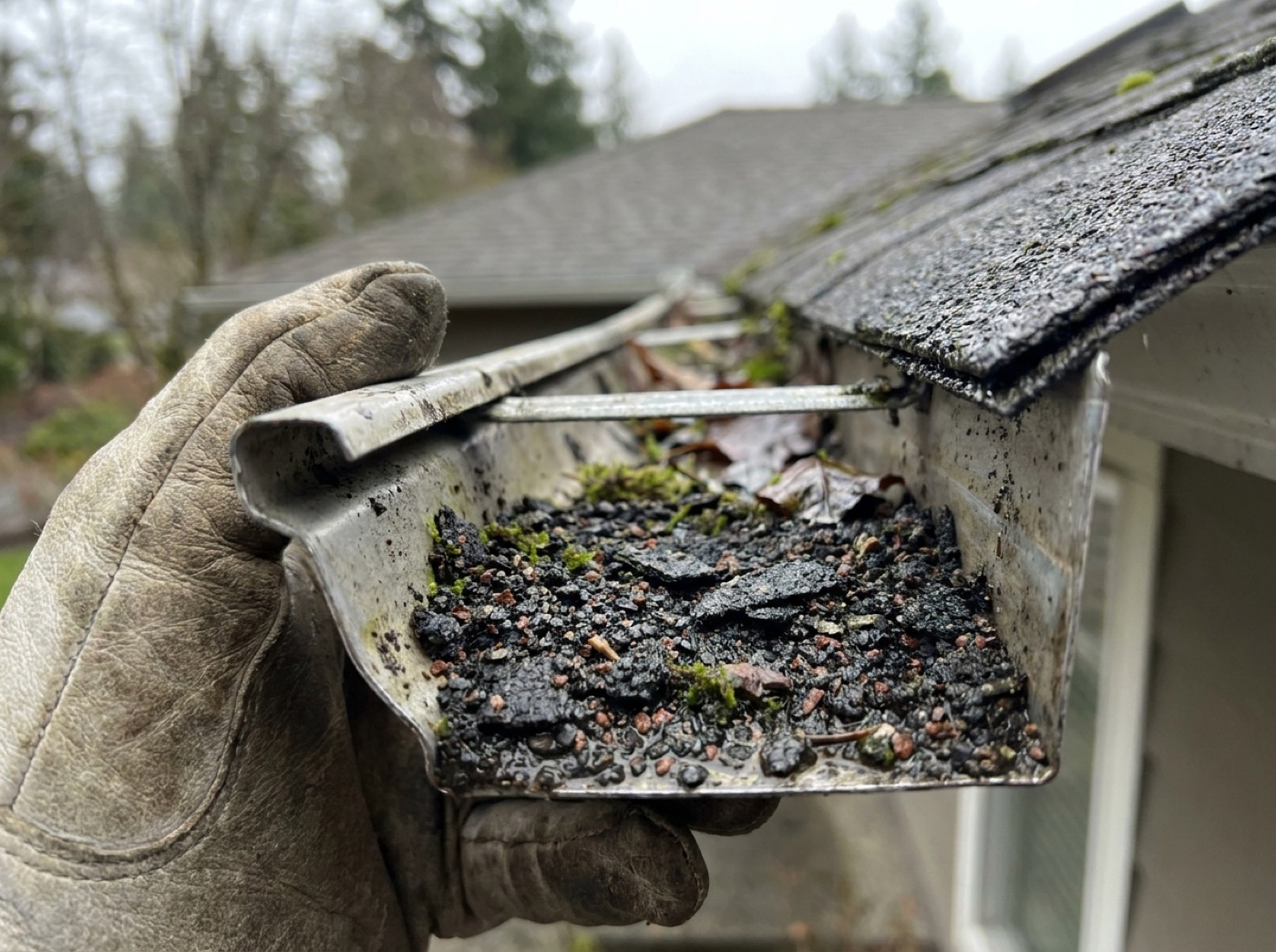
Leaves and debris that build up through September and October are the single most common reason a homeowner sees an ice dam in January that they never saw the winter before. Clearing gutters and valleys before the first hard freeze is one of the cheapest, most effective things a fall inspection catches, and it takes no material cost at all, only attention.
05 / ZONE FOURThe attic side: readiness winter cannot see
Half of what determines whether a roof has a good winter happens on the attic side of the deck, not on top of it, which is why a fall inspection is incomplete without going inside.
Moisture staining and active leaks
Any stain on the underside of the deck or the rafters is evidence of a leak that has already happened, whether or not it is currently active. Finding it in fall, before the deck has spent a winter wet under snow load, gives a much better chance of a straightforward repair instead of rot that has to be cut out and replaced.
Ventilation and airflow
Intake and exhaust ventilation keep the attic close to outdoor temperature, which is what keeps the roof deck evenly cold and prevents the melt-and-refreeze cycle that builds ice dams. A fall check looks for blocked soffit vents, insulation packed against the eaves, and exhaust vents that are not doing their job, because any of those turns an otherwise sound roof into an ice dam waiting to happen.
A roof rarely fails from the weather on top of it. It fails from something that was already wrong underneath, given a whole winter to get worse.
06 / THE MATHWhy an October fix and a January leak are not the same job
The reason this checklist matters is not aesthetic. It is financial and it is timing. Most roof repairs in Macomb County run $350 to $3,200, and a single failed pipe boot or a small flashing repair caught in the fall sits at the low end of that range. The exact same defect, discovered instead as an active interior leak after a January thaw, usually involves more than the roof: wet insulation, a stained ceiling, and sometimes drywall, on top of the roof repair itself.
covers most roof repairs found during a fall inspection, from a single pipe boot to a flashing rebuild. Larger or more complex repairs can run higher. Catching the issue in fall keeps you at the low end of that range and off the interior-damage list entirely.
There is also an access problem that has nothing to do with money. A repair crew can work a dry, bare roof in October in a single visit. The same roof under snow and ice in January may not be safely walkable at all, which means an active leak sometimes has to wait, tarped, until conditions allow a permanent fix. That is exactly the gap our emergency tarping service exists to bridge, but avoiding the wait in the first place is always the better outcome.
This same math changes the replace-or-repair conversation, too. A roof that is otherwise mid-life with one or two isolated fall findings is almost always a repair candidate, and catching those findings early keeps them isolated instead of letting a winter of moisture find the next weak point. A roof that is already near the end of its rated life is a different conversation, and a fall inspection is the honest way to find out which situation you are actually in before winter decides for you. If replacement does turn out to be the right call, most Macomb County asphalt roofs run $9,000 to $18,000 installed, and our replacement cost guide breaks down what sets the price on your specific roof.
07 / BOOKING ITGetting the fall inspection on the calendar
A fall roof inspection at Macomb Roofing Pros covers every zone above: the shingle field, flashing and penetrations, drainage and edges, and the attic side, all photographed as we go. The inspection itself is $0 with no obligation. If the roof is ready for winter, we tell you that directly. If something needs attention, you get a written price before anything is scheduled, and if a repair is the right call rather than anything bigger, that is exactly what we recommend.
Fall books up as more homeowners have the same idea at the same time, so the earlier in the season you call, the more scheduling room there is to complete any repair work before winter access closes. If your roof already has an active leak, do not wait for a scheduled slot: we offer 24/7 emergency tarping to stop water now, with the full inspection to follow. See what a complete inspection covers on our roof inspection service page, or get a ballpark on repair costs first with the 60-second cost calculator.
- Fall is the last easy, safe window to inspect and repair a roof before snow makes it unreachable.
- The shingle field, flashing and penetrations, drainage, and the attic side all get checked, in that order water actually moves.
- Clogged gutters and valleys are the most common, cheapest-to-fix cause of a January ice dam.
- Most repairs found in a fall inspection run $350 to $3,200; the same issue found as a winter leak usually costs more than the roof alone.
- The inspection is $0 with no obligation, and 24/7 emergency tarping covers any active leak found in the meantime.
Questions we hear most
Earlier is better. Booking in September or early October gives the widest window to complete any repair before winter weather limits safe roof access. Scheduling fills up fast once the first hard freeze is on the forecast, so an early call gets you more options, not just an earlier appointment.
Our fall inspection is $0 with no obligation. If we find a repair is needed, most roof repairs in Macomb County run $350 to $3,200 depending on what is found, and larger or complex repairs can run higher. You get a written price before anything is scheduled.
If we find an active leak or a failure point that will not hold through winter, we will tell you plainly and give you a repair price on the spot. For any roof that is actively leaking right now, we offer 24/7 emergency tarping to stop the water while the permanent repair is scheduled.
- FEMA, disaster declaration DR-4757-MI, Michigan severe storms of August 2023 (Macomb County designated). fema.gov/disaster/4757
- NOAA National Centers for Environmental Information, U.S. Climate Normals (Detroit-area stations). ncei.noaa.gov
- Michigan Residential Code 2015, section R806 Roof Ventilation: minimum net free ventilating area of 1/150 of the vented space, reduced to 1/300 where listed conditions are met. up.codes: MRC chapter 8