
JUMP TO A SECTION
Think of spring as the season your roof finally hands you its report card. Every freeze and thaw cycle since December, every gust that lifted a shingle edge, every pound of snow load that pressed down on the deck, all of it happened out of sight, and none of it showed up as an obvious problem while it was happening. By April, the evidence is sitting there in plain view: on the shingles, in the gutters, and on the underside of the roof deck in your attic. This guide is not about preventing ice dams or explaining attic ventilation science; our ice dam and ventilation guide covers that ground. This is the damage audit that comes after, the specific list of what a spring inspection is actually looking for and why each item matters.
01 / THE SEASONWhy spring is the tell-all season
Macomb County winters put a roof through more stress than any other stretch of the year. Meltwater works into a hairline gap in a sealant strip, refreezes overnight, and expands just enough to widen that gap. Repeat that dozens of times over a winter and small imperfections become real openings. Add the sheer weight of accumulated snow pressing on the deck and the wind that comes with every winter storm system, and a roof that looked fine in November can be carrying a season's worth of small failures by March, none of them visible from the driveway.
The reason spring is the moment to check is simple: it is the first time all winter that the roof is fully exposed again, with the snow gone and the freeze-thaw cycling mostly behind you, and it is also the last quiet window before summer's wind and hail events start adding new damage on top of whatever winter left behind. A spring inspection is not looking for a hypothetical. It is looking for the specific, physical marks a Michigan winter leaves on a roof every single year.
covers most repairs a spring inspection turns up, from a single lifted shingle course to a reworked flashing detail. The inspection itself that finds the problem is $0, no obligation. Start yours with the 60-second estimator.
02 / THE EXTERIORThe exterior checklist, item by item
A proper spring inspection works from the field of the roof outward to the edges, because that is the order damage tends to appear and the order it is easiest to miss. Here is what we are actually looking at, and what each sign means.
Shingles: creased, cracked, or simply gone
Wind does not have to tear a shingle off to damage it. A gust strong enough to lift the tab and set it back down leaves a crease in the shingle at the fold line, and a creased shingle has a weakened seal even when it looks intact from the ground. We check every visible course for creasing, for tabs that no longer lie flat, and for any shingle that has cracked from the winter cold, since asphalt gets brittle in low temperatures and is more prone to cracking under stress in January than in July. Shingles that are simply missing, often blown into a gutter or a neighbor's yard sometime over the winter, are the easiest find and usually the most urgent, since the underlayment beneath is not built to be a long-term roof surface on its own.
Flashing: displaced at valleys, chimneys, and vents
Flashing is the metal that seals every place the roof meets something else: a chimney, a valley, a plumbing vent, a wall. It is fastened, not glued down solid, which means it can shift under wind load or as ice works underneath it, and a shifted flashing detail is one of the most common places a roof starts leaking without a single missing shingle anywhere nearby. We look at every flashing point for lifted edges, pulled fasteners, and sealant that has dried and cracked over the winter, since a flashing repair now is a fraction of the cost of the water damage a displaced flashing detail can cause by the time it shows up on a ceiling.
Granule wash in the gutters and downspouts
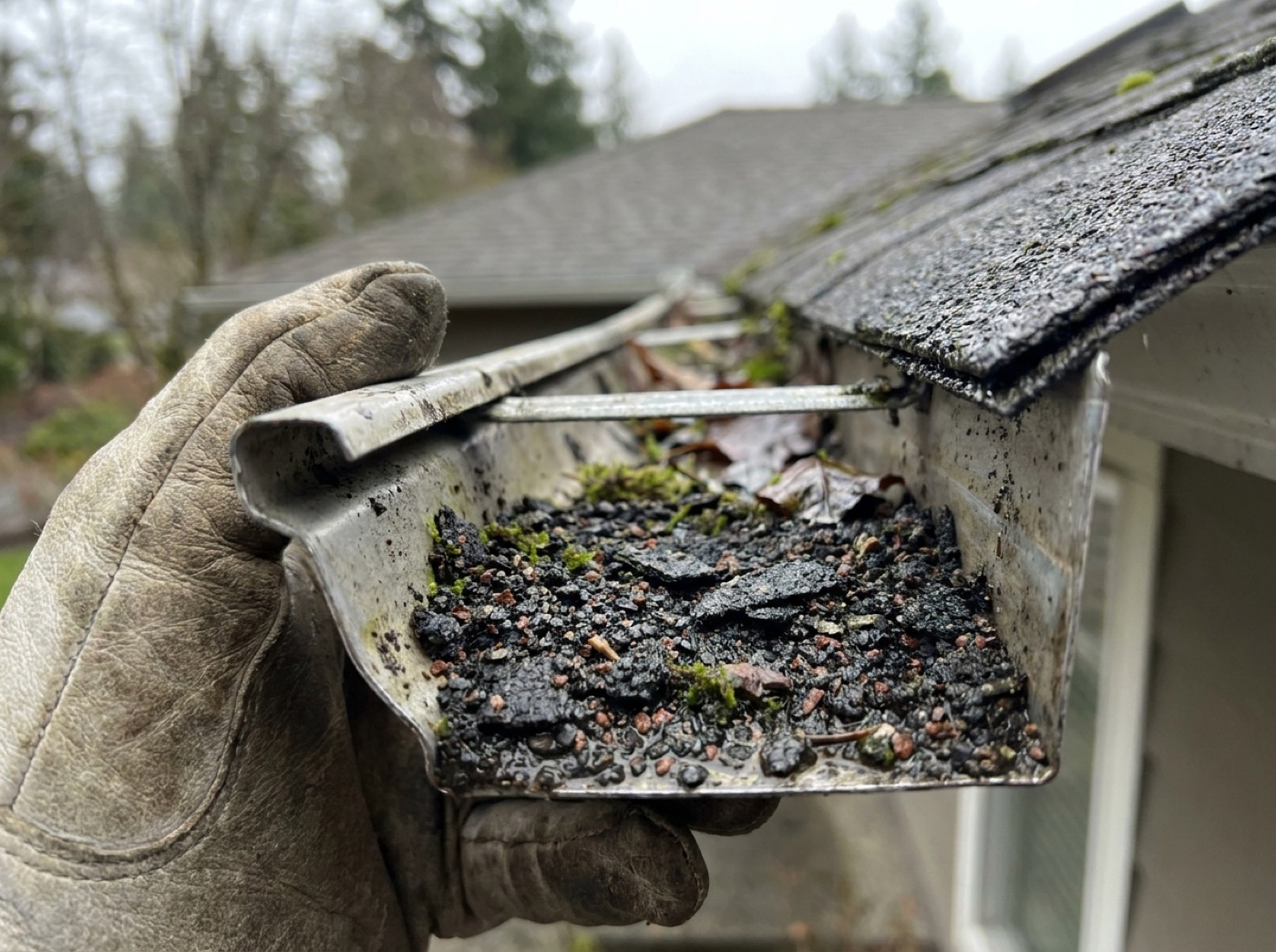
Asphalt shingles are coated in mineral granules that shield the underlying asphalt from UV light, and a healthy roof sheds a small, steady amount of granules over its life. A heavy granule deposit sitting in the gutters or washed down into the downspouts after winter is a different signal: it usually means ice and repeated freeze-thaw movement scoured granules off faster than normal wear would, and bald patches on the shingle field are the visible half of that same story. We check the gutters and the downspout outlets specifically for this, because it is often visible before a bald patch is obvious on the roof itself.
Gutters, fascia, and the roof edge
The edge of the roof takes its own kind of winter abuse. Ice that formed at the eaves over the season can pull gutters loose from their fasteners, and the weight of ice sitting in a gutter for weeks can bow a run of gutter or separate a seam. We check gutter attachment, look for sections pulled away from the fascia, and check the fascia board itself for soft spots where water may have sat against it through the winter.
- Every visible shingle course for creasing, lifted tabs, cracking, or missing pieces
- Every flashing point, valley, chimney, and vent boot for lifted or displaced metal
- Gutters and downspout outlets for heavy granule deposits, a sign of accelerated wear
- Gutter attachment and fascia for ice-season pull-away or soft spots
- Roof penetrations and pipe boots for cracked rubber after a winter of cold
- The ridge line and hip lines for any lifted or separated cap shingles
03 / THE INTERIORThe attic and interior evidence
The exterior checklist only tells half the story, because a roof can look reasonably intact from the ground while water has already been working its way under the shingles and onto the deck. That is why a real spring inspection goes into the attic, not just onto the roof, and checks the interior evidence a winter leaves behind.
Attic moisture, staining, and daylight
From inside the attic, we are looking at the underside of the roof deck for water staining, dark streaking along a rafter, or any spot where the plywood looks discolored or soft to the touch. We also check for any point where daylight is visible through the deck, which usually means a gap large enough that water has a clear path in as well. Staining concentrated near a valley, a chimney, or a plumbing vent often points straight back to the exact flashing point on the exterior checklist, which is why we check both sides of the same roof in the same visit rather than treating them as separate jobs.
Insulation condition and any compression
Wet insulation loses most of its effectiveness and can hold moisture against the deck long after the source is fixed, so we check whether attic insulation shows any staining, matting, or compression that suggests it got wet at some point over the winter. This is also a useful cross-check on ventilation, since insulation blocking soffit intake vents is a common contributor to the ice damming this guide is intentionally not covering in depth; if that is the pattern we find, we will say so plainly and point you to the ventilation guide rather than just patching the symptom.
Ceiling stains and musty odors inside the home
Not every homeowner gets into their own attic over the winter, so by spring, the interior of the house itself can carry the first evidence: a ceiling stain that appeared sometime after a January thaw, a musty smell in an upstairs closet, or a bathroom fan that seems to be running into more resistance than usual. Any of these is worth mentioning when you book an inspection, because it tells us exactly where to look first rather than starting a blind search of the whole roof.
None of this requires you to climb onto your own roof. Every item above is exactly what we check during a free inspection, on both the exterior and the attic side, with photos of anything we find. The checklist is here so you know what a thorough visit actually covers, not as a substitute for one.
04 / THE FORKWhat a spring finding turns into
Most of what a spring inspection turns up is a repair, not a replacement, and the cost usually tracks the extent of what winter did rather than the age of the roof by itself. A single displaced flashing point, one section of creased shingles, or a cracked pipe boot are all straightforward repairs, typically $350 to $3,200 depending on scope, and larger or more involved repairs can run higher. Our roof replacement cost guide lays out the full price canon if the finding points the other direction.
Replacement enters the conversation when what spring reveals is not one isolated issue but a pattern: granule loss spread across large sections of the field, staining showing up in more than one part of the attic, or a roof that was already near the end of its rated service life going into winter and is now showing several new problems at once. In that case, a full asphalt replacement in Macomb County runs $9,000 to $18,000, with most homes landing $12,000 to $16,000. We will tell you plainly which side of that line your roof is on, with photos to back it up, and we would rather write you a repair estimate than a replacement pitch when a repair is the honest answer.
One category deserves a separate note: if the winter included a wind event severe enough to be a plausible insurance matter rather than ordinary wear, that changes the path. Homeowners insurance generally covers sudden damage from wind or similar events, not gradual age-related wear, and every policy reads differently. We document what we find with photos either way and can meet your adjuster on site if a claim is a fit, but no contractor can promise how an insurer will rule on a claim. The full process is in our storm and insurance claims guide.
A spring inspection is not looking for a hunch. It is looking for the specific marks a Michigan winter leaves on a roof, and it either finds them or it does not.
05 / THE TIMINGWhy April and May beat waiting
There is a real scheduling reason to book a spring inspection early rather than let it drift into summer. Southeast Michigan's roofing season runs hardest from late spring through fall, and calendars fill fastest once summer storms start rolling through and everyone on the block calls at once. A roof that gets a spring look in April or May is choosing its own week for any repair that turns up. A roof that waits until a July storm forces the issue is taking whatever slot is left, on a roof that may now be carrying summer wind or hail damage stacked on top of whatever winter already did.
There is also a documentation reason to move early. If the exterior and attic checks above turn up something borderline, having it on record in April, before a single summer storm has passed over the house, makes it much easier to say with confidence what caused a given mark later on, if a bigger storm does roll through and the insurance question comes up. Waiting means any new damage and the leftover winter damage blur together, and that ambiguity rarely works in the homeowner's favor.
If you want the mirror-image version of this checklist for the other side of the year, our fall roof inspection checklist covers what we look for before the freeze-thaw season starts rather than after it ends. And if you are trying to decide how often to have someone look at all, our roof inspection frequency guide lays out the cadence we recommend for Macomb County homes based on roof age. Either way, the visit itself is $0 with no obligation, covers everything in this checklist, and gives you honest photos of exactly what we found. You can start it from the estimator, browse our full inspection service page, or just call and get on the calendar before the season fills up.
- Spring is the first full look at what freeze-thaw cycling, ice load, and wind did to your roof over the winter, before summer storm season adds to it.
- The exterior checklist covers creased or missing shingles, displaced flashing at valleys and chimneys, and heavy granule wash in the gutters.
- The attic side matters just as much: staining, daylight through the deck, wet or compressed insulation, and interior ceiling signs.
- Most spring findings are repairs, typically $350 to $3,200; a pattern of widespread damage points toward replacement, $9,000 to $18,000 for asphalt.
- Booking the inspection in April or May, ahead of summer storm season, means better scheduling and cleaner documentation if a claim question comes up later.
Questions we hear most
It checks the physical evidence a Michigan winter leaves behind: creased, cracked, or missing shingles, displaced flashing at valleys and chimneys, heavy granule wash in the gutters, and on the attic side, moisture staining, daylight through the deck, and any wet or compressed insulation. It is a damage audit of what freeze-thaw cycling, ice, and wind did over the winter, not a general once-over.
Our spring inspection is $0 with no obligation. If it turns up a repair, most repairs in Macomb County run $350 to $3,200 depending on scope, and larger or complex repairs can run higher. If the roof shows a widespread pattern that points toward replacement instead, we will tell you plainly and give you the numbers before recommending anything.
Both matter, for different reasons. Spring shows you what winter's freeze-thaw cycling, ice, and wind actually did to the roof, before summer storms add new damage on top of it. Fall is about closing gaps and confirming the roof is ready before the next freeze-thaw season starts. Homes past about ten years old are safer on both visits each year; our roof inspection frequency guide covers the full cadence.
- FEMA, disaster declaration DR-4757-MI, Michigan severe storms of August 2023 (Macomb County designated), cited for storm-damage context. fema.gov/disaster/4757
- NOAA National Centers for Environmental Information, U.S. Climate Normals (Detroit-area stations). ncei.noaa.gov
- Manufacturer technical and warranty literature for the major asphalt shingle lines: GAF (gaf.com), Owens Corning (owenscorning.com), and CertainTeed (certainteed.com).
- Your city or township building department: reroofing permit requirements and fee schedules are set locally in Macomb County; see the county directory of communities. macombgov.org