
JUMP TO A SECTION
Somewhere in every conversation about the August 2023 storms, the letters FEMA come up. A neighbor heard the county was declared a disaster area. A door-knocker said the declaration means a free roof. A homeowner finding fresh water stains this year wonders whether the federal government, the insurance company, or nobody at all is supposed to pay for damage that started two summers ago. All three of those people are reacting to the same real event: federal disaster declaration DR-4757, issued after the severe storms of August 2023, with Macomb County among the designated areas. The declaration is genuine and it matters. But what it changed for an individual roof claim is narrower, and more useful, than most of the folklore around it. This guide walks the whole thing in order: what the declaration was, what it did and did not do to the way a roof gets paid for, and why that one storm season is still driving late-discovered claims across the county today.
01 / THE SHORT ANSWERThe declaration changed less than people think, and more than nothing
Here is the honest headline. A federal disaster declaration does not replace, suspend, or override your homeowners insurance. After DR-4757, exactly as before it, a storm-damaged roof in Macomb County is first and foremost an insurance claim: your policy, your insurer, your adjuster. What a declaration can add is a federal backstop behind that claim. FEMA assistance, where a declaration makes it available, is generally aimed at uninsured and underinsured losses, at making a home safe and habitable rather than restoring it like-for-like, and it is structured not to duplicate what insurance pays. Low-interest SBA disaster loans may also become available to help bridge gaps that neither insurance nor grants cover.
So the practical meaning of DR-4757 for a homeowner is threefold. First, it is federal confirmation that the August 2023 event was severe, which is context an adjuster already understands. Second, it may have opened backstop programs for people whose insurance fell short, subject to eligibility rules and application windows that belong to FEMA, not to any contractor. Third, and most relevant in 2026, it marks a date: a known, documented wind event that is still the origin story behind roof damage being discovered in the county today. The claim itself still runs through your insurer, which is why the rest of this guide spends most of its time there.
Insurance first, federal help second, and only where the declaration made it available. DR-4757 did not hand anyone a roof. It confirmed the storm was real, opened possible backstops for uninsured losses, and left the ordinary claim process exactly where it was: between you and your insurance company. Anyone who tells you otherwise at your door is selling something.
02 / THE RECORDWhat DR-4757 actually was
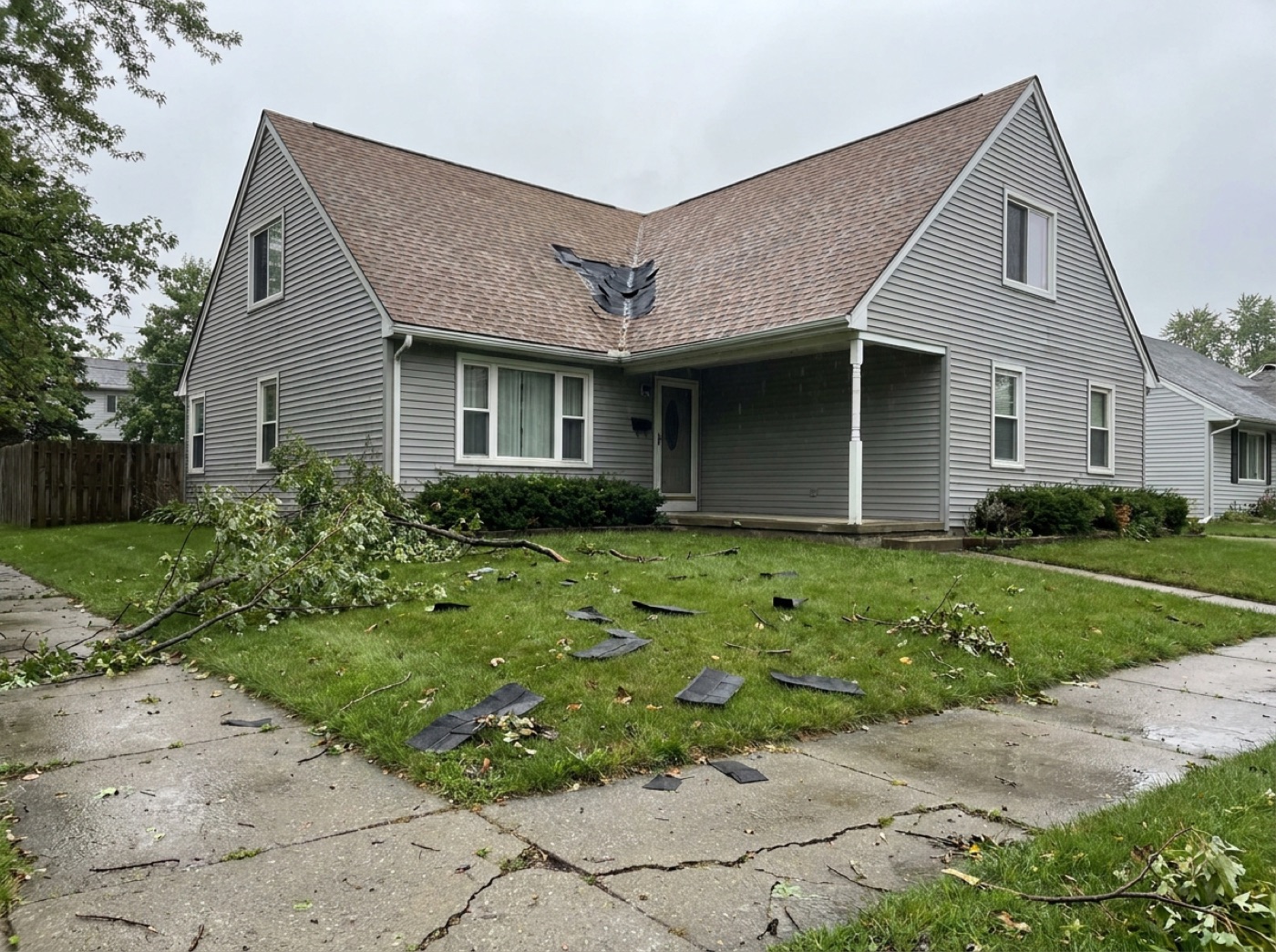
In August 2023, severe storms swept southeast Michigan with the kind of straight-line winds that lift shingle courses, break seal strips, and drive water under roof surfaces. The damage was widespread enough that the event rose through the formal chain: local and state assessment, a governor's request, and a presidential major-disaster declaration, catalogued by FEMA as DR-4757, with Macomb County among the designated counties. That is the anchor fact of this entire guide, and it is a matter of public federal record you can verify yourself at the FEMA declaration page cited in the sources below.
What a declaration is, mechanically, is a switch. It unlocks specific federal programs for specific designated areas. Which programs got switched on for which counties under DR-4757, and what assistance types were made available to households, are details that live in the official declaration record rather than in anyone's sales pitch, and we cite that record below instead of paraphrasing it from memory. The point that holds regardless of those specifics: declarations are rare, they mark genuinely severe events, and this one reached Macomb County. If your roof predates August 2023 and has never been inspected since, that fact alone is a good reason to have someone look, because wind damage from an event that strong does not always announce itself right away.
03 / THE MECHANICSWhat a declaration changes for a roof claim, and what it does not
Start with what does not change, because it is the part the door-knockers get wrong. Your homeowners policy is a private contract, and a federal declaration does not amend it. Coverage for sudden wind damage, your deductible, your documentation duties, your policy's notice requirements: all of it reads exactly the same the day after a declaration as the day before. Policies generally cover sudden storm damage rather than gradual wear, every policy is different, and your declarations page and your adjuster have the final word. Nothing on this page is legal or insurance advice, and no contractor can promise how a claim turns out.
Now what can change. Where a declaration makes household assistance available, FEMA aid can enter the picture behind insurance, generally for losses insurance does not cover: the uninsured homeowner, the underinsured loss, the documented gap between a settlement and what it actually takes to make the home safe and livable. Federal rules govern that sequence, often called sequence of delivery, and the consistent theme in them is no duplication of benefits: federal help is not designed to pay you for a loss your insurer already paid. That is why a homeowner with coverage generally has to work the insurance claim first, keep the paperwork, and only then look federal for whatever genuine gap remains.
The third player is the SBA. After major declarations, low-interest disaster loans from the Small Business Administration may become available to homeowners as well as businesses, and they can bridge the space between an insurance settlement and the real cost of repairs. A loan is not a grant, and terms and eligibility belong to the SBA for that specific declaration, but it is a real tool that many homeowners never hear about because nobody knocks on doors to sell it.
04 / THE ORDER OF MONEYInsurance first: why the sequence matters to you
The sequence is not trivia. Getting it backwards costs homeowners weeks they cannot recover. Because federal assistance generally sits behind insurance and will not duplicate it, waiting on a federal answer before opening your insurance claim is the wrong order in almost every case. The claim comes first: notice to your insurer, photos, an adjuster visit, a coverage decision. Whatever federal help may exist becomes relevant only after that process defines what your insurance did and did not pay.
The order matters for a second reason: time limits run on the insurance side whether or not any federal program exists. Michigan policies impose notice and proof-of-loss requirements, and waiting too long can hurt a claim regardless of how legitimate the damage is. Our guide to the Michigan roof claim filing deadline covers those clocks in detail, and the short version is that discovery of damage today is a reason to move today, not to research federal programs for a month first. Document what you see, call your insurer, and let the backstop question wait its turn in line.
A declaration is a backstop behind your insurance, not a substitute for it. The homeowners who come out of a storm season whole are the ones who worked the claim first and the folklore never.
05 / THE LONG TAILWhy DR-4757 is still producing claims in 2026
Here is the part of the story that matters most right now. Wind damage is not always obvious on day one. A gust that breaks the adhesive seal under a course of shingles leaves a roof that looks fine from the driveway and photographs fine from the street. Then Michigan does what Michigan does: water works into the broken seals, freezes, expands, and pries the damage wider every winter. Two or three freeze and thaw cycles later, a ceiling stain shows up over the dining room, and a homeowner is standing in 2026 looking at damage whose true birthday was August 2023. That pattern is exactly why a documented, federally recognized storm date is so useful: it gives a late-discovered claim a real event to point to.
Late discovery does not automatically doom a claim, but it changes how the claim has to be built. The connection between the event and the damage has to be documented carefully, the wear-versus-storm question gets more scrutiny from the adjuster, and the policy's time limits become a live issue. We wrote a full guide on filing a roof claim months after a storm that walks that path step by step, and a companion on how wind damage claims work in Michigan, including what adjusters look for on a wind loss specifically. Both are worth reading before you call your insurer if your damage traces back to an older event.
The honest caveat cuts both ways. Not every stain on a 2026 ceiling traces to the 2023 storms, and a claim built on wishful attribution helps nobody. Shingles age, boots crack, and flashing fails on their own schedule. The way to know which story your roof is telling is evidence: photos of the shingle field, the seal strips, the flashing, and the attic side of the deck, read by someone who has seen both wind damage and plain age many times. That is what a free inspection produces, and it is the difference between a claim an adjuster can work with and a guess.
DR-4757 has been a sales prop for storm chasers since the week it was declared. Be careful with anyone who leads with the FEMA word, promises the declaration guarantees you a paid roof, pushes a signature on the first visit, or wants to run your whole claim before you have spoken to your own insurer. A declaration guarantees nobody a roof. Take photos, call your insurance company, and get a local inspection before you sign anything.
06 / THE CLAIM ITSELFWorking a storm claim in Macomb County now
Whatever the funding stack turns out to be, the claim runs on documentation, and the documentation starts on your roof. The working sequence we recommend: photograph everything you can see safely from the ground, note the date you discovered the damage, and get a professional inspection that covers the shingle field, flashing, ventilation, gutters, and the attic side of the deck. If water is actively coming in, stabilization comes first; we offer 24/7 emergency tarping to stop the damage from spreading, which also happens to be exactly the kind of mitigation your policy expects a homeowner to perform.
From there the claim follows the path laid out in our storm and insurance claims playbook, the parent guide for everything on this page: notice to your insurer, the adjuster visit, the scope and settlement, and the work itself. Our role in that process is documentation and craft. We photograph and write up what we find, we can meet your adjuster on site to walk the roof together so nothing gets missed from the ground, and if the claim is approved we do the covered work correctly. What we never do is promise an outcome, because the coverage decision belongs to your insurer, and any contractor who guarantees a result before an adjuster has seen the roof is telling you something about themselves, not about your claim.
If your insurance falls short and a declaration-era backstop is genuinely in play for your situation, that conversation happens with FEMA and the SBA directly, through their official channels, with your insurance paperwork in hand. It costs nothing to ask, the eligibility rules are theirs alone, and the application windows are real, which is one more reason the insurance claim should already be done rather than pending when you ask.
07 / THE MONEYThe cost picture behind all of it
Every funding question gets easier once you know the real size of the job, so anchor to the numbers. Storm damage that is caught early is often a repair, and roof repairs in Macomb County run $350 to $3,200, with larger or complex repairs able to run higher. Damage that stewed under the shingles for seasons, or a roof that was already near end of life when the wind hit, may point to replacement instead: a full asphalt shingle replacement here runs $9,000 to $18,000 installed, and most homes land $12,000 to $16,000. Those are the same ranges published on our honest pricing page, and they do not change based on who is paying.
If a claim is denied, settles below the bid, or the damage turns out to be wear rather than wind, the project becomes an ordinary purchase, and financing can turn it into a monthly line item. As an illustration only: a $13,500 roof financed over a 10 year term at 9.9% APR works out to about $178 per month. That example is not an offer of credit, financing is subject to approval, and your actual rate, term, and payment depend on the lender and your credit profile. For a ballpark on your own roof before anyone visits, the 60-second cost calculator runs these same ranges against your roof size, and the instant estimator can start the storm-specific conversation directly.
The first step costs nothing at all. Our inspection is $0 with no obligation, it produces the photos a claim needs anyway, and it answers the question underneath everything above: is this storm damage, is it age, and is it a repair or a replacement. If your roof has not been looked at since August 2023, that inspection is overdue for reasons DR-4757 documented at the federal level. The wider library of claim guides lives in our roofing guides index whenever you want to go deeper.
- FEMA DR-4757 is real: a federal major-disaster declaration for the August 2023 Michigan storms that included Macomb County, and a matter of public record.
- A declaration does not change your insurance policy. Storm-damaged roofs are still insurance claims first, and the claim process runs exactly as it did before.
- Federal help, where a declaration makes it available, is a backstop for uninsured and underinsured losses, generally will not duplicate an insurance payout, and SBA disaster loans may bridge gaps.
- Wind damage from 2023 can surface years later as freeze and thaw cycles widen broken seals, which is why late-discovered claims in the county still trace to that event.
- Repairs run $350 to $3,200 and full asphalt replacements run $9,000 to $18,000; a free inspection with photos tells you which conversation you are actually in.
Questions we hear most
DR-4757 is the federal major-disaster declaration issued after the severe Michigan storms of August 2023, and Macomb County was among the designated areas. It is a matter of public federal record on FEMA's declaration page. Which specific assistance programs were made available to households under it is a detail that lives in that official record, and the only reliable way to know your own eligibility for any federal program is to check with FEMA directly.
No, not by itself. A declaration does not replace your homeowners insurance, which remains the primary source for sudden storm damage. Where a declaration makes household assistance available, FEMA aid generally acts as a backstop for uninsured and underinsured losses, aims at making a home safe and habitable rather than a full like-for-like replacement, and will not duplicate what insurance pays. SBA disaster loans may also be available to bridge gaps. Work the insurance claim first.
Possibly, but timing matters and every policy is different. Wind damage from that event can surface years later as freeze and thaw cycles widen broken shingle seals, and late-discovered claims can succeed when the damage is documented well. Michigan policies do impose notice and time-limit requirements, so if you are seeing damage now, document it and contact your insurer promptly. We can inspect for free, photograph what we find, and can meet your adjuster on site, but no contractor can promise a claim outcome.
- FEMA, disaster declaration DR-4757-MI, Michigan severe storms of August 2023 (Macomb County designated). fema.gov/disaster/4757
- FEMA, disaster declaration DR-4757-MI, Michigan severe storms, tornadoes, and flooding of August 24 to 26, 2023 (Macomb County designated; declared February 8, 2024). fema.gov/disaster/4757
- Michigan Department of Licensing and Regulatory Affairs (LARA), residential builder licensing and the public Verify a License lookup. michigan.gov/lara