
JUMP TO A SECTION
Water is the only thing a flat roof ever has to defend against, and the whole job of a drainage system is to get that water off the roof before it finds a way in. On a steep roof, gravity does the work for free. On a low-slope commercial or flat roof, drainage is engineered, and when it is undersized, clogged, or never really sloped in the first place, the roof ponds, ages in standing water, and in a Macomb County winter freezes into ice that works at every seam and flashing until something lets go. Drainage is the plumbing of your roof, and like plumbing it is invisible right up until the day it backs up. This guide walks the three drainage families you will find on metro Detroit buildings, the slope that feeds them, the overflow drainage your building code requires, and the maintenance rhythm that keeps all of it moving.
01 / THE SHORT ANSWERThe three ways water leaves a flat roof
Despite the name, a flat roof is never truly flat. It is built with a slight, deliberate slope so water runs toward a low point, and at that low point sits one of three drainage families. Interior drains pull water down through the roof and out through the building's plumbing. Scuppers let water spill out through openings in a parapet wall. Perimeter gutters catch water at the roof edge the way they would on a house. Most buildings use one of these as the primary system, and many combine two, which is exactly what you want, because a single point of drainage is a single point of failure.
On a shingle roof, drainage is barely a decision, because the pitch carries water off in seconds. On a flat roof it is one of the most important parts of the assembly and one of the most commonly shortchanged, because getting it right means slope, drain sizing, and overflow planning that do not show from the parking lot. When we replace a low-slope roof, correcting the drainage is often the difference between a roof that lasts its warranty and one that ponds itself to an early grave. A membrane reroof in Macomb County runs $9,000 to $16,000 installed, and drainage corrections are part of what moves a project inside that range. See the full ledger on our honest pricing sheet.
Standing water is not a cosmetic problem. It accelerates membrane aging, adds dead load the deck was never meant to carry indefinitely, and on many roofs it can void the manufacturer's warranty. The point of every system below is the same: keep water moving to a designed exit and never let it linger. Our guide to ponding water covers what standing water actually does to a roof; here we are focused on the hardware that prevents it.
02 / THE FAMILIESInterior drains: the workhorse of larger roofs
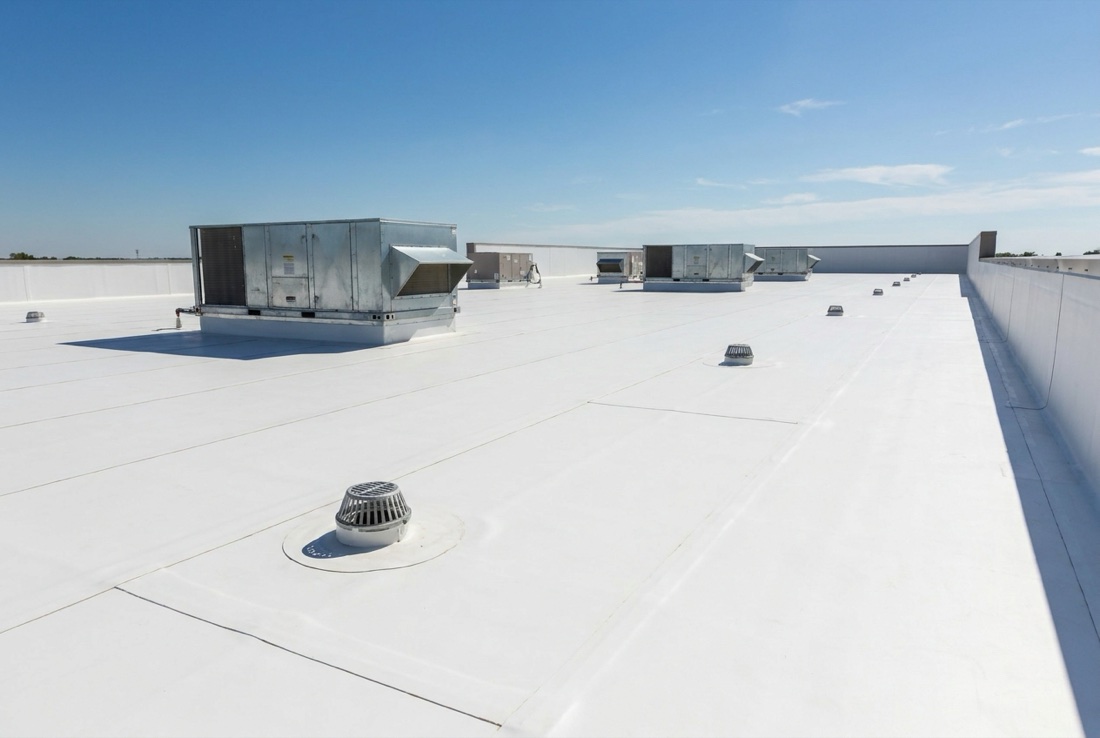
On most mid-size and larger commercial buildings, water leaves through interior roof drains: bowls set into the low points of the roof field that feed down through pipes hidden inside the building and out to the storm system. Each drain has a clamping ring that seals the membrane to the drain body and a domed strainer, sometimes called a strainer basket, that keeps leaves and debris out of the pipe. Because the plumbing runs inside heated space, interior drains resist freezing better than anything exposed to the weather, which is a real advantage in a Michigan winter.
The tradeoff is that interior drains are the hardest to inspect and the most expensive to correct, because the pipe is buried in the structure. When one clogs, water has nowhere to go but up and out across the field, and the first sign is often a growing pond around the drain or a stain on the ceiling below. Drains also sit at the very lowest point by design, so any debris the wind moves tends to migrate straight toward them. That is why the strainer basket matters and why a missing or crushed one is one of the most common things we find on a neglected roof.
Two details separate a drain that works from one that quietly leaks. The first is the sump: the membrane should be recessed slightly into a tapered pan around the drain so water is actively pulled toward it, not merely allowed to find it. The second is the seal at the clamping ring, which is a classic leak point because it is where the flexible membrane meets rigid metal, exactly the kind of transition a freeze-thaw climate loves to pry apart. When we rebuild drainage on a reroof, resetting the drain into a proper sump and remaking that seal is standard, not an upgrade.
03 / THE FAMILIESScuppers and leader heads: draining through the wall
Many metro Detroit commercial buildings are ringed by a parapet, the short wall that runs up above the roof line around the perimeter. On those buildings water usually leaves through scuppers: openings cut through the parapet at roof level that let water spill out and away from the wall. A through-wall scupper is essentially a lined chute; a common variation pairs it with a leader head, sometimes called a conductor head, a small box on the outside of the wall that catches the spill and feeds it into a downspout.
Scuppers have one big virtue: they are visible and easy to check, and there is no buried pipe to snake. They also make an excellent overflow because a scupper set a little higher in the wall can serve as the code-required secondary drainage, which we come back to below. Their weakness is winter. A scupper is an opening exposed to the outdoors, and it is a favorite place for ice to form, because meltwater running to the edge refreezes right at the throat where cold air hits it from three sides. An iced scupper dams water back onto the roof exactly when the membrane is most brittle, which is why frozen scuppers show up so often in our guide to ice buildup on flat roofs.
The detail that makes or breaks a scupper is the flashing at the opening. Cutting a hole through a parapet creates three new edges and a corner where the roof membrane, the wall, and the outside all meet, and that junction has to be flashed as a continuous, watertight assembly, not caulked as an afterthought. A poorly flashed scupper leaks into the wall cavity rather than the roof field, which means the damage can travel down inside the building for a long time before anyone connects it to the roof. When a scupper leaks, the fix is almost always at that flashed throat.
04 / THE FAMILIESPerimeter gutters on low-slope roofs
The third family is the one homeowners already understand: gutters and downspouts at the roof edge. On smaller low-slope roofs, detached garages, additions, porches, and modest single-story commercial buildings, water is sloped toward one edge and caught by an exterior gutter that carries it to downspouts. It is the simplest system to build, the cheapest to maintain, and the easiest to see when something is wrong, which is why it is common on the smaller buildings across Macomb County.
Perimeter gutters share the parapet family's weakness in winter, only more so, because the whole trough is hanging in outdoor air. Gutters on a low-slope roof are prone to filling with ice, and once a gutter freezes solid it stops draining and can pull loose from its fasteners under the weight. They also depend on the edge metal and the membrane termination behind them being watertight, because a gutter that overflows behind itself sends water straight into the fascia and the wall. Oversized downspouts, proper hangers, and clean runs matter more than most owners assume.
There is also a hybrid you will see on larger buildings: an interior gutter, or box gutter, built into the roof line rather than hung on the outside. These carry the same freeze risk as any exposed trough with an added catch, a leak in an interior gutter is a leak inside the building envelope, not over the sidewalk. Whichever edge system your building uses, the membrane detail where the field meets the gutter is the part that fails first, so it is the part worth looking at closely when a reroof is on the table.
05 / THE SLOPESlope, crickets, saddles, and tapered insulation
None of the three drainage families works without slope, and slope is where a lot of older flat roofs quietly fail. A drain in the middle of a dead-level roof does nothing if water cannot reach it, and a scupper high on a wall is useless if the field does not tip toward it. The whole surface has to be pitched, gently but continuously, so every square foot of the roof has a downhill path to an exit. On a well-built roof you should never find a puddle that has nowhere to go.
On modern low-slope roofs, that pitch usually comes from tapered insulation: rigid insulation boards manufactured in graduated thicknesses that build the slope into the assembly itself as the roof goes down. Tapered insulation is the clean way to create slope on a structurally flat deck, and it does double duty by adding the R-value the energy code now expects, which is why it shows up in both this guide and our flat roof maintenance checklist. It is also a line item, more design and more material than a flat layer, so a cheap bid that skips real slope is skipping the thing that keeps the roof dry.
Two smaller pieces do the fine steering. A cricket is a raised ridge, usually triangular in section, built on the uphill side of anything that blocks water, most often a chimney, a large rooftop unit, or a curb, so the flow splits and runs around the obstruction instead of pooling behind it. A saddle is the same idea applied between two drains or along a valley, a low peak that pushes water left and right toward the nearest exit. Crickets and saddles are how a competent installer eliminates the dead spots that a plain sloped field still leaves behind. When we find chronic ponding behind a rooftop unit, a missing cricket is very often the reason.
06 / THE CODEOverflow drainage: the backup your code requires
Here is the part most owners have never heard of and every building needs: secondary, or overflow, drainage. Building codes generally require that a roof have a backup way to shed water in case the primary drains clog, because a fully blocked drainage system can pond enough water to overload the structure. The secondary system is set slightly higher than the primary, so in normal weather it does nothing and stays dry; it only comes alive when the primary path is blocked and water begins to rise. On a scuppered building, the overflow is often a second scupper set a few inches higher in the parapet. On a drained roof, it may be an overflow drain beside each primary drain, or scuppers as a backstop.
The reason this matters to you as an owner is twofold. First, it is a code requirement, and a reroof that removes or ignores the existing overflow is not just cutting a corner, it is undoing a safety system, and your local building department has the final word on what your specific building requires (Michigan Building Code 2015, chapter 15). Second, the overflow is a diagnostic gift: if you ever see water pouring out of a scupper or drain that is normally dry, that is your building telling you the primary drainage is blocked and needs attention now, not next quarter.
Every drainage system on this page has the same seasonal weakness in a Macomb County winter. Water that lingers at a drain, scupper, or gutter refreezes there, and ice does not drain. A blocked or frozen exit turns a working roof into a bathtub, and the standing water becomes an ice lens that pries at seams and flashings all season. This is why fall drain cleaning matters more here than in warmer states, and why an active winter leak is a call-now event: we can stop the water with 24/7 emergency tarping and schedule the real repair once the roof is safe to work. Never chip ice off a membrane to clear a drain; you will trade a clog for a puncture.
07 / THE UPKEEPA maintenance rhythm for each drainage type
Drainage is the highest-payback maintenance on any flat roof, because almost every drainage failure starts as a five-minute clog that no one cleared. The baseline rhythm is simple: check the drainage in spring and again in fall, and after any major storm that drops debris. Fall is the non-negotiable one in southeast Michigan, because leaves come down right before the freeze that will lock any blockage in place until spring.
By type, the checks differ a little. For interior drains, confirm the strainer basket is present and intact, clear leaves and debris from around the bowl, and watch the drain during or just after rain to see that it actually pulls water down rather than letting a ring stand around it. For scuppers and leader heads, clear the throat and the leader head box, check that the flashing at the opening is sound, and make sure nothing on the roof has drifted to block the approach. For gutters, clean the trough and downspouts and check the hangers and the edge behind the gutter. In every case, walk the field afterward looking for the puddle that should not be there, because a ponding mark is the roof reporting a drainage problem you can still fix cheaply.
Draw a clear line between what you can safely do and what belongs to a pro. Clearing an accessible drain basket or a ground-level downspout is owner work. Getting onto a parapet in November, probing a suspect flashing, or deciding whether chronic ponding needs added drains, new crickets, or a tapered-insulation correction is a job for someone who does it for a living. A leak that traces to drainage is often cheaper to solve than owners fear, because it can be a targeted repair rather than a replacement, and flat roof repairs run $350 to $3,200 depending on scope. The honest way to know which conversation you are in is to have someone look, which is what our free inspection is for. You can start from the estimator, size a ballpark with the cost calculator, or see how flat work fits the full lineup on our roofing services hub.
- Flat roofs shed water three ways: interior drains, scuppers with leader heads, and perimeter gutters, and many buildings combine two for redundancy.
- None of them works without slope, built from tapered insulation and fine-tuned with crickets and saddles that route water around rooftop obstructions.
- Code generally requires a secondary overflow set higher than the primary; a reroof must keep it, and your building department has the final word.
- Every exit is a winter freeze point in Macomb County, so fall drain cleaning is the highest-payback maintenance a flat roof gets.
- Drainage leaks are often a targeted repair ($350 to $3,200), and a membrane reroof that corrects drainage runs $9,000 to $16,000 installed; the inspection is $0.
Questions we hear most
There are three primary families. Interior drains pull water down through pipes inside the building and are common on larger roofs. Scuppers are openings through a parapet wall that spill water out, often into a leader head and downspout. Perimeter gutters catch water at the roof edge on smaller low-slope buildings. Most roofs use one as the primary system and many add a second for backup.
It is a backup drainage path set slightly higher than the primary drains, so it stays dry until the main system clogs and water begins to rise. Building codes generally require it because a fully blocked roof can pond enough water to overload the structure. It is often a second scupper set higher in the wall or an overflow drain beside each primary drain, and your local building department confirms what your building needs.
Ponding usually means the roof lacks enough slope to move water to its drains, or a drain, scupper, or gutter is blocked. Fixes range from simply clearing the drainage to adding drains or scuppers, building crickets and saddles, or tapering the insulation to re-establish slope during a reroof. A free inspection tells you whether yours is a quick repair or a slope correction, and in a Michigan winter that standing water becomes ice that damages seams, so it is worth solving before the freeze.
- FEMA, disaster declaration DR-4757-MI, Michigan severe storms of August 2023 (Macomb County designated). fema.gov/disaster/4757
- Michigan Building Code 2015, chapter 15 Roof Assemblies and Rooftop Structures: commercial reroofing, recover, and replacement conditions. up.codes: MBC chapter 15
- SPRI, single-ply and low-slope roofing industry standards. spri.org