
JUMP TO A SECTION
Every building owner has seen it: the day after a rain, a section of the flat roof still holds a mirror of water while the rest has dried. It looks harmless, and for a while it is. But standing water is the single most reliable predictor of where a low-slope roof will fail first, and it is one of the few problems that gets worse on its own schedule whether or not anyone touches it. This guide covers what ponding is by the industry definition, why it quietly ages your membrane and can undo your warranty, what a Macomb County winter does to a pond, and the honest ladder of fixes from a broom and a drain snake all the way to re-sloping the roof at replacement. The prices here come straight from our honest pricing sheet, unpacked line by line.
01 / THE DEFINITIONWhat ponding actually is, and what it is not
Not every puddle is ponding. A flat roof is never truly flat, and after a downpour water will naturally sit in low spots for a little while before it drains or evaporates. That is normal. Ponding is the water that is still there long after the roof should have cleared. The widely cited industry threshold is water that remains on the roof more than 48 hours after rainfall stops under dry drying conditions. Past that window, you are no longer looking at drainage doing its job slowly; you are looking at a spot the roof cannot drain at all.
Water still standing on a flat roof more than 48 hours after the rain stops, in weather that should have dried it, is the commonly used industry line between normal drainage and true ponding. Many membrane manufacturers write that same window into their warranties, and water past it is treated as a defect, not weather. See the sources note below for the manufacturer language.
The practical tell is the stain. Long after a pond dries in summer, it leaves a dirty outline, a ring of collected grit, algae, and pollen baked onto the membrane where the water sat. Those ghost outlines are a map of your roof's real drainage, and they usually cluster in the same predictable places: the middle of a long span that has settled, the uphill side of a rooftop unit that blocks flow, the corner where two roof planes meet, and anywhere near a drain that has partially clogged. If you walk your roof in dry weather and see those rings, you already know where the next problem is coming from, even with no water in sight.
Ponding also has causes worth naming, because the fix depends on the cause. Sometimes it is a blocked or undersized drain that cannot move water fast enough. Sometimes it is structural: a deck that has deflected over years of load so the low point no longer sits over a drain. Sometimes it is design, a roof that was built dead level with no positive slope to begin with, which was common on older buildings. And sometimes it is added weight, a new rooftop unit or a pile of pavers that pushed a marginal span into a permanent dish. Reading which one you have is the first job of an inspection, and it is what our flat roof drainage systems guide walks through in detail.
02 / THE RISKWhy standing water is a problem, not a cosmetic one
Owners are often skeptical that a shallow puddle can hurt a roof built to shed rain. The answer is that the roof is built to shed water, not to hold it, and those are different demands. A membrane that would last decades cycling wet and dry ages very differently when one patch of it is submerged for weeks at a time, freeze after thaw, summer after summer.
It accelerates membrane aging
Standing water is a slow solvent and an incubator. It leaches plasticizers and protective components out of some membranes, holds heat and UV against the surface, and grows algae and biological film that traps still more moisture. On a seamed system, the pond sits directly on the exact detail most likely to fail: the seam. Water that would run harmlessly across a good weld or a good adhesive lap instead soaks it around the clock, working at any tiny void until it finds a way through. The field of a membrane rarely leaks first; the seam under a pond does, and our flat roof winter problems guide covers how that failure mode compounds in a freeze-thaw climate.
It can void your warranty
This is the part that surprises owners most. A great many membrane warranties specifically exclude damage caused by ponding water, using that same 48-hour language. In plain terms: if a leak develops under a pond the manufacturer already warned you about, the warranty you paid for may not cover it. That is not a threat, it is standard contract language across much of the industry, and it means a roof with chronic ponding can be simultaneously under warranty and effectively unprotected where it matters. Anyone selling you a new flat roof should be correcting the ponding as part of the job, precisely so the warranty they hand you is worth the paper. If they are not, ask why.
It multiplies the load
Water is heavy, roughly five pounds per square foot for every inch of depth. A broad, shallow pond can add up to a meaningful load on a deck that is already deflecting, which deepens the dish, which holds more water, which loads it further. It is a feedback loop, and on a marginal structure it is how a nuisance puddle becomes a structural conversation. This is rarely an emergency on its own, but it is a reason not to let ponding run for years, and a reason a good inspection looks at deflection and not just at the membrane.
It hides the leak that is already happening
A pond is also a diagnostic problem. Water can enter a compromised seam under a pond, travel sideways through wet insulation, and surface as a ceiling stain in a completely different part of the building. By the time it shows inside, the insulation under the pond may have been quietly saturating for a season, which turns what could have been a small seam repair into a wet-insulation replacement. Finding that early is exactly what an infrared moisture survey is for, and it is the difference between a targeted fix and a torn-off section.
A membrane is designed to shed water, not to hold it. The one patch of your roof that never dries is the one patch aging on a different, faster clock than the rest.
03 / THE WINTERIn Michigan, a pond becomes an ice lens
Everything above is true in Phoenix. In Macomb County there is a second act, and it is the one that does the real damage. A pond that merely ages a membrane in July becomes a block of ice in January, and ice is not a passive thing sitting on the roof. It expands as it freezes, it grips the surface it froze to, and it works at seams and flashings with every freeze-thaw cycle the winter throws at it.
The sequence is predictable. A low spot holds water into the fall. The first hard freeze turns it into an ice lens bonded to the membrane. A thaw floats it slightly and lets meltwater run under the edges into any seam nearby. The next freeze locks it down again, a little wider, a little deeper, prying at the lap it just infiltrated. Multiply that by the dozens of freeze-thaw cycles a southeast Michigan winter delivers, and a seam that was merely weak in October is a seam that leaks in March. The pond did not just age the membrane; it spent all winter mechanically grinding at the exact detail most likely to fail.
Frozen ponds also disable the drainage that would otherwise save you. Ice caps the drains and scuppers a pond sits near, so the next thaw has nowhere to go and simply deepens the pond, which freezes larger. Meltwater that should exit the roof instead backs up toward seams and base flashings at the worst possible time. This is why a pond that seemed tolerable through a couple of summers can produce its first interior leak in the dead of winter, and why we treat standing water found in a fall inspection as a fix-before-freeze item rather than a spring project. The full winter picture, including drifted snow and flashing splits, is in the winter problems guide.
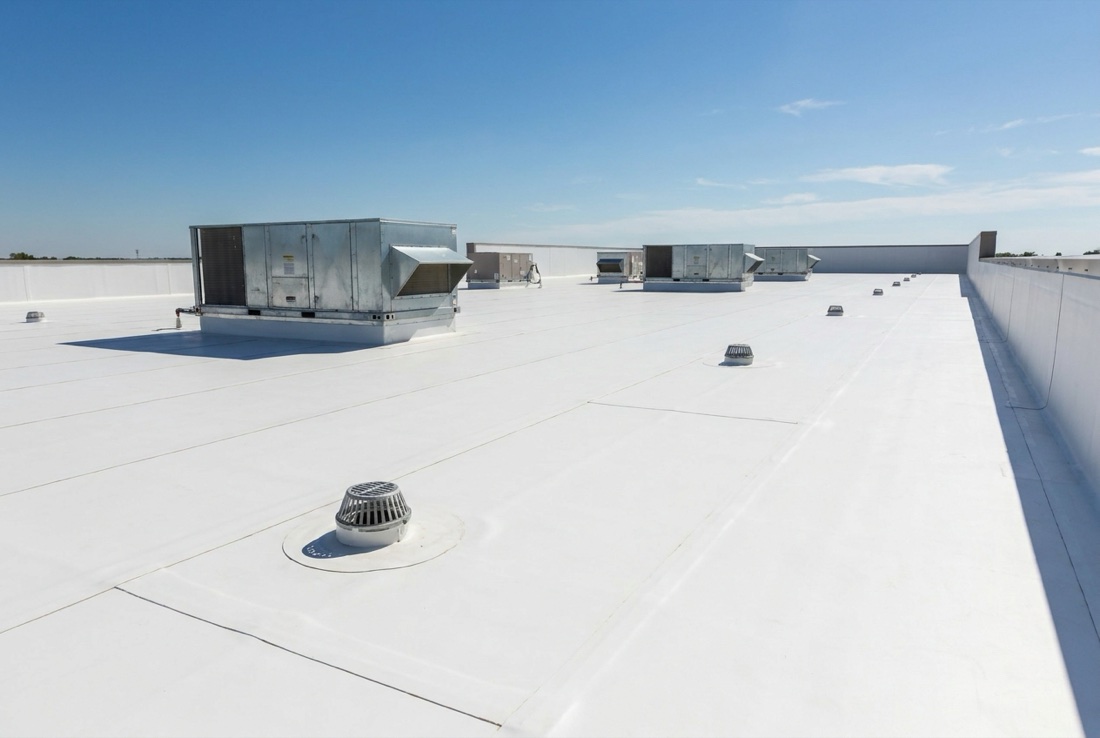
04 / THE FIX LADDERThe fix ladder, from cheapest to permanent
The good news is that ponding is fixable, and the fixes form a clear ladder from a maintenance chore up to a design correction. The right rung depends on why the water is standing and how far the membrane and insulation underneath have already gone. Start at the bottom; do not jump to the top until someone has confirmed the cheaper rungs will not solve it.
Rung 1: clear the drains and the roof
The most common cause of a new pond is the least expensive to fix: a drain, scupper, or gutter choked with leaves, gravel, or a stray piece of debris. Water that used to leave the roof in minutes now backs up behind the blockage. Clearing the drains, pulling debris off the field, and cutting back overhanging limbs that keep feeding the roof is basic maintenance, and on many roofs it makes a young pond disappear entirely. This is the first thing we check and the first thing our drainage systems guide tells owners to keep on a seasonal rhythm. If a pond returns the moment the drains are clean, the cause is deeper and you move up the ladder.
Rung 2: add or relocate drainage
If the roof drains as fast as it can and water still stands, the roof may simply not have enough drainage where the water actually collects. The fix is to add a drain or a scupper at the true low point, enlarge an undersized one, or add a secondary overflow path. This is real work, not a chore, but it is far short of rebuilding the roof, and it directly attacks the problem: it gives the pond a place to go. Placement is everything here, which is why it follows a proper survey of where the water sits, not a guess from the ground.
Rung 3: crickets, saddles, and tapered insulation
When the roof itself is too flat to move water to the drains it already has, the answer is to build slope back into the assembly. Crickets and saddles are small built-up ridges that divert water around an obstacle, like the uphill side of a rooftop unit, and steer it toward a drain. Tapered insulation is the bigger version: layers of insulation cut at an angle to build positive slope across a whole section of roof, so water is always running somewhere instead of settling. This is the workhorse fix for a chronically level roof, and it is usually done as part of a re-cover or replacement rather than on its own, because it means working at the insulation layer. It also improves your insulation package at the same time, which our flat roof replacement cost guide explains is a real lever on both price and code compliance.
Rung 4: re-slope at replacement
At the top of the ladder is the permanent fix: when the membrane is at the end of its life anyway, or the deck has deflected past what a cricket can correct, the replacement is the moment to design the ponding out for good. A new tapered insulation layout, correctly placed drains, and fresh flashings at every detail give you a roof that sheds the way it should from day one, and a warranty that is not compromised by standing water the day it is issued. Re-sloping at replacement costs nothing extra in the sense that you were replacing the roof regardless; it is simply doing the job right instead of laying a new membrane back down over the same dish that killed the last one.
One caution runs through the whole ladder: do not let anyone sell you a coating as a ponding cure. A coating can extend a dry, sound roof, but it does not create slope, and painting over a pond just gives you a coated pond. Standing water is a geometry problem, and geometry is fixed with drains and slope, not with a liquid.
05 / THE NUMBERFix it or replace it, and what that costs
So which conversation are you in? If the membrane is otherwise young and sound and the ponding is a drainage or debris problem, you are in repair territory. Flat roof repairs in Macomb County run $350 to $3,200, and larger or complex drainage corrections can run higher; our flat roof cost guide maps common flat work to that range. Clearing drains, adding a scupper, or building a cricket at one bad spot lives here, and it can buy a good membrane many more years.
You move toward replacement when the ponding has already done its damage: saturated insulation under the low spots, seams that have started to leak, or a membrane near the end of its service life where re-sloping the whole assembly is the only fix that lasts. A full flat or commercial roof replacement in Macomb County runs $9,000 to $16,000 installed, the complete assembly including the tapered insulation that designs the pond out. The honest way to know which side of that line you are on is a moisture survey and an inspection, not a guess, because the wet insulation that decides it is invisible from the surface. You can start a ballpark in about 60 seconds with the instant estimator or run your roof size through the cost calculator, both of which use the same published ranges.
For owners spreading the cost, financing is available subject to approval. As an illustration only, a $13,500 project financed over a 10 year term at 9.9% APR works out to about $178 per month. That example is not an offer of credit; your rate, term, and approval depend on the lender and your credit profile. The useful way to frame it: a pond does not resolve itself, and every winter you leave it is a winter of ice working at your seams, so the choice is usually a planned correction now against a running repair bill and a compromised warranty later. If you have an active leak while you decide, 24/7 emergency tarping keeps water out until a real repair can be made, but tarping is a stopgap, not the fix.
Our inspection is $0 with no obligation, and it looks at the whole story: where the water stands, why it stands there, whether the insulation underneath is still dry, and what rung of the ladder your roof actually needs. If a drain cleaning solves it, that is what we will tell you. When you are ready, you can see how flat work fits our full lineup on the roofing services hub or browse the rest of the guides library.
- Ponding is water still standing more than 48 hours after rain, the commonly cited industry threshold and the line most membrane warranties use.
- Standing water accelerates membrane aging, sits on the seams most likely to fail, adds load, and can void warranty coverage under that same 48-hour language.
- In Michigan a pond becomes an ice lens that grips the membrane and grinds at seams through every freeze-thaw cycle, so fall-found ponding is a fix-before-freeze item.
- The fix ladder runs from clearing drains, to adding drainage, to crickets and tapered insulation, to re-sloping at replacement; coating does not create slope and is not a cure.
- Repairs run $350 to $3,200; a full flat replacement that designs the pond out runs $9,000 to $16,000 installed, with financing subject to approval as illustrated.
Questions we hear most
The commonly cited industry definition is water that is still standing on the roof more than 48 hours after rain stops, in weather that should have dried it. A puddle that clears within a day or two is normal drainage; water past that 48-hour window is true ponding, and many membrane manufacturers use the same threshold in their warranty language. The dirty ring a dried pond leaves behind is the easiest way to spot where it happens.
Yes. Standing water accelerates membrane aging, sits directly on the seams most likely to fail, adds weight to a deck that may already be deflecting, and in Michigan freezes into an ice lens that grinds at seams all winter. Just as important, a great many warranties specifically exclude ponding damage, so a chronic pond can leave you under warranty but unprotected where a leak is most likely. It is a problem worth correcting, not ignoring.
The fixes form a ladder from cheapest to most permanent: clear blocked drains and debris, then add or relocate drainage, then build slope with crickets and tapered insulation, and finally re-slope the whole assembly at replacement. A coating is not a fix because it does not create slope. Which rung your roof needs depends on why the water stands and whether the insulation underneath is still dry, which a free inspection and moisture survey determine.
- FEMA, disaster declaration DR-4757-MI, Michigan severe storms of August 2023 (Macomb County designated). fema.gov/disaster/4757
- SPRI, single-ply and low-slope roofing industry standards. spri.org
- Michigan Building Code 2015, chapter 15 Roof Assemblies and Rooftop Structures: commercial reroofing, recover, and replacement conditions. up.codes: MBC chapter 15