
JUMP TO A SECTION
Flat roof insulation is the layer nobody sees and almost nobody asks about, right up until it shows up as the largest surprise on a reroof quote. It sits above the deck and below the membrane, it is the reason two honest bids on the same building can land thousands of dollars apart, and it is the part of the assembly a cheap quote is most likely to quietly shortchange. This guide walks the three common above-deck insulations, explains what R-value actually buys you, shows why a commercial reroof in Michigan usually has to meet a code minimum the old roof never did, and covers how the wrong insulation choice invites condensation to rot a roof from the inside. It is the close companion to our flat roof replacement cost guide, zoomed in on the single line most owners underweight.
01 / THE HIDDEN LAYERWhere insulation sits, and why it runs the price
On a low-slope roof, the insulation is not an afterthought tucked in an attic the way it is on a house. It is a structural layer of the roof itself. From the deck up, a modern flat assembly is usually a vapor consideration, one or more layers of rigid board insulation, a cover board, and then the membrane, all fastened or adhered into a single system. The insulation is doing three jobs at once, which is why it carries so much of the cost and so much of the risk.
First, it is the building's thermal barrier, the R-value that keeps heat inside in a Macomb County January and out in July. Second, on most reroofs it is what establishes slope: tapered boards are cut to move water toward the drains on a deck that was framed dead flat. Third, it is the flat, sound substrate the membrane is bonded to, so a soft or wet board underneath means a membrane that will not hold. Get the insulation wrong and you have not just a colder building. You have a roof that ponds, blisters, and fails early.
When a flat quote comes in surprisingly low, the insulation package is the usual reason. It is out of sight the day the job finishes, so thinning it, skipping a cover board, or keeping you at an old thinner R-value does not show from the parking lot. It shows up years later as condensation, a spongy deck, and a warranty claim the manufacturer denies. Reading the insulation line is how our cost guide teaches owners to tell a value bid from a future leak.
02 / THE BOARDSPolyiso, EPS, and XPS in plain terms
Three rigid boards do the vast majority of above-deck insulating on commercial flat roofs, and they are not interchangeable. They differ in how much R-value they pack per inch, how they handle moisture, how they behave in cold, and what they cost. Here is the honest shape of each, with approximate R-per-inch figures that are general product properties rather than a promise about your specific roof.
| BOARD | R PER INCH | WHERE IT FITS |
|---|---|---|
| Polyiso | about R-5.5 to R-6 | The default above-deck board; most R per inch, so a thinner, lighter stack |
| EPS | about R-3.6 to R-4.2 | Lowest cost per R; more inches for the same target; good tapered filler |
| XPS | about R-5 | Strong moisture resistance; often used in specific detail or protected assemblies |
Polyiso (polyisocyanurate) is the workhorse of commercial reroofing. It gives the most R-value per inch of the three, which means a code-required R-value is reached with fewer inches and less added height at every edge and curb. Its known quirk is that its R-value drifts down in very cold temperatures, which matters in a Michigan winter, so a good spec accounts for that rather than pretending the summer number holds all year. It is almost always what we are talking about when we say a roof needs more insulation.
EPS (expanded polystyrene, the white bead board) is the budget option by R-value: it costs the least per unit of R, but it delivers the least R per inch, so you buy more inches to hit the same target. That extra thickness is not free in labor or in edge height, but on a deep tapered package EPS is often the sensible fill. XPS (extruded polystyrene, the denser colored board) resists moisture better than the other two and shows up where that property earns its keep, though it is used more selectively above the deck. The right board is rarely a single winner; it is a balance of R-value target, budget, weight, and how the assembly is put together.
Owners argue about the membrane brand and never ask about the insulation. On a flat roof, the boards under the membrane decide as much about how warm, dry, and long-lived the roof is as the sheet on top ever will.
03 / THE CODE TRAPR-value and the Michigan code minimum that grows your scope
Here is the part that catches building owners off guard. A full commercial reroof frequently has to meet the current energy code's minimum above-deck insulation R-value, and that minimum is often higher than whatever thin layer is on the roof today. Roofs installed decades ago were built to the code of their day, and energy codes have ratcheted the required R-value up over the years. So the job is not simply peeling off an old roof and putting the same thing back. It is bringing the assembly up to today's number, which can mean more inches of polyiso, added tapered layers, and a taller assembly all the way around.
The exact minimum R-value that applies to a Macomb County commercial reroof comes from the adopted Michigan energy code, and it is a figure we cite from the code rather than recall from memory, because the number that governs your permit is the one that matters. What is worth understanding as an owner is the pattern: the code minimum tends to sit high enough that meeting it on an under-insulated old building adds real material and labor. That added scope is legitimate, not padding, and a bid that keeps you at the old thinner R-value may simply be ignoring the code your project has to pass, which is a problem you inherit at inspection.
Ask any flat-roof bidder to state the insulation type and total R-value in the proposal, not just the membrane. A quote that names the membrane brand and mil thickness but goes vague on insulation, saying only that it is done to code, is the one to question. Whether a reroof can even skip the tear-off is a related code question we cover in the recover versus tear-off guide, because you cannot bury wet or inadequate insulation and call it a new roof.
There is a silver lining to the code push. More insulation is a permanent cut to the building's heating and cooling load, so the inches the code adds are not just a compliance tax. Over a Michigan roof's service life, a better-insulated assembly is quietly paying part of itself back on the utility bill every month it is up there. That does not make the number on the bid smaller today, but it changes how an owner should weigh it against a bargain quote that skimped.
04 / SLOPE AND SUBSTRATECover boards and tapered insulation: the slope built into the roof
Two pieces of the insulation package deserve their own explanation, because they are where thin bids cut and where good roofs are made. The first is tapered insulation. Most flat decks are not actually pitched; they are framed level, and the slope that moves water to the drains is cut into the insulation boards themselves in a tapered pattern, with crickets and saddles built up to steer water around drains and rooftop units. On a roof that has ponded for years, adding real slope through tapered insulation is often the difference between a new membrane that lasts its warranty and one that sits in standing water again by the next spring. In a freeze-thaw climate, that standing water becomes an ice lens that works at every seam, which is exactly the winter failure chain our flat roof winter problems guide traces in detail.
The second is the cover board, a thin, hard layer placed on top of the insulation and directly under the membrane. It gives the membrane a firm, uniform surface to bond to, resists foot traffic and hail, and improves fire and wind performance. It is cheap relative to the whole job and it is one of the first things a race-to-the-bottom bid deletes, because the roof looks identical the day it is finished. Skip it and the membrane telegraphs every board joint and takes damage from the first tech who walks a ladder point across it. A proper assembly earns its money in the layers you never see.
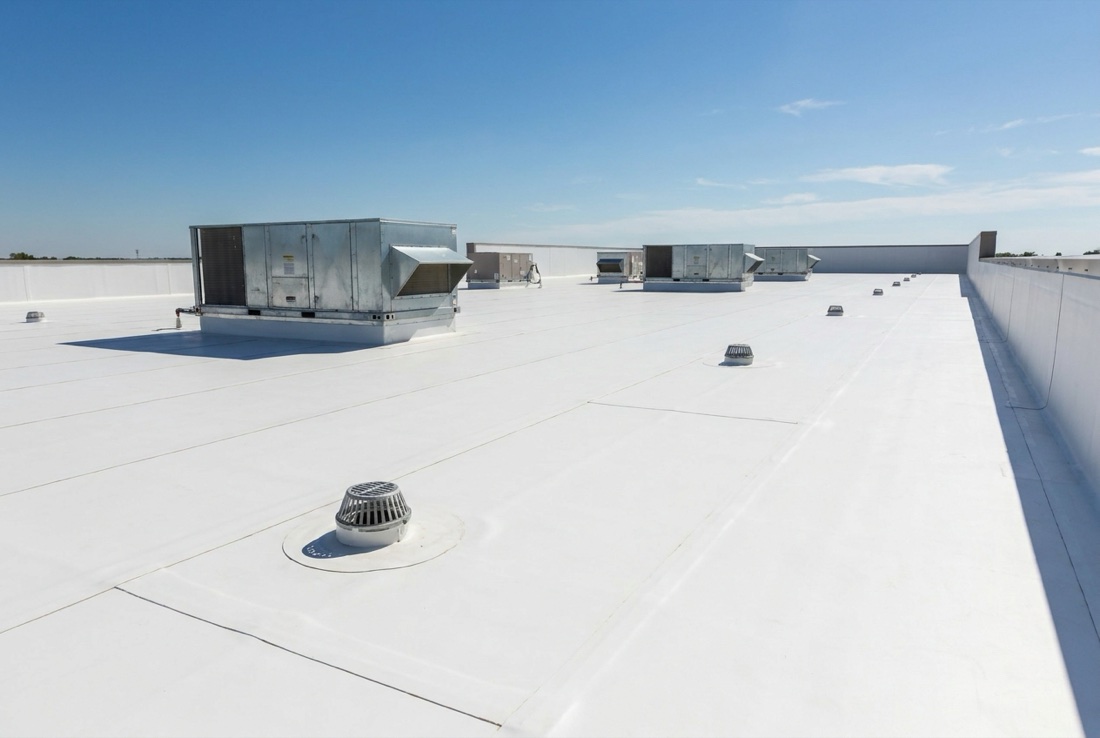
05 / THE WINTER FAILURECondensation: how insulation choice can rot a roof from inside
The reason insulation is not just a comfort question in Michigan is condensation, and it is a failure that happens where no one is looking. Warm, humid air inside a heated building wants to move upward and outward toward the cold exterior. If that moist air reaches a surface that is below its dew point, it condenses into liquid water, the same way a cold glass sweats on a summer day. On a roof, the danger surface is the underside of the deck or a point inside the assembly, and water forming there in the dead of winter has nowhere to go. It sits, it saturates the insulation, and over seasons it rots the deck from within.
This is where the amount and placement of insulation does real structural work. Enough R-value above the deck keeps the deck itself warm, above the dew point, so the moisture never has a cold surface to condense on up there. Too little insulation, or a stack that leaves a cold layer in the wrong place, moves that condensing point inside the assembly. In many Michigan buildings the assembly also needs a vapor retarder on the warm side to slow the moist interior air before it ever reaches the cold zone, and whether one is required depends on the building's interior humidity and use. A humid interior, a cold roof, and no plan for the vapor between them is a recipe for a wet roof that looks perfectly fine from above.
The practical lesson for an owner is that a flat roof is a system, and the insulation is the part of that system managing heat and moisture together. A bid that trims insulation to hit a price is not just selling you a colder building; it can be selling you a slow condensation failure that surfaces as stained ceilings and a spongy deck a few winters later. When we open a roof that has failed early, wet insulation and a rotted deck underneath a membrane that still looked serviceable is one of the most common things we find.
06 / THE REAL NUMBERWhat insulation means for your price, and getting a real one
So what does all of this do to the bottom line? The insulation package is one of the biggest single levers on a flat roof price, which is why a full flat or commercial roof replacement in Macomb County runs a range rather than a fixed number: $9,000 to $16,000 installed, the whole assembly and all details included. A code-driven jump in R-value, a deep tapered package to correct ponding, and a cover board can move an otherwise mid-range project toward the top of that spread, and every dollar of it is buying a warmer, drier, longer-lived roof rather than padding. It is the same price canon we publish on our honest pricing sheet, and you can get a ballpark on your own building in about 60 seconds with the instant estimator or the cost calculator, both of which run these published ranges.
If your roof is only leaking in a spot or two and the insulation under it is still dry, you may be looking at a repair rather than a full reroof; flat repairs run $350 to $3,200, and larger or complex repairs can run higher. The only way to know which conversation you are in, and how much insulation your project actually needs to meet code, is to have someone on the roof. Our inspection is $0 with no obligation, it looks at the membrane, the seams, the drainage, and the moisture in the insulation, and if the roof needs a repair instead of a replacement, that is what we will tell you.
For owners spreading the cost, financing is available subject to approval. As an illustration only, a $13,500 project financed over a 10 year term at 9.9% APR works out to about $178 per month. That example is not an offer of credit; your rate, term, and approval depend on the lender and your credit profile. When you are ready, you can browse the rest of our guides library or head back to the roofing services hub to see how flat and commercial work fits the full lineup.
- Above-deck insulation is a structural layer of a flat roof: it is the thermal barrier, it builds the slope to the drains, and it is the substrate the membrane bonds to.
- Polyiso gives the most R per inch and is the default; EPS is cheapest per R but needs more inches; XPS resists moisture best and is used more selectively.
- A full commercial reroof usually has to meet the current Michigan energy code R-value, which is often higher than the old roof and legitimately grows scope and cost.
- Tapered insulation and a cover board are where cheap bids cut; both are out of sight the day the job ends and both decide how the roof ages.
- Too little insulation moves the condensing point into the assembly and can rot the deck from inside; flat replacements run $9,000 to $16,000, repairs $350 to $3,200.
Questions we hear most
A full commercial reroof usually has to meet the current Michigan energy code's minimum above-deck R-value, which is frequently higher than the thin layer on an older roof. We cite that figure from the adopted code rather than recall it, because the number that governs your permit is the one that matters. The practical effect is that meeting code on an under-insulated building adds real inches of insulation, and that added scope is legitimate rather than padding.
There is no single winner. Polyiso gives the most R-value per inch and is the default above-deck board, so it hits a code R-value with fewer inches. EPS costs the least per unit of R but needs more thickness, and XPS resists moisture best and is used more selectively. The right board balances your R-value target, budget, weight, and how the assembly is built, which is exactly what a free inspection sorts out.
It can, in a way owners rarely expect. Too little insulation, or the wrong stack for a heated Michigan building, moves the condensing point into the assembly, where warm interior moisture meets a cold surface and turns to water. Over seasons that saturates the insulation and can rot the deck from inside, showing up as stained ceilings and a spongy roof even when the membrane on top still looks fine.
- FEMA, disaster declaration DR-4757-MI, Michigan severe storms of August 2023 (Macomb County designated). fema.gov/disaster/4757
- Michigan Uniform Energy Code (state adoption of the International Energy Conservation Code), LARA Bureau of Construction Codes. michigan.gov/lara: code books
- Manufacturer technical and warranty literature for the major asphalt shingle lines: GAF (gaf.com), Owens Corning (owenscorning.com), and CertainTeed (certainteed.com).
- Michigan Building Code 2015, chapter 15 Roof Assemblies and Rooftop Structures: commercial reroofing, recover, and replacement conditions. up.codes: MBC chapter 15