
JUMP TO A SECTION
Every winter a building owner in Macomb County stands in a doorway, looks up at a foot of snow sitting flat on the roof, and asks the wrong question: how many inches can it take? The honest answer is that inches tell you almost nothing. A roof does not fail because of depth. It fails because of weight, and the weight of a given depth of snow swings enormously with what that snow actually is. This guide is about the difference, about the places on a flat roof where weight concentrates far beyond the average, and about the warning signs that separate a roof you can watch from a roof you need to clear. Every design-load figure in this space is set by code and cited to source, not recalled from memory, because guessing at structural numbers is exactly how people get hurt.
01 / THE SHORT ANSWERHow much snow a flat roof can hold
A flat roof does not have a snow limit measured in inches, and any contractor who gives you one off the top of their head is guessing. What a roof has is a design load: a weight per square foot the structure was engineered to carry, established by the building code in force when it was built. For commercial and low-slope buildings in this region, that figure comes from the ground snow load in the Michigan building code and the ASCE structural standard it references, and it is a number your original engineer designed to with a safety factor on top. We cite that standard in the sources below rather than print a figure from memory, because the value that applies to your specific building depends on its code vintage, its structure, and its exposure.
Your roof was built to carry a weight, not a depth. A properly designed, sound flat roof handles an ordinary Macomb County winter without drama. The danger is not the average snowfall; it is the weight that collects in specific spots, the snow that turns to ice, and the roof that was already weakened before the season started. That is what the rest of this guide is about.
So the useful version of the question is not "how many inches" but "how heavy, and where." A roof in good structural condition, draining properly, carrying evenly distributed light snow, is a very different situation from the same roof carrying a wet, drifted, ice-layered load piled three feet deep against a parapet. Both might read "a snowy roof" from the parking lot. Only one is a problem. Sorting which is which is what an owner or property manager needs to be able to do by February.
02 / THE WEIGHTWhy a number of inches lies to you
The reason depth is a poor guide is that snow density varies by a large multiple depending on temperature, moisture, and age. Fresh, cold, dry powder is mostly air and weighs very little per inch. The same snow, warmed and settled, packs down and grows heavier for every inch that remains. Wet, heavy snow that falls near freezing weighs several times what an equal depth of powder does. And ice, whether a frozen crust on top or a lens of refrozen meltwater in the pack, is heavier still. Approximate weight-per-inch figures by snow type are published by FEMA and roofing-industry sources, cited below; the point for an owner is the ratio, not a memorized number, and the ratio is large.
This is why a mild-looking snow can be more dangerous than a dramatic one. A foot of dry January powder may be a modest load. Then a thaw-and-refreeze cycle, or a rain-on-snow event, adds water to that same pack without adding much visible height. The depth barely changes while the weight climbs sharply. An owner watching the ruler sees no reason to worry, while the actual load on the deck has quietly moved toward the roof's design limit. In a freeze-thaw climate like ours, that hidden weight gain is the rule, not the exception, and it is why the calendar and the weather matter more than the snow line.
A foot of powder and a foot of wet, refrozen pack can differ in weight by several times over. The roof feels the pounds, not the ruler, and the ruler is what fools people.
There is a second reason depth misleads: it ignores drainage. A flat roof is designed to shed meltwater, and when that water leaves, so does its weight. But if the drains and scuppers are iced shut, the meltwater has nowhere to go. It sits, it soaks into the snowpack, and then it refreezes, converting a draining roof into a bathtub with an ice lid. The relationship between snow, ice, and standing water on a low-slope roof is close enough that our guide to ponding water is worth reading alongside this one, because in winter the two problems become the same problem.
03 / THE CONCENTRATIONWhere load piles up far beyond the average
Even when the average load across a roof is comfortable, snow does not lie evenly, and structural failures start where it piles deepest. Wind is the culprit. It scours snow off open field areas and dumps it wherever it hits an obstruction, and a flat roof is full of obstructions. The result is drifts that can carry many times the field load in a narrow band, concentrated exactly where the owner is not looking.
Against parapets and walls
A parapet wall, or a taller adjacent building next door, acts like a snow fence. Wind-driven snow stacks against it and drifts deep along the base while the open middle of the roof stays shallow. These perimeter and against-the-wall drifts are among the heaviest local loads a flat roof sees, and they sit over the very edges and details that are already the roof's hardest-working parts. A roof that looks lightly covered from the center can be carrying a serious drift you cannot see from below.
Around rooftop units and curbs
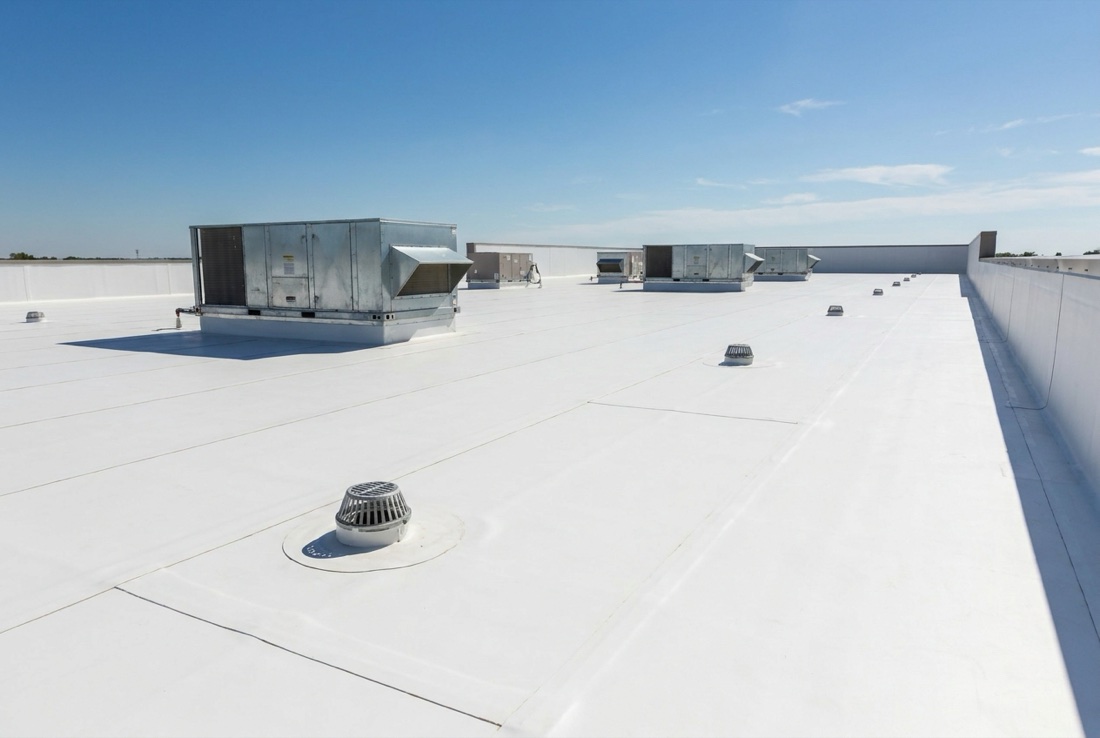
Every HVAC unit, curb, skylight, and mechanical penthouse creates its own wind shadow, and snow drifts behind and around each one. A roof crowded with equipment collects a patchwork of local drifts, each one heavier than the field average. These are also the spots where the membrane is hand-flashed and most vulnerable, so concentrated load and vulnerable detailing land in the same place, which is a bad combination under an ice load.
At roof-level changes and valleys
Where a lower roof meets a higher wall, or where two roof planes meet in a low-slope valley, snow sliding and blowing off the upper surface piles onto the lower one. A small lower roof, a canopy, or an attached single-story section can end up carrying the runoff snow of a much larger surface above it. These step-down zones are a classic overload point and deserve a careful look after any big wind event.
04 / THE SIGNALSThe warning signs your roof is overloaded
You cannot weigh a snow load with your eyes, but a structure under stress tells on itself from the inside, and the signals are usually noticeable before anything catastrophic happens. The building will speak up if you know what to listen for. Any one of these deserves attention; more than one at once is a reason to treat the roof as a live problem, not a wait-and-see.
- Doors and windows that suddenly stick or bind. When a loaded roof deflects, it can rack the frame below just enough that an interior door or window that always worked now catches. A door that binds after a heavy snow is one of the most reliable early warnings there is.
- New cracks in drywall or plaster, especially above door frames, at wall-to-ceiling joints, or running across a ceiling. Fresh cracking is the finish material reporting that the structure behind it has moved.
- Visible sagging or deflection in the ceiling, a bowed roof line, or a dip you did not notice before. Sighting along a ceiling or a beam and seeing a curve that should be straight is a serious sign.
- Creaking, popping, or cracking sounds from the structure, particularly noises that are new this winter. Wood and steel under unusual load make sounds they do not make when they are comfortable.
- Sprinkler heads or ceiling fixtures that appear to have dropped, or gaps opening between walls and the ceiling, both of which mean the deck above has moved down.
- Fresh leaks or water stains appearing mid-winter, which can mean meltwater is backing up behind ice at the drains and finding its way through stressed seams and flashings.
Doors that jam, new ceiling cracks, audible creaking, or visible sagging are not cosmetic. If you see them under a heavy snow or ice load, get people out of the affected area and get the load and the structure evaluated. When an active leak is involved, we offer 24/7 emergency tarping to stop water while a permanent repair is scheduled, and our flat roof winter problems guide covers the leak side in depth.
05 / THE FRAMEWORKA conservative when-to-act framework
Because the real numbers belong to a structural engineer and your building's code vintage, the right posture for an owner is conservative and observational rather than precise. You are not trying to calculate the exact pound count on your deck. You are trying to notice when conditions have stacked up against you and act before the building has to. Here is a framework that stays on the safe side of that line.
- Know your building's weak spots before winter. Walk the roof in the fall and note the parapets, the equipment clusters, and any lower roof sections that catch runoff from above. Those are the places drifts will form and the places to check first after any storm.
- Watch the weather, not just the depth. A rain-on-snow event, a hard thaw-and-refreeze, or several storms stacking on an unmelted base are the conditions that push weight up fast. Those are your trigger events, more than any single big snowfall.
- Keep the drains working. Iced-over drains and scuppers turn every thaw into added weight instead of relief. Clearing drain paths so meltwater can leave is often the single most useful thing you can do, and it ties directly into our safe snow removal guide.
- Respond to the interior signals. Binding doors, new cracks, sagging, and creaking are the whole point of the previous section. If the building is showing them, the framework is over and it is time to act now, not to keep measuring.
- When in doubt, reduce the load safely and get a professional look. Removing drifted snow from concentrated areas relieves the worst of it, but it has to be done without damaging the membrane or the people doing it, which is a whole discipline of its own.
The reason to err conservative is simple: the cost of being cautious is a little labor and inconvenience, while the cost of being wrong about a structural load is not measured in dollars. A roof that gives an owner reason to worry every hard winter is often a roof carrying a deeper problem, from marginal drainage to a structure that was undersized or previously modified. That is a conversation to have in the fall, on a dry roof, not in February with three feet of ice overhead. If a roof is genuinely at the end of its service life, our cost calculator and published pricing lay out what a replacement involves, and flat and commercial reroofs are handled through the same free inspection as everything else.
06 / THE REAL ANSWERGetting real eyes on a real roof
Everything above helps you read the situation. What it cannot do is measure your specific building, and no honest guide should pretend otherwise. The design load that applies to your roof, the condition of the structure carrying it, and whether that drift against the parapet is a nuisance or a hazard are questions that need someone on the roof and, when the interior signs warrant, a structural professional. Our inspection is $0 with no obligation, and if what you have is a drainage or maintenance issue rather than a structural one, that is what we will tell you. You can start from the estimator or browse the wider guides library and the roofing services hub to see how winter work fits the full picture.
A word on timing, because it matters more here than almost anywhere. The best defense against a dangerous snow load is a fall visit, when the drains can be cleared, the membrane and flashings checked, and any weak details fixed while sealants can still cure. An owner who books that inspection in October is choosing their week and heading off the problem; one who calls in January with a binding door and a creaking ceiling is managing a live situation in the worst possible conditions. Repairs to the drainage and detail work that keep a winter load honest run in the ordinary repair range, and the free inspection is the place to sort what your roof actually needs before the snow decides for you.
- A flat roof has no snow limit in inches; it has a design load in weight per square foot, set by code and cited to source, not guessed.
- Snow density varies by a large multiple: dry powder is light, wet snow is heavy, and refrozen ice is heavier still, so weight can climb while depth barely moves.
- Load concentrates in drifts against parapets, around rooftop equipment, and at lower roof sections, far beyond the field average.
- Binding doors, new ceiling cracks, visible sagging, and creaking sounds are the overload warning signs; treat them as urgent, not cosmetic.
- Keep drains clear, watch for rain-on-snow and thaw-refreeze events, and get a professional look when the interior speaks up; the free inspection is the place to start.
Questions we hear most
There is no honest answer in inches, because a roof is designed to carry a weight per square foot, not a depth. That design load is set by the Michigan building code and the ASCE standard it references for our region, with a safety factor on top. A sound, well-drained flat roof handles an ordinary winter fine; the real risk comes from drifting, ice buildup, and roofs that were already weak, which is why an on-site look matters more than any inch figure.
The clearest signals come from inside the building: interior doors or windows that suddenly stick, new cracks in drywall or plaster, visible sagging or deflection in the ceiling, and creaking or popping sounds that are new this winter. Any one of these under a heavy snow or ice load deserves immediate attention, and more than one at once means you should clear the affected area and have the structure evaluated rather than wait and measure.
Snow density depends on temperature, moisture, and age. Fresh cold powder is mostly air and weighs very little per inch, while wet snow that falls near freezing weighs several times as much, and refrozen ice is heavier still. In a freeze-thaw climate a thaw or a rain-on-snow event can add water and weight to the same snowpack without changing its visible depth, which is exactly how a mild-looking roof quietly moves toward its load limit.
- Michigan Building Code 2015, chapter 15 Roof Assemblies and Rooftop Structures: commercial reroofing, recover, and replacement conditions. up.codes: MBC chapter 15
- FEMA, disaster declaration DR-4757-MI, Michigan severe storms, tornadoes, and flooding of August 24 to 26, 2023 (Macomb County designated; declared February 8, 2024). fema.gov/disaster/4757
- FEMA, disaster declaration DR-4757-MI, Michigan severe storms of August 2023 (Macomb County designated). fema.gov/disaster/4757
- National Roofing Contractors Association, technical guidance for steep-slope roof systems. nrca.net