
JUMP TO A SECTION
Nobody's roof takes one bad freeze and fails. What actually happens to an asphalt shingle over a Macomb County winter is closer to metal fatigue than storm damage: the same small stress, repeated tens of thousands of times, until a material that started out flexible and tightly bonded ends up brittle, thin, and loosely held together. Freeze thaw is not a single event you can point to. It is the accumulated total of every one of those cycles acting on a shingle that was never designed to be tested this hard, this often. This guide is the material-science companion to our freeze thaw cycle pillar, and it goes one layer deeper: not the roof as a whole, but the shingle itself, mat, asphalt, and granules, and exactly how each piece degrades.
None of what follows is about deciding whether you need a repair or a replacement. That decision depends on your specific roof's age and condition, and it belongs to a free, on-site inspection, not a guide. This page is strictly about the physics and chemistry of what winter does to the shingle in front of you, and why the damage you see in year fifteen looks so different from the same shingle in year three.
01 / THE SHORT ANSWERFatigue, not a single failure
An asphalt shingle is a composite: a fiberglass mat, saturated and coated in asphalt, with mineral granules pressed into the top surface while the asphalt is still soft. Every one of those three components responds to cold and to repeated freezing in its own way, and every one of them gets slightly worse with each cycle. Freeze thaw damage is the sum of three parallel processes: the granules losing their grip on the asphalt beneath them, the asphalt itself hardening and losing flexibility, and the fiberglass mat developing microscopic cracks at the points where stress concentrates. None of the three needs a dramatic storm to progress. All three progress every single winter, on a roof that from the ground looks perfectly fine.
Water trapped in a shingle's pores, laps, or fastener zones expands roughly nine percent when it freezes. That is a small mechanical push on its own, but southeast Michigan crosses the freezing line dozens of times a winter. A shingle is not surviving one push. It is surviving that push repeated for as long as it is on the roof.
That is why two roofs of the same age and the same shingle line can look meaningfully different: sun exposure, slope orientation, ventilation, and how many total freeze-thaw cycles the roof has actually seen all change the math, even when the calendar age is identical.
02 / THE ANATOMYThe layers this cycle actually attacks
It helps to picture a shingle in cross section. On top, mineral granules, pressed into a layer of soft asphalt while it is still workable at the factory, give the shingle its color and its UV and weather protection. Below that, a layer of asphalt, blended with fillers and stabilizers, is the waterproofing and the glue that holds the granules in place. At the core, a fiberglass mat gives the shingle its shape and its tensile strength, the part that keeps it from tearing when wind gets under an edge. Every seam, lap, and nail hole is a place where these layers meet an edge, a fastener, or another shingle, and edges and penetrations are exactly where freeze-thaw stress concentrates.
Where moisture actually gets in
A shingle is not a perfectly sealed slab. Nail heads create a small penetration through all three layers. Shingle laps, where one course overlaps the next, create a capillary gap that can wick a thin film of water by surface tension alone. Granule surfaces are microscopically porous. None of these openings need to be a defect; they are simply part of how a shingle roof is built, and in dry conditions they never matter. The problem starts when water finds its way into one of them and then the temperature drops below freezing before the shingle has a chance to dry out.
03 / THE SURFACEGranule bond fatigue
The granules are a shingle's sacrificial layer, meant to absorb UV exposure and hail impact so the asphalt underneath does not have to. Their bond to that asphalt is a mechanical and chemical one, and it is not permanent. Thermal cycling, expansion in the heat of a summer afternoon and contraction in a January night, works on that bond the same way flexing a piece of tape wears down its adhesive. Add a freeze cycle into the mix and the math gets worse: a thin film of water sitting at the granule-asphalt interface freezes, expands, and levers at the bond from underneath, then thaws and lets water back in to do it again on the next cold night.
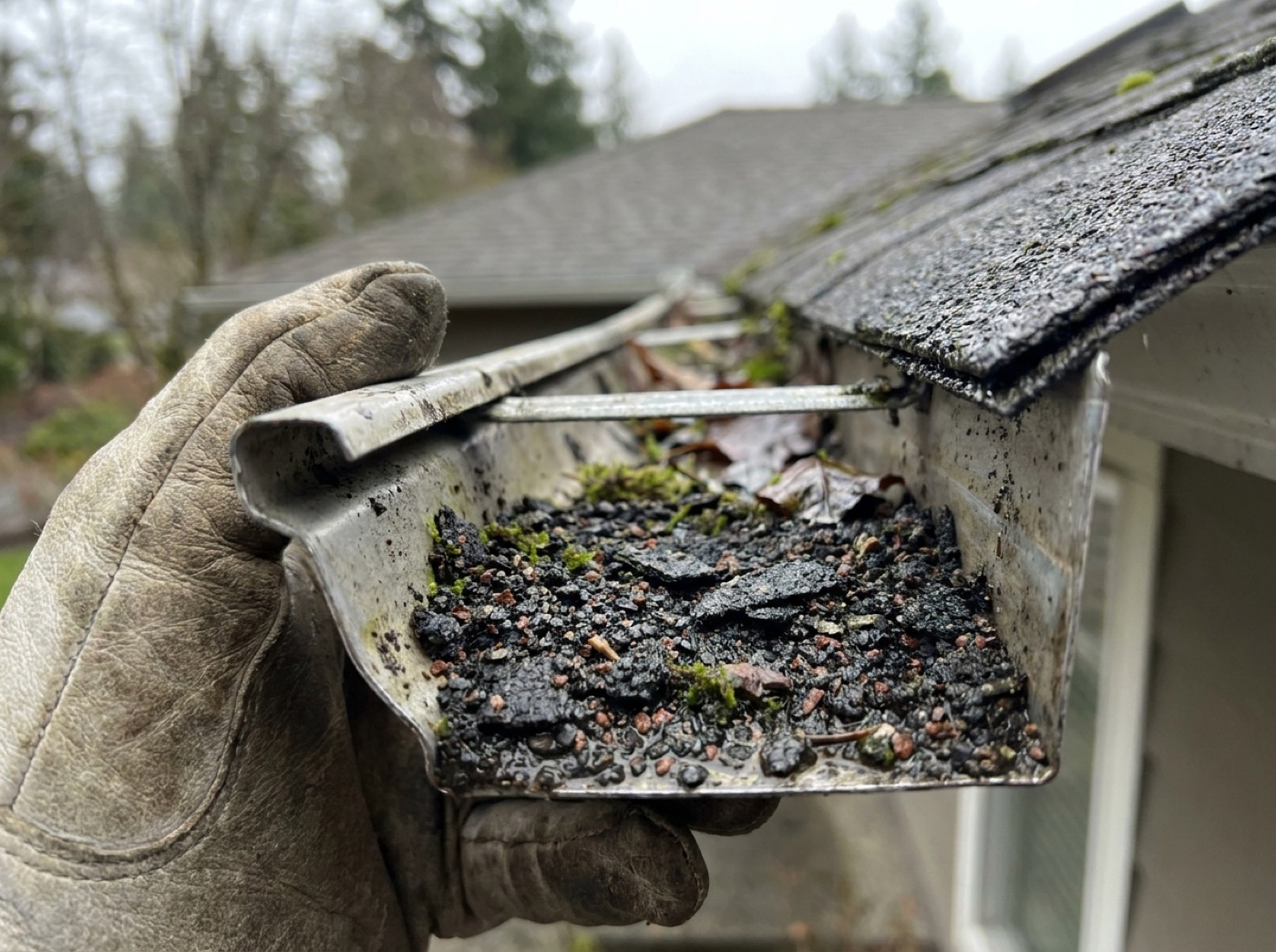
The visible result is granule loss, and it is cumulative and essentially permanent; lost granules do not come back. Early in a roof's life this shows up as a light, even shedding that is barely noticeable. In a shingle nearing the end of its rated service life, it can progress to bald patches where the asphalt underneath is visible and exposed directly to sunlight and moisture, with nothing left to protect it.
04 / THE BINDERAsphalt oxidation and embrittlement
Asphalt is a petroleum product, and like most petroleum products it changes chemically as it ages, a process called oxidation. Oxidized asphalt loses the light oils that keep it pliable, and the result is a binder that is measurably stiffer and more brittle than it was the day it was installed. This happens on every roof, in every climate, simply from age and UV exposure. What a Michigan winter adds is timing: an oxidized, already-stiffening asphalt binder is far less able to flex around a freeze-driven expansion than a fresh one is, so the same ice-expansion stress that a three-year-old shingle shrugs off can crack a fifteen-year-old one in the exact same spot.
| SHINGLE AGE | ASPHALT CONDITION | FREEZE-THAW RESPONSE |
|---|---|---|
| Early life, roughly years 1 to 5 | Oils largely intact, binder still pliable | Flexes around ice expansion with little visible effect |
| Mid life, roughly years 6 to 12 | Oxidation underway, binder stiffening | Occasional granule loss and hairline surface checking begin |
| Late life, past roughly year 12 to 15 | Binder brittle, oils substantially depleted | Cracking, curling, and bald spots accelerate visibly each winter |
That table is describing a general material trend, not a warranty clock for any specific roof; sun exposure, slope, attic ventilation, and shingle quality all shift where a given roof actually sits on it. But the direction is consistent across asphalt roofing everywhere it is installed: oxidation is a one-way process, and it makes the shingle progressively less able to absorb the same freeze-thaw stress it handled easily when it was new.
05 / THE COREMat cracking and micro-moisture at the stress points
Beneath the asphalt, the fiberglass mat is the part of the shingle doing the structural work, and it is also where freeze-thaw damage becomes mechanical rather than just chemical. Repeated expansion and contraction, especially concentrated at nail penetrations and the folded edge of a shingle lap, creates fatigue cracking in the mat itself over enough cycles, the same principle that eventually cracks a piece of sheet metal bent back and forth at the same fold line. Once a hairline crack opens in the mat at a nail zone or a lap edge, it becomes a new, slightly larger opening for water to enter on the next rain or snowmelt, which then freezes and expands the crack a little further on the next cold night. It is a slow, self-reinforcing cycle, and it is why damage tends to concentrate at the same handful of locations on every roof: nail lines, hip and ridge caps, and valley laps, the places where shingles are folded, fastened, or overlapped and stress has somewhere specific to concentrate.
The crack you see in spring did not open in one storm. It opened a fraction of a millimeter further on every hard freeze all winter, at a point of weakness that was already there.
This is also the mechanical backbone of why shingles crack more readily in cold weather than warm, a topic our shingle brittleness guide covers from the temperature side: a mat with existing fatigue micro-cracks and a binder running well below its flexible temperature range has almost no give left to absorb a sudden load, whether that load is foot traffic, wind uplift, or the freeze-thaw cycle working on it from within.
06 / THE CURVEWhy the damage accelerates late in a roof's life
If freeze-thaw damage simply added up at a constant rate, a shingle roof's decline would be a straight line: a little worse every winter, in equal amounts. That is not how it behaves, and understanding why explains a pattern almost every longtime Macomb County homeowner has noticed: a roof that looked fine for a decade seems to fall apart within two or three winters after that.
- Granule loss exposes asphalt directly to sun and moisture, which speeds up the oxidation happening underneath it, since granules exist specifically to shield the asphalt from that exposure.
- Oxidized, brittle asphalt cracks more easily under the same freeze-expansion stress, and once a crack exists, it is a new entry point for water on every subsequent cycle.
- Every new crack or bald spot is a new site where the next freeze can do damage, so the number of vulnerable points on the roof grows instead of staying fixed, even though the winter itself is no more severe than the one before it.
Each of those three feeds the next one, which is why the damage curve is closer to exponential than linear: slow and nearly invisible for the first decade, then visibly faster in the final few years of a shingle's service life. It is also why Michigan roofs often age faster than their rated warranty suggests, since manufacturer testing rarely reproduces the specific number of freeze-thaw cycles southeast Michigan puts a roof through every single winter.
07 / THE EVIDENCEReading the gutter, and what to do about it
Every spring, a small amount of granule loss in the gutters and downspouts is normal on any asphalt roof and is not, by itself, a reason to worry. What matters is the trend and the volume. A light, consistent dusting year over year is ordinary wear. A sudden increase in volume, granules collecting heavily in one specific area rather than spread evenly, or bald patches becoming visible from the ground are all signs the fatigue process described above has moved from its slow early phase into its faster late phase on at least part of the roof.
None of these signs tell you, on their own, whether a repair or a full replacement is the right next step; that answer depends on how widespread the fatigue is and what the deck underneath looks like, which is exactly what an inspection is for. A repair addresses a localized problem, a torn lap or a cracked patch, and typically runs $350 to $3,200, with larger or more complex repairs able to run higher. A full asphalt replacement, when the fatigue has spread broadly across the roof, runs $9,000 to $18,000 installed, with most Macomb County homes landing $12,000 to $16,000. Our free inspection checks the granule condition, the mat, and the flashing details up close, and it tells you honestly which category your roof is actually in, not which one is easiest to sell.
If you are seeing an active leak rather than just wear, we offer 24/7 emergency tarping to stop water while a permanent plan gets scheduled. For a wider walk of every symptom worth watching after a hard winter, our signs of winter roof damage guide covers the full checklist, of which shingle fatigue is one piece. And if you already suspect this roof is closer to the end of its curve than the beginning, the instant estimator runs our published pricing canon in about a minute, with the cost calculator applying those same ranges to your roof's size. A full look at what drives the replacement number starts at our roof replacement page, and the whole guides library is at /roofing/guides/.
- Freeze-thaw shingle damage is cumulative fatigue, not a single event: granule bond loss, asphalt oxidation, and mat cracking all progress a little further with every freeze cycle a Michigan winter delivers.
- Water trapped in a shingle's pores, laps, or nail zones expands about nine percent when it freezes, a small push repeated dozens of times each winter.
- The damage curve accelerates late in a roof's life because each type of damage exposes the shingle to the next: lost granules speed oxidation, brittle asphalt cracks more easily, and every new crack becomes a fresh entry point.
- Light, even granule loss in the gutter each spring is normal; heavy loss in one area, visible bald patches, or mat cracking at laps and nails are signs worth a free inspection.
- A localized repair runs $350 to $3,200; a full asphalt replacement runs $9,000 to $18,000, most commonly $12,000 to $16,000, and only an inspection tells you which one your roof needs.
Questions we hear most
Yes. Granule bond fatigue, asphalt oxidation, and mat micro-cracking all progress gradually and are often invisible from the ground for years before they show up as bald patches, heavy granule loss, or visible cracking. A shingle roof can be well into that process while still looking acceptable from the driveway.
No. A light, even amount of granule loss every spring is normal wear on any asphalt roof and is not, by itself, a reason for concern. What matters is the trend: a sudden increase in volume, heavy loss concentrated in one area, or visible bald asphalt patches are signs the fatigue process has moved into its faster late-life phase and are worth a free inspection.
It depends on how widespread the fatigue is. A localized area of cracked or granule-bare shingles is usually a repair, running $350 to $3,200. Once fatigue has spread broadly across the roof, a full replacement, running $9,000 to $18,000 and most commonly $12,000 to $16,000, is typically the better spend. A free inspection is the honest way to tell which situation your roof is in.
- U.S. Department of Energy, Building America Solution Center, guidance on roofing material durability and moisture cycling in cold climates. basc.pnnl.gov
- Manufacturer technical and warranty literature for the major asphalt shingle lines: GAF (gaf.com), Owens Corning (owenscorning.com), and CertainTeed (certainteed.com).
- ASTM International, standard specifications and test methods for roofing materials. astm.org