
JUMP TO A SECTION
Every asphalt shingle sold in the United States carries a rated life on the wrapper, usually somewhere between 25 and 30 years for the architectural shingles most Macomb County homeowners choose. Homeowners reasonably treat that number as a promise. It is not one. It is a laboratory estimate, produced under standardized test conditions that no real roof ever experiences, and southeast Michigan is a particularly hard place for that estimate to hold up. This guide is not here to scare anyone into a premature replacement. It is here to explain honestly why a roof in Sterling Heights, Warren, or Clinton Township can show real wear well before its rated number arrives, and what that means for a homeowner trying to judge their own roof fairly.
The short version: rated life assumes a moderate, stable climate and a roof installed with textbook ventilation over a sound deck. Macomb County roofs get freeze-thaw cycling, wide seasonal temperature swings, wet springs, humid summers, and, on a large share of the county's older housing stock, a deck and ventilation system that were never quite textbook to begin with. None of that is a defect in the shingle. It is simply a harder climate and an older building stock doing exactly what physics predicts.
01 / THE SHORT ANSWERA warranty number and a weather number are different things
Two roofs installed the same week, with the same shingle, can age at noticeably different rates depending on where they sit. A roof in a mild, dry climate can genuinely approach its rated life. A roof in Macomb County is working through dozens of freeze-thaw cycles a winter, a swing from summer highs to winter lows that stresses every material on the structure, and enough wet weather in spring to keep a marginal ventilation system damp for weeks at a time. The shingle itself has not changed. The environment testing it has.
A rated life describes a shingle under controlled, moderate conditions. A real Macomb County roof lives through freeze-thaw cycling, wide seasonal swings, and, on much of the county's older housing stock, a deck that has already carried one or two roofs before this one. The gap between the two numbers is not a manufacturing flaw. It is climate and building age, stacked.
The rest of this guide walks that gap in order: what a rated life actually measures, the specific stresses Michigan adds that a lab test does not, why the county's housing stock makes the gap wider on many homes, and how to read your own roof's aging honestly, without guessing or panicking. If you already suspect your roof is further along than its age suggests, a free inspection settles the question with photos, not assumptions. For exact lifespan-by-material numbers and replacement pricing, our replacement cost guide carries the full breakdown; this page focuses on why the number moves, not what it costs.
02 / THE RATINGWhat a shingle's rated life actually measures
Shingle manufacturers test their products against accelerated weathering standards: cycles of heat, UV exposure, and moisture run in a controlled lab over weeks, meant to approximate years of outdoor exposure. That testing is genuinely useful for comparing one shingle line against another, and it is the honest basis for the warranty period printed on the product. What it cannot fully capture is a specific roof's actual climate, actual ventilation, actual pitch, and actual maintenance history, because none of those are part of the standardized test. It is also where the old product names came from, since a shingle sold as a 30 year was named for that warranty period and not for a promised lifespan. What a 30 year shingle roof means today follows the label back to the product tier behind it.
A rated life is closer to a fuel economy sticker than a guarantee. The number on the sticker comes from a standardized test track, and your actual mileage depends on how you drive, in what weather, on what roads. A shingle's rated life comes from a standardized weathering cycle, and its actual life depends on the roof's climate, slope, sun exposure, and the attic underneath it. Two identical shingles on two different Macomb County roofs, one well ventilated and one starved for airflow, can age at genuinely different rates for reasons that have nothing to do with the shingle itself.
This matters most at the edges of a roof's life. A shingle in its first decade tolerates a hard climate reasonably well. The gap between rated and real life tends to open widest in the back half of a roof's expected service, when the asphalt has already oxidized and stiffened somewhat, and every additional freeze-thaw cycle or hot summer does proportionally more damage than it would have on day one. Our companion guide on how freeze-thaw damages shingles layer by layer covers that late-life acceleration in detail.
03 / THE STACKThe Michigan stack: five stresses a lab test does not see
Southeast Michigan does not throw one hard condition at a roof. It throws several, back to back, in the same twelve months, and it is the stacking that a standardized lab cycle struggles to replicate.
Freeze-thaw cycling
Water expands as it freezes, and any moisture that has worked its way into a seam, a lap, or a sealant strip gets pried at every time the temperature crosses freezing. Macomb County crosses that line repeatedly across a typical winter, not once. Our dedicated guide on the freeze-thaw cycle walks through exactly where this attacks a roof system, from shingle edges to flashing joints to masonry.
Wide seasonal temperature swings
A Michigan roof can see a summer surface temperature well over 100 degrees and a winter surface temperature well below freezing in the same calendar year, a swing most warm-climate roofs never experience. Every material on the roof, shingle mat, flashing metal, fasteners, expands and contracts with that swing, and repeated expansion and contraction is a fatigue mechanism in its own right, independent of any single cold snap or heat wave.
Wet springs
Southeast Michigan's spring thaw arrives with meltwater, rain, and lingering dampness in the attic and at the eaves, often for weeks at a stretch. A roof and attic system that dries out quickly ages better than one that stays damp, and a wet spring is exactly the condition that keeps marginal ventilation and marginal flashing details wet longer than they were designed to tolerate.
Humid summers and steady UV
Summer in Macomb County is not extreme heat in the desert sense, but it combines real humidity with a full season of UV exposure, and asphalt oxidizes and stiffens under sustained sun regardless of how humid the air around it is. That oxidation is the same slow embrittlement process that eventually makes an aging shingle crack rather than flex, a topic our winter brittleness guide picks up from the cold-weather side.
| STRESS | WHAT A LAB RATING ASSUMES | MACOMB COUNTY REALITY |
|---|---|---|
| Freeze-thaw | Minimal or controlled freezing cycles | Dozens of freeze-thaw crossingseach winter, working every seam |
| Temperature swing | A moderate, narrow range | Summer highs to winter lowson the same roof, same year |
| Moisture exposure | Short, controlled wet cycles | Weeks of spring thaw dampnessat eaves and in the attic |
| UV and heat | A standard exposure cycle | A full humid summer seasonof sustained oxidation |
None of these five stresses is exotic. Every roof in a cold, four-season climate deals with some version of them. What makes the Macomb County stack notable is that all five show up in the same twelve months, on the same roof, and they compound rather than average out.
04 / THE HOUSING STOCKAn older county's roofs are working from a harder starting point
Climate is only half the story. The other half is the roof underneath the shingles, and a meaningful share of Macomb County's housing dates to the ranch-building boom of the 1950s through the 1980s. Homes from that era were often built with ventilation standards, attic insulation levels, and deck materials that were normal for their time but modest by today's understanding of how a roof system is supposed to breathe and shed moisture.
A large number of those homes are also not on their first roof. Reroofing over an existing layer instead of tearing off down to the deck was a common cost-saving practice for decades, and a house carrying its second or even third covering is carrying a deck that has been sealed under shingles, undisturbed, for a very long time. A deck that has quietly softened, delaminated, or lost some of its fastener grip underneath a covering that still looks fine from the ground is one of the more common surprises a tear-off reveals, which our old attic insulation guide covers from the insulation side of the same story.
A shingle can be aging exactly on schedule and still be sitting on a deck and ventilation system that were never built for it. The two problems look identical from the driveway and need completely different fixes.
None of this means an older Macomb County home is destined for early failure. Many ranch-era roofs have been well maintained, properly reroofed with a full tear-off at some point, and ventilated correctly since. The honest point is simply that a roof's real age on this kind of housing stock is often a combination of the shingle's own calendar age and the condition of a deck and ventilation system installed decades earlier, and only an inspection that gets into the attic, not just onto the roof, can tell the two apart.
05 / THE EVIDENCEReading the signs honestly, without the scare tactics
An aging roof gives real signals before it fails, and the honest read is neither to ignore them nor to treat any single one as an emergency. Context and combination matter more than any one sign in isolation.
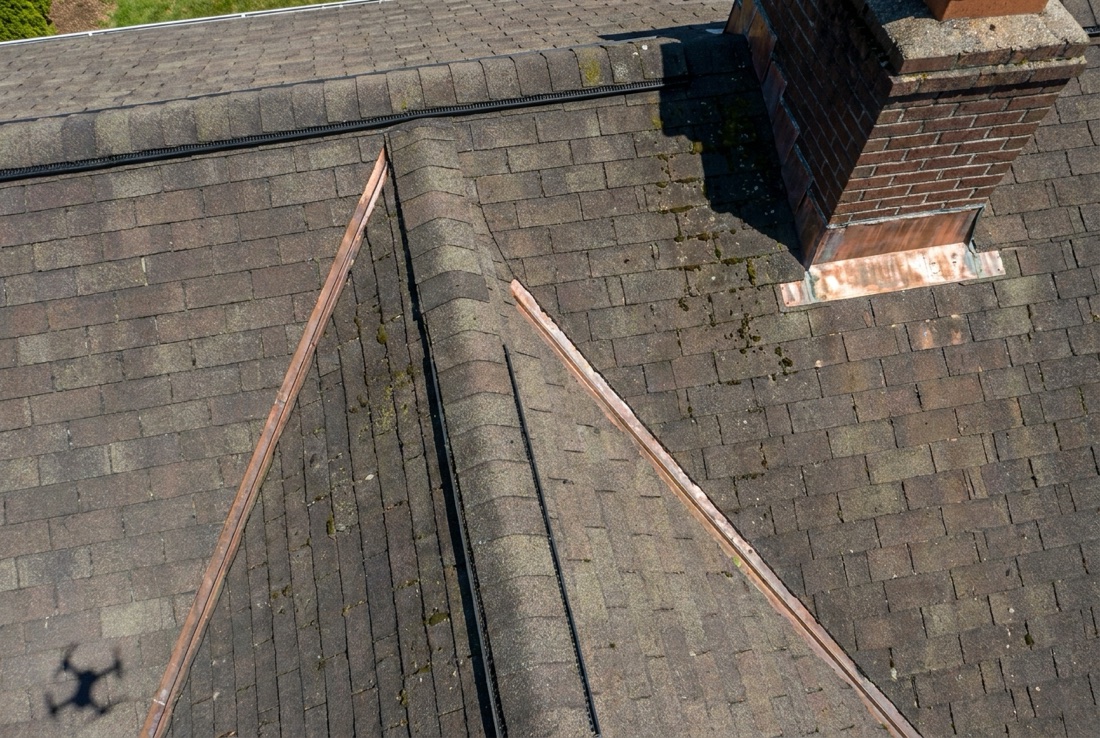
- Granule loss in the gutters, especially after a normal rain rather than a storm, is a sign the shingle's protective surface layer is wearing thin.
- Curling or cupping shingle edges show the mat losing flexibility as the asphalt oxidizes and stiffens with age.
- Cracking that shows when a shingle edge is lifted, rather than only in extreme cold, points to advanced brittleness rather than a single cold-weather event.
- Dark streaking or algae growth is mostly cosmetic on its own, but it often shows up on roofs old enough to have lost some of the granule coating that resists it.
- A second or third layer already on the roof means less room underneath for the deck to have been inspected or corrected at the last reroof.
- A soft or slightly springy feel underfoot, reported by anyone who has been up on the roof, is the one sign that deserves a prompt look, since it can indicate deck softening beneath the shingles.
One or two of these on their own are common on a roof well within its normal service life and are not, by themselves, a reason to replace anything. Several showing up together, especially combined with the roof's calendar age and the county's housing-stock context above, are the honest signal that a roof is entering its later years for real, not just on the calendar. A free inspection reads all of these at once and gives a straight answer rather than a sales pitch.
06 / THE LEVERSWhat speeds aging up, and what slows it down
Not every Macomb County roof ages at the same rate, and the difference usually comes down to a short list of factors a homeowner can actually influence, alongside a few they cannot.
| FACTOR | ACCELERATES AGING | SLOWS AGING |
|---|---|---|
| Attic ventilation | Starved or unbalanced airflow traps heat and moisture | Balanced intake and exhaust keeps the deck cold and dry |
| Sun exposure | South and west slopes with full, unshaded sun | North slopes and shade-bearing tree cover, in moderation |
| Maintenance | Ignored gutter clogs, moss, and small leaks | Periodic inspection and prompt small repairs |
| Layers | A second or third layer never torn off | A full tear-off at the last reroof, deck inspected directly |
| Climate | The Michigan stack described above, largely fixed | Cannot be changed, only planned around |
Ventilation is the single item on this list a homeowner is most likely to be able to improve without a full reroof. A roof deck kept cold and dry by balanced soffit-to-ridge airflow ages measurably better than one sitting under a hot, stagnant attic, and an inspection checks this specifically rather than assuming it is fine because the shingles look new.
Tree cover deserves a fair note: moderate shade can genuinely reduce UV-driven aging on a slope, but heavy, unmanaged tree cover also holds moisture, drops debris into valleys and gutters, and can shorten a roof's life through a different mechanism entirely. The honest answer is that shade is a mixed factor, not a simple win, and it is worth discussing during an inspection rather than assuming either way.
07 / THE NEXT STEPWhat to do with a roof that is aging on schedule, or ahead of it
A roof showing normal, honest wear for its age and climate does not need to be replaced early just because a rated-life number exists on paper. The right response is a maintenance rhythm, not a premature reroof: periodic inspections, prompt attention to small repairs before they become large ones, and keeping gutters and ventilation clear. Our Michigan roof maintenance schedule lays out a practical, season-by-season version of that rhythm.
A roof showing several of the signs above together, especially on a home carrying an older, un-torn-off covering, is a different conversation, and the honest next question is repair versus replacement, not a scare-driven push toward either one. Small, isolated issues are usually a repair in the standard $350 to $3,200 range most Macomb County repairs fall into, and larger or more complex repairs can run higher. A roof genuinely at the end of its service life, once decking, flashing, and ventilation are all accounted for, moves into replacement territory, and our replacement cost guide carries the full material-by-material pricing and the seven factors that set an individual quote.
The only way to know which conversation your roof is actually having is a look from someone who checks both the shingles and the attic side of the deck, not just the view from the driveway. Our inspection is $0 with no obligation, and it tells you honestly whether the roof needs nothing right now, a targeted repair, or a full replacement, with photos either way. If you want a ballpark before anyone visits, the instant estimator runs the same published ranges as our honest pricing page, and the cost calculator applies those ranges to your own roof's size. If a full replacement does turn out to be the right call, the process itself is covered on our roof replacement page.
- A shingle's rated life comes from a controlled lab test; a roof's real life comes from its actual climate, deck, and ventilation, and the two numbers are not the same thing.
- Freeze-thaw cycling, wide seasonal swings, wet springs, and humid summers stack together in a Macomb County year in a way accelerated weathering tests do not fully replicate.
- A large share of the county's ranch-era housing carries a deck that has quietly aged under one or two prior coverings, which can move the real conversation ahead of the shingle's calendar age.
- Granule loss, curling, brittleness, algae, extra layers, and a soft deck feel are honest aging signals; one or two alone are common, several together are the real signal.
- Ventilation is the most fixable lever on a homeowner's own roof, and a free inspection is the only way to know whether an aging roof needs nothing, a repair, or a replacement.
Questions we hear most
The rated life on a shingle wrapper comes from a standardized lab weathering test, not from Macomb County's actual climate. Freeze-thaw cycling, wide seasonal temperature swings, wet springs, and humid summers stack together here in a way the lab test does not fully capture, and on older housing stock the deck and ventilation underneath can add to the gap. A free inspection tells you honestly how your specific roof is aging.
Not always. Many ranch-era homes have been maintained well and reroofed properly with a full tear-off at some point. The honest point is that a meaningful share of the county's older housing carries a deck and ventilation system installed decades ago, so the real condition can differ from what the shingle's calendar age alone suggests. Only an inspection that checks the attic side, not just the shingles, tells you which situation you are in.
Of the factors within a homeowner's control, ventilation makes the biggest difference. A roof deck kept cold and dry by balanced soffit-to-ridge airflow ages noticeably better than one under a hot, stagnant attic. Beyond that, prompt attention to small repairs and clear gutters help, though the Michigan climate itself is a fixed factor no maintenance routine can change.
- National Centers for Environmental Information, NOAA, climate normals and temperature data for the Detroit metropolitan area. ncei.noaa.gov
- Manufacturer technical and warranty literature for the major asphalt shingle lines: GAF (gaf.com), Owens Corning (owenscorning.com), and CertainTeed (certainteed.com).
- Building Science Corporation, published research and information sheets on moisture movement, air leakage, and roof assemblies in cold climates. buildingscience.com