
JUMP TO A SECTION
Granules are the small stone chips embedded in the surface of an asphalt shingle, and they are the part of the roof doing the most unglamorous work: shielding the asphalt mat underneath from direct sun. Every asphalt roof loses some of them, every year, for the entire life of the shingle. That is normal and expected. What is not normal is a sudden pile of granules in the gutter after a windstorm, a bald patch that appeared overnight, or a downspout that is suddenly running gritty after every rain. Learning to tell the difference between a roof aging on schedule and a roof that just took a hit is one of the more useful skills a homeowner can pick up, and almost all of it can be done without a ladder.
01 / THE BASICSWhat granules actually do, and why they come loose
The asphalt mat inside a shingle is what actually keeps water out. Left exposed, that asphalt would bake, dry out, and crack far faster under direct UV exposure. The granule layer is the shingle's sunscreen: a coating of small mineral chips, often ceramic-coated for color and UV reflection, pressed into the asphalt during manufacturing. They also add fire resistance and a small amount of wear protection against foot traffic and impact.
Granules are never perfectly, permanently locked in place. Some are loosely bonded from the factory and are expected to wash off in the first few rains after installation, which is why a brand-new roof can shed a surprising amount of grit into the gutters in its first season and be perfectly fine. After that initial settling period, a slow, steady, uniform loss continues for the rest of the shingle's life as sun, rain, and freeze-thaw cycles gradually work granules loose. That baseline loss is not a defect. It is simply what an asphalt roof does while it ages, at a rate that changes with the shingle tier, the sun exposure of each slope, and the number of winters the roof has weathered.
02 / THE REAL QUESTIONNormal shedding versus a problem worth a look
The distinction that matters is not whether granules are coming off. They always are, a little. The distinction is whether the loss is gradual and even across the whole roof, which points to ordinary aging, or sudden and concentrated in specific spots, which points to an event: hail impact, wind-driven debris, or foot traffic from a repair crew or a fallen branch. A roof that is simply getting older loses granules evenly across every slope, at roughly the same rate everywhere the sun hits it the same way. A roof that just took a hit loses granules in a pattern: a cluster of bald spots on one slope, a concentration low in a valley where wind and water funnel debris, or a scatter that lines up with where hail would have struck first.
This page is about identification, not pricing. If reading it convinces you the roof is worth a professional look, the free inspection and canon repair range are the same ones referenced across this site: repairs run $350 to $3,200, larger or complex repairs can run higher, and the inspection itself is $0 with no obligation.
Age is the other half of the read. Uniform granule loss on a roof nearing the end of its rated life is expected and, by itself, not an emergency; it is a sign the shingle is aging out and worth planning around, which our roof replacement cost guide covers in detail. Uniform granule loss on a roof only a few years old, or a sudden concentrated bald patch on a roof of any age, is the pattern that deserves a closer look, because it usually means something other than ordinary time did the damage.
Sun exposure also shapes the baseline, which is why granule loss is rarely perfectly uniform even on a healthy, aging roof. A south or west-facing slope in Macomb County takes more direct afternoon sun across a Michigan summer than a north-facing slope tucked in shade for most of the day, so it is normal for the sunniest slope to show a bit more wear than the shadiest one over the years. The read you are looking for is not perfect symmetry between slopes. It is the difference between a gradual gradient that tracks with sun exposure, which is ordinary aging, and an abrupt patch that does not track with anything the sun would explain, which is the pattern worth a second look.
03 / THE GROUND CHECKWhere to look, without ever climbing the roof
You do not need to get on the roof to get a useful read on granule loss, and you should not try. Three ground-level spots tell most of the story.
The gutter trough
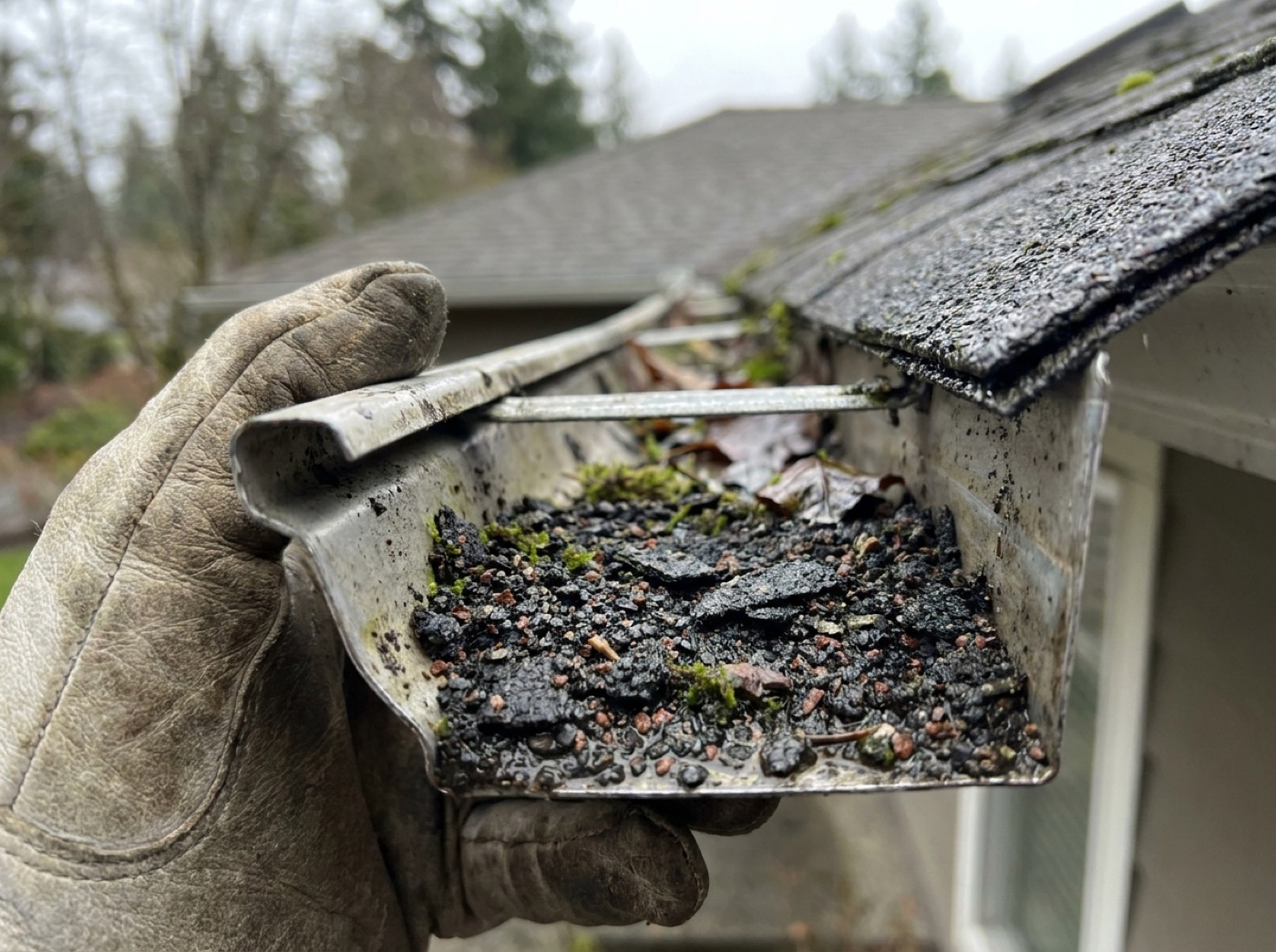
Granules that wash off the shingles travel down the slope and collect in the gutter, where they sit as a fine, sand-like grit along the bottom of the trough. Some grit in every gutter, every season, is normal. A sudden, heavy accumulation right after a windstorm or a hailstorm, especially compared to how little was there the last time you checked, is the sign worth paying attention to. If you can see into the gutter from a ladder set safely on the ground or from an upstairs window, look for the color and density of what has collected, not just whether anything is there.
The downspout and splash block
Granules that make it past the gutter travel out through the downspout and land at the splash block or the ground below it. This is often the easiest spot to check because it requires no ladder at all: a build-up of grit at the base of a downspout, especially a fresh one after a specific storm, is a strong clue that a slope somewhere upstream just shed more than usual. Compare downspouts to each other. If one downspout is carrying noticeably more grit than the others after the same storm, that tells you which side of the roof to be most curious about.
The driveway or walkway wash line
After a hard rain, look at any pavement directly under a roof edge without gutters, or under an overshoot point where gutters overflow. A faint trail of dark grit washed out in the direction water ran is the same signal as gutter grit, just visible without any climbing at all. This is especially useful right after a storm, while the wash line is still fresh and has not been rained on again or swept away.
A phone camera does more work here than the naked eye. Photograph the gutter grit, the downspout base, and any wash line the same day you notice them, with something for scale nearby such as a coin, a tape measure, or your own shoe. If a storm caused the loss, a dated photo of the wash-out is a small, useful record even before you know whether the roof needs anything more than a look. Repeating the same three checks after the next rain, and comparing the two sets of photos, tells you whether the loss was a one-time event or an ongoing pattern, which is exactly the distinction an inspector will ask about first.
04 / WHY IT MATTERSWhy bare asphalt is the real risk, not the missing grit itself
The granules themselves are not what keeps water out, so a small patch of thinning granules does not automatically mean a leak. What it means is that the asphalt mat underneath is now exposed to direct ultraviolet light with less protection than it had before. Asphalt degrades under UV exposure: it dries out, becomes brittle, and loses the flexibility that lets it handle Michigan's freeze-thaw cycles without cracking. A shingle that has lost its granule coating in a patch will age from that patch outward, faster than the rest of the roof, even if it is not leaking on the day you notice it.
That is the reason granule loss is worth checking rather than ignoring until a leak shows up: by the time bare asphalt actually lets water through, the shingle has usually been quietly weakening for a while. Catching a concentrated bald patch early, whether it came from hail, wind-blown debris, or simple age, is what keeps a small, cheap fix from turning into a larger repair once the mat underneath finally gives out.
05 / READING THE PATTERNWear, wind, or hail: three different stories in the same grit
Once you have found where the granules are collecting, the pattern of the loss on the roof itself, as best you can judge it from the ground with binoculars, tells you which of three stories you are looking at.
| PATTERN | LIKELY CAUSE | WHAT TO DO |
|---|---|---|
| Even, gradual, whole-roof | Ordinary aging | Track the roof's age, plan ahead |
| Random dark scatter, dimpled look | Hail impact | Get a professional look, do not assume |
| Concentrated in one area or edge | Wind-blown debris or foot traffic | Check that specific area up close |
| Sudden heavy grit after one storm | Event-driven, not gradual wear | Note the storm date, inspect soon |
Hail is the trickiest of the three to call from the ground, because true hail damage often does not remove granules cleanly. It bruises the mat underneath and displaces granules around the impact in a random, non-uniform scatter rather than a clean bald patch, and it can look almost normal from a distance even as it quietly shortens the shingle's life. Our companion guide on what a hail bruise on a shingle looks and feels like goes into that specific signature in detail, since granule loss and hail bruising are related but not identical clues. If you are trying to decide whether what you are seeing is ordinary time catching up with the roof or something a storm did, our guide on wind damage versus ordinary wear and tear walks through the broader set of distinctions, and our ground-level walkthrough on how to check your roof for storm damage from the ground covers the rest of the exterior, not just the granules.
A handful of grit in the gutter is not news. A sudden pile after a specific storm, or a bald patch that was not there last season, is the roof asking to be looked at.
Timing is a clue on its own, separate from the pattern itself. Granule loss you notice for the first time in the days right after a named storm, a severe thunderstorm warning, or a hail event that made the local news carries a different weight than granule loss you simply happen to notice on an ordinary weekend with no storm in recent memory. If you can pin your observation to a specific date, write that date down before you do anything else. It is the same habit our storm damage documentation checklist recommends for any post-storm finding, and it turns a vague sense that something changed into a record an inspector or, eventually, an adjuster can actually use.
06 / NEXT STEPSWhat to do with what you find
If the granule loss you are seeing looks gradual and even, and the roof is getting up in years, there is no emergency here. It is simply a data point for planning, and worth folding into a conversation about the roof's remaining service life the next time you have it looked at. If the loss looks sudden, concentrated, or tied to a specific storm, especially one severe enough to make the local news, that is worth a professional look sooner rather than later, because bare asphalt ages fast and a small patch caught early is a small fix.
Macomb County has one dated, well-documented severe wind event on the books worth knowing about: the county was included in federal disaster declaration DR-4757 after the storms of August 2023. If your roof has not been checked since an event like that, granule wash-out in the gutters is exactly the kind of clue that gets missed until years later, when the mat has already aged out from under it. A free inspection settles the question either way: our crews check the shingle field, the gutters, the flashing, and the attic side of the deck, and if the honest answer is that the roof is fine, that is what we tell you. There is no obligation attached, and if what you find turns out to be a straightforward repair rather than a full replacement, repairs run $350 to $3,200 and the write-up will say so plainly.
If you would rather see a ballpark before anyone visits, the cost calculator runs the published price canon against your roof's rough size, and our honest pricing sheet lays out every range we work from, from repairs through a full replacement. Storm-specific damage carries its own considerations around insurance, which our storm damage service page and insurance claims guide both cover; nothing on this page is insurance advice, and no contractor can promise a claim outcome.
- Every asphalt roof sheds granules gradually for life; even, whole-roof loss on an aging roof is normal.
- Sudden, concentrated bald patches, or a fresh pile of grit after one storm, point to an event rather than ordinary wear.
- Check gutters, downspouts, and driveway wash lines from the ground before ever considering a ladder.
- Bare asphalt ages fast under UV exposure, which is why an early patch is worth catching before it becomes a leak.
- A free inspection settles whether what you found is normal aging or storm damage, no obligation either way.
Questions we hear most
No. A slow, even loss of granules across the whole roof is normal aging, and new roofs also shed a batch of loosely bonded granules in their first season. What is worth a closer look is granule loss that is sudden, concentrated in one spot, or shows up right after a specific storm.
Check the gutter troughs for grit buildup, the base of each downspout or splash block for washed-out granules, and any driveway or walkway area under a roof edge for a dark wash line after rain. Comparing downspouts to each other after the same storm can point you toward which slope lost the most.
Granules shield the asphalt mat from ultraviolet light, and a bare patch ages faster than the rest of the roof even before it leaks. Catching concentrated granule loss early, whether it came from age, wind, or hail, is what keeps a small issue from becoming a larger repair once the exposed asphalt finally cracks.
- FEMA, disaster declaration DR-4757-MI, Michigan severe storms of August 2023 (Macomb County designated). fema.gov/disaster/4757
- Manufacturer technical and warranty literature for the major asphalt shingle lines: GAF (gaf.com), Owens Corning (owenscorning.com), and CertainTeed (certainteed.com).
- National Roofing Contractors Association, technical guidance for steep-slope roof systems. nrca.net
- Insurance Information Institute, consumer explainers on homeowners policy coverage, deductibles, and the claims process. iii.org