
JUMP TO A SECTION
Homeowners call us about a patch of bad-looking shingles for two very different reasons, and from the driveway they can look the same. One roof took a hit from a specific storm last month. The other has simply been aging in the sun for eighteen years and finally started showing it. The repair conversation, the urgency, and eventually the insurance conversation are completely different for each one, but this guide only deals with the first question: what does the roof itself actually show. No policy language, no claims process, just the physical evidence a shingle leaves behind depending on what actually happened to it. If you get to the end of this guide and the answer changes shape into a claims question, our storm and insurance claims hub is the next stop, not this one.
01 / THE SHORT ANSWERThe one test that holds up almost every time
Wind damage and wear differ in two ways that matter more than any single symptom: pattern and timing. Storm damage is directional, sudden, and patterned. It shows up on the slopes that faced the wind, it appears all at once tied to a specific date, and it leaves sharp, fresh-edged evidence next to shingles that look untouched right beside it. Wear is the opposite on every count. It is uniform across every slope regardless of which way the house faces, it builds up gradually over years with no single date attached, and it fades and softens evenly rather than creasing or tearing.
Ask two questions before anything else. Is the damage on one or two slopes, or spread evenly across all four? And can you point to roughly when it started, or has it always been "kind of like that"? Directional and dateable points to wind. Uniform and gradual points to wear. Almost everything below is just this test applied component by component.
Neither test is perfect alone, which is exactly why the sections below give you several independent tells rather than one. A roof that fails the pattern test but passes the timing test, or the reverse, is worth a closer look rather than an assumption either way. We will get to that overlap case directly in section 05, because it is more common than either extreme.
02 / THE STORM SIGNATUREWhat an actual wind event leaves behind
Wind damage has a signature because wind itself is directional. A gust moves across a roof from one compass heading, so it loads the slopes facing that direction hardest and leaves the opposite slopes comparatively untouched. That asymmetry is the single most reliable physical clue that something happened, as opposed to something that has simply always been aging.
Directional damage: one slope, not all four
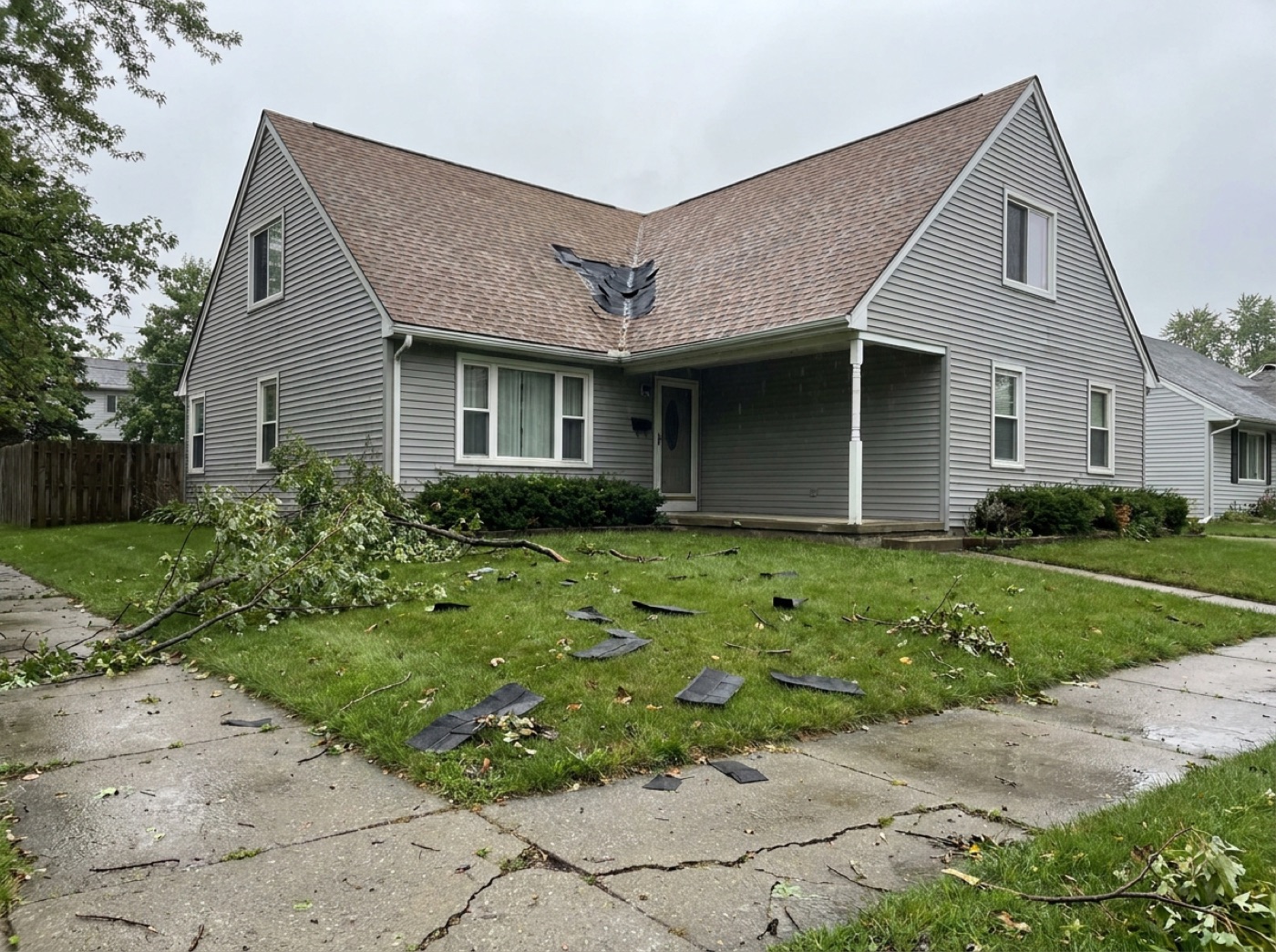
Walk the perimeter of the house and compare each roof plane to the others. Storm damage clusters on the slope or two that faced the wind during the event, plus the corners of every slope, where wind suction runs highest regardless of direction. A slope on the leeward side of the house that shows nothing while the windward slope shows creased or torn shingles is about as clean a wind signal as this guide can offer. Wear does not care which way a slope faces relative to last month's storm; it tracks sun exposure and age instead, which is a slower, different kind of unevenness covered in section 03.
Fresh exposure: color and texture that do not match
A shingle that tore or blew off recently exposes material that has never seen weather: brighter granule color, a texture with none of the surrounding roof's UV fading, sometimes exposed felt or decking that is still clean rather than gray and weathered. That contrast, a patch that looks newer or rawer than everything around it, is a strong storm tell precisely because it should not exist on a roof that aged uniformly. If the whole roof is the same faded color everywhere, including the damaged area, that argues for wear instead.
The nail head tell
Roofing nails are driven and then covered by the shingle course above, but a wind event that lifts or shifts shingles can expose a nail head that has never been in the sun. It reads as noticeably brighter or shinier than the surrounding weathered fasteners, sometimes with a faint halo where the shingle tab used to sit flush over it. A uniformly dull, weathered nail head across the whole roof is normal aging. A bright one next to dull ones nearby is a shingle that moved, and moved recently.
03 / THE WEAR SIGNATUREWhat years of ordinary aging actually look like
Wear is not a failure of the shingle so much as the shingle doing exactly what its rated life predicts, and it has its own equally recognizable signature: even, gradual, and present on every slope of the house rather than concentrated on one.
Even granule loss across every slope
Asphalt shingles shed some granules for their entire service life, and a modest, uniform amount in the gutters is normal aging, not damage. The distinguishing feature is that it shows up the same way on the north slope as the south slope, the shaded slope as the sun-baked one, rather than concentrated where wind hit hardest. A sudden pile of fresh granules tied to one storm date reads differently, and our companion guide on granule loss on shingles walks through exactly how to tell the two apart at the gutter line.
Curling and cupping, not creasing
As a shingle ages, the asphalt loses its oils and the mat stiffens, and two shapes show up as a result. Curling lifts the tab edges upward at the corners, usually starting at the bottom course where sun exposure and heat cycling are most intense. Cupping pulls the center of the tab downward while the edges stay flatter, often across an entire field of shingles rather than one or two. Neither looks like the sharp, linear crease a wind gust leaves behind; both look like the shingle slowly lost its shape over years, because that is exactly what happened.
Brittleness and uniform fading
An aged shingle cracks rather than flexes when you lift a tab by hand, because the asphalt has hardened with UV exposure and time. That brittleness shows up the same way across the whole roof, paired with color that has faded evenly rather than showing a brighter, fresher patch anywhere. A roof that is uniformly brittle and uniformly faded, with no slope standing out from the others, is describing its age, not a specific event.
04 / THE DECISION TREEPut the two signatures side by side
Most homeowners do not need a lecture on shingle chemistry; they need a checklist to run down while standing in the yard. Here is the same physical evidence from sections 02 and 03, organized as a straight comparison.
| WHAT YOU SEE | POINTS TO WIND | POINTS TO WEAR |
|---|---|---|
| Which slopes show it | One or two facing the storm | All four, evenly |
| Edge shape | Sharp crease or torn tab | Curled or cupped, no crease |
| Color and texture | Bright, unweathered patch | Faded evenly, matches whole roof |
| Nail heads nearby | Some bright, recently exposed | Uniformly dull and weathered |
| Granule loss pattern | Sudden, tied to one slope | Gradual, even across the roof |
| When it started | Points to a specific storm date | No single date, always "like that" |
A roof that checks the wind column on most of these lines is worth documenting and inspecting as storm-related. A roof that checks the wear column on most of them is describing normal end-of-life aging, and the honest next step is planning a replacement on your own timeline rather than treating it as an event. Either way, the same free inspection answers it with certainty a driveway checklist cannot.
05 / THE OVERLAPWhen a roof shows both at once
The cleanest cases in sections 02 through 04 are also the least common in practice, because most roofs that take a storm hit were not brand new when the storm arrived. A shingle that was already curling from age fails differently under wind load than a shingle installed last year, and an older, weaker mat can crease or tear at wind speeds that would not touch a newer roof at all. That means the honest answer on a lot of roofs is genuinely both: years of ordinary wear that left the shingles more vulnerable, plus a specific event that pushed already-weakened material past the point it could recover from.
South and west-facing slopes in Macomb County also age faster than north and east-facing slopes on the same house, purely from more direct sun exposure over the years, which means an uneven wear pattern by itself is not automatically a storm signal. The test that still holds up in these mixed cases is timing rather than pattern: can you point to a specific date when something changed, or a call or text to a neighbor confirming a storm passed through, versus a slow decline nobody can date. A roof with real overlap deserves a trained eye rather than a guess, because the repair scope and the honest next step both depend on getting the mix right.
The question is rarely wind or wear in isolation. It is usually how much of each, and that number is worth getting right before you spend a repair dollar on the wrong diagnosis.
06 / THE TIMINGWhy the date you notice it matters
Everything in this guide gets easier to prove the closer you are to when it happened. A crease or a bright, unweathered patch photographed the week after a storm is unambiguous evidence of that storm. The same crease photographed eight months later, after two more wind events and a season of sun exposure have started to weather it, is a much harder read, even though the underlying shingle damage has not changed. Wear does not have this problem, since by definition it has no single date to preserve, but storm evidence is perishable in a way that is easy to underestimate.
That is the entire reason documentation right after a storm matters, independent of whatever you eventually decide to do about it. A dated set of photos, taken while the fresh exposure and bright nail heads are still visibly fresh, is worth far more than a reconstruction attempted later from memory. Our guide on how to document roof storm damage walks through building that file in the first days, and it is worth doing even if you have not decided whether a repair, a claim, or nothing at all is the right next step. The file costs you twenty minutes now and can be the difference between a clear answer and a guess later.
This is also where we stay in our lane on purpose. Whether a wind event qualifies for insurance coverage, how a policy defines a covered peril versus wear and tear, and what an adjuster ultimately decides are all questions for a different guide and a different professional conversation, not this one. What we can tell you honestly, from the roof itself, is which signature the evidence actually matches, which is exactly what the free inspection in the next section produces.
07 / THE REAL ANSWERGetting a straight read on your own roof
A ground-level checklist narrows the odds; it does not replace a trained eye on the roof itself. Our inspection is $0 with no obligation, and it covers every slope, the ridge, flashing, and the attic side of the deck, with photos of exactly what we find and which signature it matches. If the honest answer is wear, we will tell you that plainly rather than reach for a storm story that is not there. If the evidence genuinely points to wind, you get a documented finding you can act on however you choose.
If the inspection points to wear and the roof is simply near the end of its service life, our companion guide to reading wind damage component by component is still worth a look before you decide, since a roof can show both signatures on different sections. And if a repair is all that is needed either way, Macomb County repairs typically run $350 to $3,200 depending on scope, the same ranges published on our honest pricing page. For a ballpark on a fuller job, the cost calculator runs the same figures against your roof size, or you can start a storm-specific estimate directly from the estimator.
- Wind damage is directional and sudden: one or two slopes, tied to a date, with sharp creases and fresh, unweathered exposure.
- Wear is uniform and gradual: every slope, no single date, with curling, cupping, and even fading instead of creases.
- Bright nail heads and unweathered patches next to dull, faded shingles are one of the clearest wind signals available.
- Many roofs show real overlap, since aged shingles fail differently under wind load than newer ones do.
- Photograph suspected storm damage in the first days; the evidence is easiest to read while it is still fresh.
Questions we hear most
Look at pattern and timing. Wind damage clusters on one or two slopes that faced the storm, shows sharp creases or torn tabs, and often exposes bright, unweathered material next to weathered shingles. Wear spreads evenly across every slope, shows curling or cupping instead of creases, and has no single date attached. A free inspection can confirm which signature your roof actually shows.
Yes, and it is common. Shingles that are already aged and brittle from years of wear can crease or tear at wind speeds that would not affect a newer roof. In those cases the honest answer is usually a mix of both, which is why a ground-level guess is less reliable the older the roof already is.
Storm evidence is easiest to read while it is fresh. A bright, unweathered patch or a crisp crease photographed soon after a storm is clear evidence of that event. The same damage months later, after more weather has aged it further, is much harder to date with confidence, even though nothing about the underlying shingle has changed.
- FEMA, disaster declaration DR-4757-MI, Michigan severe storms of August 2023 (Macomb County designated). fema.gov/disaster/4757
- Manufacturer technical and warranty literature for the major asphalt shingle lines: GAF (gaf.com), Owens Corning (owenscorning.com), and CertainTeed (certainteed.com).
- National Roofing Contractors Association, technical guidance for steep-slope roof systems. nrca.net
- National Weather Service, Detroit/Pontiac forecast office: southeast Michigan forecasts, warnings, and event records. weather.gov/dtx