
JUMP TO A SECTION
Homeowners tend to picture wind damage as something dramatic: a shingle ripped off, sitting in the yard. Most of it is quieter than that. A gust gets a finger under the edge of a tab, breaks the glue line holding it to the course below, and moves on. Nothing is missing. The shingle lies almost flat again once the wind drops. But the bond that made that section of roof one continuous, wind-resistant surface is gone, and it is not coming back on its own.
01 / THE SEALHow the seal strip is supposed to work
Every architectural and three-tab shingle ships from the factory with a strip of thermoplastic sealant along its face, usually a band of tar-like adhesive positioned so it sits under the tabs of the course installed above it. For the first several weeks after installation, sun heat softens that strip enough to let it bond to the shingle above, and once it cures, the two courses are fused. That bond is what turns a roof from thousands of loose overlapping shingles into a single surface that resists uplift. It is also the part of the system doing almost all of the wind-resistance work; the nails hold each shingle in place, but the seal strip is what keeps the tabs from flapping and catching wind underneath them.
A freshly sealed roof is genuinely hard to lift. That is why wind damage skews toward two kinds of homes: newer roofs that have not fully cured yet, especially if reroofed in cold weather, and older roofs where the seal has aged, dried out, or was compromised by a prior storm. Neither is a defect. It is just how the adhesive behaves over time and temperature.
Installation quality still matters even though the seal strip does most of the work. Nailing placement determines how much of each shingle is actually pinned down before the adhesive ever engages, and a shingle nailed too high or with too few fasteners has more unsupported tab to flex in wind before the seal gets a chance to hold it flat. On a correctly installed roof the two systems, nails and adhesive, work together: the nails hold the shingle's position and the seal keeps the tab from lifting and flapping against itself. When we inspect a roof after a wind event, we are checking both, because a seal failure on a properly nailed shingle behaves very differently from a seal failure on one that was under-fastened to begin with.
02 / THE BREAKWhat actually breaks when wind lifts a shingle
Wind does not push down on a roof, it pulls up on it, the same way air moving over a wing generates lift. That uplift force is strongest at eaves, rakes, ridges, and corners, where turbulence peels at the roof edge before it ever gets to the open field of the slope. A sustained gust, or a sharp one, gets under the leading edge of a tab that has not sealed yet or whose seal has weakened, and it pries the bond apart. Once separated, that shingle edge is a lever for the next gust to work under.
This is a different failure than a torn or missing shingle. Our guide to creased versus torn shingles covers the fold-and-fracture damage that happens when a tab flutters against itself in high wind. A lifted shingle has not folded or torn. The mat is intact. What failed is purely the adhesive bond, which is exactly why it is so easy to miss from the ground: the shingle can look like it is lying flat again once the wind dies down, even though the seal underneath is broken for good.
Wind engineers describe roof edges and corners as high-uplift zones, where suction pressure runs well above the open field of the roof. That is why a post-storm walk of the perimeter, eaves, rakes, and hips, finds the most lifted and missing shingles even when the middle of the slope looks untouched.
The shape of the house changes where that pressure concentrates, too. A simple gable roof with a clean rectangular footprint has fewer high-pressure edges than a cut-up roof with dormers, valleys, and multiple ridge lines, because every corner and hip is another edge where wind can catch. That does not mean a simple roof is immune, only that a homeowner walking the perimeter after a storm should pay closest attention wherever two roof planes meet or the roofline changes direction, not just the long straight runs of the eave.
03 / THE REAL PROBLEMWhy a lifted shingle rarely reseals for good
The instinct once a shingle is spotted lying loose is to assume it will reseal the next warm, sunny day, the same way it sealed the first time after installation. Sometimes a very recent lift, caught within days, can be pressed back down and hand-sealed with roofing cement before dirt gets into the gap. That is a real repair and it works. The problem is timing. Once a lifted tab has been open to the weather for more than a short window, grit, pollen, dust, and granules work their way between the two surfaces. Adhesive does not bond to dirt. Sun heat can still soften the old sealant strip, but it is now trying to stick to a contaminated surface instead of clean shingle, and the bond it forms, if it forms one at all, is a fraction as strong as the original.
That is the core reason this kind of damage does not fix itself with time. An older lifted shingle is not "healing" every summer the way homeowners sometimes assume; it is sitting there structurally weaker than the day it lifted, waiting on the next ordinary gust rather than another named storm to finish the job. A proper repair does not rely on the sun re-sealing it. It involves cleaning the contact surfaces, applying fresh roofing cement by hand under the tab, and fastening it correctly, which is a targeted job most roofers can do without a full section replacement if the shingle itself is not torn or brittle.
Age works against a homeowner here in a second way, beyond how long a given tab has been sitting open. Shingles get more brittle every year they spend cycling through Michigan's freeze-thaw seasons, and a mat that has hardened with age is more likely to crack when it is lifted and pressed flat again during a repair, rather than flexing back into place the way a newer shingle would. That is one reason the same storm can leave a five-year-old roof with a handful of clean, repairable lifts and a twenty-year-old roof with several shingles that crack the moment a roofer tries to reseat them. Age and prior weathering are part of what an inspection is actually assessing, not just the storm damage itself.
04 / THE CONSEQUENCE CHAINWhat a broken seal sets up next
A single unsealed tab does not usually cause a leak by itself. The consequence is what it sets up. With the bond gone, that tab and the ones around it are exposed to uplift again on the next round of ordinary wind, not another storm event, just a normal Michigan front moving through. Each cycle of lift-and-drop works the nail holes wider and can crease or crack the shingle itself, turning a sealed-but-loose problem into a torn or missing one.
There is also a water path that opens well before a shingle actually tears off. A lifted edge gives wind-driven rain a gap to push under, rather than run off the surface the way a sealed roof sheds it. Our guide to wind-driven rain leaks walks through how that works and why the entry point is rarely directly above the stain that eventually shows up on a ceiling. The pattern holds across storm damage generally: small, unaddressed failures compound with each subsequent weather event rather than staying static, which our piece on how storm damage gets worse over time covers in more detail.
Read that progression left to right and it is really one story: a broken seal is the quiet middle step between a roof that is fully protected and one that is losing shingles outright. Nothing about the underlying wood deck changes at the first stage, which is exactly why it gets missed. The roof looks the same from the driveway whether the seal under a given tab is intact or broken, right up until the day it is not.
A lifted shingle is not damage waiting to happen. The damage already happened, to the seal. What is waiting to happen is everything downstream of it.
05 / SPOTTING ITHow to spot lifted shingles without climbing the roof
You do not need to get on the roof to find most of this, and we would rather you did not. A few reliable cues are visible from the ground or from a stable ladder position at the eave line.
- A rattling or flapping sound in wind. A shingle that has lost its seal tends to buzz or slap slightly in a breeze that would not move a properly bonded roof at all, often noticeable from inside the attic before it is obvious outside.
- Visible lift lines and shadow gaps. Standing back from the house in low, angled morning or evening light, a lifted tab often throws a thin shadow line along its edge where a sealed shingle would sit flush against the one below it.
- Slightly raised edges concentrated at eaves and corners. Because uplift pressure is highest there, that is where to look first, scanning the perimeter of each slope rather than the open field.
- Tabs that move with light hand pressure at eave height. If you can safely reach the lowest course from a ladder without stepping onto the roof, a shingle that lifts easily under a gentle push has lost its bond. Do not walk the roof to check higher courses; that is exactly the kind of check we do during a free inspection.
06 / THE RIGHT MOVEWhat to do next, and what to skip
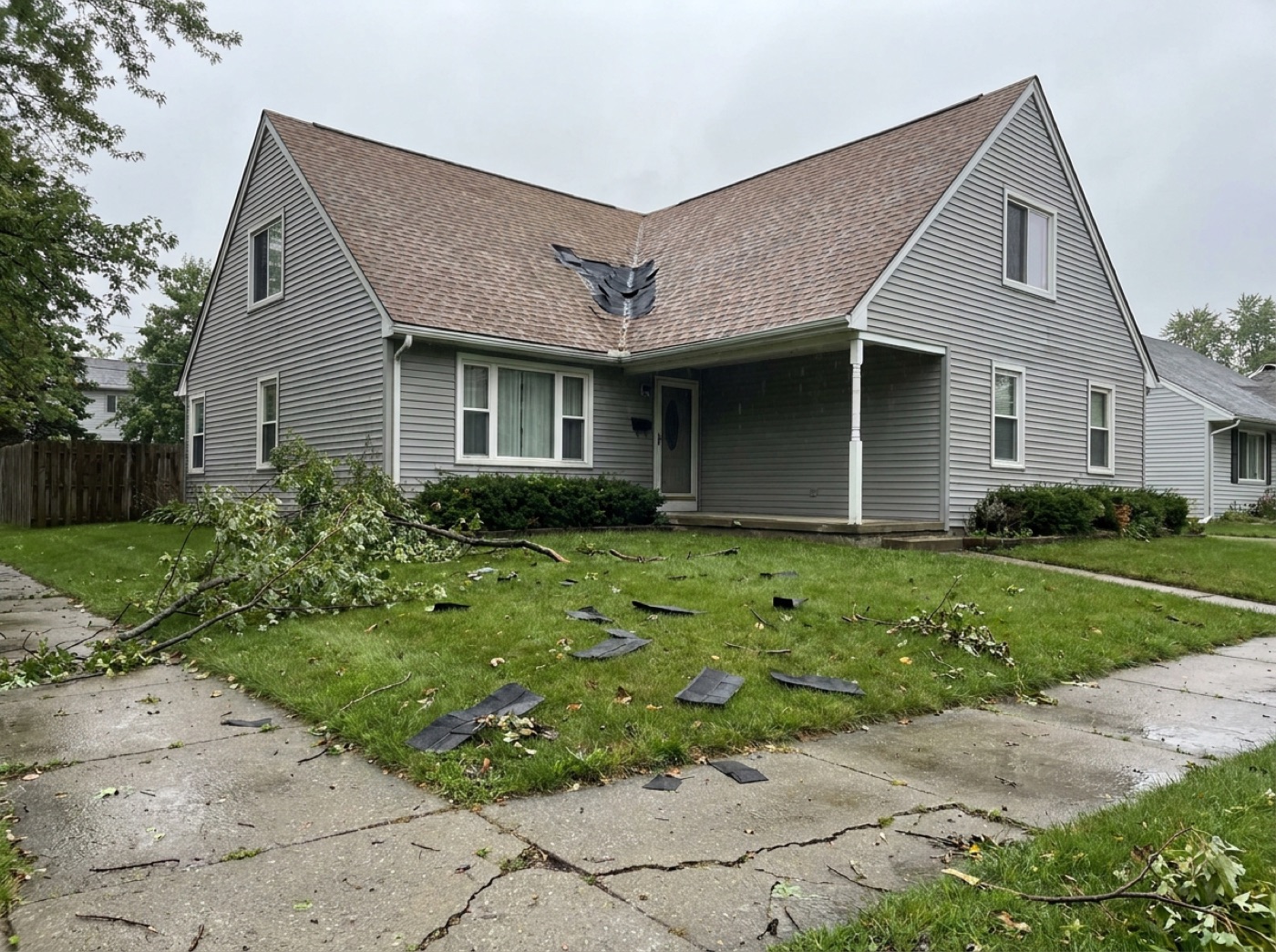
If a limb has punched through the roof or shingles are missing entirely and the deck underneath is exposed to weather, that is an active-exposure situation, and we offer 24/7 emergency tarping to stop water intrusion until a permanent repair can be scheduled. Lifted-but-intact shingles are usually not that kind of emergency; they are a documentation-and-inspection situation instead.
The most useful thing a homeowner can do after spotting the signs above is photograph what is visible from the ground and from the attic, note the date, and get a professional look before the next wind event does more with the same weak point. A storm damage inspection checks every seal along the eaves, rakes, and ridge, not just the shingle that happens to be visible from the driveway, since a storm that lifted one tab usually loosened the bond on several neighbors around it that have not fully let go yet. If the damage traces back to a covered wind event, our storm and insurance claims guide covers documentation and what a contractor can and cannot promise about the outcome of a claim.
The inspection itself is $0 with no obligation, and if it turns out the fix is a handful of resealed or replaced shingles rather than a larger repair, that is exactly what we tell you. Repairs of this kind typically fall within our published $350 to $3,200 repair range, and you can start either the repair or storm-damage path from the free estimate tool, or see the full published ranges on our pricing page and run your own numbers on the cost calculator first if you would rather have a ballpark before anyone visits.
- A shingle's wind resistance comes mostly from its factory seal strip, not the nails alone.
- Wind breaks that seal bond; it does not have to tear or remove the shingle for real damage to occur.
- Once dirt and grit get into a broken seal, it rarely reseals reliably on its own, even in full sun.
- A broken seal sets up the next ordinary wind, not another storm, to finish tearing the tab loose.
- Rattling tabs, ground-visible lift lines, and edge concentration at eaves and corners are the cues to watch for.
- The inspection that confirms it is $0, with no obligation.
Questions we hear most
Sometimes, if it is caught within a day or two and no dirt has worked into the gap. Once grit and granules contaminate the seal strip, adhesive will not bond properly to it, and the shingle stays weakened even though it may lie flat again. A hand-sealed repair, not waiting on sun heat, is the reliable fix at that point.
Listen for rattling or flapping in wind, look for thin shadow lines along shingle edges in low-angle morning or evening light, and check whether tabs at the lowest, safely reachable course move under gentle hand pressure. Concentrate your look at eaves, rakes, and corners, where uplift damage clusters. A free inspection covers the rest of the roof safely.
Usually not by itself. If shingles are missing entirely and decking is exposed to weather, that is active exposure and we offer 24/7 emergency tarping. A lifted-but-intact shingle is a documentation-and-inspection situation: photograph it and get it looked at before the next wind event, rather than treating it as an urgent same-hour emergency.
It can, depending on your policy and whether the lifting traces to a specific covered wind event. Every policy is different, and we document what we find and can meet your adjuster on site, but no contractor can promise a claim outcome. Our storm and insurance claims guide walks through the process in detail.
- FEMA, disaster declaration DR-4757-MI, Michigan severe storms of August 2023 (Macomb County designated). fema.gov/disaster/4757
- Manufacturer technical and warranty literature for the major asphalt shingle lines: GAF (gaf.com), Owens Corning (owenscorning.com), and CertainTeed (certainteed.com).
- ASCE 7, Minimum Design Loads and Associated Criteria for Buildings and Other Structures: wind uplift zones (field, perimeter, corner) for roofs.