
JUMP TO A SECTION
A roof is one structure, but it is not one climate. Every slope faces a different direction, and in Macomb County that difference matters more in winter than any other season. The south-facing plane gets hours of low winter sun almost every clear day. The north-facing plane, on many roof shapes, gets close to none. Over a single winter that gap barely registers. Over ten or fifteen winters it compounds into a visibly different roof: more moss, longer-lived snow, and shingles that show their age sooner. This guide walks through why that happens, what it means for where ice dams actually form, and how to use it as a free diagnostic the next time you look at your own roof or size up a house from the sidewalk.
01 / THE SHORT ANSWEROne roof, two microclimates
On a typical gable or hip roof, the north-facing slope stays colder, wetter, and shaded for a larger share of the winter than the south-facing slope does. Snow lingers there longer after a storm. Moss and algae, which need sustained moisture to establish, show up there first and heaviest. And because that slope spends more of the freeze-thaw season sitting wet against cold shingles, it is common for an inspection to find one slope of a roof measurably further along in its aging than its twin, even though both were installed the same day with the same materials.
The south slope gets a few hours of solar drying most winter days. The north slope, on many roof shapes, gets almost none. Over a decade and a half, that daily difference adds up to a different roof.
None of this means a north slope is defective or was installed wrong. It means direction is one of the inputs that determines remaining life, alongside material, ventilation, and installation quality, and it is worth knowing about before you judge a roof, plan a repair, or budget for a replacement.
02 / THE PHYSICSWhy aspect changes everything below freezing
The sun sits low in the sky through a Michigan winter, and that low angle is exactly what makes aspect matter so much. A south-facing slope is angled almost directly into that low winter sun for whatever hours it is out, which does two things: it warms the shingle surface enough to melt snow faster, and on many days it dries the surface between weather events. A north-facing slope, especially on a roof with any real pitch, is angled away from that same sun. For a large share of the winter it may receive no direct sunlight at all, relying only on ambient air temperature and whatever heat escapes from the attic below.
Snow retention is the visible half of the story
This is why a light snow can clear off a south slope in a day while the north slope of the identical roof still carries a white blanket a week later. The snow itself is not doing anything different. The surface underneath it is simply staying colder for longer, so there is less energy available to melt it from either direction, sun above or attic heat below.
Moisture cycling is the half you cannot see from the ground
The less visible half matters more for the shingles themselves. Asphalt shingles age fastest through repeated cycles of wet and dry, freeze and thaw, not from a single hard winter. A slope that dries out between storms sheds moisture and gets a break from that cycle. A slope that stays damp under lingering snow or in shade for weeks at a time keeps cycling through freeze and thaw far more often across the same season, and that repeated cycling is what our freeze thaw cycle guide covers as the core driver of Michigan roof aging generally. North exposure simply gives that mechanism more raw material to work with, season after season.
Wind exposure and tree cover can amplify or soften the pattern on a given lot. A north slope that also sits in the shade of mature trees compounds the effect, since shade removes even the indirect skylight a north slope would otherwise get on a bright day, while a north slope on an open, unshaded lot may show a milder version of the same asymmetry. Roof pitch matters too: a steep north slope sheds standing snow differently than a shallow one, and a low-slope north plane can hold a thin layer of snow or frost long after a steeper roof nearby has cleared. Aspect is the dominant factor on most roof shapes, but it is not the only one, and it stacks with whatever else is already working against a given slope.
It is worth saying plainly that none of this is unique to Macomb County. Any home built in a cold, four-season climate develops the same north-south asymmetry to some degree, and it is a well documented pattern in building science and roofing trade literature, not a local quirk. What makes it worth a dedicated guide here is how consistently it shows up on the ranch, colonial, and split-level roof shapes common across the county, and how rarely homeowners think to check for it before an inspection points it out.
03 / THE SYMPTOMSWhat actually shows up on the north side
The asymmetry between slopes is not subtle once you know what to look for. Three symptoms in particular tend to concentrate on the north-facing plane far more than anywhere else on the roof.
- Moss and algae growth. Both need sustained moisture and reduced sun exposure to establish, and a shaded, slow-drying north slope is close to ideal habitat. A south slope on the same house may show almost none.
- Longer snow and ice retention. Snowpack that clears from the south slope in a day or two can sit on the north slope for a week or more after the same storm, simply because less energy reaches that surface to melt it.
- Earlier granule loss and curling. Because the north slope cycles through more freeze-thaw events per season under a given snowpack, granule loss and shingle curling, both signs of an aging asphalt shingle, often appear there first, sometimes noticeably ahead of the identical shingles on the south side.
Streaking is worth a specific note, because it is often mistaken for dirt. Dark algae streaks running down a shingle field are a biological growth, not surface staining, and they show up disproportionately on north-facing and shaded slopes for the same moisture reasons described above. Algae-resistant shingle formulations exist and help, but no formulation makes a north slope behave like a south slope; it only slows how fast the difference shows.
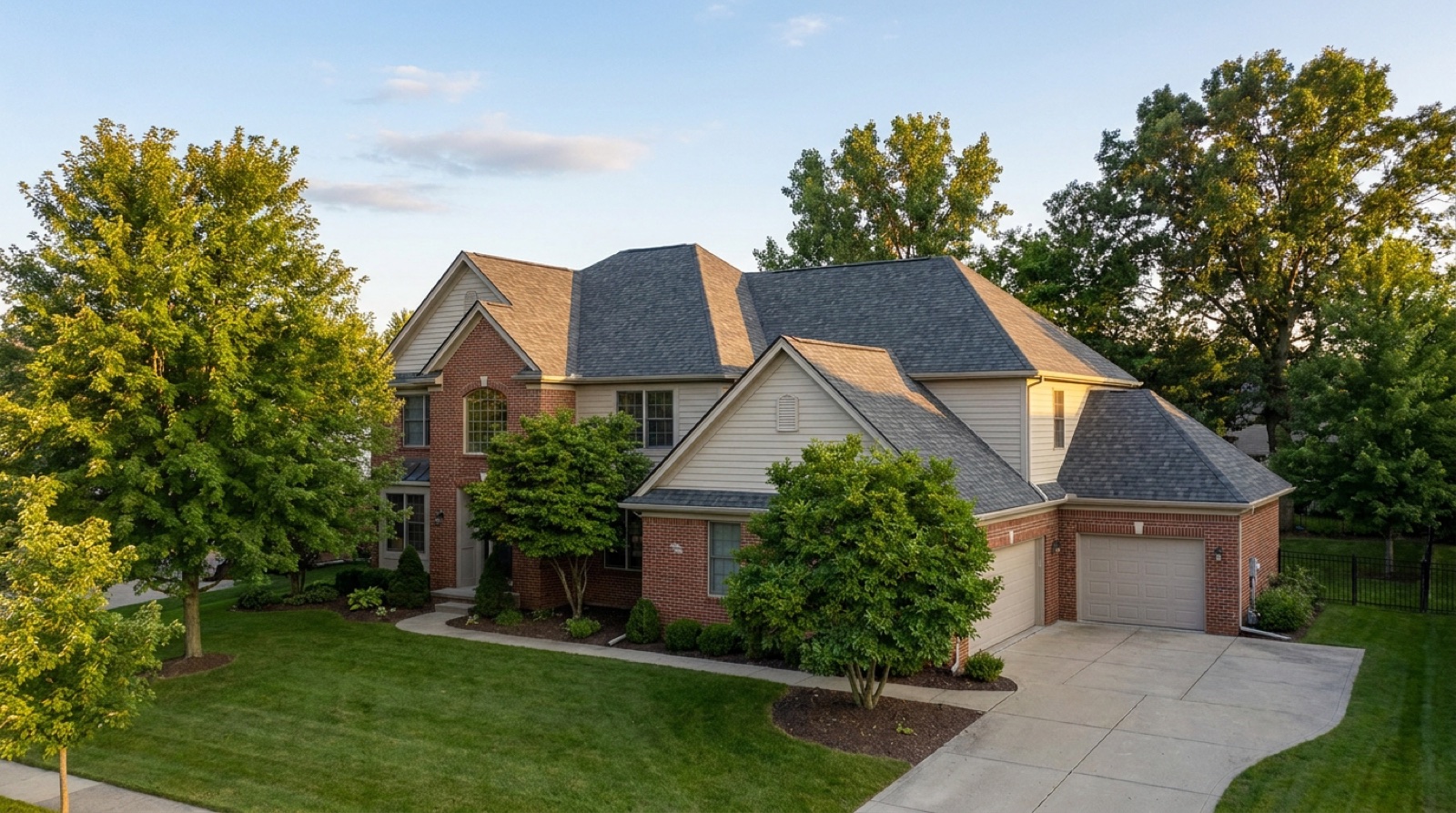
04 / THE ICE CONNECTIONWhere the ice dam actually forms
Aspect does not just affect how a slope looks. It affects where the roof's most damaging winter event, the ice dam, is most likely to start. Ice dams form when heat escaping from the attic warms the roof deck enough to melt the underside of the snowpack, and that meltwater runs downslope until it reaches the colder overhang past the exterior wall line, where it refreezes and backs up under the shingles.
A north-facing slope sets up a version of that cycle that can run longer and, in some conditions, worse than the south slope experiences. Because the surface never gets the solar assist that helps a south slope shed snow between attic-heat melt events, snow can sit there through more freeze-thaw cycles, giving the dam-building process more repeated chances to run per season. Homeowners checking for ice dams from the ground should treat the north slope as the higher-priority side to inspect, not an afterthought after checking the sunnier, more visible face of the house. Our snow melt patterns guide covers how to read bare patches and stripes on either slope to spot attic heat loss before it becomes an ice dam.
If you are only going to check one slope of your roof for icicles, ice buildup at the eave, or interior stains after a thaw, make it the north-facing side. It is the slope most likely to be running colder, wetter, and further into the freeze-thaw cycle at any given point in the season.
05 / THE STREET TESTJudging a roof from the sidewalk, the right way
Homeowners and buyers eyeballing a roof from the street or driveway almost always look at whatever slope faces the road, which is often the south or east side simply because of how the lot and street are laid out. That is exactly the slope most likely to look its best, since it has had the most solar drying and the least sustained moisture of any face of the house. A roof that looks clean and even from the front curb can be hiding a north slope with heavier moss, more granule loss, or earlier curling, simply because nobody walked around to look at it.
The useful habit, whether you are sizing up your own roof or a house you are considering buying, is to walk the full perimeter and specifically find the north-facing plane before forming an opinion. Compare it side by side with the south slope in the same light. A noticeable difference in moss coverage, snow retention after the next storm, or shingle color and texture is a real signal, not a coincidence, and it is worth mentioning specifically if you ever request an inspection or a quote.
This same logic is why our Michigan roof maintenance schedule calls out a north-slope check as part of the fall and spring walkarounds. It is a five-minute habit that catches the asymmetry early, long before it becomes an expensive surprise.
06 / THE REAL ANSWERWhat this means for your own roof
Aspect is a real factor in aging, but it is one input among several, alongside pitch, ventilation, tree cover, and how the roof was originally installed. The only way to know how much it has actually cost your specific roof in remaining life is to have someone look at both slopes side by side, measure granule condition, and check the attic deck beneath each one. That is exactly what our free inspection covers, and it is $0 with no obligation.
If the inspection finds the north slope meaningfully further along than the south, that is useful information even short of a full replacement: it can guide where a targeted repair goes first, what ventilation changes would help most, and how much runway is realistically left before both slopes need attention at once. If a full replacement does turn out to be the right call, the published range for a typical asphalt system is $9,000 to $18,000 installed, with most Macomb County homes landing $12,000 to $16,000, the same ranges on our honest pricing page.
is where most Macomb County replacements land, within a full range of $9,000 to $18,000. Run your own ballpark on the 60-second cost calculator, or get an exact number with the instant estimator.
Whether the north slope on your house turns out to need nothing more than a closer look or points toward real work, our roof replacement services page covers what that process looks like end to end, and a free inspection is the fastest way to find out which side of that line your roof is actually on.
- The north-facing slope of a roof stays colder, shadier, and wetter for more of the winter than its south-facing twin, because it gets far less direct winter sun.
- That asymmetry shows up as heavier moss and algae, longer snow retention, and often earlier granule loss and curling on the north slope specifically.
- Ice dams are more likely to build and persist on the north slope, since it cycles through freeze and thaw more times per season under a given snowpack.
- Judging a roof from the street usually means looking at its best-behaved slope; walking the full perimeter to check the north side gives a more honest read.
- Aspect is one input among several in remaining roof life, and a free inspection is the way to see what it has actually cost your specific roof.
Questions we hear most
Moss and algae need sustained moisture and reduced sun exposure to establish. The north-facing slope of most roofs gets far less direct winter sun than the south-facing slope, so it stays damp and shaded longer, which is exactly the condition moss and algae favor. The south slope on the same house can look nearly clean while the north slope shows heavy growth.
It often ages faster than its south-facing twin, because it cycles through more freeze-thaw events per season and dries out less between storms. Aspect is one factor among several including ventilation, pitch, and installation quality, so it is not a guarantee, but it is common for an inspection to find one slope measurably further along than the other on the same roof.
Yes, and the north-facing slope deserves priority if you can only check one, since it is more likely to be running colder and wetter through more of the winter. Checking for icicles, ice buildup at the eave line, and interior ceiling stains on the north side is a useful habit alongside the more visible south or street-facing slope.
- FEMA, disaster declaration DR-4757-MI, Michigan severe storms of August 2023 (Macomb County designated). fema.gov/disaster/4757
- Building Science Corporation, published research and information sheets on moisture movement, air leakage, and roof assemblies in cold climates. buildingscience.com
- Asphalt Roofing Manufacturers Association, industry technical bulletins. asphaltroofing.org
- Michigan Residential Code 2015, section R905.1.2 Ice Barriers: membrane required from the eave edge to not less than 24 inches inside the exterior wall line. up.codes: MRC chapter 9