
JUMP TO A SECTION
Here is a quiet problem buried in a lot of Macomb County roof claims. Your policy is written to repair or replace what the storm destroyed, meaning the roof as it existed the day before the wind came through. But your local building department will not permit that roof. It will permit a roof built to the code in force today, with an ice and water barrier at the eaves, drip edge at the roof edges, sound decking under the shingles, and no more than the allowed layers of roofing on the structure. On a home that was last roofed decades ago, the code-compliant roof costs more than a like-for-like copy of the old one, and somebody has to pay for the difference. Whether that somebody is your insurance carrier or you often comes down to a policy provision most homeowners have never read: ordinance or law coverage. This guide explains what it is, what it typically pays for on a roof claim, where the sublimits hide, and how the code items should show up as line items in the estimate, so the gap does not quietly land on you.
01 / THE GAPWhy a claim-funded roof can cost more than the roof you lost
Standard homeowners policies are contracts about restoring what existed. Many of them contain language that excludes, or limits, the increased cost of construction that comes from the enforcement of building codes and ordinances. In plain terms: if the storm-damaged roof was built under an older code, the policy's base promise may stop at rebuilding that older roof, even though no municipality in Macomb County will issue a permit for it. Ordinance or law coverage is the provision, sometimes built into the policy form and sometimes added by endorsement, that may pick up the extra cost of complying with current code when a covered loss forces the work.
The trigger matters. Ordinance or law coverage generally responds only when a covered peril caused the loss and a code official or the permitting process then requires the upgrades. It is not a home improvement fund: it typically will not pay to bring an undamaged roof up to code voluntarily, and it typically will not respond if the underlying claim is denied. That makes it a companion to the rest of your claim rather than a separate one, and it is why understanding your base coverage comes first. If you have not mapped where roof coverage lives in your policy, our walkthrough on reading your homeowners policy for roof coverage is the place to start.
Your claim may pay for the roof you had. The permit office requires the roof code demands today. Ordinance or law coverage is the part of the policy that may bridge those two numbers, and whether you have it, and how much of it, is printed on your declarations page right now.
02 / THE CODE ITEMSWhat Michigan code typically adds to a reroof
So what is actually in the gap? When a full replacement goes through permitting in a Macomb County community, the work is inspected against the current Michigan Residential Code, and a handful of requirements come up on nearly every older roof. The specific section numbers and details belong to the code books and your local building department, so treat the list below as the general shape, flagged for verification, rather than as code citations.
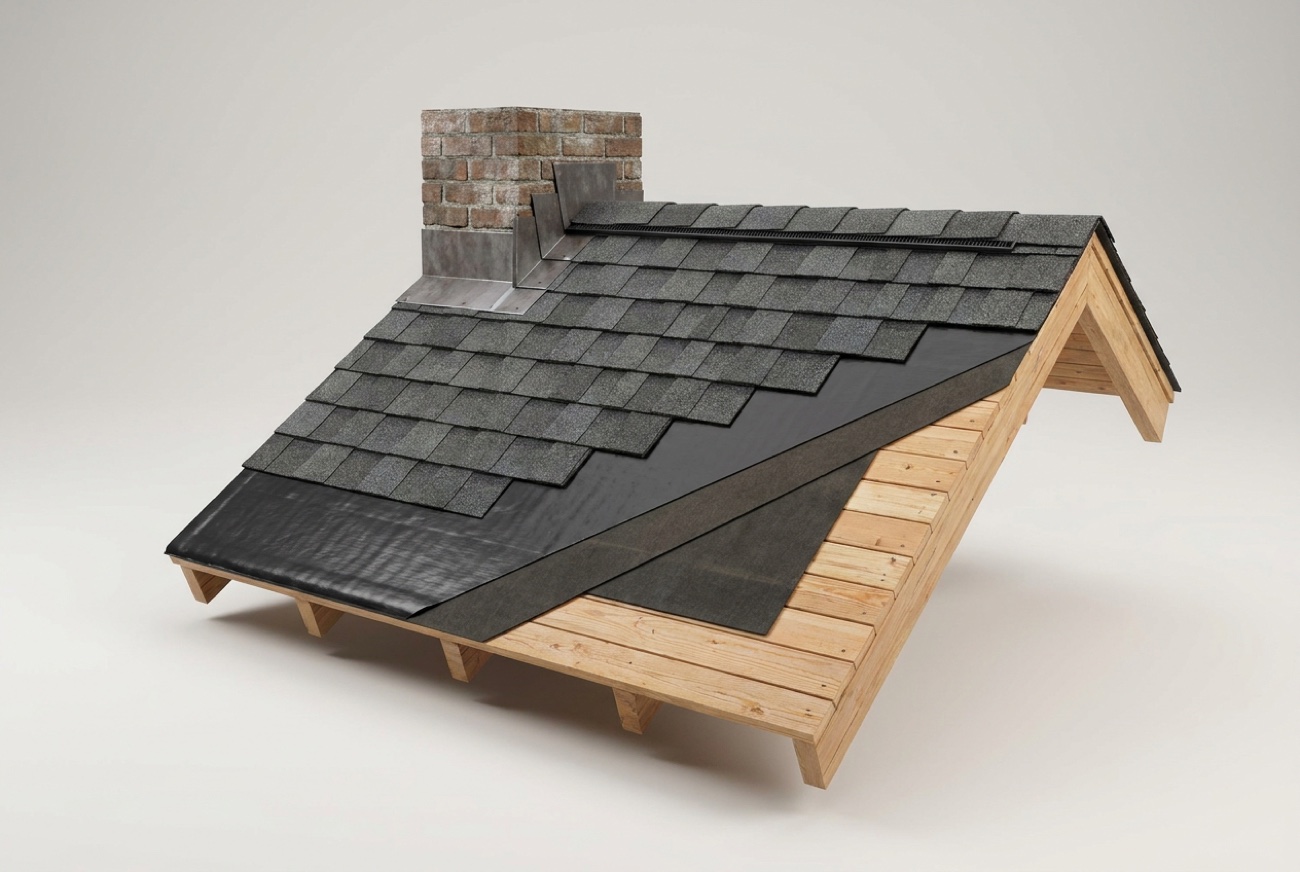
Ice and water barrier at the eaves
Michigan sits squarely in ice dam country, and the residential code generally requires a self-adhering ice barrier membrane extending from the roof edge up past the interior wall line. Homes roofed long ago may have felt paper and nothing more at the eaves. On a code-compliant reroof, the membrane is not optional, and it is material and labor the old roof never included.
Drip edge at eaves and rakes
Metal drip edge at the roof edges is a standard requirement of modern code-governed reroofs, and a surprising number of mid-century Macomb County homes have none. It is a modest line on its own, but it is exactly the kind of item a like-for-like estimate quietly omits.
Decking replacement and re-nailing
New shingles must be fastened to solid, sound decking. Rotted, delaminated, or sagging deck boards get replaced during tear-off, and plank decking with wide gaps may need overlay or replacement to accept modern fasteners. The carrier's estimate should carry an allowance for deck repair, because the permit inspection will not accept new shingles over a failed deck.
The two-layer rule and mandatory tear-off
Code generally caps a roof at two layers of asphalt shingles. If your damaged roof is already a second layer, a recover is off the table: everything comes off, and the tear-off, disposal, and edge details of a full strip-down are part of the code-compliant scope. A house that was hoping for a cheaper overlay finds out at permit time that the law has already made the decision.
Ventilation and related details can enter the picture too, depending on the scope and the municipality. The pattern to notice is that every one of these items is real money, and none of them existed on the roof the storm took. Added together on an older home, code items can be a meaningful share of a replacement that already runs $9,000 to $18,000 for asphalt in Macomb County, with most homes landing $12,000 to $16,000. The same ranges are published on our honest pricing page, and you can run your own roof against them in the cost calculator.
03 / THE COVERAGEWhat ordinance or law coverage typically pays, and what it does not
Ordinance or law provisions in property policies are commonly described in three parts, and it helps to know the vocabulary even though a residential roof claim usually only leans on one of them. The first part addresses loss to the undamaged portion of a building when code forces more demolition than the peril caused. The second addresses the cost of that required demolition itself. The third, the one that matters most on a reroof, is increased cost of construction: the added expense of repairing or rebuilding to current code rather than to the building's original specification. Ice barrier where there was none, drip edge where there was none, and a mandated tear-off where an overlay would have been cheaper all live in that third bucket.
Just as important is what the coverage typically does not do. It does not pay for upgrades you simply want, like stepping up a shingle tier or adding skylights. It does not usually respond to code violations that existed before the loss and were already your responsibility. It does not turn a denied claim into a paid one, because it rides on top of a covered loss rather than replacing the need for one. And like everything else in this lane, the exact behavior depends on your specific policy form, so the words may, can, and often are doing honest work in every sentence here. Your declarations page, your policy language, and your adjuster have the final word, and nothing on this page is legal or insurance advice.
The storm decides what was damaged. The code decides what must be built. Ordinance or law coverage decides who pays for the distance between them.
04 / THE FINE PRINTSublimits, endorsements, and where the money runs out
Here is where homeowners get surprised. Ordinance or law coverage is very often capped by a sublimit, commonly expressed as a percentage of the dwelling coverage rather than as an open-ended promise. Many standard forms include a modest default percentage, and carriers frequently offer endorsements that raise it for a small premium. On a typical roof claim the default is often enough, because roof code items are a fraction of the dwelling limit. But on older homes with large code gaps, or on claims that touch structure as well as shingles, the sublimit can become the binding constraint, and any code costs above it land on the homeowner.
Three questions to your agent sort most of this out before a storm ever tests it. First, does the policy include ordinance or law coverage at all, and is it the full three-part version or a narrower grant? Second, what is the sublimit, in both percentage and dollar terms, and what would it cost to raise it? Third, does anything about the roof specifically, such as an actual cash value roof endorsement or an age-based payment schedule, interact with the code coverage? Policies that convert roof payouts to depreciated value can shrink the base claim the code coverage rides on, which makes the fine print doubly worth reading. These are five-minute questions when the sun is out and expensive discoveries after the wind.
The common failure is not a carrier refusing to honor code coverage. It is code items never making it into the estimate at all, or a sublimit nobody checked until the checks stopped. Read the declarations page now, and read the estimate line by line later. If code work the permit requires is missing from the scope, that is a documentation problem, and documentation problems are fixable.
05 / THE PAPERWORKHow code items should appear in the adjuster's estimate
An insurance estimate is a list of line items, each with a quantity and a unit price, and code-required work should appear on it the same way shingles and labor do. When the estimate is written well, you will see the ice and water barrier, the drip edge, the deck allowance, and the tear-off scope called out explicitly, often tied to the code upgrade coverage rather than to the base dwelling coverage. When it is written poorly, the estimate reads like a copy of the old roof, and every missing line is money the settlement does not include.
| CODE ITEM | HOW IT SHOULD APPEAR | IF IT IS MISSING |
|---|---|---|
| Ice and water barrier | Its own line, by the square or linear foot | Request it, citing the permit requirement |
| Drip edge | Linear-foot line at eaves and rakes | Request as a code line item |
| Decking repair | Per-sheet allowance, adjusted after tear-off | Document with tear-off photos, supplement |
| Mandatory tear-off | Full removal and disposal in the scope | Flag if estimate assumes an overlay |
| Permit fees | Listed at the municipality's actual fee | Submit the permit receipt |
Two companion guides carry this further. Our page on missed line items in roof claims catalogs what estimates most often leave out, code items included. And because decking condition genuinely cannot be known until tear-off, the mechanism for adding discovered code work to an open claim is the supplement, which our guide to roof claim supplements explains step by step. The pattern across all of it is the same: code upgrades get paid when they are documented, itemized, and tied to the requirement that forces them, and they get absorbed by the homeowner when they stay invisible.
06 / THE PLAYBOOKWhat a Macomb County homeowner should actually do
First, before any storm: pull your declarations page and find the ordinance or law line. Know whether you have it and what the sublimit is. Macomb County has recent history that makes this more than theoretical, since the county was included in federal disaster declaration DR-4757 after the August 2023 storms, and roofs damaged in events like that are still working through claims and code-required rebuilds today.
Second, during a claim: get an independent set of eyes on the roof early. Our inspection is $0 with no obligation, it documents both the storm damage and the code-relevant conditions such as existing layers, missing drip edge, and eave protection, and we can meet your adjuster on site to walk the same evidence together. We write scopes that itemize code work explicitly, because a permit will be pulled and the building inspector will hold the job to current code regardless of what the estimate says. No contractor can promise what a carrier will pay, and anyone who does is guessing with your money. What we can promise is that nothing required by code will be missing from our paperwork.
Third, keep the sequence honest: document, report, inspect, then read every estimate against the permit requirements before work begins. If you want a ballpark on the full replacement before anyone visits, the instant estimator uses the same published ranges as this page, and the wider claims library lives on our storm and insurance hub alongside the rest of the guides collection.
- Standard policies may pay to rebuild the roof you had; Michigan code requires ice barrier, drip edge, sound decking, and no more than two shingle layers, and ordinance or law coverage is what may pay that difference.
- The coverage generally triggers only on a covered loss with code enforcement behind the upgrades; it is not a voluntary improvement fund.
- Sublimits, often a percentage of dwelling coverage, cap the code money, and endorsements can raise them cheaply before a storm.
- Code items should appear as explicit line items in the adjuster's estimate; missing lines are the most common way this money is lost.
- A free inspection documents both storm damage and code conditions, and we can meet your adjuster on site, though no contractor can promise a claim outcome.
Questions we hear most
It is the policy provision, built in or added by endorsement, that may pay the increased cost of rebuilding to current building code after a covered loss, rather than only to the roof's original specification. On a Michigan reroof that can include items like ice and water barrier, drip edge, decking repair, and a code-mandated full tear-off. It generally applies only when a covered peril caused the loss and the permitting process requires the upgrades.
Only if your policy includes ordinance or law coverage, and only up to its sublimit, which is often expressed as a percentage of your dwelling coverage. Without the coverage, many policies exclude the increased cost that code enforcement adds, leaving those items to the homeowner. Check your declarations page or ask your agent what you carry and what raising the sublimit would cost, ideally before a storm makes the question urgent.
Read the estimate line by line and look for the ice and water barrier, drip edge, deck allowance, tear-off scope, and permit fees as explicit entries. If required work is missing, it can often be added through a documented request or a supplement, supported by photos and the municipality's permit requirements. A free inspection from us documents the code-relevant conditions, and we can meet your adjuster on site to walk the roof together.
- FEMA, disaster declaration DR-4757-MI, Michigan severe storms of August 2023 (Macomb County designated). fema.gov/disaster/4757
- Michigan Residential Code 2015, section R905.1.2 Ice Barriers: membrane required from the eave edge to not less than 24 inches inside the exterior wall line. up.codes: MRC chapter 9
- Haag, engineering-based damage assessment methodology for hail and wind effects on roofing. haagglobal.com
- Your city or township building department: reroofing permit requirements and fee schedules are set locally in Macomb County; see the county directory of communities. macombgov.org