
JUMP TO A SECTION
The call usually comes the morning after the storm. There are shingles in the yard, a wet spot spreading on the bedroom ceiling, and an adjuster appointment that is days or sometimes weeks out. The homeowner wants to know one thing: can I fix this now, or do I have to sit here and watch it leak until the insurance company shows up? The honest answer is that the question hides two different questions. Can you take temporary, emergency measures to stop further damage? Not only can you, your policy generally expects you to. Can you do the permanent repair, tear out the damaged section and make it new, before anyone from the carrier has seen it? You can, but it is one of the more expensive mistakes a Macomb County homeowner can make in a claim. This guide walks the line between the two, in the same order we walk it with homeowners after every wind event.
01 / THE SHORT ANSWERTemporary yes, permanent not yet
Homeowners policies commonly contain a condition, often titled something like "duties after loss," that requires you to take reasonable steps to protect the property from further damage. That is the duty to mitigate, and it points toward action: tarp the opening, board the hole, move the furniture, catch the water. The same claim, though, lives or dies on evidence. The adjuster's job is to look at the roof and connect the damage to a covered event, and a roof that has already been rebuilt has nothing left to show. Those two pressures resolve cleanly once you put them in order.
Document the damage first, make temporary repairs to stop further loss, keep every receipt and the damaged materials, and save the permanent repair for after the adjuster has written the scope. Mitigation protects the house; patience protects the claim.
Every policy is different, and nothing on this page is legal or insurance advice; your declarations page, your policy conditions, and your adjuster have the final word. But the sequence above is consistent with how standard homeowner policy conditions are written and with the consumer guidance insurance regulators publish after storms, and it is the sequence we have never seen work against a homeowner.
02 / THE DUTYThe duty to mitigate: what your policy expects of you
Mitigation is not optional courtesy. If a wind-opened roof sits exposed through two more rain events and the ceiling collapse that follows could have been prevented with a $30 tarp, a carrier may treat that later damage differently than the storm damage itself, because policies generally cover the sudden event, not the neglect that follows it. That is the practical teeth behind the "protect the property" condition: acting promptly keeps the whole loss inside the claim, while waiting can carve part of it out.
What counts as reasonable temporary protection is narrower than people fear. Nobody expects a homeowner on the roof at midnight. Reasonable measures look like this:
- Tarping the damaged slope or opening so rain and snowmelt stay out. This is exactly what our 24/7 emergency tarping service exists for, and it is tarping only at that hour: stop the water first, decide everything else in daylight.
- Boarding or sealing a puncture from a fallen limb so the opening does not grow.
- Moving or covering belongings under the leak and pulling water off floors before it wicks into walls.
- Catching active drips and, if the ceiling is bulging with trapped water, relieving it before it brings the drywall down.
Notice what is not on the list: replacing shingles, rebuilding a valley, reroofing a slope. Mitigation is a raincoat, not surgery. The distinction matters because the raincoat is generally expected and commonly reimbursable, while the surgery, done early, can cost you the operating room evidence.
03 / THE RISKWhy permanent repairs before the inspection can hurt the claim
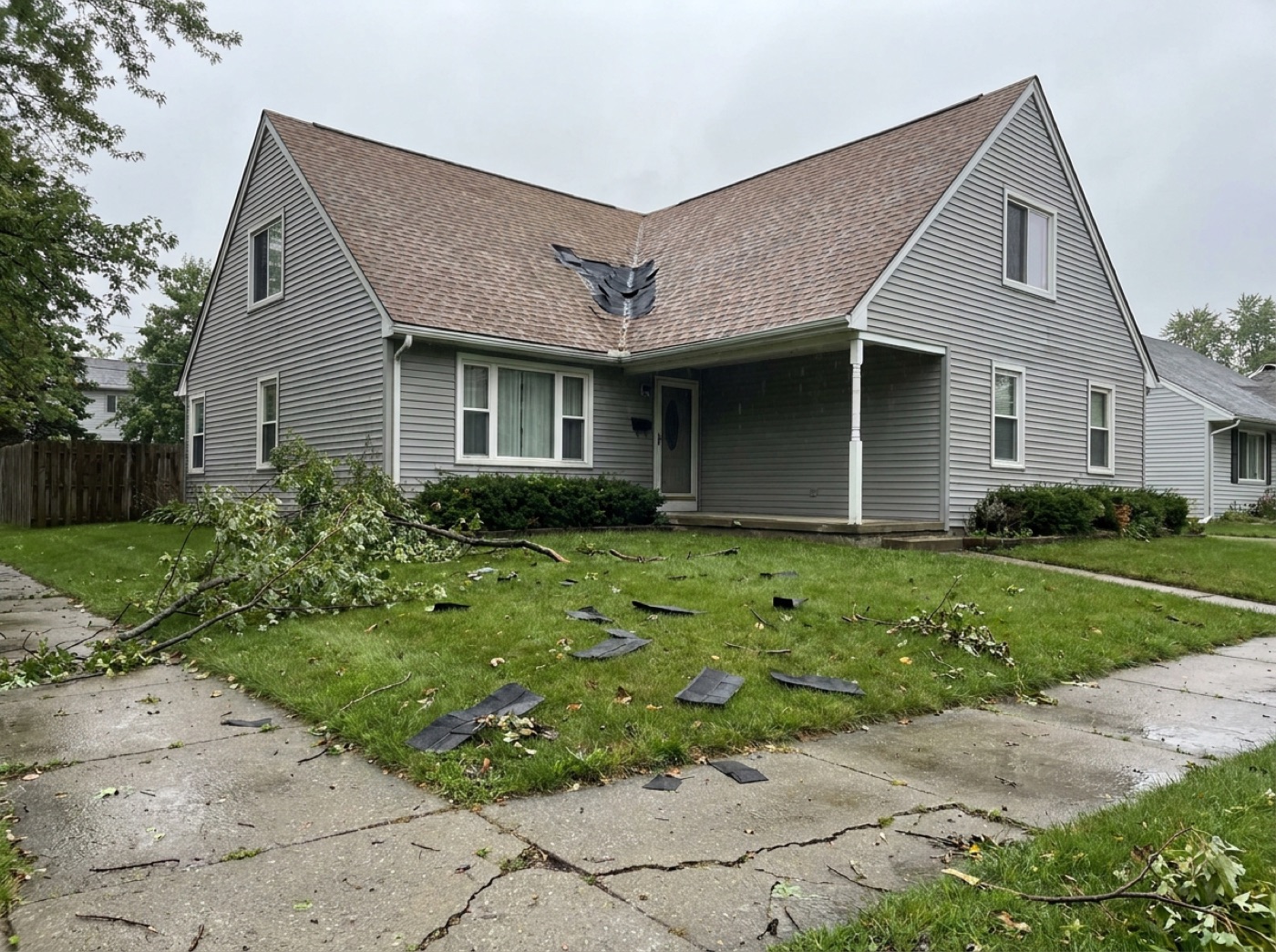
An insurance claim is an argument from evidence. The adjuster climbs the roof looking for the signature of a covered peril: creased and folded shingles from wind, mat fractures and bruising from hail, a scatter pattern that matches the storm's direction. The lifted shingles, the exposed nail lines, the granules in the gutter are the exhibits. When a crew tears all of that off and installs a clean new slope before the inspection, the exhibits go into a dumpster, and the adjuster is left evaluating a roof that no longer shows a loss.
That does not automatically sink a claim. Adjusters can work from photographs, weather records, and the damaged materials themselves if you kept them. Macomb County's August 2023 wind storms, the event behind federal disaster declaration DR-4757, were documented well enough that the storm itself was never in question for most homeowners. But a homeowner who repaired first and photographed nothing is asking the carrier to take the loss on faith, and carriers are not in the faith business. At best the claim slows down while the paperwork tries to reconstruct what the roof would have shown. At worst the damage can no longer be verified at all.
A tarp says a homeowner protected the property. A brand new slope installed three days before the inspection says the adjuster will never know what was under it.
There is a second, quieter cost to repairing early: you set the price before the scope exists. The adjuster's scope of work is the document that defines what the carrier agrees the storm did, and it is far easier to get the full damage into the scope while the damage is still on the roof. Homeowners who pay for a permanent repair out of pocket and then ask the carrier to reimburse it are negotiating from behind, with may and might where an inspection would have put line items.
04 / THE SEQUENCEThe middle path, step by step
Here is the order of operations that satisfies the duty to mitigate and preserves the claim, starting the hour you find the damage.
- Document before you touch anything. Wide shots of the whole roof from the ground on all sides, closer shots of each damaged area, and interior shots of every stain, drip, and wet spot, all with your phone's timestamp doing the record keeping. Our guide to photographing roof damage shows the exact shot list adjusters find useful.
- Mitigate temporarily. Tarp, board, and divert water, and photograph the temporary measures too, both to show the carrier you acted and to record what the tarp now covers. If the roof is not safely walkable, and after a storm it usually is not, call for emergency tarping rather than climbing.
- Report the claim promptly. Prompt notice is typically one of the listed duties after loss, and the claim number you get starts the clock toward an adjuster visit.
- Keep every receipt. Tarps, plywood, fasteners, a tarping invoice, even the fans drying the carpet. Reasonable emergency measures are commonly reimbursable as part of a covered claim, and receipts are how they get counted.
- Keep the damaged materials. If shingles blew into the yard, bag them and set them aside. Torn shingles and hail-bruised samples are physical evidence an adjuster can hold.
- Build the file while you wait. Dates, photos, the weather event, your notes. The full inventory is in our storm damage documentation checklist.
- Schedule permanent work after the scope. Once the adjuster has inspected and the scope of work exists, the permanent repair or replacement proceeds with the carrier and the contractor working from the same document.
The pattern in every step is the same: nothing you do is hidden from the carrier, and nothing the storm did is hidden from the adjuster.
05 / THE MONEYReceipts, tarps, and what reimbursement usually looks like
Temporary protection is real money, and homeowners are often surprised to learn which direction it flows. Because mitigation is a policy duty, the reasonable cost of performing it is commonly treated as part of the covered loss, meaning a tarp invoice submitted with receipts may come back to you in the settlement. May, not will: reimbursement depends on the claim being covered in the first place, on the measures being reasonable, and on your specific policy language, which is why the receipts and the photos of what the tarp prevented are worth keeping together.
Two cautions belong in the money section. First, keep temporary measures proportionate: a tarp and boarding are mitigation, while a full slope of new shingles billed as an "emergency" invites exactly the scrutiny you are trying to avoid. Second, be careful with storm chasers who offer to start permanent work immediately and "sort out the insurance later." A contractor willing to destroy the evidence before the inspection is not doing you a favor, whatever the yard sign says. Our storm and insurance claims page covers the after-storm door knock playbook in more detail.
06 / THE TIMELINEWhen permanent work can start, and what it costs
The green light for permanent repairs is the adjuster's inspection and the scope that follows it. Once the carrier has seen the roof, or has told you in writing to proceed, the evidence question is closed and the work can be planned like any other roofing project. What actually happens during that visit, and how to prepare for it, is covered in our guide to the adjuster's roof inspection, and we can meet your adjuster on the roof to walk the damage together.
On cost: storm repairs land in the same canon as any other repair in Macomb County, $350 to $3,200 for most jobs, with larger or complex repairs running higher. If the adjuster's scope calls for full replacement, asphalt runs $9,000 to $18,000 here, and most homes land $12,000 to $16,000. You can rough out either path in about a minute with the cost calculator, and the published ranges behind those numbers live on our pricing page.
One timing note that catches people: waiting for the adjuster does not mean waiting to get in a contractor's schedule. After a countywide wind event every roofer's calendar fills at once, so it is smart to get your estimate started while the claim is in process. The estimate costs nothing, it does not commit you, and it means the week the scope arrives is the week the work can be booked.
07 / OUR ROLEWhere we fit in, and what no contractor can promise
Our part in this sequence is craft and documentation, in that order. At the emergency end we tarp, 24/7, so the mitigation duty is handled without you on a wet roof in the dark. At the evidence end we photograph what we find, write it up plainly, and can meet your adjuster on site so the scope reflects what is actually up there. And when the scope exists, we do the permanent work to the standard the rest of this site describes, starting with a free inspection that tells you honestly whether you are looking at a repair or a replacement.
What we will not do is promise a claim outcome. No contractor can, and the ones who imply otherwise are borrowing credibility they do not have. Policies differ, adjusters weigh evidence, and the decision belongs to your carrier. What a homeowner controls is the quality of the record, and everything in this guide is about making that record easy to say yes to. Start with the photos, get the tarp on, and browse the rest of the guides library for the claim steps that come next.
- Temporary repairs before the adjuster are expected: policies generally require you to protect the property from further damage.
- Permanent repairs before the inspection destroy the evidence the claim depends on. Save them for after the scope.
- Document first, then tarp: photos with timestamps, receipts for every mitigation cost, and the damaged materials in a bag.
- Reasonable mitigation costs are commonly reimbursable with receipts on a covered claim, though your policy has the final word.
- Storm repairs run $350 to $3,200 in Macomb County, and our tarping line answers 24/7 at (586) 300-1746.
Questions we hear most
You can and generally should make temporary repairs like tarping and boarding, because policies commonly require you to protect the property from further damage. Permanent repairs are the risk: rebuilding the roof before the inspection removes the evidence the adjuster needs to connect the damage to a covered event. Document the damage with photos first, mitigate temporarily, and schedule permanent work after the adjuster writes the scope.
Often, yes. Reasonable emergency measures taken to prevent further damage are commonly treated as part of a covered claim, which is why you should keep every receipt for tarps, plywood, and any tarping invoice. Reimbursement is not guaranteed; it depends on the claim being covered and on your specific policy language, so save the receipts and submit them with the claim.
Yes. Shingles that blew into the yard and any damaged materials removed during tarping are physical evidence, so bag them and set them aside until the adjuster has inspected. Paired with timestamped photos of the roof taken before the tarp went on, they let the adjuster verify the damage even though the roof is now covered.
- FEMA, disaster declaration DR-4757-MI, Michigan severe storms of August 2023 (Macomb County designated). fema.gov/disaster/4757
- Insurance Information Institute, consumer explainers on homeowners policy coverage, deductibles, and the claims process. iii.org
- Michigan Department of Insurance and Financial Services (DIFS), consumer insurance resources and complaint process. michigan.gov/difs
- National Association of Insurance Commissioners, consumer insurance resources. naic.org