
JUMP TO A SECTION
Every asphalt roof has one line that takes more wind pressure than any other square foot of shingle: the ridge, where the two slopes meet and the cap shingles bend over the peak to seal it. Field shingles lie flat and shed wind across their surface. Ridge caps do not get that advantage; they fold over an edge, and the fold itself is the weak point, which is why a ridge cap cracks, creases, or lifts off well before the field shingles show any damage at all. This guide covers why the ridge goes first, how to read the damage from the ground, and what a compromised ridge means for the attic beneath it.
01 / THE SHORT ANSWERThe ridge is the roof's highest-pressure line, and the caps show it first
Ridge cap damage matters for two reasons. First, it is usually the earliest visible sign a roof took real wind, often before any other part of the roof shows a thing. Second, the ridge sits directly over the attic's highest point, often right above a ridge vent cut into the deck, so a failure here has a shorter, more direct path inside than damage almost anywhere else on the roof. Ridge cap repairs generally fall inside the published repair range of $350 to $3,200, and a longer run or one that also touches ridge vent components can land toward the higher end.
covers most ridge cap repairs in Macomb County, from resealing a short lifted run to replacing cap shingles along an entire ridge line. Larger or complex repairs can run higher. The only way to know your number is a free inspection.
The reassuring part: ridge cap damage is almost always a repair, not a reason to replace the roof. The catch is that it is easy to miss from the ground unless you know the silhouette and pattern to look for, which is exactly what the next sections cover.
02 / THE MECHANICSWhy ridge caps break before the rest of the roof does
Wind does not push evenly across a roof; it accelerates and separates at edges, corners, and the ridge line, the same reason a flag snaps hardest at its free edge. Along the ridge, wind moving up one slope crests the peak and creates a zone of turbulence and uplift right where the cap shingles are bent, nailed, and sealed. That fold is a manufactured stress point, and also the shingle's shortest nailing surface and smallest sealant strip on the entire roof.
The fold is a built-in weak point
A field shingle lies flat and relies on its full seal strip bonding to the shingle below it. A ridge cap is scored and bent over the peak, and the bend itself works against the seal every time wind flexes it. Repeated gusts, even ones well short of tearing a cap off outright, work the seal loose a little at a time, cycle after cycle, long before the shingle looks obviously wrong.
Age and sun exposure compound the risk
Ridge caps also get the most direct sun exposure of any shingle on the house. Years of UV exposure dry out the asphalt and the sealant strip, so a ridge that has gone through a decade or more of Michigan summers is more brittle at the fold than the field shingles below it, and brittle asphalt cracks under wind load a newer cap would simply flex through. None of this requires an extreme event to matter here, a point the storm-history section below covers in more detail.
03 / THE WALKTHROUGHHow to spot ridge cap damage without a ladder
You do not need to get on the roof to catch most ridge problems. Standing back from the house, across the street or in the yard, and looking along the peak in good daylight tells you most of what you need to know.
A broken silhouette along the peak
A healthy ridge reads as one clean, even line end to end. Cap damage breaks that line: a dip where a cap has lifted, a gap where one is missing, or a shadow where a cap no longer sits flush against its neighbors. Scan the whole ridge slowly rather than glancing once, since a single displaced cap near either end is easy to miss against a long, otherwise straight roofline.
Caps that no longer line up with each other
Ridge caps overlap in a shingled pattern, each covering part of the next. Wind that lifts one cap often shifts its alignment even without tearing it free, so a cap sitting crooked, rotated, or offset from the row's rhythm signals the seal underneath let go, even when the shingle is still nailed down.
Cracking and creasing at the fold
Look for a visible crack or hard crease across the bend of a cap shingle, different from ordinary wear and a direct sign of wind flexing the fold past what the aged asphalt could take. A cracked cap is compromised even if it has not moved yet, because the crack itself is now a path for water.
Exposed ridge vent or nail heads
Many Macomb County roofs run a ridge vent under the cap shingles, a slotted strip that lets attic heat and moisture escape along the peak. When wind lifts or removes caps over that vent, you may see the vent's raw material, exposed nail heads, or a strip of noticeably different color peeking through. This failure deserves extra attention, covered next, because it sits directly over an opening already built into the deck.
Granule loss concentrated at the ridge
A flexing, cracking cap sheds granules faster than a field shingle does. Gutters or ground below the ridge line showing noticeably heavier granule buildup than elsewhere on the house is a strong secondary clue pointing back up at the ridge.
04 / THE ATTICWhy a compromised ridge threatens the attic below it
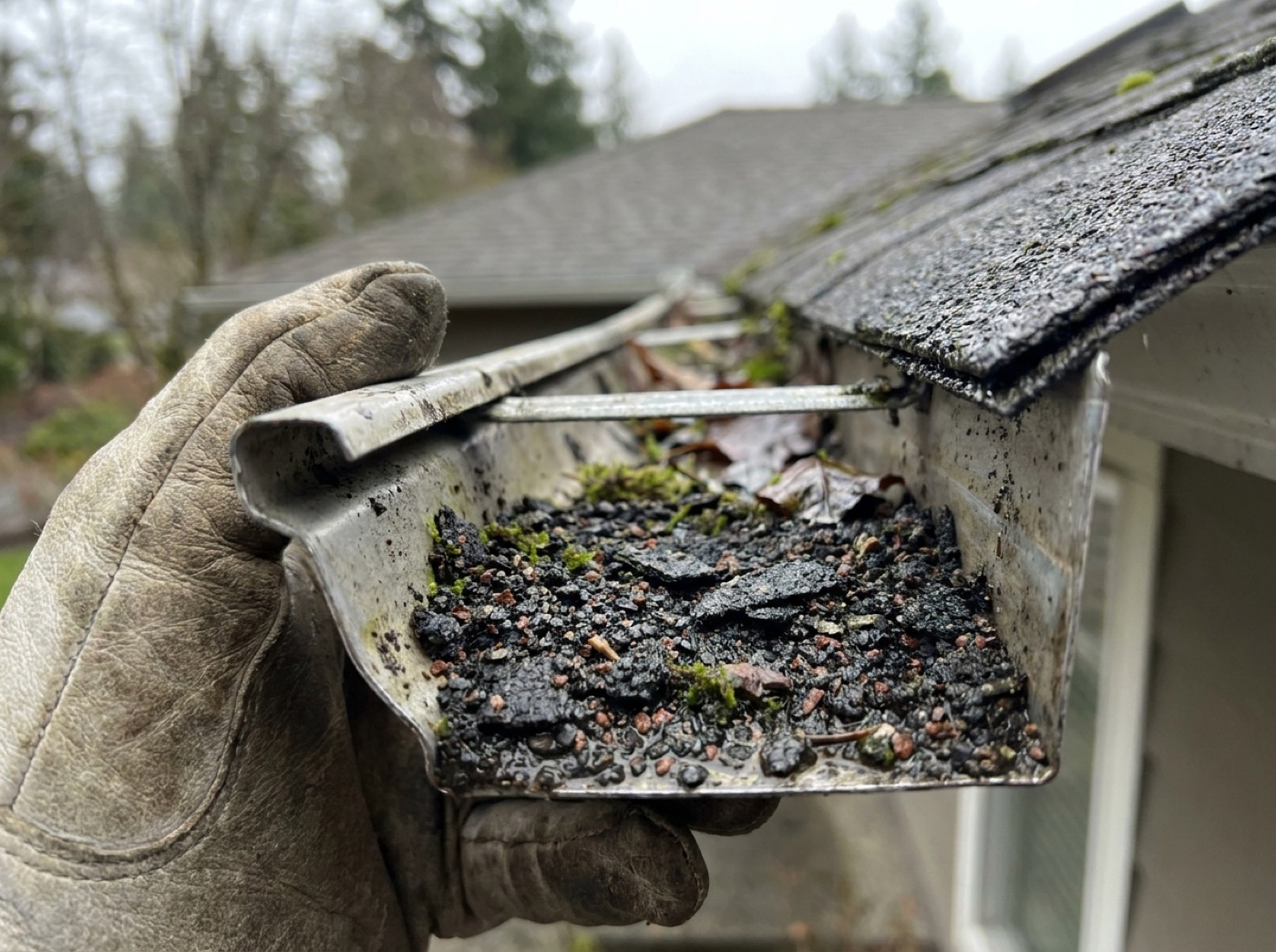
A ridge failure differs from a leak mid-slope because of what usually sits right beneath it. On many Macomb County homes the ridge line is where a ridge vent is cut into the deck for attic ventilation, so a gap in the cap shingles there is a gap over an existing opening, not solid decking. Wind-driven rain does not need to find a new way in; it only needs to get past caps that are already cracked or lifted, and it is at the vent opening itself.
Water past a compromised ridge tends to travel along the underside of the deck and down the framing before it shows up anywhere a homeowner would notice, which is why interior stains from ridge damage often appear well away from the ridge and well after the storm that caused it. Wet insulation loses much of its effectiveness even after it dries, and prolonged dampness at the highest point of the attic is exactly the condition that encourages mold on the sheathing. Our attic check after a storm guide walks through exactly what to look for up there, including the ridge board itself, worth doing after any wind event strong enough to have moved a cap.
Because the ridge often sits over a ventilation opening rather than solid deck, damage there can let moisture into the attic well before it ever produces a ceiling stain a homeowner would notice. A ridge that looks slightly off after a windy week is worth a look before the next storm finds the same gap again.
This is part of a broader pattern: wind does not damage a roof evenly, it concentrates at specific zones, and the ridge is one of the most important. Our roof wind uplift zones guide maps where else pressure builds hardest, and our signs of wind damage guide covers the rest of the roof beyond the ridge.
05 / THE FIXWhat a ridge cap repair actually costs and involves
Ridge cap work is priced by how much of the ridge line needs to come apart and go back correctly, not just how many individual caps look wrong. A short run of a few displaced caps, resealed and refastened, sits at the low end. A longer stretch, or a repair that also involves resetting an exposed or damaged ridge vent strip, sits toward the middle or higher end.
A correct repair replaces the compromised caps rather than gluing down the lifted ones, and checks the ridge vent strip underneath while the caps are off, since a torn or crushed vent will not do its job even under a brand new cap. It is also worth checking the caps on either side of any visibly damaged section, since wind that broke one seal frequently loosened its neighbors on the same gust, even where they still look flush today.
A ridge cap repair that just presses the same cracked shingle back down is not a repair. The crack is still there, and the next gust from the same direction will find it again.
If a recent windstorm is what brought you here, the honest next step is a free inspection that walks the entire ridge line rather than just the section visible from the yard. Our storm damage service page covers the full range of wind and hail issues we handle, not just the ridge. If wind caused the damage, our storm and insurance claims guide covers how documentation and an adjuster visit typically work, without promising any particular outcome on a claim. You can start either path from the storm damage estimator, and the cost calculator gives a broader ballpark if the damage turns out to extend past the ridge.
06 / THE STORM ANGLETiming, insurance, and the DR-4757 note
Ridge damage is often the visible tip of a wind event that also affected less obvious parts of the roof, which is why a damaged ridge is a reason to have the whole roof and attic checked, not just the peak. Homeowners insurance policies generally cover sudden storm damage such as wind, as opposed to gradual wear from age, and every policy is different, so a declarations page and an adjuster have the final word on any specific claim.
Macomb County's documented history matters here. Wind strong enough to crack or lift ridge caps on one house was likely strong enough to affect other homes on the same block during the same event, part of why the county's inclusion in federal disaster declaration DR-4757 after the August 2023 storms is still relevant: some of that damage has sat unaddressed since then. If your ridge has never been checked since a significant wind event, a free inspection is a low-cost way to find out where you stand.
Our role in a claim is documentation: photographing the ridge and related damage, writing up what we find, and meeting an adjuster on site if useful. What no contractor can honestly promise is the claim's outcome. For the attic side of the story, our attic check after a storm guide is the natural next read.
- Ridge caps take more wind pressure than any other shingles on the roof because of the fold over the peak, so they crack, crease, or lift before field shingles show damage.
- Look for a broken silhouette along the ridge, caps out of alignment with their neighbors, visible cracks at the fold, exposed ridge vent material, and heavier granule loss in gutters below the ridge.
- A compromised ridge often sits directly over a ridge vent cut into the deck, giving wind-driven rain a shorter path into the attic than damage almost anywhere else on the roof.
- Ridge cap repairs generally run $350 to $3,200, and a proper fix replaces the damaged caps and checks the ridge vent underneath rather than pressing the same shingle back down.
- Macomb County has a documented recent wind risk (FEMA DR-4757, August 2023), which makes a free inspection of the ridge and the attic below it a cheap way to catch a small problem before it becomes a bigger one.
Questions we hear most
Stand back from the house in good daylight and look along the ridge line for a broken silhouette, caps out of alignment with their neighbors, visible cracks or creases at the fold, exposed ridge vent material, or heavier granule buildup in the gutters below the ridge. Much of this is subtle enough to miss at a glance, which is why a free inspection after a significant windstorm is worth having.
Most ridge cap repairs in Macomb County run $350 to $3,200, depending on how much of the ridge needs new caps and whether the ridge vent underneath also needs attention. A short run of displaced caps sits at the low end; a longer stretch or one that involves the ridge vent sits higher, and larger or more complex jobs can run above that range.
The ridge often sits directly over a ridge vent cut into the deck for attic ventilation, so damaged caps there can give wind-driven rain a shorter path into the attic than a failure on the open field of the roof. Water that gets in can travel along the deck before it shows up as a stain, so a compromised ridge deserves attention even if nothing looks obviously wrong inside yet.
- FEMA, disaster declaration DR-4757-MI, Michigan severe storms of August 2023 (Macomb County designated). fema.gov/disaster/4757
- Manufacturer technical and warranty literature for the major asphalt shingle lines: GAF (gaf.com), Owens Corning (owenscorning.com), and CertainTeed (certainteed.com).
- National Roofing Contractors Association, technical guidance for steep-slope roof systems. nrca.net