
JUMP TO A SECTION
Every roof in Macomb County takes wind, most years more than once, and most of it leaves nothing behind. The signs worth learning are the ones that separate an ordinary gust from an event that actually did damage: shingles that moved, seals that broke, metal that bent, edges that lifted. This guide walks every component of a typical roof, in roughly the order a real inspection checks them, starting with what you can read from the ground and ending with the evidence that only shows up close. It stops where a homeowner's part of the job should stop, at a free inspection, not a rundown of how a claim gets filed. For what happens after damage is confirmed, our storm and insurance claims hub and our guide to how a Michigan wind claim works pick up from here.
01 / THE SHORT ANSWERWhat wind damage actually looks like
Start with the question a real inspector asks before climbing anything: is anything visibly out of place, and is anything about the roof different than it was before the storm. The second question matters more than it sounds, because the damage that costs the most rarely announces itself. A shingle that lifted and pressed itself back down, a crease that lies flat once the wind stops, a ridge cap that bent but still covers the ridge, none of those repair themselves, and none of them look dramatic from the driveway.
Field shingles, ridge caps and hips, flashing and valleys, vents and pipe boots, soffit and fascia, gutters and downspouts, and the roof's edges and corners, where wind loads run highest. The sections below cover each one: the ground-visible clue first, the close-up evidence second.
One pattern shows up on almost every wind-damaged roof in this county: the damage is not spread evenly. It clusters at the eaves, the rakes, and especially the corners, where wind moving across a roof surface accelerates and pulls upward hardest. That is not a coincidence and it is not bad luck on one slope. Section 05 below explains why, and it is the single most useful thing to know before you start looking.
| COMPONENT | GROUND-LEVEL CLUE | CLOSE-UP EVIDENCE |
|---|---|---|
| Field shingles | Missing or discolored patch | Crease shadow, loose tab, bare mat |
| Ridge caps and hips | Gap or wave in the ridge line | Cracked cap, exposed vent material |
| Flashing and valleys | Metal that looks bent or lifted | Separated seam, cracked sealant joint |
| Vents and pipe boots | Cap missing or hanging loose | Split rubber boot, cracked plastic housing |
| Soffit and fascia | Panel gap or sagging trim | Loosened or missing fasteners |
| Gutters and downspouts | Dent, bend, or visible gap at fascia | Hanger pulled from the fascia board |
02 / THE FIELDField shingles: what wind leaves behind
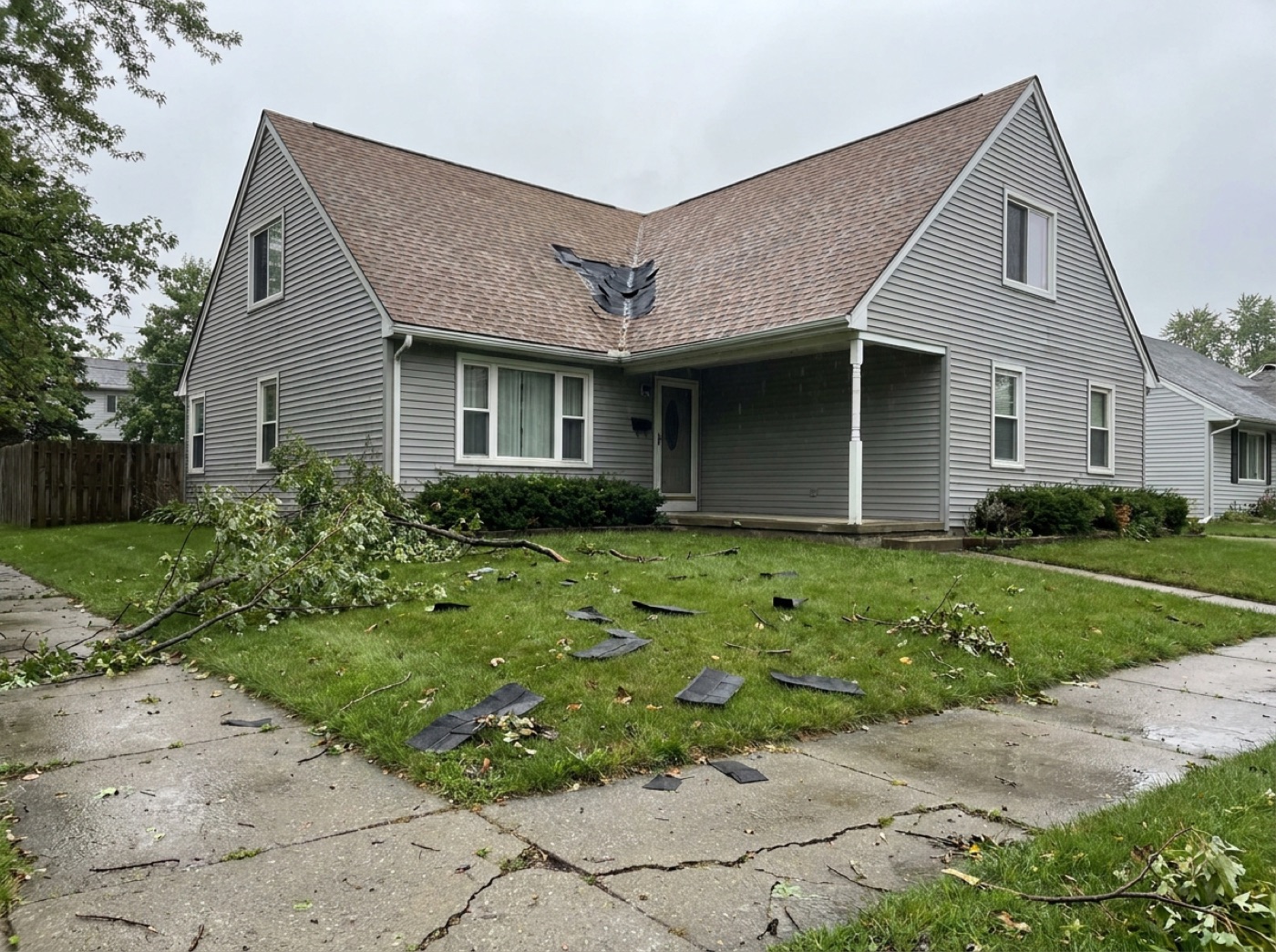
Start at ground level. Walk the yard, the driveway, and the flower beds along the house looking for shingle pieces, granules, or torn tabs that landed after the storm. Then step back and look up at the roof plane from a few different angles. A missing shingle usually reads as a slightly darker or lighter rectangle where the underlayment or bare decking is exposed instead of the surrounding shingle color. That patch is worth photographing and worth a call, because whatever is now exposed under it is not built to handle weather on its own.
Creased shingles: the sign most people miss
A crease happens when wind flutters a tab back and forth until the fiberglass mat fractures along a line, and it is the most commonly overlooked form of wind damage because a creased shingle can lie flat again once the gust passes. From the ground it looks like nothing. Up close, or in low, raking morning or evening light, a crease shows as a faint shadow line running across the tab. A creased shingle is functionally broken even though nothing is torn or missing, and it will not get better with time. Our companion guide on creased versus torn shingles covers how to read that shadow and why the distinction changes what a repair actually needs to fix.
Lifted tabs and broken seal bonds
Every shingle course is bonded to the one below it by a factory adhesive strip that activates in the sun and holds the tabs down against ordinary wind. A strong enough gust breaks that bond, and once it is broken, dust and grit contaminate the strip so it rarely reseals reliably even if the shingle presses back into place. The tell is a tab that rattles in a light breeze or one you can lift slightly by hand at the eave line, without climbing higher than a ladder allows. Our guide on lifted shingles after a storm walks through why a broken seal is really the start of the next failure, not the end of this one.
Torn or missing shingles
Past a certain wind speed a tab does not just crease, it tears loose or blows off entirely, and what is left exposed underneath, whether that is intact underlayment or bare decking, determines how urgent the situation is. One missing shingle on an otherwise sound roof is a straightforward repair. A cluster of missing shingles on one slope usually means the surrounding seal bonds took damage too, even where nothing actually blew away. Active exposure to open decking is the one scenario on this page that cannot wait for a scheduled inspection; that is what our 24/7 emergency tarping line exists for, to stop water intrusion while the permanent repair gets scheduled. Our guide on missing shingles after a storm covers how to read the loss pattern.
Granule loss as collateral evidence
Wind flutter does not just crease and lift shingles, it also scrubs granules loose from the shingle surface, and those granules end up somewhere you can actually check without a ladder: the gutter troughs, the splash blocks under downspouts, and the wash-out line along the driveway or walkway after the next hard rain. A modest amount of granule loss is normal shedding, especially on a newer roof, so this clue works best alongside the others rather than on its own. A sudden pile of granules after a specific wind event, paired with a crease or a lifted tab nearby, is a much stronger signal than granules alone. Our guide on granule loss on shingles covers how to tell normal wear from storm-driven loss.
03 / THE RIDGERidge caps and hips: the first component to fail
Ridge cap shingles bend over the highest point of the roof and take the most direct wind loading of any shingle on the structure, which is why they crack, crease, and blow off before the field shingles around them show any damage at all. From the ground, look along the silhouette of the ridge for gaps, waviness, or caps that sit at a different angle than their neighbors. Where a ridge vent runs under the caps, a section of exposed vent material or a visibly open gap is a clear sign a cap is gone.
A compromised ridge matters beyond the cap itself, because the ridge is usually where attic ventilation exhausts, and damaged caps can let wind-driven rain reach the vent opening directly. Our detailed breakdown in ridge cap shingle damage after Michigan wind storms covers what to look for from the ground and what a compromised ridge means for the attic below it.
Hips get the same treatment as ridges and for the same reason: any place where two roof planes meet at an outside angle sheds wind the same way an edge does, just diagonally instead of straight across. On a hip roof, check the hip lines with the same eye you use on the ridge, looking for caps that sit proud of their neighbors, visible gaps between caps, or a section that looks like it was pieced back together with mismatched material from a prior repair. A hip line that has already been patched once is worth a second look, because whatever weakened the original caps is still acting on the replacements.
04 / THE DETAILSFlashing, valleys, and vents
Flashing does the quiet, unglamorous work of sealing every place the roof plane is interrupted: walls, chimneys, valleys, skylights, and vent pipes. It is also where a large share of storm-caused leaks actually start, because flashing fails by flexing and separating rather than by simply blowing away. Look for step flashing along a wall that has visibly lifted away from the siding, counterflashing at a chimney that has peeled back, drip edge along the eaves that is bent or dented, and sealant joints that have cracked open where metal meets shingle.
Valley metal deserves its own look, because a valley channels more water than any other part of the roof and wind can crease or lift the shingles along its edge the same way it does in the open field. Vent stacks and pipe boots take a different kind of hit: the rubber boots can crack from wind flex on an already aging seal, and the plastic or metal caps on soil stack vents and power vents can crack or blow off entirely, leaving an open path into the attic. A flashing failure is also the classic case where the interior leak shows up weeks after the storm rather than the day of it, which our guide to wind damaged roof flashing covers in more depth, alongside the chimney-specific signs in chimney storm damage.
Skylights and dormer walls are worth the same scrutiny for the same structural reason: every place a vertical surface meets the roof plane needs flashing that flexes with the building rather than the roof, and wind loosens that connection over time even when it does not damage the skylight glass or the dormer siding itself. Look for a gap opening up along the top edge of a dormer where it meets the roof, or a bead of sealant around a skylight frame that has visibly pulled away rather than sitting flush. Both are quiet failures that tend to show up as an interior stain long before anyone notices the flashing itself.
05 / THE EDGESSoffit, fascia, gutters, and why damage clusters at the edges
Here is the physics behind the pattern mentioned in section 01. Wind moving across a roof does not push straight down on it; it accelerates over the surface and creates a negative pressure, a suction, that is strongest at the eaves, the rakes, and hardest of all at the corners, where two roof edges meet. That is why the first shingles to lift and the first ridge caps to fail are almost always along the perimeter, and it is why a careful inspector checks the corners and edges first even when the field of the roof looks untouched.
That same suction works on the trim components at the edge of the roof. Soffit panels, the underside pieces that close off the eave overhang, can loosen or drop when wind gets underneath them, especially where a fastener has already worked loose over the years. Fascia boards can pull away from the rafter tails they are nailed to. Gutters and downspouts, being long, lightweight, and mounted right at the edge where suction is strongest, are some of the most commonly damaged components in a wind event: look for sections bent or dented, hangers pulled loose, or a run of gutter that has visibly separated from the fascia along one stretch of the house. Our companion piece on roof wind uplift zones goes deeper on why the edges and corners take the load they do, and what that means for where damage tends to start on your specific roof shape.
The shape of your house changes where this shows up first. A simple rectangular roof concentrates the worst suction at its four corners, so those are the first spots worth checking on a gable roof. A house with dormers, bump-outs, or an attached garage at a different roofline has more corners than the basic footprint suggests, and each inside or outside corner where two roof shapes meet is another place wind separates and pulls. If your home has any of those features, do not stop the walk at the main roof's obvious corners; check every place the roofline changes shape, because that is where the same physics repeats itself in miniature.
06 / THE HIDDEN DAMAGEWhat you cannot see from the ground
Everything above this section can, in theory, be spotted with your feet on the ground and a pair of binoculars or a phone camera zoomed in. The honest caveat is that a real ground-level survey catches maybe half the picture. A crease that lies flat, a seal bond that broke but did not visibly lift, a ridge cap that bent without cracking its granule surface, none of these show up as a gap or a shadow from thirty feet below. They show up as a soft give under a gloved hand or a slightly different sound when tapped, which is why walking the roof itself, carefully and by someone trained to do it, finds damage a ground survey physically cannot.
The damage that costs a homeowner the most is rarely the damage they can see. It is the shingle that looks fine from the yard and is already broken where it counts.
Some of the hidden damage is not on the shingles at all. Repeated wind flutter over more than one storm can work roofing nails loose in the decking underneath, a condition sometimes called nail pop, where a fastener backs partway out and creates a small dimple or crack in the shingle above it long after the wind event that started the process. The fiberglass mat inside a shingle can also fatigue from repeated flexing the same way a piece of metal weakens from being bent back and forth, so a roof that has taken two or three notable wind events without ever being inspected can be carrying accumulated damage that no single storm would have caused on its own. None of this is visible from the ground, and most of it is not visible from a quick glance even on the roof itself, which is exactly why a trained inspection matters more than a homeowner's honest best effort.
This is also where the insurance conversation gets honest. A carrier and a homeowner can both look at the same roof from the ground and see nothing, while a close inspection finds a slope's worth of creased and unsealed shingles that are already on borrowed time. Documenting that gap with photos is exactly what a free inspection produces, and if a claim ends up being the right path, we can meet your adjuster on site so both sides are looking at the same evidence. No contractor can promise what a carrier decides, but nobody has to guess when the roof has actually been walked. Our guides on hidden roof storm damage and what you actually can check from the ground go deeper on where that line sits.
07 / THE LOCAL RECORDMacomb County's recent wind history, and what to do next
This is not a hypothetical for this county. After the severe wind storms of August 2023, Macomb County was included in federal disaster declaration DR-4757, and roofs across the area took real damage of exactly the kind described above: lifted and creased shingles, broken seal bonds, and flashing that failed quietly and leaked weeks later. Events like that are not rare here, and a roof that has gone through one or two of them without ever being inspected up close is carrying damage nobody has confirmed one way or the other.
Southeast Michigan sits in a corridor that sees organized wind events, not just isolated gusts, several times most years, and Macomb County's mix of open subdivisions, mature tree cover, and lake-influenced weather patterns means exposure varies block to block even within the same storm. A home on an open corner lot with few windbreaks nearby can take a harder hit than a similar house two streets over that happens to sit behind a tree line. That is one more reason a generic answer never fits a specific roof, and why the walk in this guide is meant to be done on your own house rather than assumed from a neighbor's experience.
The only way to turn a ground-level guess into a real answer is an inspection, and ours is $0 with no obligation. It covers the field shingles, the ridge, flashing and valleys, vents, soffit and fascia, gutters, and the attic side of the deck, with photos of everything we find. If the roof checks out clean, we tell you that. If it needs a repair, Macomb County repairs typically run $350 to $3,200 depending on scope, and you get a written price, not a replacement pitch. You can see the same ranges on our honest pricing page, model your own roof on the cost calculator, or start a storm-specific estimate directly from the homepage.
- Damage clusters at eaves, rakes, and corners because wind suction is strongest there, not because those areas are weaker.
- Creased shingles and broken seal bonds can look fine from the ground and are still functionally broken.
- Ridge caps and flashing typically fail before field shingles show any visible sign at all.
- Active exposure from missing shingles gets 24/7 emergency tarping; everything else gets a free inspection first.
- Macomb County was included in FEMA disaster declaration DR-4757 after the August 2023 wind storms, and events like it recur here.
Questions we hear most
It ranges from obvious to invisible: missing or torn shingles and bent gutters are easy to spot from the ground, while creased shingles, broken seal bonds, and bent ridge caps can look completely normal until someone gets close enough to check by hand. Damage also tends to cluster at the eaves, rakes, and corners, where wind pulls hardest on the roof surface.
Yes, and it is more common than the visible kind. A creased shingle can flutter and settle flat again, and a broken seal bond does not always leave a shingle visibly lifted. Both are functionally damaged and will not repair themselves, which is why a close inspection catches problems a ground-level look misses.
If shingles are missing and decking or underlayment is exposed, start with 24/7 emergency tarping to stop water intrusion. For everything else, a free inspection is the right first step: we document the field shingles, ridge, flashing, vents, and attic side of the deck with photos, and can meet your adjuster on site if you decide to file a claim, though no contractor can promise how a claim will be decided.
- FEMA, disaster declaration DR-4757-MI, Michigan severe storms of August 2023 (Macomb County designated). fema.gov/disaster/4757
- National Roofing Contractors Association, technical guidance for steep-slope roof systems. nrca.net
- Manufacturer technical and warranty literature for the major asphalt shingle lines: GAF (gaf.com), Owens Corning (owenscorning.com), and CertainTeed (certainteed.com).
- Haag, engineering-based damage assessment methodology for hail and wind effects on roofing. haagglobal.com