
JUMP TO A SECTION
There is a version of the roof coating pitch that treats a five-gallon pail like a bottle of aspirin: whatever hurts, spray this on it and the leak goes away. It does not work that way, and the roofs we get called back to after a bad coating job are proof. A coating is a fluid-applied membrane you roll or spray over an existing roof to seal its aging seams, reflect the sun, and add years of dry service. On a roof that is still structurally sound and, above all, dry underneath, that is a genuinely good deal. On a roof with soaked insulation, it is the fastest way to turn a repairable problem into a full tear-off, because you have just sealed the water in. This guide walks the four coating chemistries a Macomb County building owner will actually be offered, silicone, acrylic, urethane, and asphaltic, where each one earns its keep, and the one prep rule that decides whether any of them lasts. Every flat and commercial roof we install still lands inside the same published range on our honest pricing sheet; a coating is the lifecycle stage that can delay that spend, not a way to fake it.
01 / THE PREMISEWhat a roof coating actually is, and is not
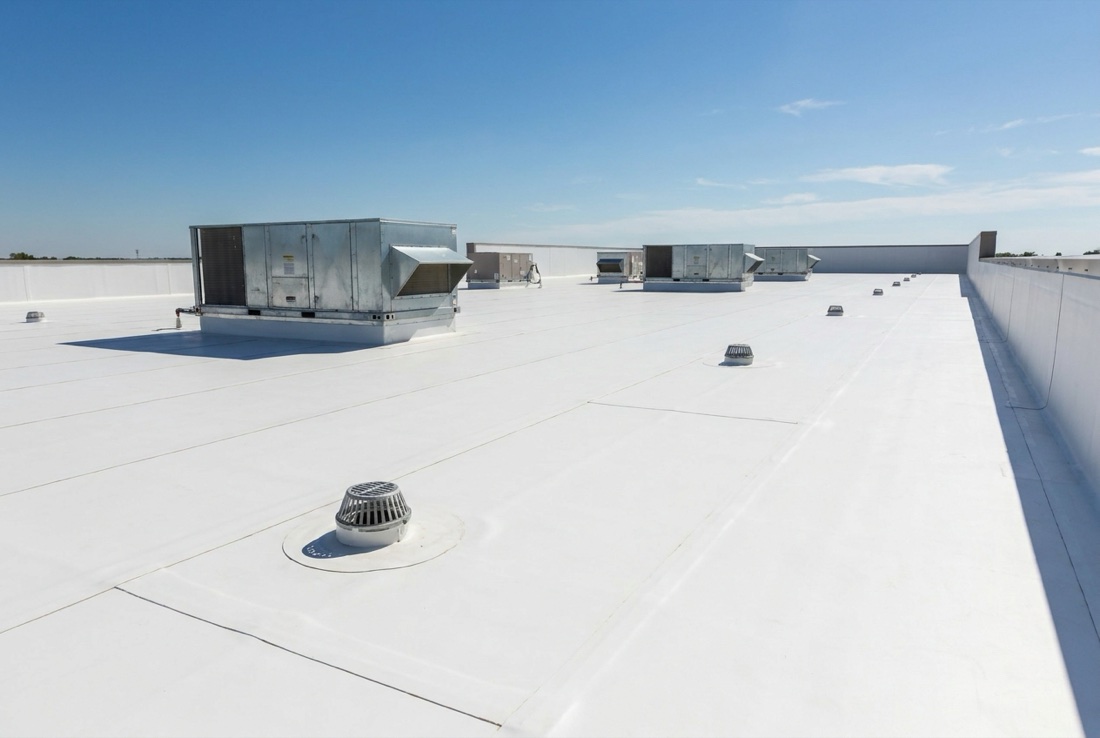
A roof coating is a liquid applied in one or more coats over an existing low-slope roof, where it cures into a seamless, flexible film bonded to the surface below. Because it goes on as a fluid, it self-flashes around penetrations, curbs, and seams that a sheet membrane has to detail by hand, and it turns a field of individual laps into one continuous skin. Most commercial coatings are also reflective, so a dark, heat-soaked roof becomes a bright one that sheds solar load instead of storing it. That combination, sealed seams plus reflectivity, is the whole value proposition.
What a coating is not is a new roof. It does not add insulation, it does not replace a wet or failing deck, and it cannot bridge a structural problem. Think of it as a restoration: it extends the roof you already have by protecting the membrane and slowing the aging that would otherwise end its life. That places coating squarely between two other options in the lifecycle. Below it sits the targeted repair, when only a seam or a penetration has failed. Above it sits full replacement, when the assembly is too far gone to save. Deciding which of the three you actually need is the real question, and our coating versus replacement guide lays out that decision tree in full.
A coating restores a roof that is dry and structurally sound. It disqualifies itself the moment the insulation underneath is saturated, because sealing wet material inside the assembly traps the moisture against the deck and accelerates rot. Before anyone talks coating chemistry, the honest first step is confirming the roof is dry, which is what a moisture survey is for.
That rule is why a reputable coating conversation never starts with a product and never starts with a price. It starts with the question of whether the roof is a candidate at all. An infrared moisture survey answers it by finding wet insulation before a single gallon is ordered, and on many roofs the survey is the difference between a restoration that lasts and a coating that fails inside a year. If the roof is dry, the next decision is which chemistry fits it, and that is where the four families diverge.
02 / THE CHEMISTRIESThe four coating families, honestly described
There are four coating chemistries a Michigan building owner is likely to be quoted, and they behave differently enough that picking the wrong one for your roof is a real mistake. Here is each one as it actually performs, not as the brochure describes it.
Silicone: the ponding-tolerant favorite
High-solids silicone is the coating most owners will be offered first, and for good reason: it tolerates standing water better than any other chemistry, which matters enormously on flat roofs that never drain perfectly. It cures into a durable, weather-stable film, resists the ultraviolet breakdown that ages other coatings, and can often be applied in a single thick coat, which cuts labor. Its honest tradeoffs are that it attracts dirt as it weathers, which dulls the reflectivity over time, and that its surface can be slick when wet. It is also fussy about what you can put over it later, because almost nothing sticks to cured silicone except more silicone. Because it is the default choice on so many Michigan roofs, we give it its own deep dive in the silicone roof coating guide.
Acrylic: the economical reflective coat
Acrylic is a water-based coating, which makes it the easiest to apply, the easiest to clean up, and usually the least expensive per gallon. It delivers excellent initial reflectivity and holds up well on a roof that drains properly. Its defining weakness is exactly the thing silicone shrugs off: acrylic does not tolerate ponding water. Because it is water-based, standing water can re-emulsify a not-fully-cured film and thin it over time, so acrylic belongs on roofs with real slope and clean drainage, not on a roof that holds a pond after every storm. It also loses a little thickness each year to normal weathering, which is built into its recoat cycle rather than being a defect.
Urethane (polyurethane): the tough, high-traffic coat
Polyurethane coatings are the abrasion champions of the group. Where silicone and acrylic can be scuffed by foot traffic and dropped tools, urethane resists physical impact and wear, which makes it the choice for roofs that get regular service traffic to rooftop equipment. Aromatic and aliphatic urethanes are often used as a two-part system, a tougher, cheaper base coat below and a color-stable top coat above. The tradeoffs are cost and handling: urethanes are typically pricier than acrylic, more sensitive to application conditions, and give off stronger odors during cure, which matters on an occupied building. For a roof that takes a beating, though, the toughness is the whole point.
Asphaltic and aluminized coatings: the traditional restorer
Asphalt-based coatings are the oldest family and are most often used to restore aging built-up and modified bitumen roofs, the systems they are chemically compatible with. Aluminized asphalt coatings add reflective flakes to a black asphalt base, cutting heat gain on a mod-bit roof without changing its fundamental character. They are economical and familiar, but they are the least reflective and generally the shortest-lived of the four, and they are not the answer for restoring a single-ply membrane. Treat asphaltic coatings as the natural maintenance coat for an asphalt-based roof rather than a universal option.
| COATING | MICHIGAN STRENGTH | WATCH ITEM |
|---|---|---|
| Silicone | Best ponding tolerance, UV-stable | Attracts dirt; only silicone re-coats it |
| Acrylic | Economical, high initial reflectivity | Poor on ponding roofs; weathers thinner |
| Urethane | Toughest against traffic and impact | Pricier, odor on occupied buildings |
| Asphaltic | Restores mod-bit and built-up roofs | Least reflective, shortest life |
03 / BY SCENARIOWhich coating wins for your roof
Chemistry only matters once you match it to the roof under it. Here is which family tends to win for the buildings we actually restore across Macomb County, assuming the roof has already passed the dry test.
A flat roof that ponds after every rain
If water stands on your roof for a day or more after it rains, silicone is almost always the answer, because it is the one chemistry engineered to live under standing water without breaking down. Acrylic in the same spot will thin and fail early, and asphaltic coatings do no better in a pond. The caution worth stating plainly is that coating a ponding roof treats the symptom, not the cause: the water that stands in summer freezes into ice lenses all winter and keeps working at the roof. A silicone restoration can buy real time on a ponding roof, but correcting why it ponds is the durable fix, and our drainage systems guide covers the drains, scuppers, and tapered insulation that solve it.
A well-drained roof where budget is the driver
On a roof with honest slope and clean drainage, acrylic often makes the most sense. It delivers strong reflectivity, goes on easily, and costs the least, and the ponding weakness that disqualifies it elsewhere simply never comes into play on a roof that sheds water. This is the classic case for a mid-life single-ply roof that is still dry but starting to show its age: an acrylic coat resets the reflectivity, seals the weathering seams, and adds years without a tear-off.
A roof with heavy service traffic
Offices, medical buildings, and anything with rooftop HVAC share a problem: technicians walk to that equipment, and every trip abrades the roof surface along the same paths. On a roof like that, urethane's impact and abrasion resistance earns its higher price, either as the whole system or as a tough base coat under a more reflective top coat. A common hybrid is a urethane base for durability with a silicone top coat for ponding tolerance and UV stability, giving you toughness where feet land and weather resistance across the field.
An aging built-up or modified bitumen roof
If your existing roof is asphalt-based, a mod-bit or an old built-up system, an aluminized asphaltic coating is the traditional, chemically compatible way to restore it and cut its heat gain. That said, silicone and acrylic systems are also formulated to go over properly prepared mod-bit today, so asphaltic is no longer the only option, just the most familiar one. For any of these, the substrate has to be clean, sound, and dry first, which brings us to the rule that quietly decides every coating job.
A coating does not fix a roof. It preserves a roof that is already worth preserving. The skill is in knowing which roof that is, and the honesty is in saying so when it is not.
04 / THE PREPThe surface-prep truth nobody advertises
Here is the part of the coating business that no product label emphasizes, because it is unglamorous and it is where most failures actually happen. A coating is only as good as the surface it bonds to, and coatings fail on roofs that are dirty, wet, or saturated far more often than they fail on their own chemistry. Skipping prep is how a cheap coating quote gets cheap, and it is why the same product can last for years on one roof and peel within a season on another.
Clean comes first
Every coating needs a clean substrate to adhere, which means the roof has to be pressure-washed and, for many systems, treated with a primer matched to the membrane below. Dirt, chalk, oxidation, and biological growth are all bond-breakers. A coating rolled over a dirty roof is bonded to the dirt, not the roof, and it will let go in sheets when the film starts to move with temperature. On a weathered single-ply, the cleaning and priming step is not optional prep to be trimmed from the bid; it is the job.
Dry is non-negotiable
The surface has to be dry when the coating goes on, and just as important, the assembly underneath has to be dry before you ever commit to coating at all. This is the rule that sends people to a moisture survey. If the insulation below the membrane is holding water, a coating seals that water in, and trapped moisture rots the deck and blisters the new film from below. Wet insulation is a hard disqualifier: no coating chemistry can overcome it, and any contractor willing to coat over a saturated roof is selling you a future tear-off. A moisture survey is how a saturated roof gets caught before the money is spent.
Michigan's window is short
Coatings cure within a temperature and humidity window, and a Michigan calendar is not generous with it. Most systems want surface and air temperatures above a manufacturer-specified minimum for a period after application, and dew and early frost cut the workable day short in fall. That is why coating projects here are scheduled with the season in mind: a coat applied too late in the year, or ahead of a rain that hits before it cures, is a coat that never develops its rated performance. Booking the work while the weather still cooperates is part of doing it right.
05 / THE LIFECYCLERecoat cycles and where coating sits in a roof's life
One of the honest advantages of a coating is that it is renewable. A membrane roof reaches a point where the only option is tear-off and replacement. A coated roof, by contrast, weathers down over years and can then be washed and recoated, often without stripping what is already there, resetting the clock for another cycle. That is the mechanism behind the sustainability pitch for coatings: a well-maintained coated roof can sometimes be recoated indefinitely rather than sent to a landfill, as long as the underlying assembly stays dry and sound.
Each chemistry has its own recoat rhythm, and the smart move is to plan for it rather than treat the first coat as permanent. Acrylic loses film thickness to weathering and expects a maintenance recoat on a cycle; silicone weathers more slowly but still benefits from eventual recoating; urethane holds its toughness well; asphaltic is the shortest-lived and needs attention soonest. Any specific interval belongs in your project documents from the manufacturer of the system you actually choose, not in a memorized number, because it varies by product, mil thickness, and how hard your roof lives. What matters for planning is the principle: budget for a recoat, and the roof keeps performing.
This is also where coating fits into a broader maintenance mindset. A coated roof that is inspected, kept clean, and recoated on schedule outlasts one that is coated once and forgotten, the same way any roof rewards attention. If you manage the building, folding coating maintenance into a documented program keeps the restoration honest and preserves the paper trail that supports a future sale or warranty conversation. The alternative, running the coat to failure and then discovering wet insulation, is how a restorable roof becomes a replacement.
06 / THE NUMBERWhat it costs, and getting a real number
Owners always want a price stapled to the word coating, and the honest framing is comparative rather than a fixed figure. A restoration is a lifecycle move precisely because it costs a fraction of a tear-off while extending the roof you already own; that is the entire economic case for doing it. But it only pencils out on a roof that qualifies. When the insulation is saturated, seam failure is widespread, or the deck itself is going, coating is throwing good money after bad, and replacement is the sound spend. A full flat or commercial roof replacement in Macomb County runs $9,000 to $16,000 installed, and larger or unusual roofs can run higher. That range is the reference point a coating is measured against, not a number a coating adds to.
is where most Macomb County flat roof replacements land when a coating is no longer the right call. A restoration aims to postpone that spend on a roof that still qualifies, not to replace it. Run a ballpark in about 60 seconds with the instant estimator or the cost calculator.
If the roof is only leaking in a spot or two and the assembly under it is dry, you may not be looking at a coating or a replacement at all, just a repair. Flat roof repairs run $350 to $3,200, and larger or complex repairs can run higher. For owners spreading the cost of a full replacement when a coating is no longer viable, financing is available subject to approval. As an illustration only, a $13,500 project financed over a 10 year term at 9.9% APR works out to about $178 per month. That example is not an offer of credit; your rate, term, and approval depend on the lender and your credit profile.
There is only one way to know whether your roof is a coating candidate, which chemistry fits it, and whether it is dry enough to coat at all, and it is not a brochure. It is someone on the roof, checking the drainage, the seams, the substrate, and above all whether the insulation is dry. Our inspection is $0 with no obligation, and if the roof needs a repair or a full replacement instead of a coating, that is exactly what we will tell you. When you are weighing the options, our coating versus replacement guide is the decision framework, and you can browse the rest of the guides library or head back to the roofing services hub to see how restoration fits the full lineup. Active leaks in the meantime are held off with 24/7 emergency tarping until a real repair can be scheduled.
- A coating is a restoration, not a new roof; it extends a dry, sound roof and cannot save a wet or failing one.
- Silicone tolerates ponding, acrylic is economical on well-drained roofs, urethane is toughest against traffic, and asphaltic restores mod-bit and built-up roofs.
- Saturated insulation is a hard disqualifier; sealing water inside the assembly rots the deck, which is why a moisture survey comes first.
- Coatings fail on dirty, wet, or saturated roofs far more than on their own chemistry, so cleaning and priming is the job, not optional prep.
- Coating is the lifecycle stage between repair ($350 to $3,200) and full flat replacement ($9,000 to $16,000); a free inspection tells you which one you need.
Questions we hear most
There is no single best coating, because the right chemistry depends on the roof. Silicone suits roofs that pond, acrylic suits well-drained roofs on a budget, urethane suits roofs with heavy service traffic, and asphaltic coatings restore aging built-up and modified bitumen roofs. The most important factor is not the product at all but whether the roof is dry underneath, which a free inspection or moisture survey confirms before any coating is chosen.
No. Coating over saturated insulation seals the water inside the assembly, where it rots the deck and blisters the new film from below. Wet insulation is a hard disqualifier that no coating chemistry can overcome, which is why an honest coating job starts with confirming the roof is dry, often with an infrared moisture survey. If the insulation is wet, the roof needs replacement, not a coating.
On a roof that qualifies, yes. A restoration costs a fraction of a tear-off and extends a dry, sound roof for years, which is the whole economic case for coating. But it only pencils out on the right roof; when the insulation is saturated or seam failure is widespread, coating wastes money and replacement is the sound spend. A full flat or commercial replacement in Macomb County runs $9,000 to $16,000 installed, and a free inspection tells you which path fits your roof.
- FEMA, disaster declaration DR-4757-MI, Michigan severe storms of August 2023 (Macomb County designated). fema.gov/disaster/4757
- SPRI, single-ply and low-slope roofing industry standards. spri.org
- Manufacturer technical and warranty literature for the major asphalt shingle lines: GAF (gaf.com), Owens Corning (owenscorning.com), and CertainTeed (certainteed.com).