
JUMP TO A SECTION
Silicone is the most-asked-about restoration on flat roofs, and for good reason: on the right candidate it seals aging seams, reflects summer heat, and buys years for a fraction of what a tear-off costs. But silicone is not magic, and the page that sells it rarely tells you where it fails. This guide is the honest version, written for Macomb County buildings that spend a third of the year below freezing and hold standing water the rest of it. It covers what high-solids silicone actually is, why it tolerates ponding better than any other coating, the surface prep that makes or breaks the job, the tradeoffs nobody mentions, and the fall deadline that quietly decides whether you coat this year or wait until next. All of it comes back to one honest question, which is whether your roof is even a candidate, and that gets answered on the roof, not in a brochure.
01 / THE DEFINITIONWhat a silicone roof coating actually is
A silicone roof coating is a fluid-applied, high-solids silicone that is sprayed or rolled over an existing membrane and cures into a single seamless rubbery skin across the whole roof. It is a restoration, not a new roof: it renews a membrane that is still structurally dry and sound, sealing the aging seams and small breaches that let a good roof start to weep. It belongs on the lifecycle timeline between a repair and a full replacement, and the fastest way to understand where it fits is our roof coating versus replacement guide, which draws the line between the two.
The word that matters most in that description is solids. When silicone cures, the solvents and moisture carriers flash off and what stays behind on the roof is the solids content. A high-solids silicone leaves most of what you sprayed on the roof, which is why silicone can build a usable, waterproof film in a single pass where thinner coatings need two or three coats to reach the same thickness. That single-coat capability is a real labor advantage on a large roof, and it is one reason silicone has become the default coating conversation for commercial buildings. For the full menu of coating chemistries and how silicone compares to acrylic, urethane, and asphaltic products, our commercial roof coatings overview lays them side by side.
Silicone is a high-solids, fluid-applied restoration that cures into one seamless film. It renews a dry, sound roof for a fraction of a tear-off. It does nothing for a roof with wet insulation underneath, and no amount of silicone changes that.
That last point is the honest guardrail on the whole topic. A coating restores the surface of an assembly; it cannot dry out what is already soaked inside it. If the insulation under the membrane is saturated, sealing a silicone skin over the top traps that moisture against the deck and accelerates the rot instead of stopping it. Which is why the first step on any coating job is not a price, it is finding out whether the roof is dry, and why an infrared moisture scan often precedes a coating quote rather than following it.
02 / THE MICHIGAN CASEWhy silicone suits a Michigan flat roof
Silicone earned its place on low-slope buildings by being good at the two things Michigan roofs suffer most: standing water and temperature swings. Both deserve a plain explanation, because they are the reasons silicone gets specified here instead of a cheaper coating.
It tolerates ponding better than any other coating
Most coatings soften, re-emulsify, or slowly wash away where water stands on them. Cured silicone does not: it is essentially unbothered by ponded water, which is the single biggest reason it dominates the coating market for flat roofs that drain poorly. That is a large share of the roofs in metro Detroit, because low-slope commercial roofs almost always develop a few birdbaths over their life. Standing water is still a problem worth correcting at its source, and our guide to ponding water on a flat roof walks the fix ladder from drain cleaning to added scuppers to re-sloping. But where a roof ponds and a full drainage correction is not in the budget this year, silicone is the coating that survives the water rather than dissolving in it.
It reflects heat and rides the freeze-thaw
A bright silicone surface reflects summer sun instead of absorbing it, which eases the cooling load on the space below and slows the heat aging that punishes dark membranes. That reflectivity is a genuine benefit on a sun-exposed roof. The colder half of the story matters just as much here: a Michigan roof can swing sixty degrees between a January night and an April afternoon, and every one of those cycles flexes the membrane and works at its seams. A cured silicone film stays flexible through that cycling rather than cracking, which is why it holds up on a roof that expands and contracts hard all winter. It will not repair a structural problem, but as a surface that has to live through freeze-thaw, silicone is well suited to the climate.
Silicone is the coating you choose when the roof ponds and the deck is still dry. Get either half of that wrong and you have bought an expensive coat of paint.
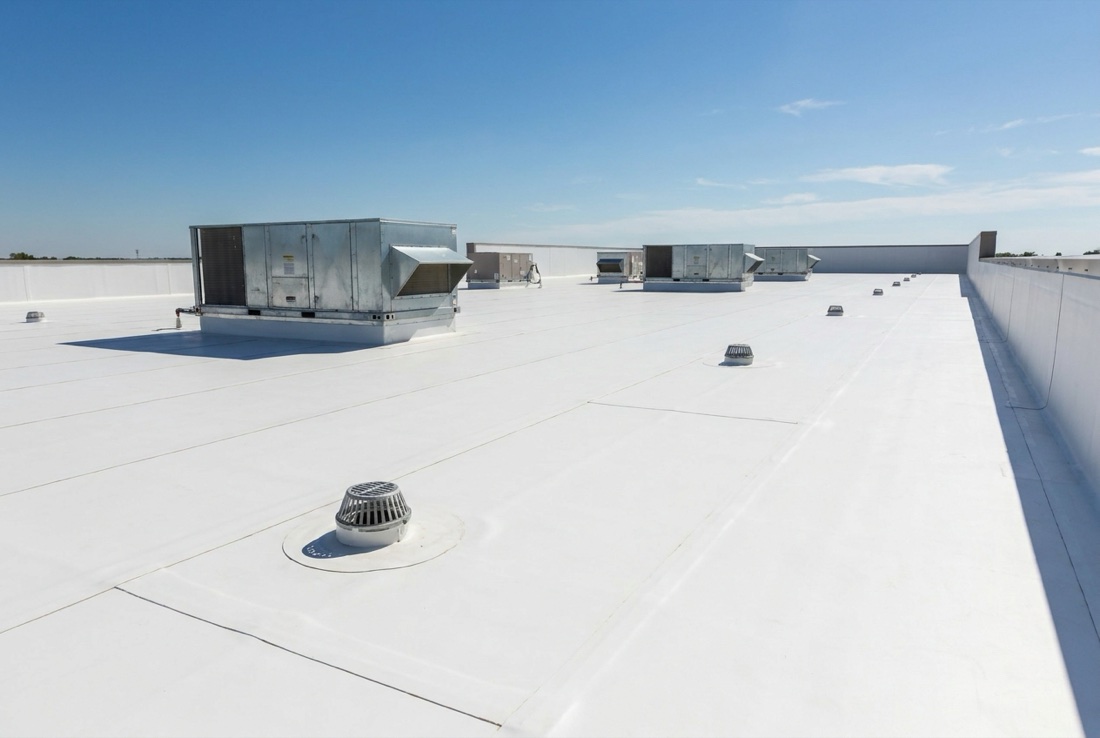
03 / THE PREPSubstrate and surface prep: where coatings live or die
If there is one truth about roof coatings that the sales brochure buries, it is this: the coating almost never fails because the product was bad. It fails because it was applied to a dirty, wet, or wrong surface. Silicone bonds to what it touches, and if what it touches is grime, a coating that should have lasted years peels in months. Prep is not a step you can trade away for a lower price, and the honest way to compare two coating quotes is to compare how each one prepares the roof, not just the gallons of silicone on the line item.
The prep that applies to every roof
Regardless of what the roof is made of, the surface has to be genuinely clean and dry before silicone goes down, which on a real roof means a power wash and often a detergent scrub to strip off the film of dirt, chalk, and biological growth that every weathered membrane carries. Every failing seam, split, and open detail is repaired first, because a coating bridges a hairline, not a gap. Pitch pockets and penetrations are reinforced with a base layer and fabric where needed. Only then does the field coat go on. Skip the wash and the silicone bonds to the dirt instead of the roof, and the dirt is what lets go.
Prep and adhesion by substrate
What the roof is made of changes the prep, and a crew that treats every roof the same is a crew to be wary of. On TPO and other single-ply, weathered thermoplastic develops a surface layer that a coating will not grip, so the sheet must be cleaned and, on many products, primed before silicone will adhere reliably. On EPDM rubber, the black membrane holds oils and a chalky film that fight adhesion, so thorough washing and the manufacturer's specified primer are not optional. On modified bitumen and built-up, the granulated or asphaltic surface usually accepts silicone well once cleaned, though bleed-through can require a bleed-blocking base coat. On metal, the enemies are rust and oil: the panels are cleaned, rusted areas treated, and fasteners and seams detailed before the field coat, since a coating over active rust just hides the corrosion for a while. The common thread is that adhesion is earned by preparation, and the correct primer for the substrate is part of the job, not an upsell.
Be cautious with any coating quote that does not spell out the wash, the seam repairs, and the primer for your specific membrane. A price that looks low because it skips prep is not a bargain; it is a coating that fails early and takes your money with it. Ask what happens to the roof before the first drop of silicone is sprayed.
04 / THE TRADEOFFSThe tradeoffs nobody puts in the brochure
Silicone is a strong product, but honest advice means naming its weaknesses, because they are real and they matter to how the roof behaves for years after the crew leaves.
Dirt pickup dulls the reflectivity
Silicone is notorious for holding onto dirt. The same surface chemistry that shrugs off water also grabs airborne grime, so that bright reflective white you paid for goes gray within a season or two as dust and pollen settle and stay. The waterproofing is unaffected, but a good part of the energy benefit fades as the surface dulls, and owners who were sold on reflectivity are sometimes surprised by how quickly a silicone roof stops looking white. It is a cosmetic and efficiency tradeoff, not a leak risk, but it is worth knowing before you sign.
It gets slippery, especially wet
Cured silicone is slick, and it is genuinely slippery when it is wet, frosted, or dewy. On a roof that people walk regularly to service rooftop equipment, that is a safety consideration, and it is a real one in a climate where the roof is frosted or damp for much of the year. The usual answer is broadcasting granules into the coating along the walking paths to add traction, or planning walkway pads over the routes to equipment. It is a solvable problem, but it has to be planned for rather than discovered the first frosty morning a technician goes up.
You can only recoat with silicone
Silicone's best long-term feature is that it is recoatable: when the film eventually thins, you clean it and apply a fresh silicone coat to renew the roof again, extending the life without a tear-off. The catch buried in that benefit is that almost nothing else sticks to cured silicone. Once a roof is siliconed, you are on the silicone path for future work, because other coatings and many adhesives will not bond to it. That is fine if silicone is the right long-term plan, but it is a commitment worth making on purpose rather than by accident.
05 / THE TIMINGThe fall deadline, the temperature window, and cost
This is where the Michigan calendar stops being a footnote and becomes the whole decision. Silicone is a wet product that has to cure, and curing depends on temperature and moisture, which in this state means the application window closes earlier than owners expect.
Why fall is a real deadline
Silicone needs surface and air temperatures above a manufacturer-specified minimum, and it needs the roof to stay dry long enough to cure after it goes down. Both of those get scarce as fall turns to winter in metro Detroit. Cold slows the cure, heavy dew and early frost can ruin a fresh application overnight, and once the roof will not reliably stay warm and dry through a cure window, the job simply cannot be done correctly until spring. That makes the coating decision seasonal in a way replacement is not: a building owner who decides in September is usually choosing a slot in a closing window, while one who calls in November is often booking for next year. If a coating is the plan for this year, the honest advice is to move on it before the weather makes the decision for you. The exact temperature thresholds come from the product data sheet, not from memory, and they are one of the things a real inspection nails down.
What it costs, and the honest alternative
Owners always want a price stapled to the word coating, and here is the honest frame. A silicone restoration is meaningfully cheaper than a tear-off because you are renewing the roof you have instead of hauling it to a landfill and building a new assembly, which is exactly why it is worth considering on a dry, sound roof. But the actual figure depends entirely on the roof: its size, its condition, how much seam and detail repair it needs before the field coat, and the substrate and primer it calls for. Because those swing so widely, we price a coating from the roof rather than from a chart, and the inspection that produces that number is $0 with no obligation.
The alternative to know is replacement, because a coating is not always the right call. When the insulation is saturated, when seams are failing across the whole field, or when the deck itself is going, the money spent coating a dying roof is wasted, and a full flat or commercial replacement in Macomb County runs $9,000 to $16,000 installed, with larger or unusual roofs running higher. Our flat roof replacement cost guide breaks down what moves a project inside that range, and financing is available subject to approval: as an illustration only, a $13,500 project financed over a 10 year term at 9.9% APR works out to about $178 per month. That example is not an offer of credit; your rate, term, and approval depend on the lender and your credit profile. You can run a ballpark against your own roof in about 60 seconds with the instant estimator or the cost calculator, and the published ranges behind both live on our honest pricing sheet.
The only way to know whether your building is a silicone candidate or a replacement is someone on the roof: checking whether the insulation is dry, how the seams and details are holding, what the substrate is, and whether the surface can be prepped to take a coating this season. If the roof is dry and sound, a coating may be the smart, lower-cost move. If it is wet or failing, we will tell you that instead of selling you a coating that cannot save it, and an active leak in the meantime is held off with 24/7 emergency tarping until the real work can be scheduled. From here you can compare paths in the coating versus replacement guide, browse the full guides library, or head back to the roofing services hub to see how flat and commercial work fits the rest of the lineup.
- Silicone is a high-solids, fluid-applied restoration that renews a dry, sound roof; it does nothing for a roof with wet insulation underneath.
- It tolerates ponding better than any other coating and stays flexible through Michigan freeze-thaw, which is why it dominates flat roof restorations here.
- Prep, not product, decides success: the roof must be washed clean and dry, seams repaired, and the correct primer used for TPO, EPDM, mod-bit, or metal.
- Know the tradeoffs: silicone holds dirt and dulls, gets slippery when wet, and can only ever be recoated with more silicone.
- Fall is a real deadline because silicone needs warm, dry cure time; coating is priced from a free inspection, and full flat replacement runs $9,000 to $16,000.
Questions we hear most
Service life depends on the film thickness applied, the condition of the roof underneath, and how well the surface was prepped, so an honest number comes from looking at your roof rather than a chart. The real advantage is that silicone is recoatable: when the film eventually thins, the roof is cleaned and a fresh silicone coat renews it again without a tear-off. A free inspection is the way to judge whether your roof is a candidate and what to expect.
Yes, and that is one of silicone's biggest strengths. Cured silicone is essentially unbothered by standing water, which is why it dominates coatings for flat roofs that drain poorly. The important caveat is that the insulation under the membrane must be dry; a coating seals the surface but cannot dry out saturated insulation, so a roof with wet insulation needs repair or replacement, not a coating. Correcting the drainage at its source is still the better long-term fix.
Silicone is a wet product that must cure, and curing needs surface and air temperatures above a manufacturer-specified minimum plus enough dry time before rain, dew, or frost. As fall turns to winter in metro Detroit, those conditions disappear, and a coating applied too cold or too late can fail to cure correctly. That makes coating seasonal: if it is your plan for the year, it is worth scheduling before the weather closes the window until spring.
- FEMA, disaster declaration DR-4757-MI, Michigan severe storms of August 2023 (Macomb County designated). fema.gov/disaster/4757
- SPRI, single-ply and low-slope roofing industry standards. spri.org