
JUMP TO A SECTION
The 1,500 square foot ranch is the quiet workhorse of Macomb County's housing stock: single story, low and wide, the house that filled the county's postwar subdivisions and still trades hands every week from Warren to Chesterfield. It is also one of the easiest roofs in the region to price honestly, because the shape is simple and the access is safe. This guide does the arithmetic out loud. It walks from your home's floor area to the number of squares actually sitting on the roof, places a typical ranch inside our published price canon, and then names the specific things that pull the final figure below the middle of the band or push it above.
01 / THE SHORT ANSWERWhat a 1,500 square foot ranch roof costs here
For a straightforward single story ranch of about 1,500 square feet, a full asphalt shingle replacement in Macomb County usually lands in the lower and middle part of the county-wide band. The whole asphalt canon runs $9,000 to $18,000 installed, and most homes land $12,000 to $16,000. A simple ranch with one layer to tear off, sound decking, and an uncomplicated roofline tends to sit toward the bottom half of that most-homes range, while the same house with two old layers, rotted decking, or a steep newer addition can climb toward the top of the full band. Every figure is the complete installed job: tear-off, disposal, underlayment, ice and water barrier, flashing, ventilation, the shingles, and the labor.
is where most Macomb County asphalt roofs land, and a simple 1,500 square foot ranch commonly sits in the lower half of that band within the wider $9,000 to $18,000 canon. Get your own ballpark in about 60 seconds with the instant estimator.
Shape decides more of this than size does. A 1,500 square foot two story carries roughly half the roof a 1,500 square foot ranch does, and the cost to reshingle a 1,500 square foot house runs that split in squares. The reason a range this wide still applies to one house size is that the square footage of living space does not price a roof. Two 1,500 square foot ranches on the same street can carry different roof areas, different pitches, and very different histories under the shingles. Here is the standing price canon those numbers come from, the same ledger on our honest pricing sheet:
Every line there is an installed price for the complete job, not a materials-only teaser, and larger or complex repairs can run higher than the range shown. To turn the asphalt band into a number for your specific ranch, you need the one thing the ranges leave out: how many squares of roof you actually have. That is where we start.
02 / THE GEOMETRYFrom 1,500 square feet to roof squares
Roofers do not price in house square footage. They price in squares, and a square is 100 square feet of roof surface. The trap in a size-based search like this one is assuming your roof has 15 squares because your house has 1,500 square feet of floor space. It almost never does. The roof is larger than the floor plan for two reasons, and both push the square count up.
Pitch adds surface you cannot see from the ground
A roof is a slope, and a slope covers more area than the flat rectangle under it. Roofers account for this with a pitch multiplier. A gently sloped ranch roof around 4/12 carries a multiplier near 1.06; a common 6/12 roof near 1.12. In plain terms, the angle alone adds six to twelve percent of surface over the footprint. Most Macomb County ranches wear a low, shallow pitch, which is part of why they price efficiently, but even a shallow roof carries more surface than the number on your tax bill.
Overhangs add the rest
The roof also extends past the walls at the eaves and rake edges, another band of surface the footprint never counted. Put the pitch multiplier and the overhang together and a single story home with 1,500 square feet of living space typically carries roughly 18 to 22 squares of roof, meaning about 1,800 to 2,200 square feet of surface to shingle. That is the number a crew actually prices, and it is the reason a budget built by multiplying a per-foot figure by 1,500 comes out low. That gap between footprint and roof area is also why a single story ranch and a two story house with the same listed square footage are never the same job. The cost to roof a ranch vs a colonial works that comparison out.
A quick example shows the gap. Say you set a budget by multiplying an online per-foot number by your home's 1,500 square feet. The crew that measures the roof finds 20 squares, or 2,000 square feet of surface, a third more area than you priced. The bid comes back a third higher and feels padded, when nothing was padded at all: you simply fed the math the wrong, smaller area. If you want to measure it properly before anyone visits, our cost calculator runs the canon ranges against a real roof size, and the larger scenarios in our 2,000 square foot home cost guide show how stacking floors changes the picture.
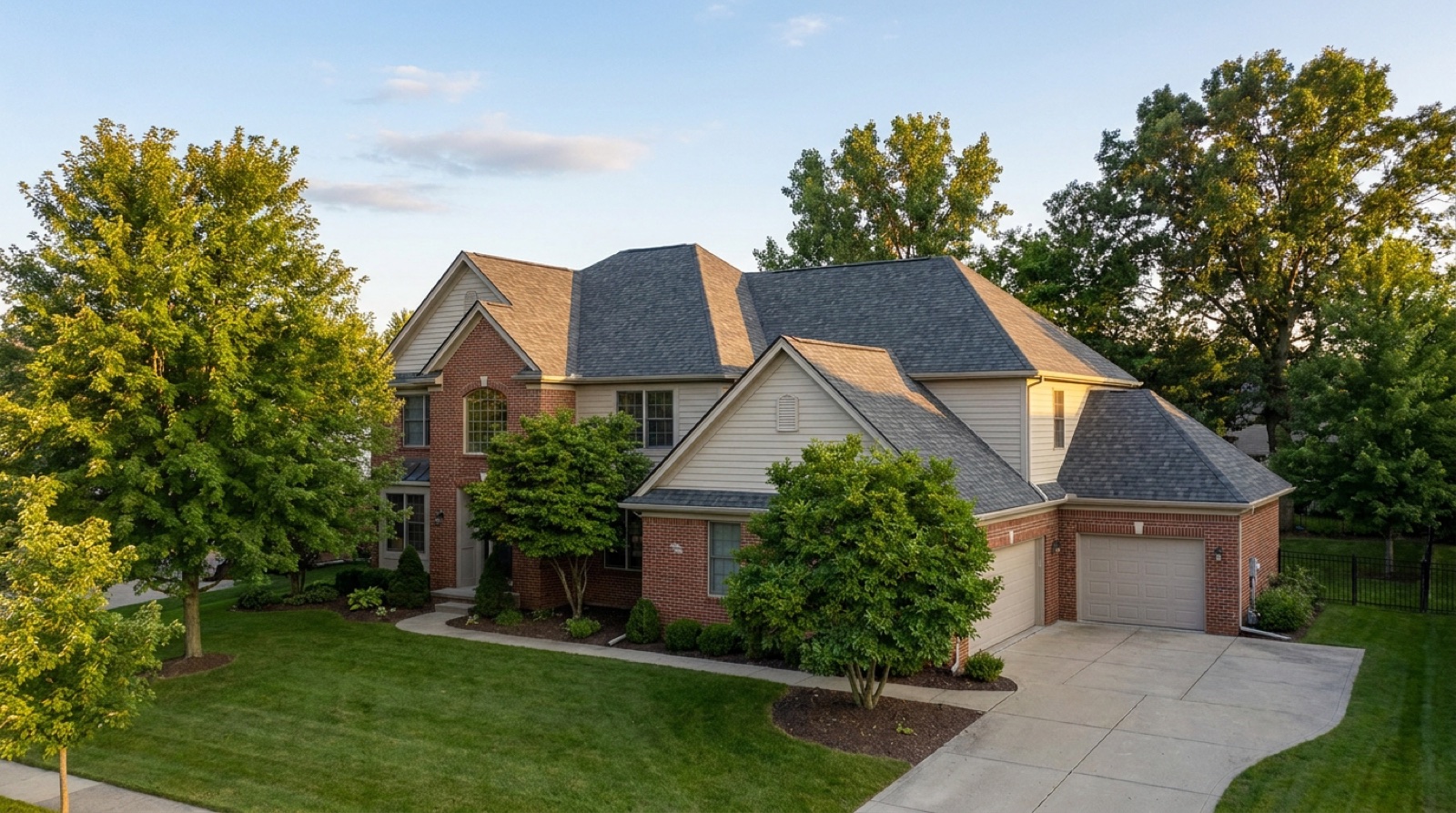
03 / THE BASE CASEWhy a simple ranch is an efficient reroof
Once you know the square count, the ranch's virtues become clear. Everything that makes a roof expensive to work on, height, steepness, and complexity, is exactly what a classic ranch lacks. This is why a straightforward ranch tends to sit in the friendlier half of the price band rather than at the top of it.
Single story, safe access
A one story roof is reached from a standard ladder, staged from the ground, and torn off into a dumpster placed a few steps away. There is no second story staging, no carrying bundles up two flights, and less time lost to fall protection setup. Labor is a large part of any roofing bill, and safe, quick access keeps those hours down.
A walkable pitch
Most Macomb County ranches carry a low hip or gable roof a crew can walk upright. A walkable pitch shingles faster than a steep one, which needs harnesses, roof jacks, and slower movement. The shallow angle also adds less surface area for the same footprint. Both effects work in your favor at pricing time. The brick ranch replacement cost guide digs deeper into why the county's signature house is so economical to reroof.
A simple roofline
A plain ranch is often a single rectangle with a hip or gable, one or two penetrations, and a straightforward chimney. Fewer valleys, dormers, and wall intersections mean less hand-flashed detail work, which is some of the slowest and most skilled labor on any roof. A cut-up roof of the same square count is a different, costlier job, a point our replacement cost guide breaks down factor by factor.
04 / THE UP-DRIVERSWhat pushes a ranch above the band
A ranch earns its low placement only when the simple case holds. The same house can climb toward the top of the $9,000 to $18,000 canon when the roof carries history the search-bar estimate never sees. Here are the usual culprits, roughly in the order they show up on a real ranch.
A second layer to tear off
Michigan practice caps a roof at two layers, so a ranch reroofed on a budget decades ago often carries a second layer of old shingles. Everything must come off before new shingles go down, and the tear-off crew is handling twice the weight and twice the disposal volume. A double tear-off is one of the most common reasons a simple ranch quote lands higher than the owner expected, which is why a good estimate always states in writing how many layers it assumes.
Decking that needs replacing
Under the shingles is the wood deck, and no one can see all of it until tear-off. Older ranches sometimes have board or plank decking with gaps, or soft and delaminated sheathing that must be replaced per sheet before the new roof goes on. This is the single most common source of legitimate mid-job cost change, and a fair quote states the per-sheet decking price up front so a surprise on the deck is not a surprise on the invoice.
An aging chimney
Many ranches carry a brick furnace chimney that needs new flashing at every reroof, and on older homes the masonry itself may need attention before flashing will seal. If the chimney is no longer in use, some owners choose to remove it during the reroof rather than pay to flash it forever. Either path adds to the base number, and both are worth pricing while the crew is already on the roof.
Added complexity
Not every ranch is a plain rectangle. Additions, an attached garage at a different pitch, bay windows, and later dormers all add valleys and flashing that pull the number up. None of these are hidden fees; they are simply more roof and more detail than the base case, and they are exactly what an on-site measurement captures that a size-based estimate cannot.
This is also the fair way to compare two quotes on the same ranch. Any two honest bids should each account for the roof size in squares, the pitch, the number of existing layers and the tear-off that implies, a stated per-sheet decking allowance, the material tier, the flashing at every penetration, and the local permit. Line those items up side by side and the quotes usually explain their own difference. A bid that comes in thousands cheaper than the others is rarely a better deal on the same work; it is almost always missing one of those lines, and the missing line reappears later as a leak, a change order, or a roof that ages early from a starved attic. On a simple ranch there are not many places for a real cost to hide, which is exactly why a lowball stands out.
Two identical 1,500 square foot ranches can price thousands apart, and both bids can be fair. The difference is almost always layers, decking, and the chimney, not the salesman.
05 / THE OUTBUILDINGSThe detached garage question
One driver deserves its own section because it prices counterintuitively: the detached garage that sits on so many older Macomb County lots. Homeowners assume a small garage roof is cheap, then get a per-square figure that looks higher than the house, and conclude the roofer is padding it. The economics explain why, and understanding them saves real money on a property that carries both a house and an outbuilding.
Every roofing job carries fixed costs that do not shrink with the roof: mobilizing a crew, delivering material, a dumpster, driveway protection, and a minimum profitable day of work. Spread those over a small garage and the per-square-foot figure climbs, even though the total dollar amount stays modest. The temptation on an outbuilding is to overlay new shingles on the old to save money, but a layover only postpones a full tear-off and can hide decking problems underneath. The cheapest honest path is almost always to pair the garage with the house reroof, so one mobilization covers both and the fixed costs are shared. If you are budgeting the whole property, price the house and the garage together rather than as two separate visits.
06 / THE MATERIALMaterial and financing at this size
Most 1,500 square foot ranches in the county are shingled with architectural asphalt, the sweet spot of wind rating, appearance, and price, and that is the material the canon band above assumes. Stepping up to a premium or designer asphalt line raises the per-square cost modestly; stepping all the way to metal moves the whole project into its own canon range of $18,000 to $30,000, because the panels, trim, and skilled labor cost more in exchange for a roof that typically outlasts two or three asphalt roofs. On a modestly sized ranch, the smaller square count keeps even an upgrade from running away, which is part of why owners planning to stay for decades sometimes make the jump here.
Whatever the material, most homeowners do not pay for a roof out of savings, and financing turns a five figure project into a monthly line. As an illustration only, a $13,500 roof financed over a 10 year term at 9.9% APR works out to about $178 per month:
That example is an illustration only, not an offer of credit. Financing is subject to approval, and your actual rate, term, and payment depend on the lender and your credit profile. When you get your free quote, ask us to run your real figures against the material you are considering.
- A simple 1,500 square foot ranch usually lands in the lower half of the $12,000 to $16,000 most-homes band, inside the wider asphalt canon of $9,000 to $18,000.
- Your roof is bigger than your floor plan: pitch and overhangs put a 1,500 square foot ranch at roughly 18 to 22 squares of surface, not 15.
- Single story access, a walkable pitch, and a simple roofline are what keep a classic ranch in the friendly half of the price band.
- A second layer, rotted decking, an aging chimney, and added complexity are the four things that push a ranch toward the top of the range.
- Pair a detached garage with the house reroof to share fixed costs, and remember the only exact number comes from an inspection, which is $0 with no obligation.
07 / THE REAL NUMBERGetting your ranch's real price, free
Everything above narrows the range. Only one thing produces your actual number: someone on your roof counting squares, reading the pitch, checking the flashing and ventilation, and looking at the attic side of the deck. Our inspection is $0 with no obligation, and it comes with photos of whatever we find. If the roof only needs a repair, and repairs here run $350 to $3,200, that is what we will tell you, not a replacement pitch.
If you want a ballpark before anyone visits, start with the instant estimator, which uses these same published ranges, or browse the rest of the cost library from the roofing services hub and our guides section. A 1,500 square foot ranch is one of the most predictable roofs in the county to price. The predictability comes from measuring it, not from guessing at its square footage.
Questions we hear most
A simple single story ranch of about 1,500 square feet usually lands in the lower half of the $12,000 to $16,000 most-homes band, inside the wider asphalt canon of $9,000 to $18,000 installed. A single layer to tear off and sound decking keep it low; two old layers, rotted decking, or an aging chimney push it up. The only exact figure comes from a free on-site inspection.
Because a roof is sloped and overhangs the walls. A pitch multiplier adds surface for the angle, and the eaves and rakes add more past the footprint. A 1,500 square foot ranch typically carries about 18 to 22 squares of roof, which is 1,800 to 2,200 square feet of surface, so pricing off your living-space number alone comes out low.
Usually yes. Every job carries fixed costs like mobilizing a crew, a dumpster, and driveway protection that do not shrink with a small roof, so a garage priced on its own can look expensive per square. Pairing it with the house reroof shares those costs across one mobilization. We can price both together on the same free inspection.
- Macomb Roofing Pros 2026 price canon, installed ranges by system: asphalt $9,000 to $18,000 (most homes $12,000 to $16,000), metal $18,000 to $30,000, tile and slate $20,000 to $36,000, flat and commercial $9,000 to $16,000, repairs $350 to $3,200.
- National Roofing Contractors Association, technical guidance for steep-slope roof systems. nrca.net