
JUMP TO A SECTION
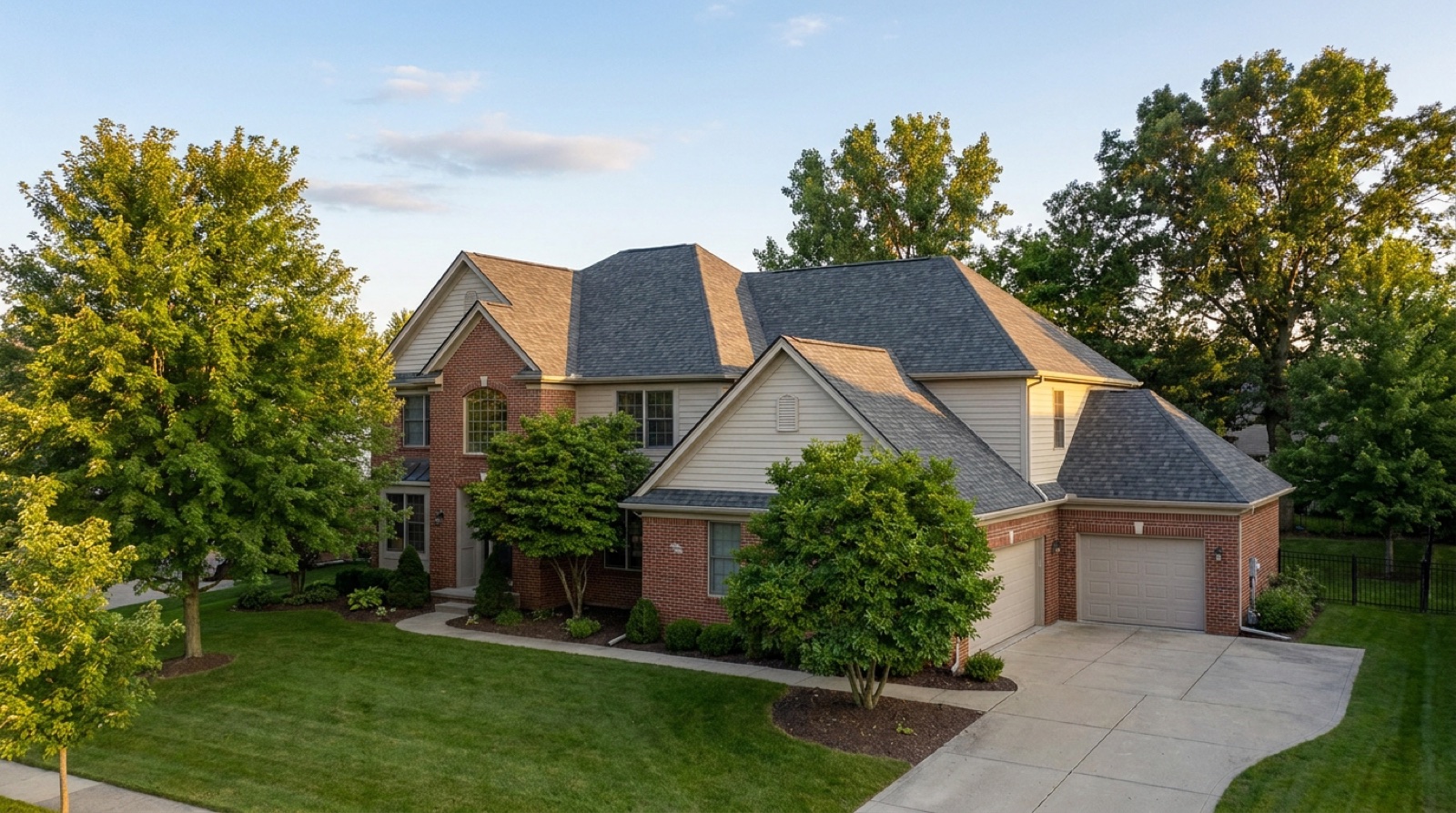
Drive any established Macomb County subdivision and you are looking at the same house over and over: a low, single-story brick ranch from the 1950s through the 1980s, sitting on a modest lot with a wide, walkable roof. It is the most common home in the county, and for a roofing crew it is also one of the most straightforward. A full asphalt shingle replacement on a brick ranch runs $9,000 to $18,000 installed, and most homes land $12,000 to $16,000, the same countywide ranges on our honest pricing sheet. The ranch shape tends to pull a lot of homes toward the friendlier half of that band. This guide explains why the style helps you, and where the age of these houses quietly adds cost back.
01 / THE SHORT ANSWERWhat it costs to reroof a brick ranch
The number most ranch owners want is the middle of the asphalt range, because a typical single-story ranch is exactly the kind of house that lands there or a little below. The full range is wider on purpose: your exact figure depends on the size, shape, and condition of your particular roof, which is the subject of the next three sections. If you are comparing your figure against a two story neighbor down the block, you are not comparing the same amount of roof. Our cost to roof a ranch vs a colonial page explains why the ranch is usually the larger job of the two.
sits inside a full asphalt range of $9,000 to $18,000. Every figure here is the complete installed job: tear-off of the old shingles, disposal, underlayment, ice and water barrier, flashing, ventilation, the new shingles, and labor. A smaller or simpler ranch can come in under the midpoint. Get your own ballpark in about 60 seconds with the instant estimator.
Premium systems cost more because the materials and the labor to install them cost more. Here is the full ledger, the same one that applies anywhere in Macomb County:
For the full anatomy of these numbers, our Macomb County roof replacement cost guide breaks each line down to its parts. This page is about how those ranges land on a brick ranch specifically, and why so many of them come in at or below the county midpoint. If you want the numbers tied to a specific size, our 1,500 square foot ranch cost guide walks the footprint-to-squares math for the classic starter ranch.
Every figure on this page is an installed price for the complete job, not a materials-only teaser, and larger or complex repairs can run higher than the range shown. The ranges are wide because your exact number depends on the roof in front of us. No honest roofer can hand you a firm price on your ranch without getting on the roof first, which is exactly why the inspection is free.
02 / THE SHAPEWhy a brick ranch reroofs on the cheaper side
A brick ranch is close to the ideal reroof from a crew's point of view, and several features of the style work together to keep the labor efficient. None of them shows up as a line called "ranch discount" on a quote, but each one shaves hours or risk off the job, and hours and risk are what you are really paying for.
One story, safe and fast access
A single-story home is the easiest roof to work on and to load. Shingles and materials go up a shorter distance, the tear-off debris comes down a shorter distance, and a crew moves faster when they are not staging around a second story. The height of a two-story colonial is invisible on the finished roof but very real in the labor hours, and the ranch simply does not carry it.
A low, walkable pitch
Most ranch roofs sit at a gentle pitch that a crew can walk upright, without the harnesses, roof jacks, and staging a steep roof demands. Walkability keeps the install moving and keeps the labor line reasonable. Two roofs with the same square footage can price very differently on pitch alone, and the ranch is almost always on the friendly side of that split. Our guide on split and tri-level roof cost shows the opposite case, where mixed planes and transitions add labor a flat ranch never has.
A compact, simple footprint
Roofers price by the square, which is 100 square feet of roof surface, and a single-story ranch carries fewer squares than a large two-story home. Fewer squares means fewer bundles of shingles, less underlayment, and fewer labor hours, roughly in proportion. A modest ranch footprint is the first and biggest reason these homes tend to land in the lower half of the range.
A clean hip or gable roofline
Many Macomb County ranches wear a simple hip roof, and some a plain gable, with only a plumbing vent or two breaking the field. That matters because every valley, dormer, skylight, and wall intersection is a spot that has to be flashed by hand, and a roof without much cut-up detail is a roof without much extra flashing labor. A hip roof does carry a bit more ridge and hip-cap detail than a bare gable, but a straightforward hipped ranch is still a low-complexity roof compared with the cut-up rooflines on larger, newer homes.
It is worth being clear about what landing lower does and does not mean. A compact, walkable, simple ranch roof is genuinely cheaper to install, but that is a reason to expect a fair price, not a reason to accept a thin one. The same job still needs a full tear-off, a proper ice and water barrier at the eaves, balanced ventilation, and new flashing. A quote that comes in reasonable because the home is a modest ranch is fine; a quote that comes in cheap because it quietly leaves those items out is the kind that costs more over the life of the roof.
03 / THE AGEWhat the era of these houses adds back
The same thing that makes these homes cheap to shingle, their age and their era, is also what can push a ranch quote up. A house built between the 1950s and the 1980s has usually been reroofed at least once already, and the choices a prior owner or a bargain contractor made decades ago surface at tear-off. Here are the drivers that most often move a ranch from the bottom of the range toward the middle.
A second layer of shingles
Ranches reroofed on a budget in the past were often shingled over rather than torn off, leaving a second layer laid on top of the first. When that roof is finally replaced, everything has to come off before new shingles go down, and the tear-off crew is handling twice the weight and twice the disposal volume. Older ranches are exactly where we tend to find a hidden second layer, and it is one of the most common reasons a quote lands higher than a neighbor expected. Our main cost guide covers how a legitimate quote should state its layer assumptions in writing.
Plank decking and board gaps
Many homes of this vintage were built with plank decking, individual wood boards run across the rafters, rather than the continuous sheets of plywood or OSB used today. Over decades those boards can cup, split, or pull apart at the seams, and wide gaps between planks do not give modern shingles the solid, continuous nailing surface they are designed for. Depending on the condition, that can mean replacing damaged boards or sheeting over the planks to create a proper deck. Nobody can see the deck until tear-off, so a fair quote states the per-sheet or per-board price for this work up front, turning a mid-job find into a known unit cost rather than a surprise.
An aging brick chimney
A masonry chimney is the single most common leak point on an older brick home, and it is also flashing-intensive work. On a ranch of this age the chimney is often an original furnace flue, and the step and counter flashing where the roof meets the brick has usually reached the end of its life. Rebuilding that flashing properly, rather than smearing fresh sealant over the old metal, takes time and material, and it shows up on the quote. It is money well spent: a chimney done right is the difference between a repair that holds and one that reopens the next spring. If yours is an unused furnace chimney, it can sometimes make sense to remove it during the reroof instead of maintaining flashing on it forever, a tradeoff worth raising at the inspection.
The detached garage
A great many Macomb County ranch lots include a detached garage with its own roof, and that garage is effectively a small second roof on the same job. Whether to reroof it at the same time is a real decision worth making up front: doing both in one mobilization is usually more efficient than a separate trip later, but it is also a line item that moves the total. A good estimator prices the house and the garage as clearly separate numbers so you can choose, and if the garage roof still has life left there is no reason to replace it early just because the house needs one.
04 / THE COMPARISONReading a brick ranch quote
Two neighbors with near-identical ranches can get quotes that sit thousands of dollars apart, and both can be honest. The gap usually comes down to what each quote actually includes. A fair estimate accounts for roof size, pitch, any second layer, a decking allowance, the material tier, chimney and flashing detail, ventilation, and the permit. A quote that is far cheaper than the others is often missing one of those lines, and the missing line becomes a bill later or a leak the winter after that.
A quote that is thousands cheaper is not a better deal until you find the line the other quotes have and it does not. On a ranch, compare what is in the price, not just the price.
One line every legitimate ranch quote should carry is the permit. Reroofing in Macomb County communities requires a permit from the local building department, with fees set by the municipality, and a proper job includes the code-required ice barrier membrane at the eaves for our freeze-thaw climate. A quote priced like a materials receipt with no permit and no ice barrier is not actually cheaper; it is incomplete, and the gap surfaces at inspection or the first hard winter.
Ventilation deserves its own look on a ranch. A long, low roof over a shallow attic can trap heat and moisture if the intake and exhaust are not balanced, and Michigan winters build ice dams when attic heat melts the underside of the snowpack and the water refreezes at the cold eaves. A thorough ranch quote often includes ridge vents, baffles, or added soffit intake, and the cheapest quote is frequently the one that leaves them out. A roof installed over a starved attic ages faster from below than it does from the weather above.
Location on the map does not change the canon, but housing stock does shade the averages. A city like Warren, built largely from compact post-war ranches, tends to run toward the lower half of the range for exactly the reasons in this guide. If you want to run your own ranch against these ranges before anyone visits, the cost calculator does it in about a minute.
05 / THE FORKRepair, replace, or finance
Not every problem on a ranch is a new roof. Repairs run $350 to $3,200, and larger or complex repairs can run higher. A repair is usually the right call when the roof is still mid-life, the damage is localized to one area, and the deck underneath is sound. Under those conditions a targeted fix buys you years, and there is no reason to replace a roof with plenty of life left. Our roof repair page covers what those fixes involve, and a walkable ranch is one of the more affordable roofs to repair when a repair is the honest answer.
Replacement starts to win when the shingles are near the end of their rated life, when leaks show up in more than one place, when granule loss has left large bald patches, or when repair estimates start climbing past a quarter of what a new roof would cost. At that point repair money is a toll you keep paying for months instead of buying years, and a full roof replacement is the better spend.
When replacement is the answer, financing turns a five-figure project into a monthly line item. As an illustration only, a $13,500 roof financed over a 10 year term at 9.9% APR works out to about $178 per month. That example is not an offer of credit; financing is subject to approval, and your actual rate, term, and payment depend on the lender and your credit profile. Ask about financing when you get your free quote and we will run your real figures.
06 / THE REAL NUMBERGetting a real number on your ranch
Everything above narrows the range. Only one thing produces your actual number: someone on your roof. Our inspection is $0 with no obligation, and it covers the shingles, flashing, chimney, ventilation, gutters, and the attic side of the deck, with photos of everything we find. On a ranch that attic look matters, because it is where a hidden second layer, plank-deck gaps, and a tired chimney flashing detail first give themselves away. If the roof is fine, we tell you it is fine. If it needs a repair rather than a replacement, you get a repair price, not a replacement pitch.
Timing is worth a word. Roofing in southeast Michigan runs hardest from late spring through fall, and schedules fill fastest right after storm events, when a whole block calls at once. Macomb County was inside federal disaster declaration DR-4757 after the severe storms of August 2023, and if your ranch roof was never checked after that event, a free inspection is a cheap way to know where you stand. The full storm playbook, and what we can and cannot promise about a claim, is on our storm and insurance claims page.
You can browse more style and cost pages in our guides library, or start straight from the estimator and pick replacement as the job type. The price canon on this page does not change by season; your leverage on scheduling does, so the homeowner who books an inspection in spring chooses their week, and the one who waits until fall takes what is left.
- Most brick ranch reroofs run $9,000 to $18,000, and most homes land $12,000 to $16,000, often at or below the county midpoint.
- The ranch style helps you: one story, a walkable pitch, a compact footprint, and a simple hip or gable roofline all keep the labor efficient.
- The age of these homes adds cost back: a hidden second layer, plank-deck gaps, an aging brick chimney, and a detached garage are the usual drivers.
- Compare what each quote includes, not just the bottom number; a ranch quote missing the permit, ice barrier, or ventilation is incomplete, not cheap.
- Repairs run $350 to $3,200; replacement wins once repairs multiply or the roof nears end of life.
- Financing example: a $13,500 roof is about $178 per month over 10 years at 9.9% APR, subject to approval, illustration only.
- The exact number requires an inspection, and ours is $0 with no obligation.
Questions we hear most
Most asphalt shingle replacements on a brick ranch run $9,000 to $18,000 installed, and most homes land $12,000 to $16,000. The single-story, walkable, compact ranch often lands toward the lower half of that range, but a hidden second layer of shingles, plank-decking repairs, or an aging chimney can move a quote up. The only way to get an exact number is a free on-site inspection.
A ranch carries several efficiencies at once: one story means safer, faster access, a low pitch keeps a crew walking upright without extra staging, and a compact footprint means fewer roofing squares to shingle. A simple hip or gable roofline also means less flashing worked by hand. None of that shows up as a discount line, but each one shaves labor hours off the job, and labor is what you are really paying for.
The age of these homes is where extra cost hides. Many were shingled over decades ago, so a second layer has to come off at tear-off. Older ranches often have plank decking that can gap or split and need repair, and the original brick chimney usually needs its step and counter flashing rebuilt. A fair quote states the per-sheet decking price up front so a mid-job find is a known cost, not a surprise.
- FEMA, disaster declaration DR-4757-MI, Michigan severe storms of August 2023 (Macomb County designated). fema.gov/disaster/4757
- Michigan Residential Code 2015, section R905.1.2 Ice Barriers: membrane required from the eave edge to not less than 24 inches inside the exterior wall line. up.codes: MRC chapter 9
- Your city or township building department: reroofing permit requirements and fee schedules are set locally in Macomb County; see the county directory of communities. macombgov.org