
JUMP TO A SECTION
Every roof has two layers that matter: the shingles you can see from the driveway, and the wood deck underneath them that you almost never can. The deck, plywood sheathing or in older Macomb County homes sometimes plank boards, is the structural surface everything else is fastened to and sealed against. When it is solid, a repair or a reroof goes exactly as quoted. When it is soft, delaminated, or rotted in places, the job's real scope was never fully knowable from the outside, and that gap between what a quote assumes and what the deck actually is drives more surprise costs than any other part of a roofing job. A thorough inspection cannot see through shingles, but it can read the deck's condition indirectly, and that is the whole subject of this guide: how a trained inspector infers what is happening under a surface that will not show its hand until the old shingles come off.
01 / THE SHORT ANSWERWhat a decking inspection actually tells you
A roof decking inspection is a set of indirect checks, not a direct look, because the deck is buried under shingles and underlayment on top and often insulation below. Inspectors combine a walked feel across the roof surface, an attic-side visual with a flashlight, moisture readings where access allows, and a trained eye for the wavy shadow lines a failing deck casts across an otherwise flat shingle field. None of these individually prove exactly how many sheets are bad. Together they give a defensible estimate of deck condition before anyone opens the roof up, which is the difference between a quote that is close to reality and one that is a guess with a number attached.
Decking condition is the single biggest swing factor in what a repair or replacement actually costs once work begins, because it is priced per sheet and nobody can count every sheet until the old shingles are off. A good inspection narrows the uncertainty; only tear-off eliminates it.
02 / THE PROBLEMWhy the deck is mostly invisible until tear-off
Three layers stand between an inspector and the deck itself: the shingles, the underlayment or ice barrier beneath them, and in most cases the fasteners holding everything down tight to the wood. Pulling all of that up to inspect the deck directly would mean starting the tear-off before anyone has agreed to a job, which nobody does for a free inspection. So the deck has to be read through the layers on top of it and, where possible, from below through the attic.
This is also why an honest quote always includes a per-sheet decking allowance rather than a firm number of bad sheets. A contractor who promises an exact deck count before tear-off is either guessing or has been on a nearly identical roof recently enough to have a strong hunch. Neither is a substitute for the count that happens once the shingles are actually up, and any legitimate crew shows you photos of what they replace and prices it against the per-sheet rate already in your written quote, not a number invented after the fact.
Two houses on the same street, built the same year, can have very different deck stories underneath nearly identical shingles. One owner replaced a failed pipe boot the week it started leaking; the other let a slow drip run for two winters before anyone noticed the ceiling stain. From the driveway, both roofs can look equally fine. Under the shingles, one deck is sound plywood and the other has a patch of sheathing that has been slowly absorbing water long enough to lose real strength. That gap between visible condition and actual deck condition is exactly why the indirect methods in this guide exist, and why two quotes on similar-looking roofs can legitimately carry different decking allowances.
03 / METHOD ONEThe walking feel: reading the deck through your boots
A roof deck in good condition feels uniformly firm underfoot across the entire slope. Wood that has delaminated, rotted, or lost its structural stiffness feels different in a way experienced feet learn to catch: a slight give or spring where the surrounding deck is rigid, a soft or spongy step where a healthy sheet would feel solid, or a dull thud instead of a firm one when weight shifts. None of these is dramatic. A badly rotted section can announce itself with an obvious sag, but most decking problems an inspection actually catches are subtle enough that an untrained foot would walk right over them without noticing anything at all.
The walking feel is strongest near roof edges, valleys, and anywhere flashing has a history of failing, because water finds those spots first and deck damage radiates outward from wherever water has been getting in longest. An inspector who walks the whole roof rather than just the ridge line is doing this check on purpose, not for exercise.
Foot placement matters too. A careful inspector steps directly over rafters when possible, both to avoid unnecessary stress on a deck that may already be compromised and because the feel of a step directly above a rafter is naturally firmer than one over open span between rafters, even on a perfectly healthy deck. Knowing the difference between that normal firmness gradient and an actual soft spot is a large part of what separates an experienced walk from a quick, uninformative stroll across the shingles.
04 / METHOD TWOThe attic-side visual and moisture meters
The underside of the deck is the one place it can actually be seen without removing shingles, and it is where a decking problem usually confesses itself first. A flashlight sweep across the underside of the roof looks for water stains, dark discoloration, sagging or wavy sheathing between rafters, and daylight coming through pinholes that mark a failed fastener or a hidden gap. Our attic-side inspection guide covers this check in full; decking is one part of a broader under-deck read that also catches ventilation and insulation problems.
Where access allows, a moisture meter reads the actual moisture content of exposed wood, whether that is deck framing visible in the attic or, on a flat or low-slope commercial roof, probe points into the membrane and cover board. A meter reading well above ambient wood moisture confirms water is present even where nothing looks visibly wet yet, which matters because wet wood that has not yet stained or sagged is still losing structural strength. A single reading is a data point, not a verdict; inspectors look for a pattern of elevated readings that lines up with a known leak path or a low spot before calling it a decking concern.
Attic-side access also lets an inspector cross-reference decking clues against everything else the underside of the roof reveals: rusted nail tips, compressed or displaced insulation, and the musty smell that often accompanies a slow, chronic leak rather than a single dramatic one. A stained rafter next to a section of insulation that has visibly settled is a stronger signal together than either one alone, and reading them as a set is part of what an experienced inspection adds over a quick flashlight glance.
05 / METHOD THREEWavy shadow lines: reading the deck from outside
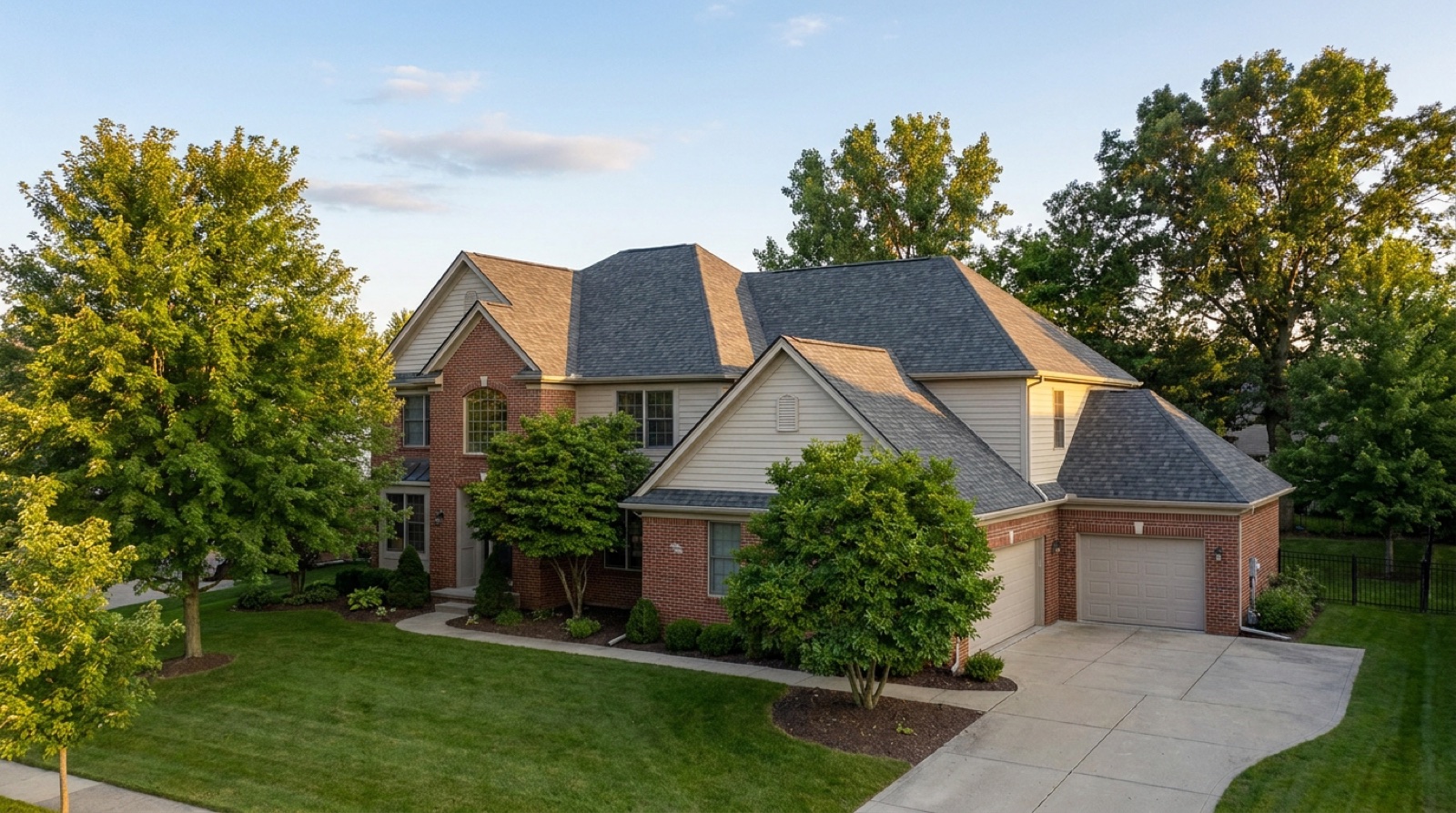
A roof deck that has softened or delaminated in a section no longer holds a perfectly flat plane, even under a full layer of shingles, and low-angle sunlight across the shingle field reveals it as a subtle wave or dip in the reflected light where a healthy roof would show a flat, even shadow line. This is one of the more useful checks an inspector can do from the ground or a ladder, because it does not require touching the roof at all and it can flag a soft area before it ever becomes visible as a walkable sag or an attic-side stain.
The catch is that this read depends heavily on light angle and roof color, so it works best early or late in the day and is easiest on darker, less textured shingles. It is a screening tool, not a diagnosis on its own; an inspector who spots a wavy line will cross-check it with the walking feel and the attic-side look before writing it up as a probable decking concern rather than a shadow from a nearby tree.
06 / THE COST IMPACTWhy decking condition swings a job's real price
Decking is priced per sheet, replaced only where it fails, and that per-sheet allowance is the most common reason a final invoice differs from the original quote on an otherwise straightforward reroof. A roof with a handful of soft sheets near one valley adds a modest, predictable line item. A roof with widespread rot from years of an unresolved leak or chronic ice damming can turn a routine replacement into a materially bigger job, because a deck that will not hold fasteners reliably is not something any legitimate crew should shingle over. Our roof replacement cost guide covers where decking sits among the other factors that move price, and how a written quote should state the per-sheet rate up front rather than leaving it as a surprise.
The reason a pre-inspection matters here is not that it eliminates the uncertainty; nothing short of tear-off does that completely. It is that a decking concern flagged in advance, with photos from the attic side and a description of where the walking feel was soft, lets you budget for a realistic range before a crew is on your roof mid-job, rather than hearing about it for the first time as a change order.
There is also a Michigan-specific reason decking allowances tend to run a little wider here than in milder climates. Freeze-thaw cycling does not just wear on shingles; water that has worked its way into a seam or a fastener hole in the deck itself expands each time it freezes, gradually opening the wood's grain and accelerating rot in a way steady, moderate weather never would. A deck that might sit quietly compromised for a decade in a mild climate can deteriorate meaningfully faster here, which is one more reason a periodic inspection matters even on a roof that is not obviously failing yet.
Nobody can promise you an exact decking count before the shingles come off. What a good inspection can promise is that the number will not surprise you.
07 / THE FREE PATHGetting probable decking issues flagged early, at no cost
A free Macomb Roofing Pros inspection runs all of the checks above on every visit: a walked feel across the surface, an attic-side flashlight sweep with moisture readings where the attic is accessible, and an outside read of the shingle field for the shadow lines that hint at a soft spot below. If nothing turns up, you get a report that says so, with photos. If something does, you get a written description of where the concern is and roughly how it is likely to affect scope, months before any tear-off would confirm it either way. That advance notice is worth having whether the roof turns out to need a targeted repair in the $350 to $3,200 range or a full replacement, and it costs nothing to find out. Start one from the instant estimator, or see the full visit described start to finish on our roof inspection service page.
If you are weighing how a decking finding might change your budget, the cost calculator and our honest pricing sheet use the same published ranges as the rest of this site, and a roof already showing sag or age-related wear is also a good candidate for our guide on how inspectors estimate remaining roof life, since decking condition is one of the clearest signals used in that read.
- The deck is buried under shingles and underlayment, so a decking inspection reads it indirectly: walking feel, attic-side visual, moisture meters, and exterior shadow lines.
- None of these methods gives an exact bad-sheet count. Only tear-off does, which is why an honest quote states a per-sheet allowance rather than a firm number.
- The attic side is where decking problems usually confess first, through staining, sag, or daylight at the deck, before anything shows from the top.
- Decking condition is the single biggest swing factor in final cost on most reroofs and repairs, more than any other line item nobody can fully see in advance.
- A free inspection flags probable decking issues early with photos, so a soft spot becomes a budgeted line item instead of a mid-job surprise.
Questions we hear most
No, and any inspector who claims an exact count before tear-off is guessing. A thorough inspection uses walking feel, attic-side checks, and moisture readings to flag probable soft areas and give a realistic estimate, but the confirmed count only comes once the old shingles are off.
It usually means the plywood or plank sheathing underneath the shingles has delaminated, absorbed moisture, or begun to rot, and it has lost some of the stiffness a healthy deck has. It is one of the clearest signs an inspector checks for by walking the roof surface and cross-checking with an attic-side look.
No. Isolated soft spots near a valley or an old leak can often be repaired by replacing just those sheets during a targeted repair. Widespread rot across large sections of the roof is more often found alongside a roof that needs full replacement anyway. A free inspection tells you honestly which situation you are in.
- Manufacturer technical and warranty literature for the major asphalt shingle lines: GAF (gaf.com), Owens Corning (owenscorning.com), and CertainTeed (certainteed.com).
- Michigan Residential Code 2015, section R905.1.2 Ice Barriers: membrane required from the eave edge to not less than 24 inches inside the exterior wall line. up.codes: MRC chapter 9
- National Roofing Contractors Association, technical guidance for steep-slope roof systems. nrca.net