
JUMP TO A SECTION
Type "how long does a roof last" into a search bar and you get a national average, the same number whether your house sits in Macomb County or Phoenix. That number is not useless, but it is not your roof either. When an inspector walks your property and looks you in the eye afterward with an actual estimate, they are not reading off a chart. They are weighing a specific set of physical evidence against a specific climate, the same way a mechanic listens to an engine instead of quoting the owner's manual. This guide walks through exactly what goes into that number: the inputs, the visible signs, the hidden ones, and why the honest version of the answer always comes with a confidence level attached rather than a promise.
01 / THE SHORT ANSWERHow the number actually gets built
A remaining-life estimate is built by comparing what a roof's age and material would predict against what its physical condition actually shows, then explaining the gap. Two roofs installed the same summer, same shingle tier, same crew, can diverge sharply a decade later if one had proper attic ventilation and the other did not. Age tells an inspector how much time the climate has had to work on a roof. Condition tells them what that time actually did. The estimate is where those two lines meet.
is what a real on-site look costs. National averages and online calculators cannot see your shingles, your attic, or your flashing. The free inspection is the only way to trade a guess for a number specific to your roof.
If you are trying to decide whether your roof is worth a repair or is closer to needing a full replacement, our roof replacement cost guide lays out the price side of that decision once you have a real condition read to work from.
02 / THE INPUTSSix inputs an inspector actually weighs
Ask a roof inspector how they arrive at a life estimate and none of them will give you a formula. What they will give you is a list of inputs they run through on every roof, in roughly this order of weight. It is worth being clear about what this estimate is not: it is not a warranty term, and it is not a manufacturer's rated lifespan restated in different words. A manufacturer's rating describes how the product performs under generalized lab and field-test conditions. A remaining-life estimate describes how this particular roof, with its particular installation and its particular Michigan weather history, is actually holding up against that rating.
- Material and installation quality. The shingle tier sets the ceiling: three-tab, architectural, and designer shingles carry different rated lifespans before a single nail goes in. Installation quality decides how close a roof gets to that ceiling. A rushed or shortcut install can shave years off even a premium product.
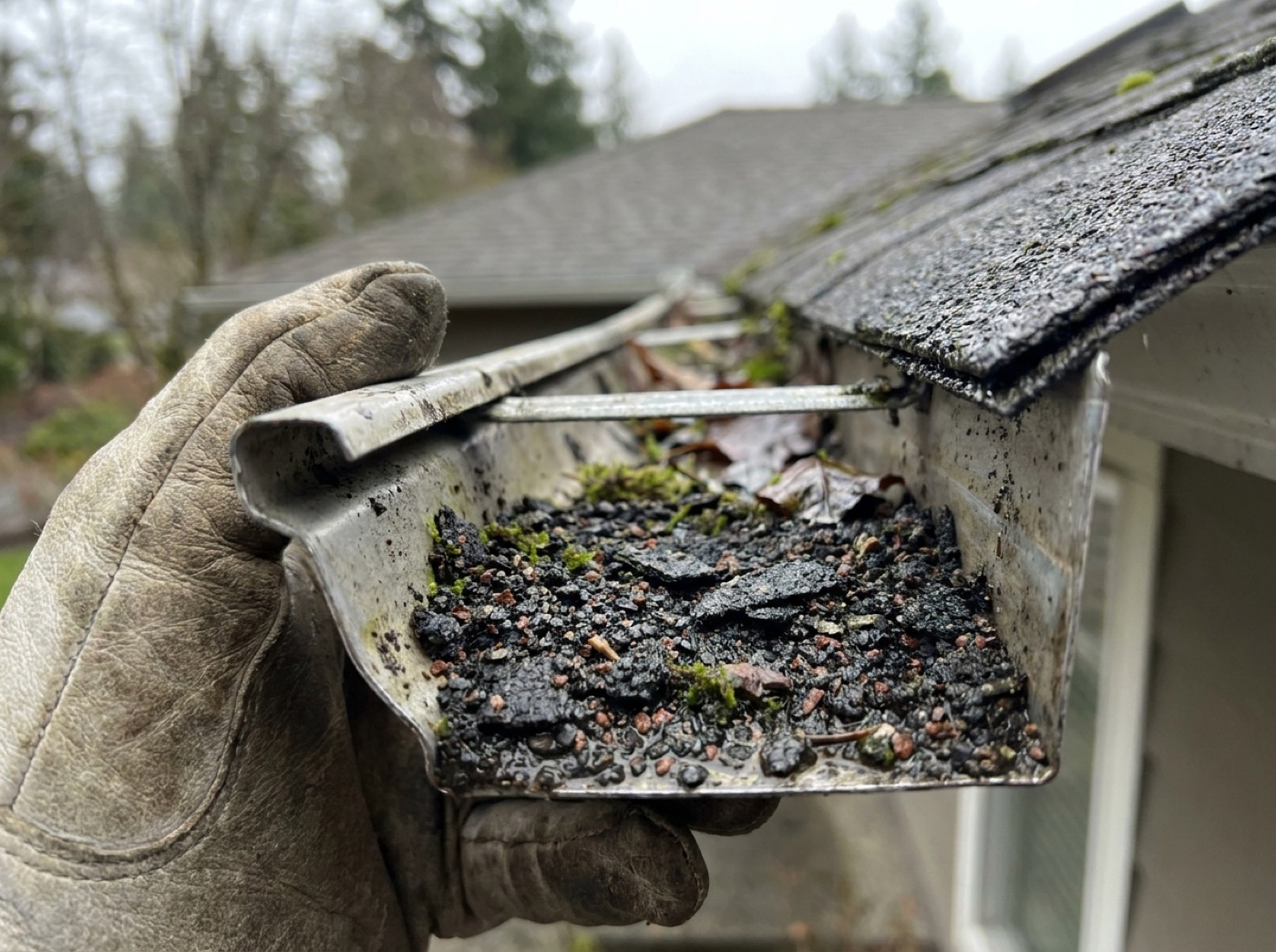
- Granule reserve. Granules are the shingle's sunscreen, shielding the asphalt underneath from UV breakdown. An inspector reads how much granule coating remains on the shingle surface versus how much has already washed into the gutters, because that single measurement tracks closely with how much protective life is left.
- Flashing condition. Flashing is often the first system to fail, well before the shingle field around it looks worn. Rusted step flashing, cracked sealant at a chimney, or a valley showing daylight all shorten the honest estimate regardless of how young the shingles look.
- Ventilation history. A roof over a poorly ventilated attic ages from below, cooked by trapped summer heat and softened by winter moisture, even when nothing looks wrong from the ground. Inspectors weigh signs of ventilation trouble in the attic just as heavily as what they see on the shingle field.
- Freeze-thaw exposure. How many winters a roof has actually been through in southeast Michigan, and how exposed it has been to ice damming at the eaves, is a bigger driver of real-world wear than the number on the closing disclosure.
- Repair history. A roof with a clean record of prompt, competent repairs has generally been protected from small problems compounding into big ones. A roof with a patchwork of deferred or poorly matched repairs often shows accelerated wear exactly where those patches sit.
None of these six inputs works alone. A young roof with a serious ventilation deficit can score worse on a life estimate than an older roof that was vented correctly from day one, which is why age by itself is such a poor stand-in for the real answer.
The weight each input carries also shifts as a roof moves through its life. On a roof still well inside its expected middle years, installation quality and repair history tend to dominate the estimate, because those two inputs are what decide whether the roof is tracking toward its rated ceiling or falling behind it early. On a roof already deep into its expected life, granule reserve and flashing condition move to the front, because they are the two inputs most directly tied to how much protective margin is left before failure. Freeze-thaw exposure and ventilation history sit underneath both stages as a kind of running total, since neither one is a one-time reading; they are cumulative, and an inspector is really asking how many winters of that cumulative load the roof has already absorbed.
03 / THE SURFACEReading the shingle field
The shingle field is where an inspection usually starts, because it carries the most visible evidence of remaining life. Our companion guide on what pros look for during a shingle inspection walks the full checklist; the short version is that granule loss, curling or cupping edges, cracking in a pattern rather than one spot, and lifted or failed sealant strips each subtract from the estimate, and they tend to compound once two or more show up together.
Aspect matters too. South and west facing slopes generally take the harshest sun and often show granule loss and curling first. North facing slopes and shaded valleys hold moisture longer and tend to grow moss and dark streaking earlier, which is its own diagnostic; our guide on what black streaks and moss actually tell an inspector covers why that discoloration is treated as a symptom of moisture retention rather than a cosmetic issue alone. Reading a roof well means walking every slope, not just the one visible from the driveway, which is one reason a ground-level glance rarely produces a trustworthy number.
Patched shingles are a record, not just a repair
A shingle field that carries a handful of mismatched patches is telling an inspector something specific: the repair history input from section 02 in physical form. A few well-placed patches, done promptly and matched as closely as aged shingles allow, generally signal a roof that has been maintained rather than neglected. Patches clustered in one area, or a pattern of small repairs spreading outward from a single point year over year, usually mean the field around that point is failing faster than the rest of the roof and the estimate for that section should trail the estimate for the roof as a whole.
How often that surface gets a professional look also shapes how reliable the estimate can be over time. Our guide on how often a roof should be inspected by age lays out a general cadence, because a life estimate built on a single visit years ago is worth far less than one refreshed on a reasonable schedule.
04 / BELOW THE SURFACEWhat is happening below the shingles
Shingles are the part everyone sees, but a life estimate that stops at the surface is only half an inspection. The deck underneath, the wood the shingles are fastened to, cannot be fully seen without removing shingles, so inspectors read it indirectly: soft spots felt underfoot while walking the roof, sagging lines viewed along a slope from the eave, and staining or daylight visible from the attic side. Our roof decking inspection guide covers these indirect reads in detail, because decking condition can shorten a life estimate significantly even when the shingles above it still look presentable.
The attic itself is the other half of the below-the-surface picture. An inspector checks for frost or moisture on the underside of the deck, insulation that has settled or gone damp, and whether intake and exhaust ventilation are balanced or fighting each other. Ventilation history is one of the six inputs from section 02 for a reason: an attic that has been under-ventilated for years is quietly aging the deck and the shingle from beneath, and that damage does not always announce itself with an interior stain until it is well underway.
A life estimate that only looks at the shingles is reading half the evidence. The deck and the attic tell the other half of the story, and they rarely lie.
| WHERE | WHAT AN INSPECTOR CHECKS | WHY IT MOVES THE ESTIMATE |
|---|---|---|
| Roof deck, from above | Soft or springy spots underfoot, sagging between rafters | Soft decking means water already reached the wood; the estimate drops sharply regardless of shingle age |
| Attic, underside of deck | Frost, staining, dark streaking, corroded nail tips | Early moisture cycling that will shorten deck life before it ever shows on the shingles |
| Attic insulation | Settling, compression, dampness | Degraded insulation feeds the ventilation problem and accelerates aging from below |
| Intake and exhaust vents | Blocked soffits, undersized ridge vent, mismatched intake to exhaust | Imbalanced airflow is one of the single biggest accelerants of below-surface wear |
05 / THE HONEST ANSWERWhy estimates are ranges, not promises
A responsible inspector will not hand you a single number and call it fact, and you should be skeptical of anyone who does. Remaining roof life is inherently probabilistic: it depends on future weather that has not happened yet, on maintenance decisions the homeowner has not made yet, and on hidden deck condition that even a thorough visual inspection can only estimate rather than measure with certainty. The honest output looks like a range attached to a confidence level, something closer to "this roof likely has several more years under normal conditions, with moderate confidence, based on the granule reserve and ventilation we observed," rather than a bare number.
That range shrinks and firms up the more evidence an inspector gathers. A quick walk of the shingle field from the ground produces a wide, low-confidence range. A full inspection covering the shingle field on every slope, the flashing at every penetration, and the attic side of the deck produces a much tighter one. This is also why a general online lifespan average is close to worthless for your specific decision: it carries none of your roof's actual evidence, so it cannot narrow the range at all. The same logic applies whether the question is remaining life or whether today's wear points toward a repair or a full replacement: rated life and national averages are a starting ceiling, and real evidence on your roof is what actually determines your number.
A trustworthy answer names the evidence behind it: granule reserve, flashing condition, ventilation signs, and attic-side findings, followed by a range and a confidence level. An answer that skips straight to a single guaranteed number, with nothing shown to back it, is a sales pitch wearing an inspection's clothes.
| CONFIDENCE LEVEL | WHAT PRODUCES IT | WHAT IT IS GOOD FOR |
|---|---|---|
| Low | Ground-level look or photos only, no roof or attic access | A first impression; not enough evidence for a repair or replacement decision |
| Moderate | Full visual walk of the shingle field, no attic access | Reasonable for routine maintenance planning and spotting obvious wear |
| High | Full roof walk plus attic-side inspection, with photos | The standard we use before recommending a specific repair or replacement path |
06 / THE REAL NUMBERGetting your own number, free
Everything above explains the method. Getting the actual answer for your roof requires someone to apply that method to your specific shingles, your specific attic, and your specific history of Michigan winters. Our roof inspection service is $0 with no obligation, and it covers the shingle field on every slope, flashing at every penetration, and the attic side of the deck, with photos of everything we find. You get the evidence along with the range, not just a number to take on faith.
If the estimate lands on the older end and the roof is genuinely nearing the end of its useful life, our roof replacement service page and the 60-second cost calculator can give you the price side of that conversation using the same published canon on our honest pricing page. If it lands on the younger end, or the wear turns out to be isolated, that is exactly what we will tell you, and a targeted repair may be the right call instead. Either way, you are working from evidence collected on your roof rather than a national average that was never about your house to begin with.
What you should walk away with is not just a spoken number. A written estimate worth trusting names the inputs behind it: photos of the shingle field by slope, the flashing detail at each penetration, and the attic side of the deck, along with the range and confidence level those photos support. That is the same standard we hold ourselves to on every inspection, and it is what lets you compare our number against a second opinion on equal footing rather than one contractor's word against another's.
- A remaining-life estimate compares what age and material predict against what the roof's actual condition shows, then explains the gap.
- Six inputs drive the number: material and installation quality, granule reserve, flashing condition, ventilation history, freeze-thaw exposure, and repair history.
- Reading the roof means the shingle field on every slope plus the deck and attic below it; surface-only reads miss half the evidence.
- An honest estimate is a range with a confidence level, not a single guaranteed year, and the range tightens as more evidence is gathered.
- The only way to get a real number for your specific roof is an inspection, and ours is $0 with no obligation.
Questions we hear most
They weigh your roof's material and installation quality against its actual condition: granule reserve, flashing condition, ventilation history, freeze-thaw exposure, and repair history. Age sets an expectation, but visible wear and attic-side evidence determine where your roof actually falls, so the estimate is built from your roof, not a general chart.
A responsible inspector gives you a range with a confidence level rather than a single guaranteed year, because future weather, maintenance, and hidden deck condition all carry uncertainty. The range tightens the more evidence is gathered, which is why a full inspection produces a more useful answer than a quick look from the ground.
Not for a specific decision. A national average carries none of your roof's actual evidence, its material tier, its ventilation, its Michigan winters, so it cannot tell you where your particular roof stands. A free, on-site inspection reads your shingles, flashing, and attic directly and gives you a range built on that evidence instead.
- National Roofing Contractors Association, technical guidance for steep-slope roof systems. nrca.net
- Manufacturer technical and warranty literature for the major asphalt shingle lines: GAF (gaf.com), Owens Corning (owenscorning.com), and CertainTeed (certainteed.com).
- Michigan Residential Code 2015, section R905.1.2 Ice Barriers: membrane required from the eave edge to not less than 24 inches inside the exterior wall line. up.codes: MRC chapter 9
- ENERGY STAR (U.S. EPA/DOE), recommended home insulation R-values: R-49 to R-60 for attics in climate zone 5, which covers southeast Michigan. energystar.gov: insulation R-values