
JUMP TO A SECTION
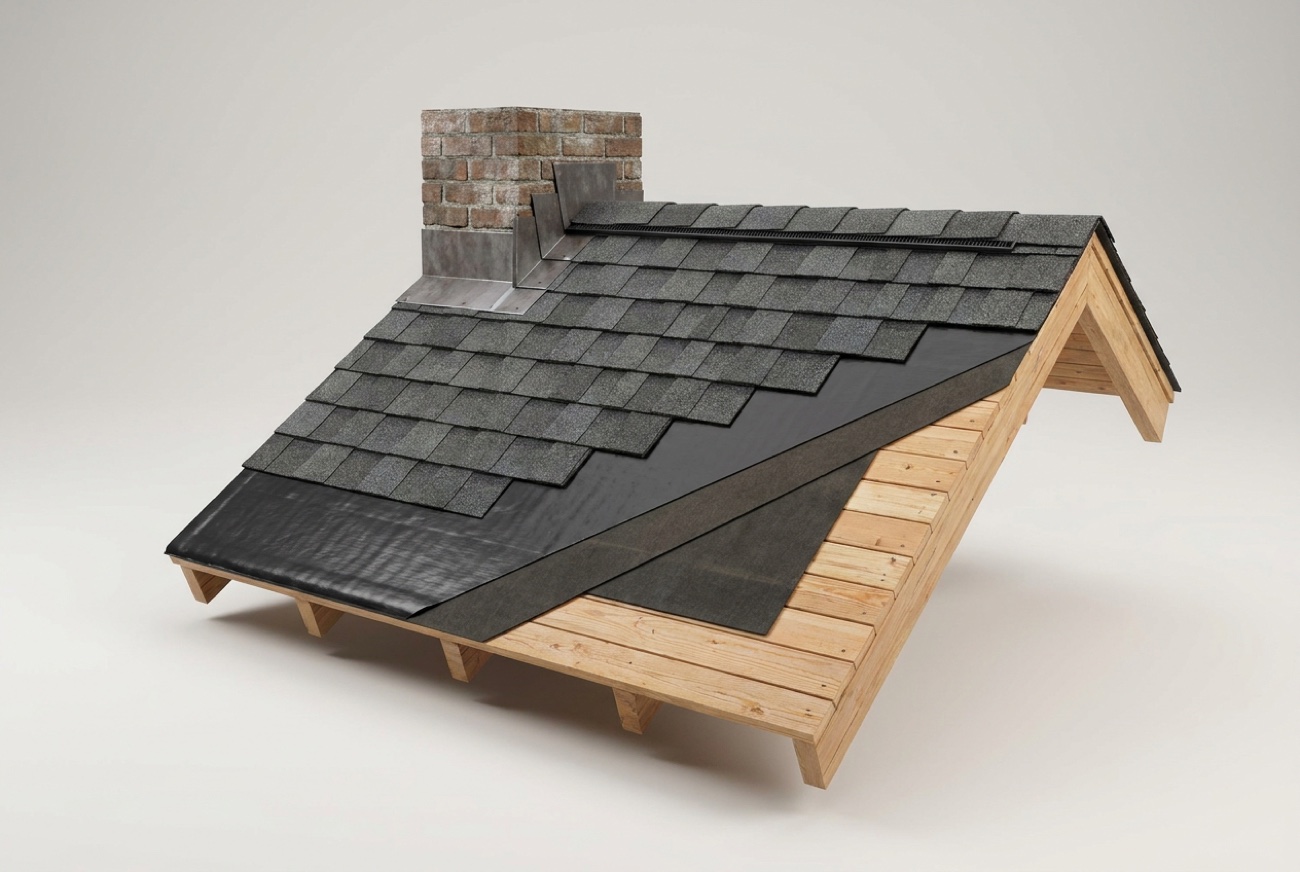
Ask a homeowner what a roof inspection looks like and most describe the same scene: someone on a ladder, walking the shingles, maybe snapping a few photos. That is real work, but it is only the outside half. The roof deck itself, the plywood or plank surface every shingle is nailed to, is mostly invisible from above once the shingles are down. The only place it can be seen directly is from underneath, in the attic, with a flashlight. That is where an inspector finds the handful of tells the topside cannot show: daylight coming through where there should be none, a stain trailing down a rafter, a rusted ring around a nail tip, insulation that is matted flat instead of standing loose. None of it requires tearing anything apart. It just requires someone willing to climb the pull-down stairs and look.
01 / THE SHORT ANSWERThe attic is where an inspection gets honest
A shingle field shows you what the weather has done to the outside of the roof: sun, wind, hail, age. The attic shows you what has actually gotten through it. Those are two different questions, and a thorough inspection answers both. A roof can look tired from the driveway and still have a bone-dry, unstained deck underneath, which is good news worth confirming rather than assuming. A roof can also look fine from the ground and still have a quietly rotting rafter tail or a soaked patch of insulation from a leak nobody has noticed yet from inside the house. The attic side is the tie-breaker in both directions.
A leak rarely announces itself at the shingle it came through. Water runs along the underside of the deck and down a rafter before it shows up anywhere a homeowner would notice, which is why the entry point and the visible symptom are often feet apart. Checking the attic side is how that gap gets closed. If you are starting from a symptom you already noticed, our signs your roof needs an inspection guide is the companion piece to this one.
02 / THE REASONWhy the entry point and the symptom rarely match
Water does not fall straight down from wherever it gets in. It lands on the top of the deck, follows the slope and the grain of the wood, and travels along the underside until it finds a low point, a nail, a seam, or a rafter to run down. By the time that water reaches a ceiling and leaves a stain a homeowner can see from the living room, it may have traveled several feet from the actual failure. Tracing a leak backward from an inside stain to its true source on the roof is difficult work if you skip the middle step. The attic side is that middle step: it shows the water's path in the open, on bare wood and framing, before drywall and paint hide it.
There is a second reason the attic side matters just as much on a roof with no known problem at all. A dry, clean deck with tight, evenly spaced nail lines and loose, fluffy insulation is itself a finding. It tells an inspector the roof has been performing as designed, and it is exactly the kind of good news a free inspection is built to deliver honestly rather than manufacture a problem to justify the visit.
The attic side also protects a homeowner from the opposite mistake: paying for repair work aimed at the wrong spot. A crew that only walks the shingles can guess at where a leak enters, patch that guess, and still leave the actual failure open, because the visible symptom and the true entry point were never the same location to begin with. Checking the deck from underneath, before any repair is proposed, is what turns a guess into a documented finding, and it is the difference between a repair that holds and one that reopens the next time it rains.
A shingle inspection tells you what the weather did to the roof. An attic inspection tells you what got through it. A thorough inspection answers both questions, not just the one you can see from the yard.
03 / THE CHECKLISTThe under-deck checklist, clue by clue
An inspector working the attic side is scanning for a short, specific list of tells with a flashlight, moving along the ridge and down toward the eaves on both slopes. Here is what each one looks like and why it matters.
Daylight where there should be none
With the attic lights off, a pinpoint of daylight through the roof deck is one of the clearest signals an inspector can find, because it means there is an actual gap, not just a stain from an old, already-repaired leak. A single pinhole often traces to a missed or backed-out nail. A cluster of small points along a line usually means a run of nails working loose together, which is common along a ridge or hip after wind events.
Stained or discolored sheathing and rafters
A brown or gray-black stain on the plywood or on a rafter is water that has already been there, whether the leak is still active or was patched long ago. The color, size, and edge of the stain tell an inspector a lot: a hard, dark ring with a crisp edge usually means an old, dried event, while a soft, spreading, lighter stain suggests moisture is still arriving. Stains found low, near the eave, often point to a different cause than stains found high, near the ridge or a penetration, which is why location matters as much as the stain itself.
Rusted nail tips
Roofing nails are driven up through the deck from below the shingles, so their tips poke through into the attic and are one of the easiest things to check with a flashlight. A little surface rust on scattered tips is normal aging and rarely a concern by itself. Heavy, widespread rust, or rust concentrated with visible moisture droplets on the tips themselves, points to persistent condensation or a chronic leak rather than a one-time event, and it is often the first physical evidence an inspector finds before locating the actual entry point.
Compressed, matted, or wet insulation
Loose-fill or batt insulation that has been sitting under a leak loses its loft, mats down flat, and often darkens in color. Compressed insulation does more than mark the spot; it also stops doing its job, since insulating value depends heavily on trapped air that wet, flattened material no longer holds. Finding a matted patch tells an inspector both where water has been landing and that the insulation itself may need replacing along with whatever repair stops the leak.
Frost and condensation on cold mornings
On a cold Macomb County morning, a light coating of frost on the underside of the deck or on exposed nail tips can be normal, ordinary condensation, but heavy or widespread frost is a different signal. It usually means warm, moist air from the living space below is reaching the cold deck more than it should, which an inspector will note separately from an actual water leak, since the two problems can look similar at first glance but call for different fixes.
A musty smell when the hatch opens
Smell is not something a photo can document, but it is one of the first things an inspector notices the moment the attic hatch opens, and it shapes what gets checked next. A musty, damp odor usually means moisture has been sitting somewhere in the insulation or on the wood long enough to start affecting it, even if nothing is visibly wet at that exact moment. It is a reason to look harder at the areas the smell seems strongest, rather than a finding on its own.
None of these six tells is checked in a single glance from the hatch opening. A proper attic-side check means actually walking the joists with a flashlight, not just leaning in from the pull-down stairs, because the sections farthest from the hatch, over a garage bump-out, a dormer, or the far end of a long ranch, are exactly where a stain or a compressed patch of insulation is easiest to miss from a distance and easiest for a rushed inspection to skip entirely.
04 / THE TRANSLATIONWhat each clue points to on the roof above
None of these clues are read in isolation. An inspector is constantly translating what the flashlight shows below into a location on the roof above, because the attic side and the shingle side of the inspection are really one investigation split across two vantage points. The table below is a simplified version of that translation.
| ATTIC CLUE | COMMONLY POINTS TO |
|---|---|
| Daylight near the ridge or a hip | Loosened ridge cap fasteners or ridge vent seal |
| Daylight around a single point, mid-slope | A missed or backed-out nail through the deck |
| Stain trailing down from a roof penetration | A pipe boot, vent flashing, or skylight curb above it |
| Stain along a sloped line, not straight down | Valley metal or step flashing at a wall or chimney |
| Rust and stain concentrated at the eaves | Ice barrier or edge flashing performance in winter |
| Widespread frost with no single wet spot | Attic air leakage from the living space, a ventilation topic |
That last row is worth flagging on its own, because it is the point where an attic-side finding stops being about the roof covering and starts being about the building itself. It is a real and common finding, and it is exactly why the next section draws a clear line around what this guide covers.
It is also worth saying plainly that this translation runs both ways during an actual inspection. An inspector who spots a soft, discolored patch on the shingle field from above will usually climb into the attic afterward to confirm it from below, and an inspector who finds a stain on the deck will usually go back up and look at that exact spot on the roof before writing anything down. The two vantage points check each other, and a finding that shows up in only one of them, never both, is treated with more caution than one that is confirmed from both sides.
05 / THE SCOPE NOTEWhat the attic check is not
It is worth being precise about what an attic-side inspection finding is and is not. Finding heavy frost, widespread condensation, or a chronic musty smell tells an inspector that air movement between the house and the attic is likely part of the picture. It does not, by itself, diagnose whether the fix is more soffit intake, a different ridge vent, added baffles, or sealing bypasses at the attic floor. That is a system design question with its own body of building science, and it lives in its own guides rather than inside an inspection walkthrough.
The same line applies to ice dams. An attic check can surface evidence consistent with ice damming, staining at the eaves, damp insulation along the lowest few feet of the slope, but the physics of how an ice dam forms, and what stops one from forming again next winter, is a separate topic from what an inspector documents during a walkthrough. This guide sticks to what the flashlight finds and what it suggests. The mechanics of ventilation design and ice dam prevention are covered elsewhere in our guides library, and a free inspection is exactly how those follow-up questions get answered on your specific roof.
06 / THE FULL PICTUREHow the attic check fits into the free inspection
The attic side is one part of a full inspection, not a separate visit. When we walk a Macomb County roof for a free, no-obligation inspection, the same appointment covers the shingle field, the flashing at valleys and penetrations, the gutters and edges, and the attic side of the deck, with photos of anything worth documenting. If the attic side turns up nothing, a clean, dry deck with tight nail lines and undisturbed insulation, that is good news we tell you plainly. If it turns up a stain, a rust pattern, or a matted patch of insulation, that finding gets tied back to a specific spot on the roof above before anyone talks price.
If a repair turns out to be the answer, most Macomb County roof repairs run $350 to $3,200 depending on scope, and larger or complex repairs can run higher. But the attic side of the inspection exists to answer a different question first: not what a fix costs, but whether one is actually needed and, if so, exactly where. You can start either path from the instant estimator, or run your own numbers first on the 60-second cost calculator.
- A roof inspection is not complete without the attic side; the shingles show weather damage, the attic side shows what actually got through.
- Daylight, stained sheathing, rusted nail tips, compressed or wet insulation, frost, and musty odor are the six tells inspectors check for with a flashlight.
- Each clue's location on the deck usually points to a specific spot on the roof above, from ridge caps to valley flashing to eave edges.
- Widespread frost or condensation is a real finding, but the fix is a ventilation and air-sealing question handled in its own guides, not diagnosed on the spot.
- The attic check is included free in every Macomb Roofing Pros inspection, with no obligation either way.
Questions we hear most
Yes. Every inspection includes the attic side of the deck along with the shingle field, flashing, and gutters. We check for daylight, staining, rust on nail tips, and insulation condition, and photograph anything worth documenting either way.
It means water has been there at some point, though not necessarily recently. A hard, dark, crisp-edged stain usually means an old event, while a soft, spreading stain suggests moisture is still arriving. Where the stain sits on the deck usually points to a specific flashing detail or penetration on the roof above it.
It can surface evidence consistent with one, such as staining or damp insulation near the eaves, but diagnosing and preventing ice dams is a ventilation and building-science question with its own dedicated guides. A free inspection is the right place to raise that question so we can look at your specific attic and roof together.
- FEMA, disaster declaration DR-4757-MI, Michigan severe storms of August 2023 (Macomb County designated). fema.gov/disaster/4757
- InterNACHI Standards of Practice for home inspections (scope of a generalist roof inspection). nachi.org/sop
- Michigan Residential Code 2015, section R905.2 Asphalt Shingles: fastening, slope, and underlayment application requirements. up.codes: MRC chapter 9
- Manufacturer technical and warranty literature for the major asphalt shingle lines: GAF (gaf.com), Owens Corning (owenscorning.com), and CertainTeed (certainteed.com).