
JUMP TO A SECTION
Water showing up inside a wall confuses people because a wall does not look like part of the roof. It is, functionally. Where a roof edge dies into a sidewall, or a chimney or valley sheds water down alongside a wall's framing, the roof and the wall share the same water-shedding system, and a gap in that system on the roof side sends water straight down inside the wall before it ever reaches a place a homeowner can see it. By the time drywall bubbles or a baseboard goes soft, the actual failure is usually feet away, up at the roofline, and has often been running for a season or more.
01 / THE SHORT ANSWERWall water almost always starts at the roof
Plumbing and window leaks happen, but the far more common source of water inside an exterior wall, especially a wall that sits below or beside a roof line, is a failed roof detail at exactly that intersection. The three usual suspects are a missing or undersized kick-out flashing where a roof edge meets a sidewall, a gap in step flashing running up that same wall, or a valley or chimney shedding more water than the flashing below it was built to handle. All three dump water at the top of the wall assembly, inside the wall's own weather barrier, where it can travel down for a long time before anything shows on the inside face of the drywall.
A leak that shows up on a ceiling is usually easier to trace, because water tends to travel a short, mostly horizontal path along the deck before it drips down. A leak that shows up in a wall has often traveled vertically for several feet inside the wall cavity, following sheathing, studs, and insulation, which is why the visible stain and the actual roof failure can look unrelated at first glance. Our attic tracing guide covers the ceiling-side version of this problem in detail.
02 / THE MECHANISMThe three roof-to-wall failures that let water in
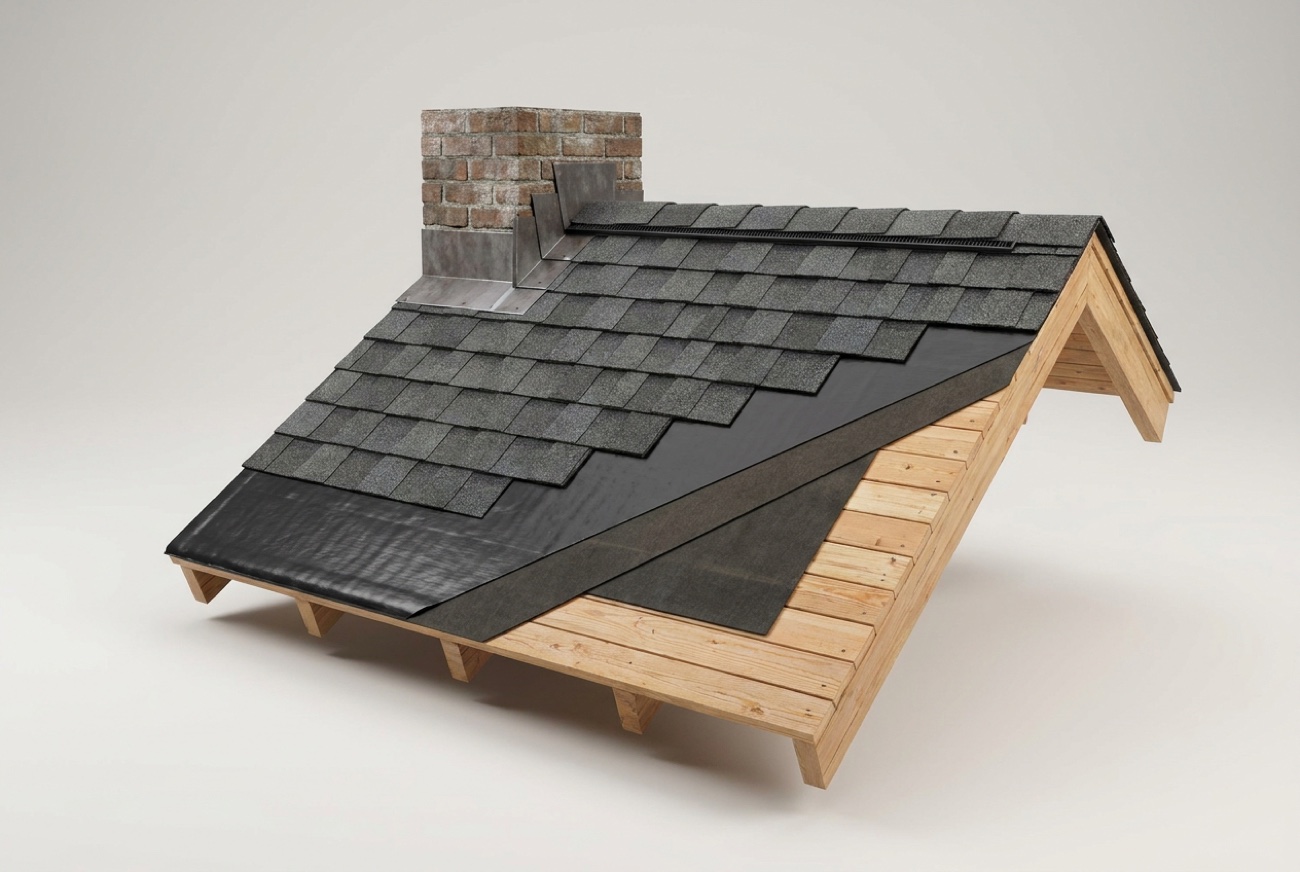
Every one of these failures involves the same basic geometry: a roof plane meeting a vertical wall, at an angle or a straight run, where two very different building materials have to be woven together so water always ends up on top of, never behind, the next layer down. Vinyl siding, brick veneer, and fiber cement all cover this intersection differently, but none of them are the water-shedding layer on their own. The actual barrier is the flashing tucked behind whatever finish the wall wears on the outside, which is exactly why a wall can look fine from the driveway while the flashing behind the siding has already failed.
Missing or undersized kick-out flashing
Where a roof edge terminates into a sidewall, the last few inches of that roof edge need a small, angled piece of metal called a kick-out flashing to divert water away from the wall and out into the gutter. Without it, years of ordinary rain running down that roof slope get funneled directly behind the siding at exactly that corner instead. Many older Macomb County homes never had one installed, because the detail was inconsistently required or simply skipped by builders decades ago, and it is one of the most common single points of failure we find behind a stained or rotted corner. Our dedicated kick-out flashing guide covers how to spot the telltale stain and what a retrofit involves.
Step flashing gaps along a sidewall
Where a roof slope runs alongside a wall rather than just terminating into it, individual L-shaped pieces of step flashing are woven in one per shingle course, each one lapped correctly with the piece above and below. When step flashing is installed too few pieces at a time, gets covered over with siding instead of left exposed to be re-flashed, or simply rusts and separates after enough freeze-thaw cycles, water works in at the gap and runs down inside the wall along the same path the flashing was supposed to protect. This is a repair job, not a caulk job. Our flashing repair guide walks through why a proper fix means replacing the metal, not sealing over it.
Valley or chimney water riding down inside the framing
A valley or a wide chimney can shed a surprising volume of water during a hard rain, and if the flashing below it is undersized, corroded, or simply overwhelmed, that water does not stop at the roof edge. It can ride down along the framing behind the siding or masonry, following the same downhill path the water was always going to take, and surface inside a wall a story below where the flashing problem actually is. This is why an inspector tracing a wall leak often starts by looking well above the visible stain, not level with it.
03 / THE PROGRESSIONWhat happens inside the wall over time
A wall leak rarely announces itself the week it starts. Because the water is running down inside a cavity that is not visible from either side, the damage builds quietly, and the timeline matters for deciding how urgent the repair is.
The order is fairly consistent because it follows the water itself. Sheathing and framing are the first things wet, since they sit directly behind the failed flashing detail. Insulation packed against that sheathing absorbs the moisture next and loses its loft, which is usually the point where a musty smell becomes noticeable before any staining shows on the drywall. Drywall itself is often the last thing to visibly change, which is exactly why homeowners are surprised at how much hidden damage an inspector finds once a wall like this is finally opened. Left long enough, water reaching the sill plate at the base of the wall or the framing around a window can create the kind of rot and mold conditions covered in more depth in our attic mold guide, though the mechanism inside a wall cavity is the same as in an attic: source moisture first, remediation second.
04 / THE DIAGNOSISWhy the roof-to-wall intersection is the first place a pro looks
Given how consistently these three failures show up, a roofer investigating a wall leak does not start by opening drywall. The first move is almost always outside, standing back from the house and looking at the exact spot where a roof plane meets that wall: is there a kick-out flashing visible at the bottom of the run, does the step flashing show consistent metal exposed above the siding line course by course, and is there a valley or chimney uphill of the stain that could be shedding water past undersized flashing. That single visual check rules in or out the majority of causes before anyone opens anything.
The roof-to-wall corner is checked first because it is where the two systems actually meet. Most wall leaks are not a mystery once someone looks at that exact intersection instead of just the stain inside.
From there, a hose test reproduces the leak under controlled conditions, starting low on the suspected flashing run and working upward in stages, watching the interior side the whole time. This is the same zone-by-zone method covered in our main leak tracing guide, applied specifically to a roof-wall intersection instead of a field of shingles. Getting a positive result at a specific stage of the hose test is what turns a guess into a documented finding before any repair is proposed, and it also tells us how far down the wall the water has likely traveled, since a leak that shows itself only after several minutes of wetting a high section usually means a longer path down than one that appears almost immediately.
05 / WHAT TO EXPECTOpening the wall versus fixing the roof detail
Once the roof-side failure is confirmed, the repair itself is almost always at the roof: replacing or adding kick-out flashing, re-weaving step flashing correctly up the wall, or rebuilding an undersized valley or chimney flashing detail. That part of the job is a roofing repair, and it runs within the same published range as any other roof repair in Macomb County, $350 to $3,200, with larger or more complex flashing rebuilds landing toward the higher end and a simple kick-out retrofit often at the lower end.
Whether the wall itself needs to be opened is a separate question, and it depends on how long the leak ran and how far the water traveled. A wall caught early, with a small, dry-to-the-touch stain and no soft spots, may only need the roof-side fix and a cosmetic patch. A wall with soft drywall, a musty smell, or visibly matted insulation usually needs a section opened to confirm the sheathing and framing underneath are sound and to let everything dry properly before it is closed back up. Painting over a stain before the roof-side cause is fixed only hides the problem and lets it keep running behind fresh paint.
We are straightforward about which of those two categories a given wall falls into once we can see the flashing and, where accessible, the framing behind it. If the roof-side fix alone solves it, that is what we recommend, and if a section of wall genuinely needs to come open, we will tell you that plainly rather than guessing from the outside. Because the roof and the wall are two different trades once drywall and siding repair are involved, we handle the roof-side flashing ourselves and are upfront about which parts of the job, like drywall finishing or exterior paint matching, typically fall to a general contractor or a painter instead.
06 / NEXT STEPSGetting a wall leak stopped for good
If you are looking at a stain, soft spot, or musty smell near a roof-wall intersection, kick-out flashing, a valley, or a chimney, the fastest way to a real answer is a free inspection. We check the exact corner where the roof and wall meet, confirm the failure with a hose test where needed, and give you a written repair price before any work starts. If the leak has been running long enough that we suspect deeper damage, we will tell you honestly what opening the wall would show rather than assume the worst or the best.
You can start from the instant estimator and choose repair as the job type, or run a ballpark on the 60-second cost calculator first. Our full published ranges, including repairs, replacement, and financing, are always on our honest pricing page.
- Water inside a wall almost always started at the roof, at a missing kick-out flashing, a step flashing gap, or a valley or chimney overwhelming the flashing below it.
- Because the leak travels down inside the wall cavity, the visible stain and the actual roof failure can be feet apart.
- Left unchecked, wall moisture progresses from damp sheathing to matted insulation to drywall damage to, eventually, sill and framing decay.
- A roofer checks the roof-to-wall intersection first, then confirms with a hose test before proposing a repair.
- The roof-side repair falls within the standard $350 to $3,200 repair range; whether the wall itself needs to be opened depends on how long the leak ran.
Questions we hear most
Check whether the stain sits below or beside a roof edge, valley, or chimney, especially near a kick-out flashing location or a sidewall the roof runs into. Plumbing and window leaks tend to sit near pipes or window openings regardless of roof geometry. A free inspection can confirm the source with a hose test rather than a guess.
Not always. If the leak was caught early and the drywall and insulation are still dry, fixing the roof-side flashing detail may be enough. If the wall has soft drywall, a musty smell, or visibly wet insulation, a section usually needs to come open so it can dry properly and be checked before closing it back up.
The roof-side repair, replacing or adding flashing at the roof-to-wall intersection, falls within our standard repair range of $350 to $3,200, depending on the flashing type and how much needs to be rebuilt. Any interior wall repair beyond that is priced separately once the extent of the damage is known. A free inspection gives you both numbers before you commit to anything.
- EPA, guidance on mold and moisture in building materials. epa.gov/mold/mold-cleanup-your-home
- Michigan Residential Code, 2015 edition, adopted with Michigan amendments by the LARA Bureau of Construction Codes, in effect since February 8, 2016. michigan.gov/lara: code books
- Manufacturer technical and warranty literature for the major asphalt shingle lines: GAF (gaf.com), Owens Corning (owenscorning.com), and CertainTeed (certainteed.com).
- InterNACHI Standards of Practice for home inspections (scope of a generalist roof inspection). nachi.org/sop