
JUMP TO A SECTION
"Nobody works on roofs in winter" is one of the more expensive myths in Macomb County homeownership, and it is only half true. A wind-lifted shingle, a cracked pipe boot, or a flashing seam pulling away from a chimney does not become less urgent because the calendar says January, and leaving it until April means an entire season of meltwater and freeze-thaw cycling finding its way into your attic. The real answer is more useful than a flat yes or no: certain repairs are genuinely sound work in the cold, done with the right materials and technique, and a smaller set of repairs depend on a chemical process that simply will not finish below a certain temperature, no matter how skilled the crew is. This guide draws that line clearly, by repair type, so you know what a winter call can actually solve.
01 / THE SHORT ANSWERYes, with the right repair and the right technique
Flashing work, pipe boot replacement, decking repairs, and shingle replacement done with hand-sealing all hold up fine when performed correctly in cold weather. What does not work in winter is a repair that relies on a shingle's factory seal strip activating on its own, because that strip is engineered to bond using heat from the sun, and a January roof in Macomb County rarely gets warm enough for long enough to trigger it. The fix for that gap is not to skip the repair. It is to hand-seal it, which we cover in section 04.
covers most Macomb County roof repairs year-round, including winter calls, and larger or complex repairs can run higher. A leak in December is still a $0, no-obligation inspection away from a written price.
The one thing winter genuinely changes is scheduling around weather windows, not whether the work can be done well. A crew that shows up, assesses conditions, and either repairs the roof correctly or explains exactly why a section needs to wait is doing the job right. A crew that refuses every winter call, or one that shows up and cuts corners regardless of temperature, are both failing you in different directions.
| REPAIR TYPE | COLD-WEATHER VERDICT | WHY |
|---|---|---|
| Flashing and metal repair | Fine in cold | Mechanical work; sealant is swapped for a cold-rated product |
| Pipe boot replacement | Fine in cold | Mechanical swap; no seal strip involved |
| Decking repair | Fine in cold | Carpentry, not a temperature-dependent process |
| Hand-sealed shingle patch | Fine in cold | Bond is applied by hand, not by sun exposure |
| Full reshingle relying on factory seal alone | Waits for consistent warmth | Thousands of seal strips all need sun-triggered bonding |
Read that table as the practical cheat sheet: almost every individual repair call, the kind most homeowners actually place in the winter, lands in the "fine in cold" column. It is only large-scale shingle work depending entirely on unassisted sealing that needs to wait, and even that has a workaround, covered in section 04.
02 / WHAT COLD ALLOWSRepairs that hold up fine in cold weather
Several of the most common repair calls we take in December, January, and February are not compromised by the temperature at all. Here is what a Macomb County crew can do correctly in genuinely cold conditions.
Flashing and metal work
Flashing is metal: step flashing, chimney flashing, valley metal, and the counter-flashing that ties a roof into a wall. Metal does not need to self-seal, and cutting, bending, and fastening it is not a chemical process, so cold weather does not change the quality of the work. What does change is the sealant used at the edges, which is why a crew doing flashing repair in winter uses a cold-weather-rated sealant rather than a standard summer product that can go stiff and crack in low temperatures.
Pipe boot replacement
The rubber boots around plumbing vents split with age regardless of season, and swapping one is mechanical work: cut out the old boot, slide the new one over the pipe, fasten and flash it. There is no seal strip involved, so a boot replacement in February is exactly as durable as one done in July, and it is one of the most common winter calls we take because a split boot lets meltwater straight down the pipe into the ceiling below.
Decking repairs
If ice or a prior leak has rotted a section of the wood deck under the shingles, replacing that sheet is carpentry, not chemistry. A crew can cut out the bad section, fasten in new decking, and re-flash and shingle over it in cold weather using the same hand-sealing approach covered below. Waiting until spring to fix known rotted decking just gives freeze-thaw cycling more months to spread the damage to the framing underneath it.
Hand-sealed shingle replacement
Individual shingle repairs, from a wind-torn patch to a section damaged by ice, can be replaced correctly in winter as long as the crew hand-seals every tab rather than relying on the factory strip to bond on its own. This is standard, well-established roofing technique, not an improvised workaround, and it is the piece most homeowners have never heard of, which is exactly why section 04 walks through it in detail.
03 / WHAT WAITSThe one thing that genuinely waits for warmth
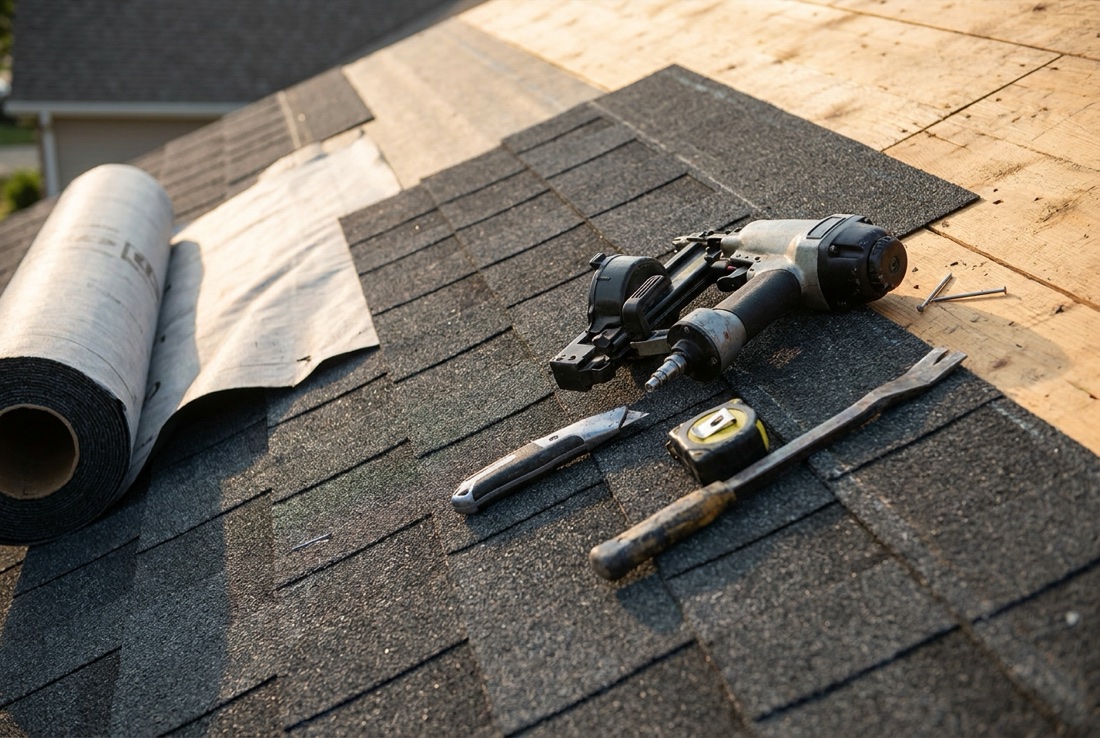
Every asphalt shingle ships with a factory-applied seal strip, a band of adhesive that bonds the shingle above to the one below it once it reaches a warm enough temperature, usually from direct sun exposure over a period of consecutive warm days. That bond is what keeps shingles locked flat against wind uplift. In a Macomb County winter, a north-facing slope or a shaded section of roof can go weeks without ever reaching the temperature that strip needs, which means a large-scale reshingling job left to rely purely on factory sealing would sit unsealed and vulnerable to wind for an unpredictable stretch of the season.
That is the real boundary. It is not that a crew "cannot" work on a roof in winter. It is that any repair or replacement depending entirely on unassisted factory sealing needs a stretch of consistent warm weather to finish properly, and a Macomb County winter frequently will not deliver that stretch on schedule. The professional answer to that gap is hand-sealing, covered next, not postponing every repair until April.
This is also why a full roof replacement in the dead of winter is a different conversation than a targeted repair. A whole new roof means thousands of seal strips that all need to bond, and while it can be done with disciplined hand-sealing across the entire field, it is a bigger lift than a repair covering a handful of shingles. If you are weighing a full winter replacement rather than a repair, our guide on freeze-thaw damage covers how the cold affects shingles at a material level, and the roof replacement team can walk you through timing specific to a full reroof.
It helps to separate the calendar problem from the physics problem. The calendar problem is that a Macomb County winter might not deliver a stretch of consistently warm, sunny days on any predictable schedule, so a job that depends entirely on the weather to finish its own seal is a job with an uncertain completion date. The physics problem is narrower: only the seal strip itself needs warmth. Every other part of a repair, from cutting shingles to fastening flashing to setting a new boot, is unaffected by temperature. Understanding that distinction is what lets a homeowner tell the difference between a legitimate "this piece needs to wait" and a contractor using winter as a blanket excuse to avoid a job.
04 / THE TECHNIQUEHand-sealing and cold-weather adhesives, explained
Hand-sealing is exactly what it sounds like: instead of waiting for the sun to activate the factory seal strip, the installer applies a small, precise dab of roofing cement or a cold-weather-rated sealant by hand under each shingle tab and presses it down, creating an immediate mechanical bond that does not depend on temperature or sunlight at all. It is standard practice taught across the roofing trade for cold-season work, and when it is done correctly, a hand-sealed shingle holds against wind just as reliably as one that sealed itself in July.
The materials matter as much as the technique. Standard roofing cement and caulk are formulated to stay workable in warm weather, and in real cold they can stiffen, apply unevenly, or fail to bond at all. Cold-weather-rated sealants and adhesives are formulated to stay pliable and to cure at low temperatures, and using the correct product for the conditions is the difference between a repair that lasts and one that looks fine in January and fails in March. Manufacturer installation guidance covers the specific temperature thresholds and application methods for hand-sealing and cold-rated products in detail, and it is worth asking any contractor doing winter work whether they are following it.
If a repair involves shingle work in cold weather, ask directly whether the crew hand-seals every tab and what product they use to do it. A straightforward answer with a product name is a good sign. A shrug, or a promise that "it will seal itself once it warms up," is not.
None of this is exotic. Hand-sealing and cold-rated adhesives exist precisely because roofs do not stop needing repairs from November through March, and the trade has had decades to work out how to do that repair correctly. The technique adds a small amount of labor time to a shingle repair, which is a fair trade for a fix that holds through the rest of the winter instead of lifting again in the first hard wind.
05 / CREW SAFETYCrew safety limits on snow and ice
Separate from the chemistry of sealing, there is a hard safety limit that has nothing to do with material science: a roof covered in snow or glazed with ice is not a surface a crew can walk safely, full stop. A shingle roof that is bone dry and cold is workable with the right footwear and staging. The same roof under a few inches of snow, or with a layer of ice from a recent freeze-thaw cycle, is not, and no legitimate contractor will send a crew onto it in that condition regardless of how urgent the repair feels.
In practice this means a winter repair call often starts with snow and ice removal from the work area before any actual repair begins, or a short delay until conditions clear enough to work safely. That is not a stall tactic. It is the same judgment call that keeps a crew off a wet roof discussed in our guide on roofing in the rain, applied to a colder version of the same problem. A contractor who tells you honestly that today is not safe, and reschedules for tomorrow or later that week, is protecting the quality of your repair as much as their own crew.
This is also where 24/7 emergency tarping earns its place in the winter conversation. If a section of roof is actively letting water or snowmelt into the house, a tarp stops the bleeding safely, even in conditions that are not yet safe for a full repair crew, and buys time until the weather and the roof surface allow the permanent fix to go in correctly. Tarping is available around the clock; the permanent repair is scheduled for the first window when the roof can be worked safely.
A repair crew that will not walk an icy roof is not being cautious for no reason. They are making sure the repair they hand you actually holds, instead of rushing a job on a surface where a slip ends the workday before the fix is finished.
Daylight is the other quiet limit on winter scheduling. Michigan loses several hours of usable daylight between the summer and winter solstice, and a repair crew needs enough light to see flashing seams, nail patterns, and sealant lines clearly. Combine a shorter window with the time needed to clear snow from a work area first, and a winter repair day simply covers fewer jobs than a summer one, which is one honest reason winter scheduling can move a little slower even when every individual repair is done exactly right.
06 / THE REAL NUMBERGetting a winter repair priced, free
Everything above is a framework for understanding what a winter repair call can and cannot solve immediately. The only way to know what your specific roof needs, and whether conditions allow the crew to start today or tomorrow, is an inspection. Ours is $0 with no obligation, and if the roof only needs a targeted repair rather than anything bigger, that is exactly what we will tell you, along with a written price before work starts.
What a winter inspection actually covers
A winter inspection looks at the same things a summer one does: the shingle field, the flashing at every wall and penetration, the ventilation, and the attic side of the deck, with photos of everything we find. What changes is the order of operations on site. If snow or ice is present, clearing a safe path to the problem area comes first. From there, the inspection identifies exactly which category the repair falls into, whether it is a same-day fix like a boot swap or flashing seam, a hand-sealed shingle repair, or a larger job better suited to a scheduled window once conditions improve, and you get that scope in writing before any work begins.
If shingles on your roof are lifting in wind or you are not sure whether a seal is holding, our guide on shingles that will not seal down walks through the causes beyond cold weather alone. And if you want a ballpark before anyone visits, the instant estimator runs the same published ranges as this page, while the cost calculator applies them to your specific job. You can also start from our roof repair service page or browse the rest of the library at Macomb Roofing Pros guides.
- Flashing work, pipe boot replacement, decking repairs, and hand-sealed shingle work all hold up fine in cold weather; none of them depend on temperature to succeed.
- The one real limit is factory seal strips, which need warm-weather sun exposure to bond on their own; hand-sealing with a cold-weather-rated product solves that gap.
- Crew safety on snow- or ice-covered slopes is a hard stop, separate from the chemistry question, and 24/7 emergency tarping bridges the gap until conditions allow a safe repair.
- Repairs run $350 to $3,200 year-round, including winter calls, and larger or complex repairs can run higher.
- The exact scope and price for your roof needs an inspection, and ours is $0 with no obligation.
Questions we hear most
Yes, for most common repairs. Flashing work, pipe boot swaps, decking repairs, and hand-sealed shingle replacement all hold up fine in cold weather when done with the right technique and cold-rated materials. The one thing that cannot happen in the cold is a shingle's factory seal strip bonding on its own, which is why hand-sealing exists.
Hand-sealing means the installer applies roofing cement or a cold-weather-rated sealant by hand under each shingle tab instead of waiting for the sun to activate the factory seal strip. It creates an immediate bond that does not depend on temperature, and it is standard trade practice for cold-season shingle work, not an improvised shortcut.
A crew will not walk a roof that is snow-covered or glazed with ice, because that is not a safe surface regardless of how urgent the repair is. A winter call often starts with clearing the work area or a short reschedule to safer conditions. If water is actively coming in, 24/7 emergency tarping can stop it in the meantime while the permanent repair waits for a safe window.
- FEMA, disaster declaration DR-4757-MI, Michigan severe storms of August 2023 (Macomb County designated). fema.gov/disaster/4757
- Manufacturer technical and warranty literature for the major asphalt shingle lines: GAF (gaf.com), Owens Corning (owenscorning.com), and CertainTeed (certainteed.com).
- U.S. Occupational Safety and Health Administration, fall protection requirements for roofing work. osha.gov