
JUMP TO A SECTION
From the driveway, most asphalt shingle roofs look about the same: a flat gray or brown plane that either looks new or looks old. Up close, on a ladder or standing on the field itself, the shingles tell a much more specific story. Granule wear has a pattern. Curling has a cause. A crease across a tab is not the same defect as a hairline crack down the middle of one. This guide is a field read, the same one we use on a free roof inspection: what each condition looks like, what it usually means about the shingle's remaining life, and how to separate ordinary Michigan weathering from damage tied to one specific event. It stops at diagnosis. Whether a given finding calls for a spot repair or points toward full replacement is its own decision, covered in our replacement and repair guides.
01 / THE FRAMEReading a shingle field like an inspector
An inspector walking a roof is not looking for one thing. They are scanning for a handful of specific conditions, in a rough order, and cross-checking what they see against the roof's approximate age and the local weather history. Two questions sit underneath almost every finding: is this wear, meaning the shingle is simply getting old, or is this an event, meaning something specific happened to it on a given day. The answer changes what happens next, because wear points toward a replacement conversation and an event can sometimes point toward an insurance conversation instead.
The order matters too. A useful field read starts at the surface, with granule condition and shape, then works down into the mat itself with cracking, then finishes with the findings most tied to a specific wind date: creases, tears, and exposed nails. Working in that sequence keeps age-driven findings and event-driven findings from getting mixed together in the notes, which is exactly the mistake that turns a five minute driveway glance into a wrong guess about what the roof actually needs.
None of the conditions below are a verdict on their own. A few curled tabs on an 18 year old roof and the same curl on a 4 year old roof mean very different things. Use this as a vocabulary and a checklist, then get an actual inspection for the verdict. Ours is $0 with no obligation.
02 / THE SURFACEGranule loss: the clearest age signal on the roof
Asphalt shingles are coated in mineral granules that do two jobs: they shield the asphalt underneath from UV light, and they give the shingle its color and its fire rating. Every shingle sheds some granules over its life, and a small amount in the gutter after a new roof is normal runoff from manufacturing. What an inspector is actually watching for is the pattern of loss, not the mere presence of it.
Even, gradual thinning
A roof nearing the end of its rated life typically shows granule loss spread fairly evenly across the whole field, with the asphalt mat starting to show through as a darker, shinier patch here and there. This is the ordinary aging pattern: years of sun and freeze-thaw cycles slowly working the granules loose. It is a strong argument for budgeting toward replacement rather than chasing individual repairs, especially once it shows up on more than one slope.
Bald patches and clustered loss
Granule loss concentrated in one patch, one slope, or around a specific hail-struck area is a different signal. Hail bruises a shingle by fracturing the mat under the granules, which then wash away first from the bruised spots, leaving small, roughly circular bald patches that look different from the gradual thinning above. This pattern is worth photographing and dating, because it can be the difference between a wear finding and an event finding.
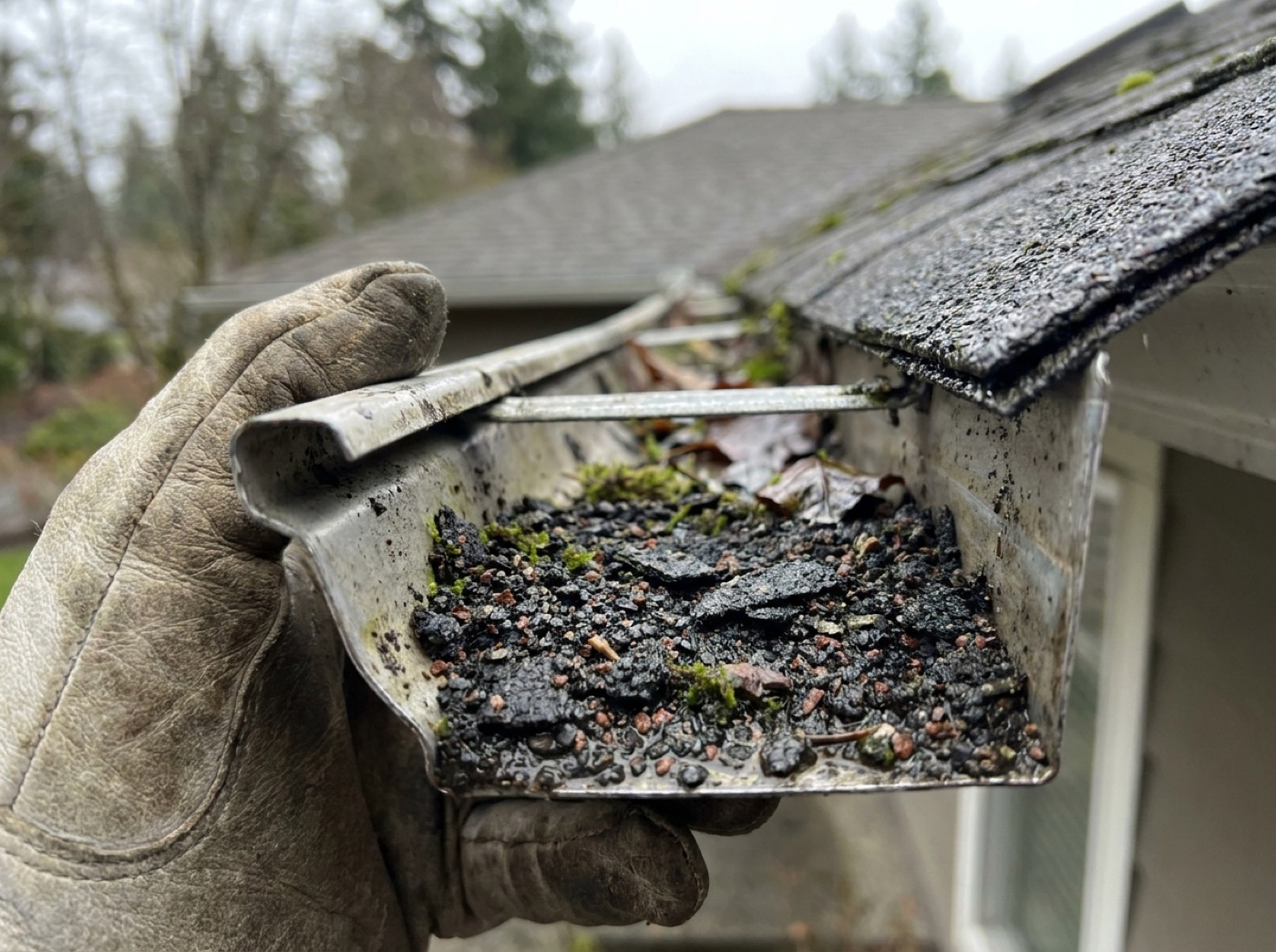
A magnifying loupe and a raking light at a low sun angle make granule loss far easier to see than a straight-on look in bright daylight, which is why a thorough inspection is not done from the ground. If you want to check your own roof safely without getting on it, our 21-point inspection checklist covers what to look for with binoculars from the yard.
03 / SHAPECurling, cupping, and blistering
After granule loss, the next thing an inspector checks is whether the shingle is still lying flat. A healthy shingle sits tight against the roof deck and against its neighbors. Several distinct problems can make it stop doing that, and they do not all mean the same thing.
Curling and cupping
Curling is when the edges of a shingle lift away from the roof while the center stays anchored, and cupping is the same idea from the opposite direction, with the edges of each granule tab turning upward like a shallow bowl. Both are usually driven by the asphalt drying out and losing flexibility with age, often accelerated by poor attic ventilation cooking the shingle from underneath. A curled edge is more vulnerable to wind getting under it, so curling in one area often precedes wind lift nearby.
Blistering
Blistering shows up as small raised bumps or bubbles in the shingle surface, sometimes with granules missing from the top of the bump where it has worn through. It is caused by trapped moisture or gas pockets inside the shingle expanding and contracting with heat, and like curling it is often tied to a hot, poorly ventilated attic. Blisters that have popped and exposed the mat underneath are a point of accelerated wear, since that exposed asphalt has no granule protection left at all.
Curling and blistering that are worse on the south and west facing slopes than the north and east slopes usually point to sun and heat exposure rather than a manufacturing issue, since those slopes take the most direct afternoon sun in Michigan. Ventilation upgrades can slow the problem on a roof that still has years left; they will not reverse damage already done.
04 / THE MATCracking: thermal stress on the shingle itself
Cracking is different from curling because it is a failure in the shingle mat, not just its shape. Two patterns show up most often on Michigan roofs.
Thermal cracking
Thermal cracking appears as fine, often parallel hairline cracks running across the shingle surface, usually most visible after the shingle has been through many freeze-thaw cycles. Michigan's swing between summer heat and winter cold repeatedly expands and contracts the asphalt mat, and eventually it loses elasticity and starts to crack the way old rubber does. This is almost always an age finding rather than an event finding, and it tends to show up roof-wide rather than in one isolated area.
Cracked or split tabs
A tab that is cracked straight through, especially near the tab slots or at a nail line, is more likely a stress crack from wind flexing the shingle, an installation issue such as a misaligned nail, or physical impact. Unlike the fine web of thermal cracking, an isolated split tab is worth a closer look at the surrounding courses to see whether it is a one-off or the leading edge of a wider problem.
A hairline crack across every shingle on the roof is age. A single split tab next to three lifted neighbors is usually an event. Telling them apart is most of the job.
05 / THE WIND SIGNSCreased tabs, wind lift, and exposed nail heads
Some of the most consequential findings on a shingle inspection are the ones tied to a specific wind event rather than gradual wear, because they can open a path for water immediately, not years from now.
Creased or lifted tabs
When wind gets under a shingle tab and flexes it back, it can leave a visible crease line across the tab even after the shingle settles back down, and the adhesive seal strip underneath is often broken at that crease whether or not the tab looks obviously out of place. A creased tab has usually lost some or all of its factory seal, which means the next strong wind can lift it again more easily, and water can work in at the crease during wind-driven rain in the meantime.
Torn or missing tabs
A tab torn off entirely, or a bare rectangle of exposed underlayment where a shingle used to be, is unambiguous wind damage, usually from a specific storm rather than slow wear. These spots are the most urgent finding on a shingle inspection, since the underlayment is only ever meant to be a secondary, temporary barrier, not the finished roof surface.
Exposed or backed-out nail heads
Nails that sit proud of the shingle surface, whether from a high nail placement during installation or from the shingle working loose around the fastener over time, create small, direct paths for water at every affected nail. A backed-out nail head is often visible as a small dark dimple with the metal showing through, and it is a quick, inexpensive item on its own but is also a sign worth checking the whole slope for a pattern of the same issue.
Creased tabs, torn shingles, and clustered granule bruising after a known storm are exactly the findings that matter for a homeowners insurance claim. Photograph what you can safely see from the ground and get a professional inspection before doing anything else. Our wind and hail damage inspection guide and our storm and insurance claims page walk through documentation and what happens next; no contractor can promise a claim outcome.
06 / THE DISTINCTIONWear from age versus damage from one event
Almost every finding above sorts into one of two buckets, and getting the sort right matters more in Michigan than in milder climates, because our roofs carry both kinds of stress at once. Freeze-thaw cycling, big seasonal temperature swings, and a real wind and hail history all act on the same shingle field, sometimes in the same year.
Signs that point to ordinary age
Findings spread evenly across every slope, a roof that is at or past the upper end of its rated service life, thermal cracking in a fine web pattern, and granule loss that thins gradually rather than in bald clusters all point toward wear. Age findings do not usually improve with a spot repair; they are a signal to start planning for a full replacement on your own timeline rather than the roof's.
Signs that point to a specific event
Findings clustered on one slope, especially the slope that faced the storm; creased or torn tabs that line up with a known wind date; and bruised, circular granule loss consistent with hail all point toward an event. Macomb County has recent history here: the county was included in federal disaster declaration DR-4757 after the severe wind storms of August 2023, and roofs that were never inspected afterward can still be carrying that damage today, worsening a little with every freeze and thaw since.
Insurance policies generally cover sudden storm damage such as wind and hail, not gradual wear from age, and every policy reads a little differently, so the declarations page and the adjuster have the final word. That is exactly why the sort above matters: it is the first filter an inspector applies before any conversation about a claim even starts.
07 / NEXT STEPWhat these findings become on a real inspection
Everything above is a vocabulary, not a verdict. A real inspection turns these individual findings into a written, photographed report that covers the shingle field, the flashing, the ventilation, and the attic side of the deck, the same scope described on our roof inspection service page. The report tells you plainly whether what we found is age, an event, or a mix of both, and what that means for your options. If the roof only needs a targeted fix, our repair guide covers what that looks like and what it costs; if the findings point toward the end of the roof's life, our replacement guide covers the same for a full system.
The inspection itself is $0 with no obligation, and if the roof is fine, that is exactly what the report will say. There is no upsell built into the process for work you do not need.
A word on timing. Shingle findings rarely stay static once they appear. A creased tab left through another windy season is more likely to tear loose, and a blistered patch left through another summer is more likely to bald out and expose bare mat. None of that means every finding is an emergency, but it does mean a small issue caught early is usually the cheapest version of that issue you will ever see. Getting on the schedule for a look this season, rather than waiting for a leak to force the question, is the practical takeaway underneath everything above.
- Granule loss, curling, cracking, and wind lift each have a distinct look and a distinct likely cause.
- Spread evenly across the whole roof, most findings point to ordinary age. Clustered on one slope after a known storm, they point to an event.
- Creased tabs and bruised granule patches are the findings that matter most for an insurance conversation.
- This guide stops at diagnosis; repair-or-replace is a separate decision covered in our repair and replacement guides.
- A free inspection turns these findings into a written, photographed report, with no obligation.
Questions we hear most
Not automatically. A small amount of granule loss is normal, especially in the first year or two as excess manufacturing granules wash off. Heavy, even granule loss across the whole roof with the asphalt mat showing through is a stronger sign of a roof nearing the end of its life, while a bald patch in one spot can be a localized issue. An inspection tells you which pattern you actually have.
You can often spot the obvious signs from the ground with binoculars, such as a missing shingle or a visibly lifted tab, but confirming a broken seal strip, a hidden crease, or bruised granules usually requires getting on the roof and often the attic side of the deck. A free inspection with photos is the reliable way to know for sure.
Note which slopes are affected and roughly how widespread it is, then schedule an inspection rather than guessing at repair versus replacement from the ground. A professional can tell you whether the finding is isolated and repairable or part of a broader pattern that points toward replacement, and our inspections are $0 with no obligation.
- FEMA, disaster declaration DR-4757-MI, Michigan severe storms of August 2023 (Macomb County designated). fema.gov/disaster/4757
- Manufacturer technical and warranty literature for the major asphalt shingle lines: GAF (gaf.com), Owens Corning (owenscorning.com), and CertainTeed (certainteed.com).
- National Roofing Contractors Association, technical guidance for steep-slope roof systems. nrca.net
- Michigan Residential Code 2015, section R806 Roof Ventilation: minimum net free ventilating area of 1/150 of the vented space, reduced to 1/300 where listed conditions are met. up.codes: MRC chapter 8