
JUMP TO A SECTION
Every shingle wrapper carries a wind rating, usually printed as a number of miles per hour, and most homeowners have never read past it. That number comes from a laboratory test class, not a promise about what happens on your specific roof in a specific storm. This guide walks through what the wind classes on shingle packaging actually measure, why the crew's installation details change the real-world performance as much as the rating on the bag, and what makes sense for an open-exposure or lakeward home in Macomb County. It also covers the high-wind nailing patterns a good crew uses on every job, rated shingle or not.
01 / THE SHORT ANSWERWhat those MPH numbers mean
Asphalt shingle packaging is generally marketed against a handful of wind classes, commonly shown as ratings in the neighborhood of 60, 80, 110, and up to 130 mph depending on the product line and manufacturer. Those figures correspond to pass thresholds in the ASTM wind resistance standards the shingle was tested under, not a guarantee that the shingle will survive exactly that wind speed on your roof and no higher. A higher-rated shingle has passed a more demanding lab test than a lower-rated one, which is a real and useful signal, but the number on the wrapper assumes the shingle was installed to the manufacturer's instructions. An identical shingle installed correctly and installed carelessly can behave very differently in the same storm.
is the installed range for a full asphalt replacement in Macomb County, with most homes landing $12,000 TO $16,000. If a wind event has already left your roof needing more than a repair, the instant estimator gives you a ballpark in about 60 seconds.
The practical takeaway for most homeowners: the wind class matters, but it is one input among several. Roof geometry, exposure, and installation quality all sit alongside the rating in determining how a roof actually performs, which is exactly what the rest of this guide unpacks.
02 / THE STANDARDSWhat the ASTM wind tests actually measure
Two ASTM test methods sit behind most shingle wind marketing, and they measure different things. One method applies a controlled uplift force to a shingle sample and holds it for a set duration, checking whether the tabs stay sealed and in place. The other simulates gusting, oscillating wind in a test chamber rather than a single steady force, which is a closer approximation of how real wind actually behaves against a roof surface. A shingle can carry a class rating from either or both standards, and the exact pass criteria, test durations, and class thresholds are defined in the standards themselves rather than in manufacturer marketing copy.
What both tests have in common is that they are sealant tests as much as anything else. Asphalt shingles hold down in wind primarily through a factory-applied sealant strip that bonds to the shingle course above it once activated, not through the nails alone. A wind class rating is really a statement about how well that sealed shingle system resists uplift under laboratory conditions, which is why the details covered in the next section, correct nailing and a properly sealed starter course, matter as much as which class is printed on the wrapper.
Sealant activation takes heat
The sealant strip that does most of the wind-holding work needs a period of warmth and sun exposure to fully bond, generally taking anywhere from a few days to a few weeks depending on the season. A roof installed on a cold, overcast stretch of a Michigan spring or fall may not reach full sealed strength until the first real run of warm days afterward. That is a normal, expected part of asphalt roofing, not a defect, but it is worth knowing if a wind event happens to hit a very recently installed roof before the sealant has fully cured.
03 / THE REAL FACTORWhy installation can matter more than the rating
A shingle's wind class is earned under ideal laboratory installation. On a real roof, three details do more to determine actual wind performance than the number on the wrapper: nail count, nail placement, and the starter strip.
Nail count and placement
Manufacturer instructions specify a minimum number of nails per shingle and a nailing zone, a defined strip on the shingle where each nail must land to catch both the shingle being installed and the course below it. Too few nails, nails placed outside the zone, or nails driven at an angle instead of flush all weaken the hold regardless of what class the shingle is rated for. Many manufacturers require a higher nail count, often six nails instead of four, specifically for higher wind zones or steeper roof pitches, which is a detail a quote should specify rather than leave to guesswork.
The starter strip
The starter course along the eaves and rakes is a purpose-made starter strip product with factory sealant already positioned to bond the very first course of field shingles down tight against wind. A roof where the starter strip was cut from a field shingle instead of installed with a proper starter product, or where the starter sealant was misaligned, tends to lose shingles at the edges first in a wind event, precisely because the edges see the highest uplift forces on the whole roof.
This is also why a lower-rated shingle installed meticulously can outperform a higher-rated shingle installed carelessly. The class printed on the wrapper describes the product tested under ideal conditions; the installation on your roof is what determines whether your roof actually gets that performance. Our shingle tier guide covers how wind rating differs by product tier in more depth.
04 / MACOMB COUNTYWhat rating makes sense here
Most of Macomb County sits in a general wind exposure that a standard architectural shingle handles well when installed correctly. A handful of situations shift the calculation toward a higher wind class or the nailing upgrades covered in the next section.
- Open exposure homes, sitting on larger lots without wind-breaking trees or neighboring structures, see higher effective wind loads on the roof than a sheltered lot in a dense subdivision.
- Lakeward homes along Lake St. Clair and the connecting waterways see less obstructed wind off the water than inland properties, which is a real factor for homes in and around communities like St. Clair Shores and Harrison Township.
- Steep or cut-up rooflines with hips, dormers, and valleys create more edge and corner area, and edges and corners are exactly where wind uplift concentrates hardest.
Macomb County also has a recent, real-world reason to take wind spec seriously. The county was included in federal disaster declaration DR-4757 after the severe wind storms of August 2023, an event that lifted shingles and drove water under roof surfaces across the region in ways that were often invisible from the ground until the next rain. A roof that has never been inspected since that event is worth a look, wind class aside.
One point worth separating clearly: wind rating and impact rating are different specifications testing different things. Wind class measures resistance to uplift; impact class, most commonly discussed as Class 4, measures resistance to hail and falling debris. A shingle can carry a strong wind class and a modest impact class, or vice versa, and some premium products carry both. Our Class 4 impact-resistant shingle guide covers that separate spec, including the insurance discount angle some carriers offer for it, in full.
05 / IN PRACTICEHigh-wind nailing patterns, in practice
Regardless of which shingle class a homeowner chooses, the nailing pattern a crew actually uses on install day is where wind performance is won or lost. A few practical items worth asking about, or looking for on an existing roof:
- Nail count per shingle. Confirm whether the manufacturer's instructions for the specific product and roof pitch call for four nails or six, and ask which the crew is using.
- Nailing zone accuracy. Nails belong in the manufacturer's defined nailing zone on each shingle, not high, low, or angled, so they catch both the current course and the one beneath it.
- Purpose-made starter strip. The eaves and rakes should carry a dedicated starter product with factory sealant, not field shingles cut down and repurposed.
- Hip and ridge fastening. Ridge cap shingles see high wind exposure at the roof's highest point and should be fastened per the manufacturer's hip-and-ridge specification, not treated as an afterthought.
- Hand-sealing in cold weather. On roofs installed in cold months, some crews hand-apply a dab of roofing cement under tabs and starter courses to hold the shingle down until the factory sealant activates on its own in warmer weather.
None of these items add meaningfully to the cost of a job when they are part of the standard install, which they should be. They are the difference between a roof that earns its wind rating in practice and one that only earned it on paper.
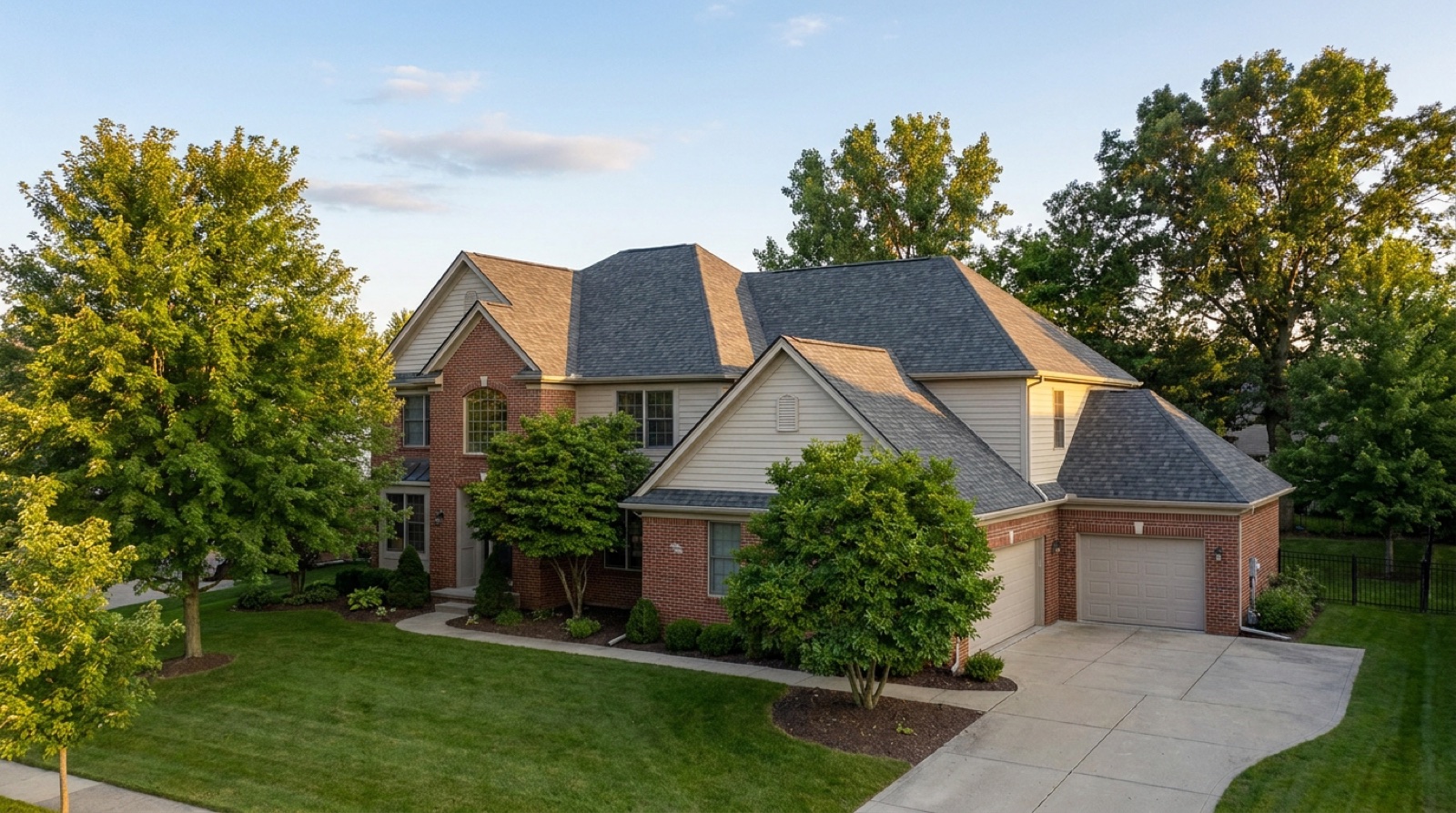
A wind class describes what a shingle did in a lab. Nail count, nailing zone, and the starter strip describe what your roof will do in the next storm.
06 / THE REAL NUMBERGetting the right spec for your roof, free
The right wind class and nailing spec for a given house depends on its exposure, geometry, and pitch, which is exactly what an on-site look answers better than a general guide can. Our inspection is $0 with no obligation, and for a replacement it covers exposure, roof shape, and a specific recommendation on shingle tier and nailing pattern, not just a generic quote.
If you already have wind damage from a recent storm, that is a different and more urgent conversation, one our storm and insurance claims guide walks through in detail, including documentation and what we can and cannot promise about a claim outcome. If you are planning a standard replacement and want a ballpark first, the instant estimator uses the published price canon, and the cost calculator applies it to your roof size. You can browse the rest of the replacement lane in our guides library, or start from the roof replacement service page.
- Shingle wind ratings, commonly shown around 60 to 130 mph, come from ASTM lab test classes that describe the product under ideal installation, not a guaranteed survival speed on your roof.
- The tests are largely sealant tests: how well a bonded shingle course resists uplift, which is why nail count, nail placement, and the starter strip matter as much as the printed class.
- Sealant strips need warmth and sun to fully activate, so a roof installed in cold weather reaches full sealed strength once the first real warm spell arrives.
- Open-exposure and lakeward Macomb County homes, plus cut-up rooflines with more edges and corners, are where a higher wind class and nailing upgrades matter most.
- Wind rating and impact rating (Class 4) are different specs measuring different things; a roof can carry either, both, or neither.
- The exact right spec for your roof is a free, no-obligation inspection away.
Questions we hear most
They correspond to pass thresholds in ASTM wind resistance test standards, commonly shown around 60, 80, 110, and up to 130 mph depending on the product. The rating describes how the shingle performed under laboratory conditions with ideal installation, not a guaranteed survival speed on your actual roof, which is why installation quality matters alongside the rating.
No. A higher-rated shingle has passed a more demanding lab test, which is a real and useful signal, but real-world performance also depends on nail count, nail placement, the starter strip, and your roof's exposure and geometry. A well-installed standard shingle can outperform a poorly installed premium one.
No, they are separate specifications. Wind rating measures resistance to uplift; impact rating, most commonly discussed as Class 4, measures resistance to hail and falling debris. Some products carry a strong rating in one and a modest rating in the other, and some carry both.
- FEMA, disaster declaration DR-4757-MI, Michigan severe storms of August 2023 (Macomb County designated). fema.gov/disaster/4757
- ASTM D3161 and ASTM D7158, standard test methods and classifications for wind resistance of asphalt shingles.
- Manufacturer technical and warranty literature for the major asphalt shingle lines: GAF (gaf.com), Owens Corning (owenscorning.com), and CertainTeed (certainteed.com).