
JUMP TO A SECTION
Wind damage tends to announce itself: a missing shingle, a lifted tab rattling in the next gust, something visibly wrong. Hail is quieter. A hailstone hits a shingle, does its damage below the surface, and the shingle can lie flat and look intact for years afterward. That is exactly why hail is the storm damage homeowners miss most, and why it is worth learning to read the specific signs instead of just glancing up and deciding the roof looks fine. This guide walks every place hail leaves evidence, from the shingle mat itself down to the vents, gutters, and yard, the same way we walk a roof on a free storm inspection.
Everything in this guide can be checked from the ground, a window, or the base of a ladder. A roof after a hailstorm is not the place to be walking around testing shingles by hand. If you want a hands-on check, that is what a trained inspector is for, not a Saturday project.
01 / THE SHORT ANSWERHail damage is usually invisible from the ground
Here is the uncomfortable truth up front: most hail damage does not show up as a hole, a stain, or anything you can spot standing in your yard. Hail bruises the shingle's fiberglass mat without breaking the surface, and a bruised shingle can go a full season, sometimes several, without a drop of water getting through. The damage is real and it is permanent, it just does not announce itself the way a missing shingle does. That gap between when the damage happens and when it finally leaks is the whole reason this guide exists.
So what can a homeowner actually do before calling anyone? Plenty. You will not diagnose a bruised shingle from the driveway, but you can gather real evidence: granules in the gutter, dents in the soft metal around the roof, and the pattern of hits across siding, screens, and the yard. That evidence is often enough to justify a free inspection, and the inspection is where the shingle-level read happens. Think of this guide as the homeowner's half of the job.
02 / THE BRUISEWhat a hail bruise actually is
An asphalt shingle is built in layers: a fiberglass mat coated in asphalt and topped with a layer of protective granules. When a hailstone hits with enough force, it does not always tear the surface. Instead it can fracture the fiberglass mat underneath while the granule surface stays mostly intact, leaving a soft, slightly depressed spot that a trained hand can feel but an untrained eye can easily miss. That fractured mat is a bruise, and it is functionally broken even though the shingle still looks whole.
What inspectors actually check for
A trained eye looks for a shallow dimple in the shingle surface, often with the granules around it displaced or thinned in a small circle, and confirms it with gentle finger pressure that finds the give underneath. This is a deliberate, practiced touch, not a poke or a press with a tool, and it is exactly why walking your own roof to check for it is a bad trade: one wrong step on a granule-thin or storm-loosened shingle can do more damage than the hail did. Our companion piece on what a hail bruise looks and feels like goes deeper on the visual and tactile cues professionals use.
Bruise versus simple granule rub-off
Not every bald spot is a bruise. Foot traffic, tree contact, and age all wear granules away in patches that have no soft spot underneath and no fracture in the mat. The distinction matters because a true bruise compromises the shingle's ability to shed water over time, while surface rub-off is cosmetic. This is one more reason the touch test belongs to a professional: telling the two apart from a photo or a ladder-length view is unreliable, and getting it wrong in either direction either wastes a claim or misses a real problem.
Size and age both change what a bruise looks like
Larger hailstones generally leave a more obvious mark, but size alone does not decide whether a shingle bruises, the shingle's age and condition matter just as much. An older, more brittle shingle can bruise from a hit that would barely mark a new one, while a fresh, still-pliable shingle can sometimes absorb a moderate hit with less visible evidence. That is one reason two roofs on the same street, hit by the same storm, can come away looking very different, and why an inspector reads the whole roof rather than judging by a single shingle.
03 / THE SURFACEGranule loss and exposed asphalt
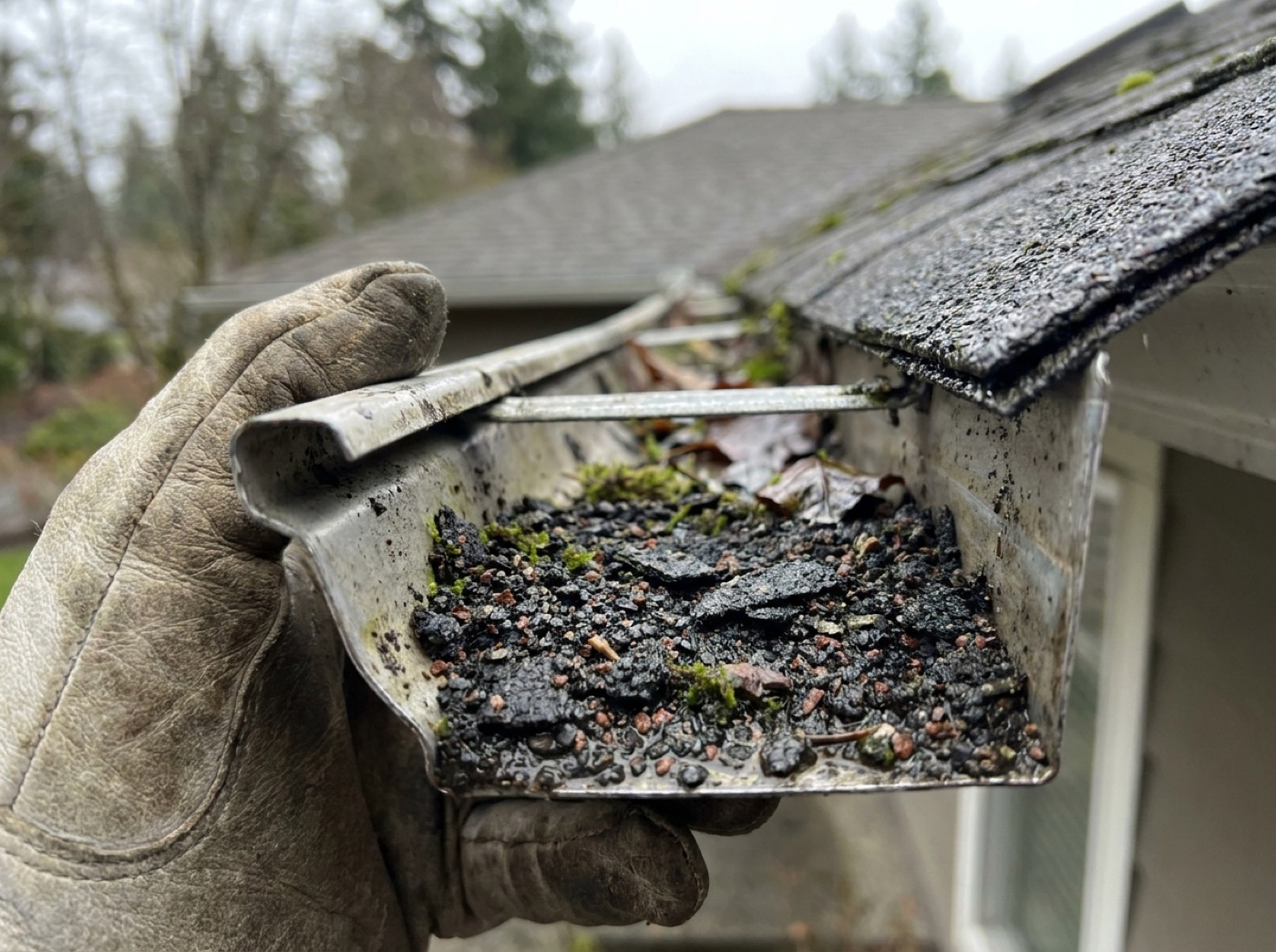
Granules are the shingle's sunscreen. They shield the asphalt layer from UV light, and when a hailstone knocks a patch of them loose, what is left behind is bare asphalt that looks shinier and darker than the surrounding shingle, almost like a wet spot that never dries. That shiny patch is a visible, ground-checkable clue, even when the bruise underneath it is not.
You will not spot this reliably by staring up at the roof from the yard. Instead, check where granules end up after they shake loose: gutter troughs, the ground below downspouts, and driveway or patio surfaces after a hard rain often show a wash of dark granules that were not there before the storm. A sudden, concentrated increase in granules right after a hailstorm, especially in one area rather than spread evenly, is a meaningful signal worth photographing and mentioning when you call for an inspection.
It is worth separating storm-driven granule loss from ordinary wear. New shingles shed some loose granules in their first year as a matter of course, and aging shingles lose granules gradually and evenly over their whole service life. What points to hail specifically is loss that is sudden, tied to a known storm date, and concentrated rather than uniform across the roof. Our guide on granule loss and what it means covers that normal-versus-storm distinction in more depth.
Exposed asphalt matters for more than appearance. Granules exist specifically to block ultraviolet light from breaking down the asphalt layer underneath, so a bare patch left by hail is not just a cosmetic blemish, it is a spot that ages faster than the rest of the roof from that point forward. A shingle with a hail-stripped patch and one with a hail bruise nearby can end up failing years ahead of the rest of the roof, which is part of why an insurer and an inspector both care about mapping every affected shingle rather than treating a few visible spots as the whole story.
04 / THE PATTERNRandom scatter, not a straight line
One of the most useful things to understand about hail is how it hits: randomly, in whatever direction the wind was carrying it, scattered across a slope rather than lined up in any pattern. That randomness is actually diagnostic. Damage that runs in a straight line, follows a walking path, or clusters right around a vent pipe or satellite mount is far more likely to be mechanical, foot traffic, an installer's boot, or equipment contact, than storm-caused.
Hail also does not respect roof slope evenly. Slopes facing the direction the storm blew in from typically take the heaviest hits, while a sheltered slope on the opposite side of the same roof, or a section shielded by a taller part of the house, can show almost nothing. If you notice one slope looking rougher than another after a storm, that lopsided pattern is itself a clue, and it is one you can often see just by walking the yard and looking up at each face of the roof in turn.
This is also where soft metal evidence becomes so useful, because it corroborates the pattern. If vents and flashing on the same slope show a cluster of small round dents, that is strong support that the marks on the shingles nearby are impact damage rather than wear. Reading the whole roof as one pattern, not one shingle at a time, is a big part of how a professional inspection separates real hail damage from coincidence.
Roof pitch and layout play a role too. A steep slope facing straight into wind-driven hail can take a harder, more direct hit than a shallow slope catching the same stones at a glancing angle, and a dormer or valley can shield one small section while leaving the surrounding field exposed. None of this is something to map out yourself with a ladder. The point of understanding it is simply to make sense of why a roof can show heavy damage on one face and almost none on another, so an uneven read from the ground does not get mistaken for no damage at all.
05 / THE WITNESSESSoft metals and the yard tell the story first
Before anyone needs to look closely at the shingles, the softer materials around your property often make the case on their own. Aluminum roof vents, flashing, and gutters dent at hail sizes that may not visibly mark a shingle, which makes them a useful early check you can partly do without a ladder, using binoculars or a phone zoom from the ground.
- Roof vents and flashing. Look for small round dents on plumbing vent caps, box vents, and any exposed metal flashing. These are usually the easiest hail evidence to spot with the naked eye.
- Gutters and downspouts. Fresh dents, dings, or dimples along the gutter face, especially clustered on one side of the house, point to storm impact rather than age.
- Window screens. Torn or bowed-out mesh on the storm-facing side of the house is a quick, ground-level hail indicator.
- AC condenser fins. Bent or flattened fins on the outdoor unit are a classic hail witness mark, since the thin aluminum dents easily.
- Siding, decks, and vehicles. Small dings on vinyl siding, splatter or dent marks on a deck or patio surface, and any hail dents on cars parked outside during the storm all help establish that hail actually reached your property, and roughly how large it was.
A full ground-level sweep of these witness marks, photographed with something for scale like a coin or a tape measure, is the single most useful thing a homeowner can do before calling for a professional look. It does not tell you definitively whether the shingles were damaged, but it tells you whether hail large enough to matter actually hit your house, which is often the missing piece. Our guides on reading hail dents on soft metals and collateral hail damage indicators walk this sweep in more detail.
Do the sweep the same day if you can, or as soon after the storm as it is safe to walk the property. Dents on soft metal and torn screens do not disappear, but splatter marks on decks and driveways wash away in the next rain, and stripped foliage gets cleaned up along with normal yard work. A same-day set of photos, with the date noted, is worth far more later than a memory of what the yard looked like.
The yard usually tells you whether hail hit hard enough to matter before the roof ever does. Start there, then let a trained eye finish the story on the shingles.
06 / THE TIMELINEWhy hail damage rarely leaks right away
This is the section that explains why so much hail damage gets missed entirely. Unlike a torn-off shingle, which opens a direct path for water immediately, a bruised mat is still covered by granules and asphalt on the surface. Water does not usually find its way through a fresh bruise the week after the storm. What happens instead is slower: the fractured mat weakens the shingle's structure, granule loss over the damaged spot accelerates because there is less material holding them, and sun exposure degrades the exposed asphalt faster than the surrounding shingle. Over months and seasons, that one weak spot is where a leak eventually starts, often long after anyone remembers the storm that caused it.
That delay is precisely why hail damage should be checked soon after a storm rather than waited out. A shingle roof that ages out five or ten years early because of unaddressed hail bruising is a far more expensive outcome than a free inspection would have been. It is also why insurance policies generally treat hail as coverable storm damage: policies are built around sudden events, and a bruise dated to a specific storm is a very different claim than gradual wear nobody can date at all.
There is a practical timing wrinkle here too. Many policies and most adjusters expect a claim to be filed within a reasonable window of the storm that caused the damage, and the longer a homeowner waits, the harder it becomes to tie a given bruise to a specific date rather than general wear. That is another reason an inspection soon after a known hail event, rather than only after a leak finally appears, tends to serve homeowners better on both fronts: the roof and the paperwork.
07 / THE REAL ANSWERGetting a real answer, free
Everything above gives you a homeowner's version of the read: what to photograph, what pattern to look for, and why the absence of an obvious problem does not mean the absence of damage. The only way to actually confirm hail damage on the shingles themselves is a trained inspection, done on the roof, checking the mat by feel where the ground-level clues point. Ours is $0 with no obligation, and it covers the shingles, the soft metals, and the ground-level evidence together as one picture, with photos of everything we find.
If the inspection turns up nothing, that is what we tell you, plainly. If it turns up damage, we document it thoroughly enough to support a claim conversation with your insurer, and we can meet your adjuster on site to walk the roof together. What we will not do is promise a claim outcome; no roofer honestly can, and every policy is different. Our storm and insurance claims guide covers everything after the inspection, from documentation to what an adjuster is actually looking for.
Macomb County has real recent history with damaging storms. The severe weather of August 2023 was significant enough that the county was included in federal disaster declaration DR-4757, and hail events of that scale reach entire neighborhoods at once, not just one unlucky house. If your roof has never been checked after a hailstorm, or you noticed any of the witness marks above, the honest next step is the same free look we would give any roof: our storm damage service page covers the whole process, and the cost calculator is there if a repair turns out to be needed.
If the inspection does confirm damage and a repair is the right call, most hail-related shingle repairs fall inside the general repair range of $350 to $3,200, with larger or more complex work running higher, the same published range on our honest pricing sheet that covers every other repair scenario on this site. Nothing about hail changes that math; what changes is simply whether the damage is found in time to keep the number at the lower end.
- Hail damage is usually invisible from the ground; a bruised shingle mat can look normal for years before it leaks.
- Fresh, concentrated granule loss in gutters and downspouts after a storm is a real, ground-checkable clue.
- Soft metals, vents, flashing, gutters, AC fins, dent more easily than shingles and are a fast early read.
- Random, scattered impact marks point to hail; straight lines or clusters around traffic areas usually do not.
- A trained hands-on inspection is the only way to confirm shingle-level damage, and ours is free with no obligation.
Questions we hear most
You often cannot confirm it from the ground, which is the point of this guide. Start with what you can check safely: granules in the gutters and downspouts, dents on vents and flashing, and marks on screens, siding, or AC fins. Those signs justify a professional inspection, which is the only reliable way to check the shingle mat itself.
No, and that is exactly why it gets missed. A bruised shingle mat can stay watertight for a long time before the weakened spot finally fails, often well after anyone remembers which storm caused it. That is why checking soon after a hailstorm, rather than waiting for a leak, protects the roof's remaining service life.
Often, yes, since policies generally cover sudden storm events like hail rather than gradual wear, but every policy is different and coverage decisions belong to your insurer. We document what we find with photos and can meet your adjuster on site, but no contractor can promise how a claim will resolve. A free inspection is the right first step either way.
- FEMA, disaster declaration DR-4757-MI, Michigan severe storms of August 2023 (Macomb County designated). fema.gov/disaster/4757
- Manufacturer technical and warranty literature for the major asphalt shingle lines: GAF (gaf.com), Owens Corning (owenscorning.com), and CertainTeed (certainteed.com).
- National Weather Service, Detroit/Pontiac forecast office: southeast Michigan forecasts, warnings, and event records. weather.gov/dtx
- Insurance Institute for Business & Home Safety, roof research and the FORTIFIED Roof standard. ibhs.org