
JUMP TO A SECTION
Most homeowners do not wake up one morning and decide they need a new roof. Something small gets their attention first: a shingle lying in the yard after a windy night, a faint ring on a ceiling tile, a neighbor's crew parked next door for the third day in a row. None of those moments prove anything on their own, and panicking over one lifted shingle is just as unhelpful as ignoring ten of them. What actually helps is knowing which small things are worth a second look, and having a fast, free way to get that look before a small problem turns into a big one. Below are ten signs Macomb County homeowners bring up most often, what each one really means, and what a trained eye checks to confirm or rule it out. None of them require you to become a roofer overnight. They are simply the vocabulary for describing what you already noticed, so that when you do call, the visit can start where the actual concern is instead of a blind walk of the whole roof.
01 / THE SHORT ANSWEROne sign is enough to make the call
You do not need all ten signs below stacked up before it is worth having someone look. Any single one is reason enough, because the entire point of an inspection is to find out early, while the fix is still small and the price is still low. A free roof inspection from Macomb Roofing Pros costs nothing and carries no obligation, so there is no version of this list where waiting for more evidence saves you money. On most roofs, small issues stay small only as long as someone catches them before another Michigan freeze and thaw cycle works on them. The list below is grouped by where you are likely to notice each sign: from the street and gutters, from inside the house, and from context clues tied to age and storms, so you can jump straight to the section that matches what you saw.
- Granules collecting in the gutters or piling up at the downspout.
- Shingles that are lifted, curled, cracked, or missing, especially after wind.
- Dark streaks or spreading moss across the shingle field.
- A roofline or ridge that looks wavy or dipped when you step back from the house.
- A stain, ring, or bubbled paint on a ceiling or wall.
- Daylight visible through the roof deck when you look up in the attic.
- A musty smell or damp insulation in the attic.
- Neighbors on your street getting new roofs around the same age as yours.
- A wind or hail event you never had checked afterward.
- A roof 15 to 20 years old or older with no documented inspection on file.
you do not need to diagnose it yourself. Describe what you noticed when you call, and we will look at that spot specifically along with everything else. The inspection is $0, no obligation, whether the roof turns out to be fine or not.
02 / FROM THE STREETSigns you can see from the ground and gutters
Four of the most common signs do not require a ladder at all. They show up in the gutters, on the ground after a storm, or simply by stepping back and looking at the house the way an appraiser would.
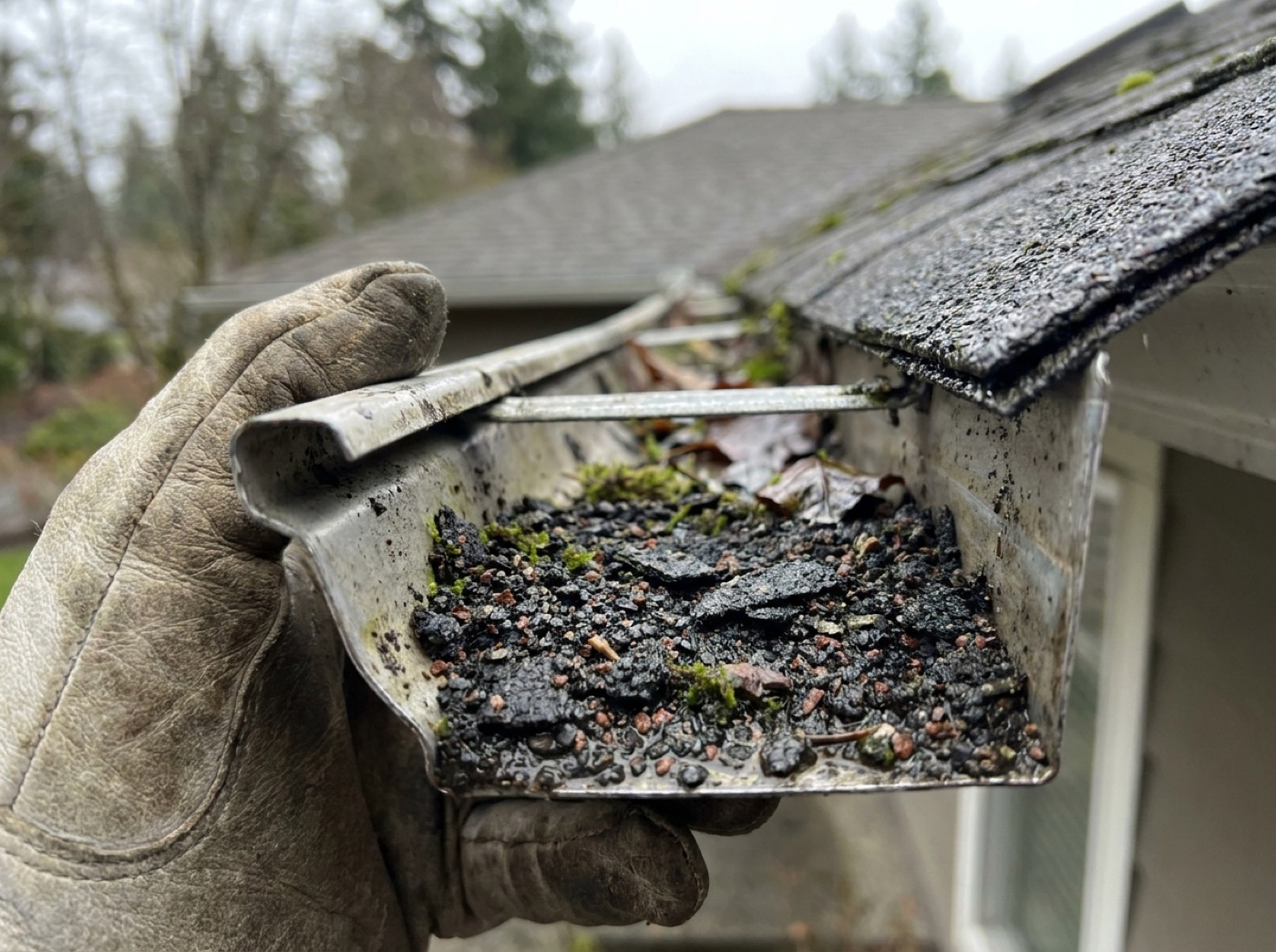
1. Granules collecting in the gutters or downspout
Asphalt shingles are coated in ceramic granules that protect the underlying asphalt from UV light, and every shingle sheds some granules for its entire life. The question is how many, and when. A light dusting is normal, especially on a newer roof shedding its manufacturing excess. Handfuls of granules, bald patches visible on the shingle field, or granules that suddenly increase after a storm point to a shingle field that is aging out or was damaged by hail. A useful habit is checking the downspout splash area after any storm and comparing what collects there to what you find after an ordinary rain; a sudden jump is worth mentioning when you call. An inspector checks the shingle surface directly for the wear pattern, because granule loss from age looks different up close than granule loss from impact.
2. Shingles lifted, curled, cracked, or missing after wind
A gust strong enough to lift or tear a shingle rarely stops at just one. Wind gets under a loosened tab, works the seal strip free, and the next gust takes the whole shingle, so one obvious gap in the field is a reason to check the courses around it, not just replace the one that is gone. An inspector walks the field looking for lifted tabs and broken seal strips that are not visible from the ground, because those are the ones most likely to leak before the next storm finishes the job. Photographing what you find in the yard right after a storm, before mowing or cleanup scatters it, gives an inspector a helpful head start on where to look first when they arrive.
3. Dark streaks or spreading moss
Black streaking is usually algae, a cosmetic issue that does not shorten shingle life on its own. Moss is a different matter: it holds moisture against the shingle surface and can physically lift shingle edges over time, especially on shaded, north-facing slopes common in Macomb County's tree-lined neighborhoods. An inspector distinguishes cosmetic staining from moss that is actively working shingles loose, since one is a cleaning conversation and the other is a maintenance issue. Where moss has taken hold on shaded valleys or north slopes, the inspector also checks whether it has been holding water against the deck long enough to affect the underlayment, not just the shingle surface.
4. A wavy or dipped roofline
Step back to the far end of the driveway and look at the ridge and the eaves against a straight line. A subtle wave can be cosmetic settling in an older home, but a clear dip usually means something structural underneath has weakened, whether that is the decking, the rafters, or a truss carrying more weight than it was built for. This is one sign that should not wait, because the attic side of the roof is where an inspector confirms what is actually happening under that dip. Photographing the roofline from the same spot in the driveway every year or two, even with a phone camera, is a simple way to catch a slow change before it becomes obvious to the eye alone.
03 / FROM INSIDESigns that show up inside the house
Water rarely drips straight down from where it enters the roof. It runs along the underside of the deck and down a rafter before it ever shows up on drywall, which is why the signs inside the house are often the ones people notice first and understand least.
5. A stain, ring, or bubbled paint on a ceiling or wall
A brown ring on a ceiling tile, a soft bubble in painted drywall, or a stain that grows after every rain is water finding its way in somewhere above. The stain's location on the ceiling is rarely directly under the actual entry point on the roof, which is exactly why a ground-level guess at the cause is unreliable. An inspector traces the path from the attic side, following the rafter or the deck's grain back toward the true source. Noting when the stain first appeared and whether it grows only during rain or after every thaw is useful context, because that timing pattern often points toward flashing versus ice-dam backup before anyone even gets on the roof.
6. Daylight visible through the roof deck
Stand in the attic with the lights off during the day and look up. Any pinpricks of daylight mean there is a gap in the deck or the flashing large enough for light, and therefore water, to pass through. This is one of the more definitive signs on this list because it removes the guesswork: a hole is a hole. An inspector notes exactly where the light comes through and matches it to the corresponding spot on the roof surface. This check works best on a bright day and takes only a minute, which makes it one of the easiest signs on this list for a homeowner to confirm before ever picking up the phone.
7. A musty smell or damp insulation
Not every leak leaves a visible stain right away, especially if it is dripping onto insulation that soaks it up before it ever reaches drywall. A persistent musty smell in an upstairs room or damp, matted insulation in the attic is often the earliest sign of a slow leak, well before a ceiling ring appears. An inspector checks insulation condition and moisture readings on the attic side as a standard part of the visit, not just as a response to a complaint. Matted or discolored insulation directly under a section of roof is often the clearest confirmation that a slow leak has been active for a while, even when the roof surface above looks completely ordinary.
The stain on your ceiling tells you water got in. It almost never tells you where. That is what the attic side of the inspection is for.
04 / AGE AND STORMSSigns tied to age, storms, and your street
The last three signs are not about a single visible defect. They are context clues, the kind that do not show up as a spot on the roof but still tell you it is time to look.
8. Neighbors on your street are getting new roofs
Homes built in the same subdivision around the same time were usually roofed by the same builder with similar materials, and shingles wear on a similar clock when they have had the same weather exposure. If several houses near yours were reroofed within a year or two of each other and your roof is the same age, that pattern is worth checking rather than assuming your roof is the exception. It is also worth asking a neighbor what prompted their reroof, whether that was age, a specific storm, or an insurance claim, since the answer often applies to your own roof as well.
9. A wind or hail event you never had checked
Macomb County has real storm history: the county was included in federal disaster declaration DR-4757 after the severe wind storms of August 2023. Wind events like that can lift shingles and break seal strips in ways that are invisible from the ground and get worse each freeze and thaw cycle afterward. If your roof was never looked at after a significant storm, whether that one or a more recent event, an inspection is the only way to know whether hidden damage is sitting there quietly. Homeowners insurance may cover sudden wind and hail damage depending on the policy, and if a claim is a possibility we can document what we find with photos and can meet your adjuster on site, though no contractor can promise how a claim will be decided. Our storm and insurance claims guide covers documentation and what a claim can and cannot promise if damage is found.
10. Your roof is 15 to 20 years old or older with no record of an inspection
Most asphalt shingle systems are rated for a service life in that range, and the last several years of that life are when a roof shifts from occasional maintenance issue to a system approaching its end. If nobody has walked yours and looked at the attic side in the last few years, age alone is a legitimate reason to schedule a look, independent of any visible symptom. An inspection at this stage often shifts from hunting for a single defect to estimating how many years of service life realistically remain, which is useful information whether you plan to stay in the home or sell it.
is the typical range for a roof repair in Macomb County, covering everything from a single failed pipe boot to a rebuilt valley; larger or complex repairs can run higher. Catching a sign early is almost always what keeps a problem on the low end of that range instead of the high end, or off the list entirely.
05 / THE VISIT ITSELFWhat happens when you call one in
Booking a free inspection is a phone call, not a commitment. You describe what you noticed, whether that is granules in the gutter or a stain on the ceiling, and we schedule a visit that covers the shingle field, flashing, penetrations, and the attic side of the deck, not just the one spot you mentioned. Our full walkthrough of that visit, from arrival to the sit-down where findings are explained, is in what happens during a roof inspection.
If you want to look before you call, our ground-level DIY inspection guide covers what you can safely check without a ladder, and our attic-side inspection guide explains what a flashlight and a look up at the deck can tell you before anyone even visits. Neither replaces a professional walk, but both help you describe what you are seeing more precisely when you do call.
Whatever we find, you get photos of it, and the roof gets one of three honest answers: it is fine, it needs a repair, or it is time to talk about replacement. There is no follow-up call pressuring you toward the more expensive answer, because a large share of our inspections turn up nothing more than a note to check again in a year. If you want a ballpark on replacement cost before that conversation, the cost calculator runs the same published ranges against your roof size, and you can start either path from the estimator right now. Our office hours are Monday through Saturday, 7 AM to 7 PM, and if the sign you noticed is an active leak rather than a slow one, we also offer emergency tarping to stop the water while the permanent fix is scheduled.
- Any single sign on this list, not all ten, is reason enough to schedule a look.
- Signs from the ground include granules in the gutter, lifted or missing shingles, moss, and a wavy roofline.
- Signs from inside include ceiling stains, daylight through the attic deck, and musty or damp insulation.
- Age, unreviewed storm damage, and a neighborhood pattern of reroofing are context clues worth acting on too.
- The inspection that checks every one of these is $0 with no obligation.
Questions we hear most
Granules collecting in the gutters and shingles lifted or torn loose after wind are the two signs we hear about most in Macomb County. Neither one automatically means a repair or a replacement is needed, which is exactly why a look rather than a guess is the right next step.
Yes, especially if your roof is 15 to 20 years old or older, or if a significant wind or hail event passed through your area and it was never checked afterward. Some damage, like a cracked pipe boot or a lifted seal strip, is not visible from the ground even when it is actively letting water in.
No. A healthy roof gets told it is healthy, and if the honest answer is a small repair rather than a full replacement, that is what you will hear. The inspection is $0 with no obligation either way, and every finding comes with photos so you can see exactly what we saw.
- FEMA, disaster declaration DR-4757-MI, Michigan severe storms of August 2023 (Macomb County designated). fema.gov/disaster/4757
- National Roofing Contractors Association, technical guidance for steep-slope roof systems. nrca.net
- Manufacturer technical and warranty literature for the major asphalt shingle lines: GAF (gaf.com), Owens Corning (owenscorning.com), and CertainTeed (certainteed.com).
- InterNACHI Standards of Practice for home inspections (scope of a generalist roof inspection). nachi.org/sop