
JUMP TO A SECTION
Most homeowners either ignore their roof completely between storms or feel like the only way to know anything is to climb up and look, which we do not recommend for reasons covered in our guide on whether it is safe to walk on your roof. There is a useful middle option. A pair of binoculars, a phone with a zoom lens, and twenty minutes walking the perimeter of your house will tell you a real amount about the condition of your roof, its edges, and what is happening underneath it. This guide is that checklist, written the way we would walk a homeowner through it in person: five stops around the exterior, one pass through the attic and ceilings, and an honest list of what none of it can see. The point of the ground check is not to replace a professional look. It is to tell you whether today is the day to make the free call.
01 / THE SHORT ANSWERWhat a ground inspection can and cannot tell you
A ground-level self-check is genuinely useful for spotting the signs that show up first and biggest: missing or lifted shingles, sagging gutters, granules collecting in the downspout splash, and ceiling stains inside the house. It is not useful for flashing detail, pipe boot condition, or anything on the deck itself, because those either sit too low to the roof plane to read from thirty feet away or are hidden entirely under the shingles. Our 10 signs your roof needs an inspection guide covers the full symptom list in more depth; this page is specifically about running that check safely, from the ground, on your own schedule.
think of this as the check that tells you whether to make the call, not the check that replaces the call. A free professional inspection covers everything the ground view cannot, including the flashing, the attic side of the deck, and anything hidden by an angle you cannot see from your yard.
Most of what actually fails on a roof, valley metal, step flashing at a sidewall, a cracked pipe boot, a soft spot in the decking, is invisible from the ground under any conditions. That is not a flaw in this checklist. It is the reason the checklist exists as a first step and not a final answer.
02 / BEFORE YOU STARTWhat you need, and when to skip this entirely
This check requires no ladder and no roof access. You need binoculars or a phone camera with digital zoom, daylight, and a dry, calm day so you are not fighting glare or wind while you look. Walk the full perimeter of the house if you can, since problems concentrate on specific slopes and you want to see all of them, not just the front elevation from the driveway.
- Skip the roof entirely and call for the free inspection instead if: there is an active leak, water is coming through a ceiling right now, or a recent storm has left visible debris, torn shingles on the ground, or a tree limb down on the house.
- Do this check in daylight, not at dusk. Low sun angle and shadow make lifted shingles and gutter sag much easier to see than flat overcast light does, but any daylight beats guessing in the dark.
- Bring a notebook or your phone's camera roll. A photo dated today is the baseline you compare against next season, and it is useful information to hand an inspector even if nothing looks urgent yet.
Timing matters more than most homeowners assume. Right after a rain is actually a decent window, because a wet roof shows dark stains and pooling more clearly than a dry one, and any active drip line off a gutter or fascia board becomes obvious. Right after a windstorm is the other good window, since that is when lifted or torn shingles are freshest and easiest to spot before a following rain pushes water into whatever the wind opened up. Avoid checking in bright midday sun straight overhead, which flattens the shadows that make curling, lifted tabs, and shingle wear visible in the first place; early morning or late afternoon light, coming in at an angle, tends to show far more. One month of the year improves the view itself rather than the light. Once the leaves come down, whole elevations start reading from the yard with nothing standing in front of them, which is the case the October roof calendar makes for spending that walk properly instead of squinting from the end of the driveway.
03 / THE CHECKLISTThe five-stop ground checklist
Walk these five stops in order. Each one takes a few minutes, and together they cover the parts of a roof that genuinely can be read from ground level.
Stop 1: the shingle field, slope by slope
From each side of the house, zoom in on the shingle surface and look for a uniform color and a flat, unbroken plane. You are looking for tabs that stick up or curl at the edge, dark patches where granules have worn away in a bald spot rather than scattering evenly, and any straight-line cracks running across several courses. Check each slope separately, because our guide on north-facing slopes explains why one side of a roof commonly ages years ahead of its twin, and a problem hiding on the back slope never shows from the street.
Stop 2: the ridge line silhouette
Stand back far enough to see the full roofline against the sky and sight down the ridge. It should read as one straight line from end to end. A dip, wave, or sag anywhere along it is worth a photo and a mention when you call, because it can point to a structural issue underneath rather than a surface one.
Stop 3: eaves, gutters, and downspouts
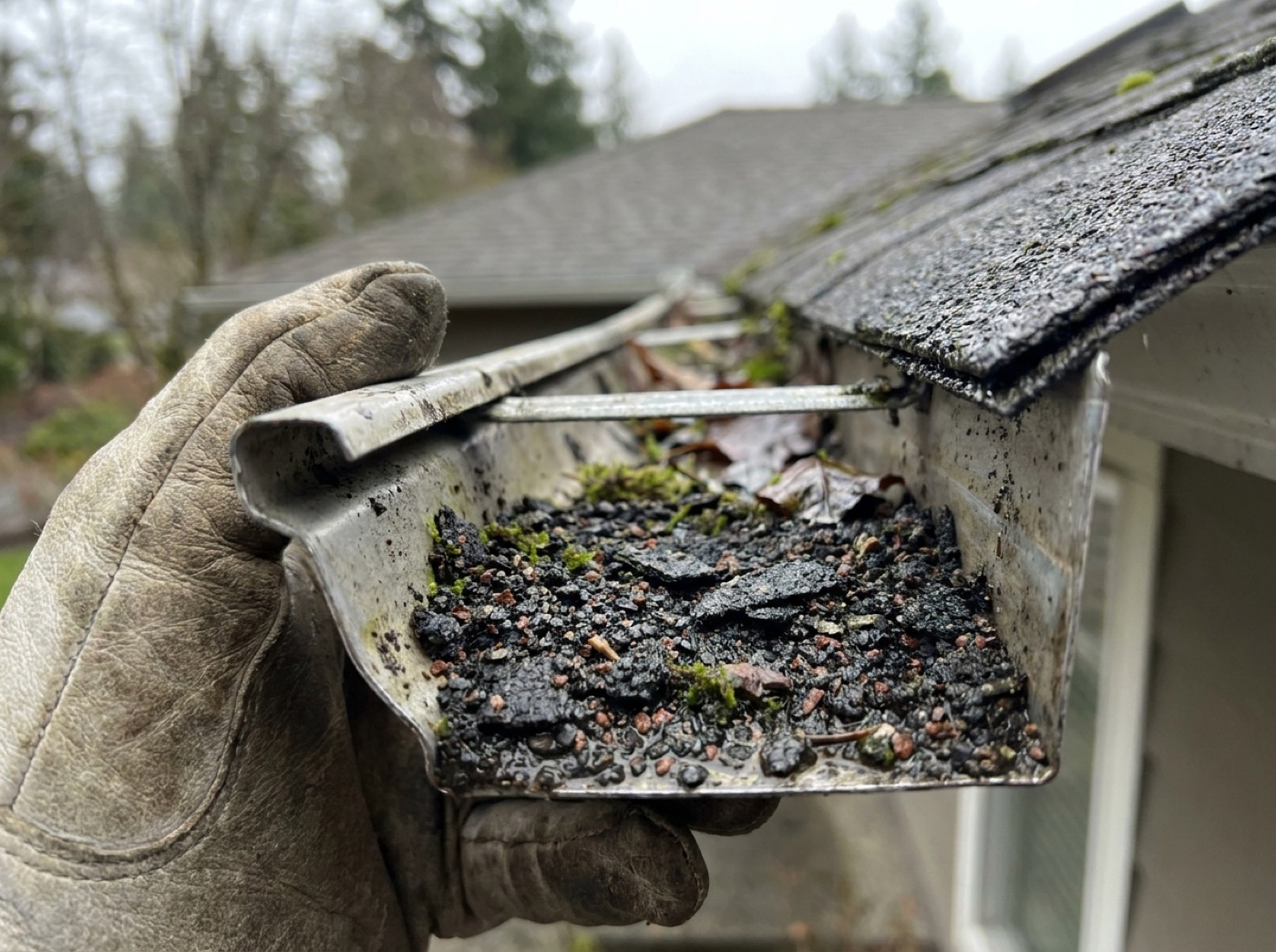
Look at where the gutters attach to the fascia board. Sagging sections, gutters pulled away from the roofline, or standing water sitting in a low spot all mean the drainage system is not doing its job, and none of that requires a ladder to spot. Check the downspout splash area or the ground below it for a buildup of granules, since a steady trickle of granules is one of the more reliable early signs of shingle wear, distinct from the light seasonal shedding every asphalt roof does.
Stop 4: flashing you can actually see from the ground
You cannot properly inspect flashing from the yard, but you can often spot a visible failure: a strip of metal that has pulled away from a chimney, daylight visible behind a step-flashing line at a sidewall, or a valley where the metal looks corroded or is buried under a ridge of moss. Anything you can see wrong from here is worth documenting, and anything that looks fine from here still needs the closer look our roof flashing inspection guide describes, because flashing failures are frequently invisible until someone is standing next to them.
Stop 5: moss, algae, and standing debris
Dark streaking running down a slope is usually algae staining and mostly cosmetic. A raised, textured patch of green or gray growth is moss, and it holds moisture directly against the shingle surface in a way that becomes a real problem over a Michigan winter as that trapped water freezes and thaws. Note where you see it and how thick it looks; a thin patch and a thick, spreading mat are different findings.
| STOP | GOOD SIGN | WORTH A CALL |
|---|---|---|
| 1. Shingle field | Even color, flat plane, no bald patches | Curling, cracking, bald patches |
| 2. Ridge line | One straight line against the sky | Dip, wave, or sag |
| 3. Eaves and gutters | Tight to the fascia, draining freely | Sagging, standing water, granule buildup |
| 4. Visible flashing | Metal seated tight at chimneys and walls | Pulled metal, daylight gaps, caulk patches |
| 5. Moss and algae | Faint streaking only | Thick, spreading moss mats |
That table is meant as a quick reference on a second or third pass, after you have already walked the five stops once slowly. If every row lands on the left column, you have a genuinely reassuring result. If even one row lands on the right, that alone is a fair reason to book the free inspection rather than wait for a second symptom to confirm it.
04 / THE INTERIOR CHECKThe five minutes inside that matter as much as the walk outside
The most reliable evidence of a roof problem often is not on the roof at all. Walk your top-floor ceilings and look for new discoloration, a soft or bulging patch of drywall, or the faint ring stain left by a leak that came and went with the weather. If you have attic access, a flashlight look at the underside of the deck is worth the five minutes: daylight showing through anywhere it should not, dark staining on the sheathing, or a musty smell are all signs pointing the other direction, from the roof down into the house rather than up from the yard. Our soffit and fascia inspection guide covers the eave-level version of this same interior-exterior pairing in more detail.
if attic access means an unstable pull-down ladder or a crawl over exposed joists in poor light, treat that the same as roof access: skip it, and let the free inspection cover both the roof and the attic side properly.
05 / THE LIMITSWhat ground observation cannot see, and why that is most of what actually fails
Here is the part most self-check guides gloss over. The failures that cause the majority of real leaks, a cracked pipe boot, a step-flashing seam that has opened at a sidewall, granule loss on a slope angled away from your sightline, a soft or delaminated section of decking under otherwise normal-looking shingles, are simply not visible from thirty or forty feet away with binoculars, no matter how good your eyes are. Roofers price by the square and by the zone precisely because a roof has to be walked, and its underside probed, to know its real condition. A ground check tells you the roof looks fine or looks concerning from the angles you can reach. It cannot tell you the roof is fine, full stop, and no honest inspector would claim a driveway look is equivalent to a walked one.
This is also why a clean-looking ground check is not a reason to skip inspections indefinitely. Our guide on how inspectors estimate remaining roof life walks through the inputs, granule reserve, flashing condition, ventilation history, that only show up once someone is actually on the roof and in the attic, which is exactly what a free professional visit adds on top of what you found today.
A ground check tells you whether to make the call. It was never going to be the thing that replaces it.
06 / READING YOUR RESULTSWhat to do with what you found
If your walk turned up nothing, no lifted shingles, no gutter sag, no ceiling stains, that is a genuinely good sign, and it is reasonable to simply repeat the check next season, ideally timed around the seasonal rhythm our Michigan roof maintenance schedule lays out. If you found one or two minor items, a little granule buildup, a slightly sagging gutter, that is worth a photo and a mention on a routine inspection call rather than an emergency one.
If you found active staining inside the house, a visibly damaged slope, or anything that looks like storm damage, that is the trigger to call now rather than wait for a convenient week. Either way, the next step is the same free visit: our inspectors walk all five zones, including the ones you cannot see from the yard, and hand you a written report with photos, whether the news is a clean bill or a real repair. If it turns out to be nothing more than a repair, that is exactly what we will tell you, in the $350 to $3,200 range depending on scope, rather than a pitch toward a full replacement you do not need.
You can start that visit any time from the instant estimator, and if you are already weighing repair against replacement cost while you wait, the cost calculator runs the same published ranges used on the rest of this site.
- A ground check with binoculars covers the shingle field, the ridge silhouette, the eaves and gutters, visible flashing failures, and moss or algae growth.
- The interior check, ceilings and attic deck if access is safe, catches evidence a roof-only look never will.
- Most actual roof failures, flashing seams, pipe boots, hidden decking, cannot be seen from the ground under any conditions.
- A clean ground check is good news, not a green light to skip inspections indefinitely.
- The free professional inspection is the step that covers everything a ground check structurally cannot.
Questions we hear most
No. A ground check with binoculars is genuinely useful for the shingle field, the ridge line, gutters, and visible flashing failures, but flashing detail, pipe boots, and the attic side of the deck cannot be reliably seen from the yard. Those need a walked inspection, which is free and comes with no obligation.
A ground check is worth running every season as part of a routine like our Michigan roof maintenance schedule. A professional inspection makes sense on a similar seasonal cadence, and immediately any time the ground check or an interior check turns up a sign of a problem.
Call for the free inspection. A ceiling stain with no visible roof damage from the ground is common, because water rarely drips straight down from where it entered. It travels along the deck first, and only a roof and attic walk-through finds the actual source.
- U.S. Consumer Product Safety Commission, ladder and home-maintenance injury data and safety guidance. cpsc.gov
- Manufacturer technical and warranty literature for the major asphalt shingle lines: GAF (gaf.com), Owens Corning (owenscorning.com), and CertainTeed (certainteed.com).
- National Roofing Contractors Association, technical guidance for steep-slope roof systems. nrca.net