
JUMP TO A SECTION
A soft board under the gutter, a stained panel drooping at the corner of the eave, a spot where a squirrel finally chewed through: soffit and fascia damage almost never shows up as its own emergency. It shows up as a line an inspector points to during something else, a repair, a storm check, or the walk-around before a roof bid. Because the damage is usually local, a few feet here, a torn panel there, it prices as a repair, not as a whole-house trim replacement, and repairs in Macomb County run $350 to $3,200, with larger or rot-heavy runs climbing toward the top of that band. This guide walks through what actually sets your number inside that range, why the damage so often gets found while a crew is up there for something else, and how to get a real figure instead of a guess.
01 / THE SHORT ANSWERWhat a soffit and fascia repair actually costs
Fixing rotted or damaged soffit and fascia on its own, without a full roof replacement attached, is priced as a repair. In Macomb County that means $350 to $3,200, the same band that covers a single failed pipe boot on one end and a rebuilt valley on the other. A short stretch of soft fascia behind a clogged gutter, caught early and repaired in an afternoon, sits well toward the low end. A long run of rot that traveled behind several panels, needs the gutter detached and rehung, and involves working off a ladder at a second-story eave climbs toward the top.
covers the vast majority of standalone soffit and fascia repairs in Macomb County. Where you land in that range depends on how many feet of trim are bad, how high the work sits, and whether the gutter has to come down and go back up to get at it. If the whole roof is also due, the trim work usually folds into a full replacement instead, which runs $9,000 to $18,000, with most homes landing $12,000 to $16,000. Get a real number in about 60 seconds with the instant estimator.
One national cost-guide benchmark puts soffit and fascia repair in a similar per-linear-foot band once labor, material, and access are folded together, which lines up with what we see on Macomb County calls. The honest caveat with any published per-foot number is that it assumes average access and average rot. Your driveway does not care about averages, and the only way to know your real price is to have someone look at the wood behind the panel, which is exactly what a free inspection does.
02 / THE DRIVERSWhat actually drives the price inside that range
Two houses with what looks like the same amount of damage from the driveway can land at very different numbers, because the price is set by a handful of specific factors, not by a flat per-house rate. Knowing them tells you roughly where your job will fall before anyone gives you a figure.
How far the rot has traveled
The single biggest swing factor is how much of the wood behind the visible damage is actually gone. A panel that looks stained but is still solid when pressed is a quick swap. A board that is soft, spongy, or crumbles under a screwdriver has to be traced back until the crew hits sound wood, which sometimes means opening up several extra feet beyond where the damage first appeared. Rot spreads along the grain and behind the finish long before it shows on the surface, so the visible bad spot is almost always smaller than the actual repair.
Working height and access
A single-story eave a crew can reach from a ladder is straightforward work. A second-story overhang, a steep roof pitch above it, or trim tucked behind a porch roof or bay window all add setup time, staging, or fall-protection steps that a simple ladder job does not need. Two identical patches of rot at two different heights are not the same price, because the labor to safely reach the wood is part of what you are paying for.
Wrap-and-cap versus full board replacement
If the fascia board itself is sound and the damage is cosmetic or limited to old paint and minor surface wear, the fix can be as simple as capping it in aluminum trim coil, a quick, lower-cost path. If the board is actually rotted, the old wood has to come out, new lumber has to be cut, primed, and fastened in, and then it can be capped or painted. That extra demolition-and-rebuild step, not the cap itself, is what pushes a job from the low end of the range toward the middle or top.
Whether the gutter has to come down and go back up
Fascia is what the gutter is screwed into, so on most homes the gutter run above the damaged section has to be unhooked, set aside, and rehung once the new or repaired board is in place. A short section behind a single gutter bracket is a small add. A long run where several sections of gutter, downspout straps, and end caps all have to come off and go back on correctly, level and sealed, adds real labor, and it is one of the most common reasons a repair estimate comes in higher than a homeowner expected from the size of the visible damage alone.
03 / THE PATTERNWhy this so often shows up mid-job, not on its own
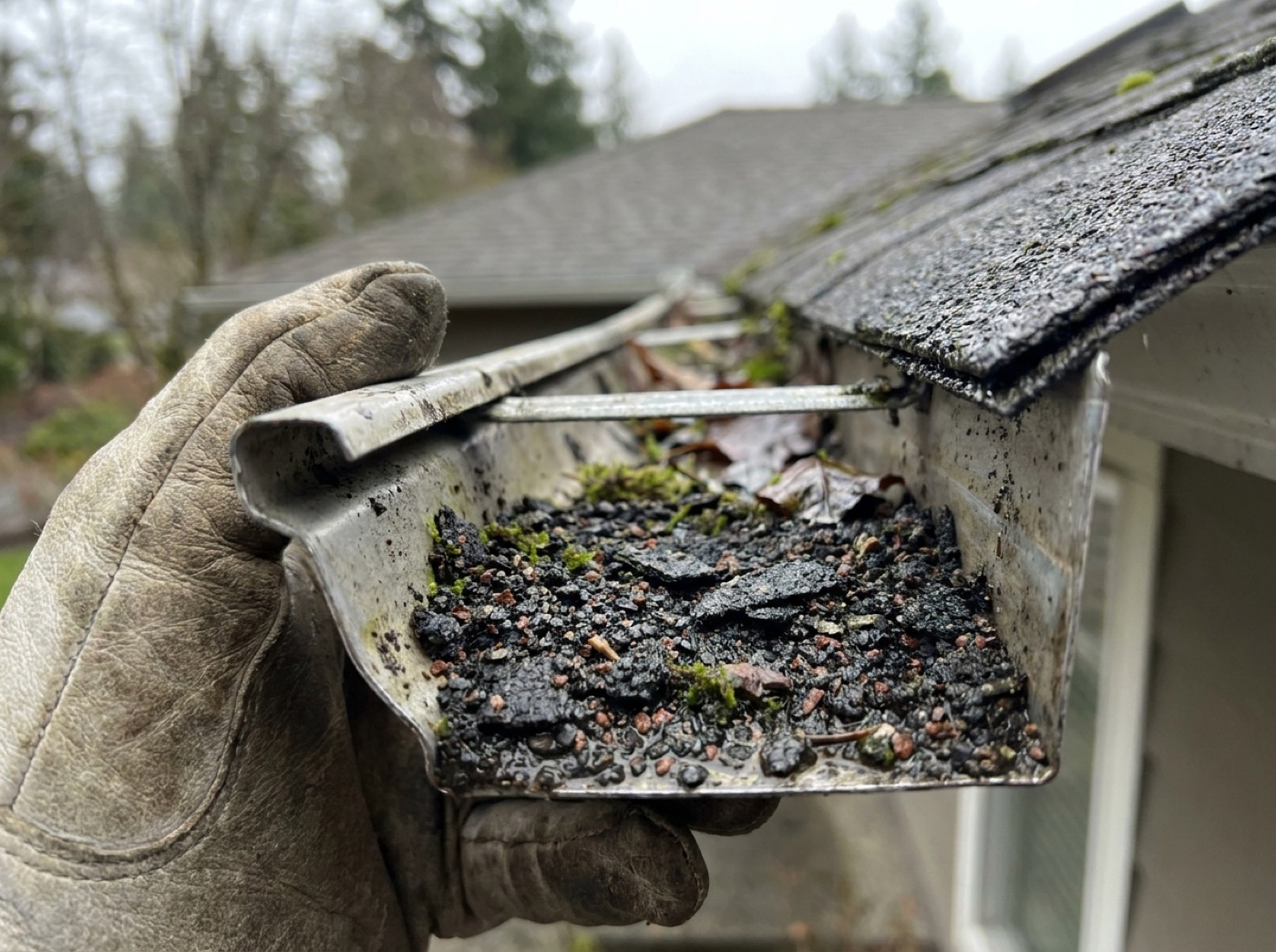
It is rare for a homeowner to call specifically about soffit and fascia. Far more often, the damage gets found while a crew is up there for a different reason: a roof inspection, a gutter cleaning, an emergency tarp after a storm, or the walk-around before a replacement quote. That is not a coincidence. Fascia and soffit sit at the exact spot where the roof, the gutters, and the attic ventilation all meet, so a problem in any one of those systems tends to surface there first, visible from the ground, long before it becomes an interior leak.
This is exactly why the free inspection matters even when soffit and fascia are not the reason you called. A roof inspection that only looks at the shingles misses the edge condition entirely, and a homeowner who is not told about soft fascia during a routine visit often does not learn about it until a downspout pulls loose or a soffit panel finally drops. Catching it during an unrelated visit, while the ladder is already up, is the cheapest way this repair ever gets done, which is the same access logic that applies to a full reroof. Our hidden costs of a roof replacement guide covers the same principle for the larger job.
Nobody schedules a soffit and fascia inspection. They find out during the roof inspection, the gutter cleaning, or the storm check, which is exactly why those visits are worth having done properly.
04 / THE SIGNSSigns you have it before a crew tells you
You do not need to climb a ladder to catch most of this early. A few things are visible from the ground on a normal walk around the house.
- Paint peeling or bubbling on the fascia board, especially directly under a gutter seam or end cap
- A soffit panel that sags, has visibly pulled away from the fascia, or shows a dark stained line along one edge
- Small holes, gaps, or chewed openings in soffit panels, which is often how animals get into the soffit in the first place
- A gutter section that has visibly pulled away from the house slightly at one spot, which usually means the fascia behind it is no longer holding the screws tight
- Interior signs like a stain at the top of an exterior wall or a soft spot in a ceiling near the eave, which can indicate the rot has traveled further than the exterior view suggests
None of these signs are exact enough to price a repair from the driveway, but any one of them is a reasonable trigger to have someone look before it grows. If you are also seeing gutters that overflow or run behind the trim instead of into the downspout, that is worth a look at its own, and our gutter replacement cost guide covers when the gutters themselves, not just the fascia they hang on, are due.
05 / THE DECISIONRepair it now, or wait and fold it into a reroof
If your roof still has years of life left and the damage is contained to a short run, repairing the soffit and fascia now is the right call. Waiting does not save money here. Rot keeps traveling along the wood grain, the gutter keeps working looser, and the eventual repair only grows. A repair addressed while it is still small stays toward the lower end of the $350 to $3,200 range.
If your roof is also near the end of its life, or you already know a replacement is coming in the next year or two, it is worth asking whether the trim work should wait and ride on that job instead. As covered in our companion guide on soffit and fascia replacement cost, doing the edge trim while a crew is already staged for a full reroof avoids paying for access twice, and it lets the soffit intake and any new ridge exhaust get balanced as one ventilation system rather than two unrelated fixes. The trade-off is straightforward: fix an active, worsening problem now, or defer it a short window if the roof itself is genuinely on the near-term calendar. An honest inspection will tell you which situation you are actually in.
What you should not do is ignore soft fascia because a roof replacement is a vague someday plan with no real timeline. Rot does not wait for your schedule, and the gap between a rotted fascia board found today and a roof crew showing up in eighteen months is exactly the window where the damage compounds.
06 / THE REAL NUMBERGetting your actual repair price, free
Every driver above narrows the range, but only a hands-on look tells you your real number, because the wood behind the panel cannot be graded accurately from the ground. Our inspection is $0 with no obligation. We check the soffit and fascia along with the shingles, flashing, and gutters, press on the boards to find where sound wood starts, and give you a written price for exactly what needs fixing, whether that is a short cap-and-caulk job or a longer run that needs the gutter down and new boards in.
If the inspection turns up a repair, that is what we will tell you and price. If it turns up something bigger, active leaks feeding the rot, a deck problem behind it, or a roof genuinely near the end of its service life, we will tell you that too, with the reasoning laid out rather than a number with no explanation behind it. You can also get a same-day ballpark on the trim work alongside a full roof price using the estimator, the cost calculator, or our published honest pricing sheet.
- Standalone soffit and fascia repair in Macomb County runs $350 to $3,200, the same range that covers other localized roof repairs.
- The price inside that range is set by how far the rot traveled, how high the work sits, whether the fix is a cap or a full board swap, and whether the gutter has to come down and go back up.
- This damage is usually found mid-job, during a roof inspection, gutter cleaning, or storm check, not as its own scheduled visit.
- A small repair caught early stays cheap; rot that keeps traveling does not, so the timing decision is repair now or fold it into a near-term reroof, not ignore it.
- The only way to know your real number is a free inspection that checks the wood behind the panel, and ours is $0 with no obligation.
Questions we hear most
A standalone soffit and fascia repair in Macomb County typically runs $350 to $3,200, depending on how much of the trim is affected, how high it sits, and whether the gutter has to be removed and rehung to reach it. Larger or more rot-heavy runs land toward the top of that range. If the repair rides on a full roof replacement instead, it usually folds into that job's $9,000 to $18,000 cost rather than pricing separately.
Soffit and fascia sit exactly where the roof edge, the gutters, and the attic ventilation meet, so problems in any of those systems tend to surface there first and are visible from the ground. It is common for this damage to be found during a roof inspection, gutter cleaning, or storm check rather than as its own scheduled visit, which is one reason a thorough inspection covers more than just the shingles.
If the roof still has years of life left, repairing rotted soffit and fascia now is usually the right call, since rot keeps spreading and only grows more expensive to fix later. If a full replacement is genuinely on the near-term calendar, it can make sense to fold the trim work into that job to avoid paying for access twice. A free inspection can tell you which situation actually applies to your home.
- Macomb Roofing Pros 2026 price canon, installed ranges by system: repairs $350 to $3,200 (larger or complex can run higher); asphalt replacement $9,000 to $18,000 (most homes $12,000 to $16,000).
- Fixr, asphalt shingle roof cost guide: 2026 national installed range roughly $8,000 to $16,000, average near $12,000. fixr.com: asphalt roof cost
- FEMA, disaster declaration DR-4757-MI, Michigan severe storms of August 2023 (Macomb County designated). fema.gov/disaster/4757