
JUMP TO A SECTION
An architectural shingle, sometimes called a dimensional or laminate shingle, is an asphalt roof shingle built from two or more layers of material bonded together so it reads as thick and three-dimensional instead of flat. It is the shingle most Macomb County homes are wearing right now, and if a roofer walks your property today, the odds are overwhelming that the asphalt shingle on the estimate is an architectural one. This guide explains, in plain terms, what that construction is, how it differs from the older three-tab style, what the sub-tiers within architectural lines mean, and what upgrading at replacement time actually buys you. All the pricing here matches the same canon on our honest pricing sheet.
01 / THE SHORT ANSWERArchitectural shingles, defined
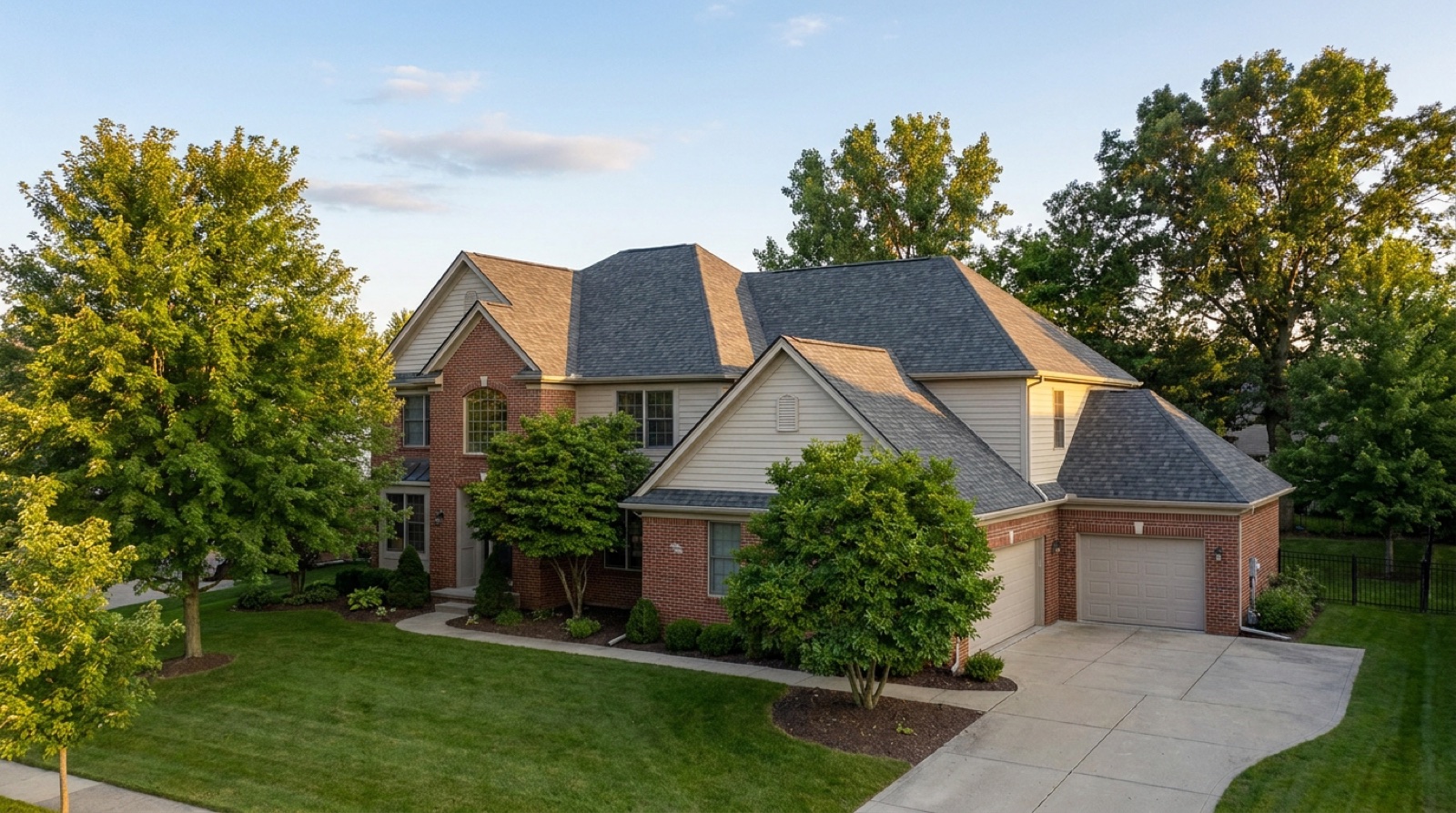
An architectural shingle is a laminated asphalt shingle: at least two layers of shingle material fused together, usually with a heavier base mat and a thicker asphalt coating, so the finished shingle is significantly more substantial than a single-layer product. The extra thickness creates a raised, shadow-lined surface that mimics the look of wood shake or natural slate from the street, which is the origin of the name "dimensional."
is where most Macomb County architectural asphalt replacements land, inside a full range of $9,000 to $18,000 installed. Get your own ballpark in about 60 seconds with the instant estimator, or run it against your roof size in the cost calculator.
There is no separate, standalone price for "an architectural shingle." It is one line on a full replacement estimate that also includes tear-off, disposal, underlayment, ice barrier membrane at the eaves, flashing, ventilation, and labor. When you see the $9,000 to $18,000 asphalt range quoted, you are almost always looking at an architectural roof, because it has become the baseline spec rather than a premium add-on.
02 / THE CONSTRUCTIONHow an architectural shingle is actually built
Peel back the marketing language and an architectural shingle is a manufacturing decision, not a style choice. Manufacturers laminate a base shingle to a second, offset layer, or build a thicker single mat with extra asphalt and granule coating, so the finished product carries more mass per square foot than a flat shingle. That extra mass is doing real work in three places at once.
Weight and wind performance
The added layer means more material holding the shingle flat against the deck, and manufacturers back that up with higher wind ratings than their three-tab counterparts. In a wind-exposed climate like ours, that is not a cosmetic detail. Wind is the single most common cause of the shingle failures our crews get called out for.
The shadow-line look
Because the layers are offset or the mat is thickened in a pattern, the shingle reads as a series of raised tabs and recessed shadow lines from the ground, rather than the uniform, repeating cutout grid of a three-tab roof. From the street it looks closer to a wood shake or slate roof, at a fraction of either material's cost and weight.
Sealant strips and better adhesion
Architectural shingles are manufactured with a factory-applied sealant strip positioned to bond firmly to the course below once the roof heats in the sun. Combined with the added mass, that bond is a large part of why architectural roofs seal down tighter and stay sealed longer than the shingle style they replaced.
Granule coating and no visible cutouts
The ceramic-coated mineral granules that give any asphalt shingle its color and its UV protection are pressed into the top layer, and on an architectural shingle that layer is thicker and more consistent across the surface. There is also no cutout slot running through the tab the way there is on a three-tab shingle, which removes one of the more common places moisture and wind can work into a flat shingle over time. Most architectural lines also ship with an algae-resistant granule blend, which matters in a humid Great Lakes summer where roof-north streaking is common on untreated shingles.
03 / THE COMPARISONArchitectural vs the three-tab shingle it replaced
Three-tab shingles are the older style: a single flat layer with cutout slots dividing the surface into a uniform grid of rectangular tabs. They are lighter, thinner, and cost less to manufacture, and for decades they were the standard shingle on Michigan homes. A large share of the pre-1990s roofs still standing in Macomb County were originally shingled this way.
The market shifted for a simple reason: the upfront cost gap between three-tab and architectural is modest, while the durability and wind-rating gap is not. Architectural shingles carry more material, seal down harder, and are rated for stronger winds, which matters through a Michigan freeze-thaw cycle that stresses every seal on the roof each winter. The short version is that three-tab has faded to a niche, budget-driven choice, and most homeowners who compare the two side by side, using the same guide library we publish this page in, choose architectural without much hesitation.
| FEATURE | THREE-TAB | ARCHITECTURAL |
|---|---|---|
| Layers | Single flat mat | Two or more laminated layers |
| Look from the street | Uniform cutout grid | Raised, shadow-lined, dimensional |
| Relative weight | Lighter | Heavier per square |
| Wind rating | Lower | Higher, manufacturer rated |
| Market share on new Macomb County roofs | Small, niche | Large majority |
The shingle you see from the street is one layer of a system. What makes it architectural is what happens underneath that layer, not just what it looks like.
It is worth being direct about one thing: a three-tab roof that is otherwise sound is not a roof that needs to be torn off just to upgrade the shingle. The comparison matters most at replacement time, when you are choosing a spec for a roof that has to perform for the next fifteen to thirty years. If you are simply trying to figure out how much life is left in the three-tab roof you already have, that is a separate question from which shingle to buy next, and our shingle lifespan guide is the better starting point for that question.
04 / THE SUB-TIERSThe tiers inside architectural, and where they sit
"Architectural" is not one product, it is a category that spans a range of thickness and detail. Understanding the sub-tiers helps you read a quote correctly, because two roofers can both write "architectural shingle" and mean noticeably different products.
- Standard or mid-grade architectural: the workhorse spec most Macomb County replacements use. Solid wind rating, the dimensional look, and the tier that anchors most homes toward the middle of the $9,000 to $18,000 asphalt band.
- High-definition or heavier architectural: an extra layer of thickness and a deeper shadow line, priced a step above standard, aimed at homeowners who want a bolder look without moving into designer territory.
- Designer, luxury, or premium shingles: the top of the asphalt ladder. These are heavier still, with shake- or slate-look profiles built for high-visibility rooflines, and they run toward the top of the asphalt range rather than the middle. Our designer and luxury shingle guide covers that tier in detail.
For a broader look at how all of these fit together, including the flat three-tab tier and where each style shows up on a real Macomb County estimate, our types of asphalt shingles guide lays out the full ladder side by side.
Reading the shingle line on your quote
A written quote should name the actual product line, not just the word "architectural." That name tells you the tier, the manufacturer's stated wind rating, and the length of the material warranty, all of which vary between standard and high-definition products even though both are laminated. If a quote just says "architectural shingle, color: your choice" with no brand or line named, ask which product it is. That single question is often the fastest way to tell a fully specified bid from a placeholder number.
Warranty terms move with the tier
Manufacturers typically extend longer material warranties on their higher tiers, and some limited lifetime warranties require the full system, meaning the manufacturer's own underlayment, starter strip, and ridge cap installed alongside the shingle, to remain in force. That is one more reason the shingle name matters more than the word "architectural" alone, and it is worth asking your contractor to show you the specific warranty terms for the product they are quoting before you sign.
05 / THE UPGRADEWhat upgrading to architectural actually gets you at replacement
If your current roof is a three-tab nearing the end of its life and you are pricing a full roof replacement, upgrading to architectural is close to the default decision rather than an optional add-on, and here is what that upgrade is actually buying.
Longer, steadier service life
Manufacturers rate architectural shingles for longer service life than three-tab, and the added mass and stronger sealant hold up better through repeated freeze-thaw cycles. We keep performance claims general on purpose, since real lifespan depends on ventilation, install quality, and your roof's exposure, but the direction is consistent: heavier, better-sealed shingles tend to age slower in this climate. Our asphalt shingle lifespan guide goes deeper on what actually determines how long a Michigan roof lasts.
A stronger wind rating on paper and in practice
Because architectural shingles are heavier and seal down more firmly, they carry higher wind ratings from the manufacturer, and that rating is not just a label. Wind-lifted shingles are one of the most common repair calls we get, and a well-sealed architectural roof resists that failure mode better than a thin, single-layer shingle.
Resale and curb appeal
The dimensional look reads as a higher-end roof from the street, which matters if you are weighing a replacement ahead of a sale or simply want the house to look its best. It is a modest line item on the overall estimate compared with the difference it makes in how the roof presents.
Color and blend selection
Architectural lines are made in far more color blends than three-tab, from traditional weathered wood tones to charcoal and slate-look grays, and the deeper shadow lines let a blended color carry more visual texture than a flat shingle can. If your neighborhood has an HOA color guideline or you simply want to match nearby rooflines, an architectural lineup usually gives you more workable options than the three-tab shelf did.
Most homeowners do not pay for a roof from savings. As an illustration only, a $13,500 project financed over a 10 year term at 9.9% APR works out to about $178 per month. That example is not an offer of credit; financing is subject to approval, and your actual rate, term, and payment depend on the lender and your credit profile.
One more note on timing: if your roof is mid-life and the trouble is a single leak rather than widespread wear, a repair in the $350 to $3,200 range may be the right move rather than a full architectural re-roof, and larger or complex repairs can run higher. A free inspection is the honest way to know which conversation you are actually in.
06 / THE REAL NUMBERGetting your actual architectural roof price, free
Everything above narrows the range. Only one thing produces your actual number: someone on your roof. Our inspection is $0 with no obligation, and it covers the shingles, flashing, ventilation, gutters, and the attic side of the deck, with photos of everything we find. If the roof only needs a repair, that is exactly what we will tell you, not a replacement pitch.
If you want a ballpark before anyone visits, the instant estimator runs the same published ranges on this page, and the cost calculator applies them to your roof size. You can also browse the wider ladder of shingle guides, or start from the roofing services hub for services and pricing across Macomb County.
- An architectural shingle is a laminated, multi-layer asphalt shingle, built thicker and dimensional-looking, and it is the Macomb County default.
- A full architectural replacement runs $9,000 to $18,000, with most homes landing $12,000 to $16,000, the same as the general asphalt canon.
- The extra mass over three-tab means a stronger wind rating and a firmer factory seal, which matters through Michigan freeze-thaw winters.
- Architectural spans sub-tiers, from standard mid-grade up to designer and luxury lines toward the top of the asphalt band.
- The exact number for your roof needs an inspection, and ours is $0 with no obligation.
Questions we hear most
They are asphalt shingles built from two or more laminated layers, usually a heavier base mat with extra asphalt coating and granules, bonded so the finished shingle is thicker and reads as dimensional rather than flat. That added mass is what gives them a stronger wind rating and a firmer seal than a single-layer shingle.
For most Michigan homes, yes. Architectural shingles are heavier, better sealed, and rated for higher wind resistance, and the upfront price difference over three-tab is modest while the durability gap is not. That is why the market here has moved almost entirely to architectural at replacement time.
Architectural is the default asphalt spec here, so a full replacement runs $9,000 to $18,000 installed, and most homes land $12,000 to $16,000. That figure is the whole job, not a shingle-only price: tear-off, disposal, ice barrier, underlayment, flashing, ventilation, the shingles, and labor. A free on-site inspection gives you the exact number for your roof.
- FEMA, disaster declaration DR-4757-MI, Michigan severe storms of August 2023 (Macomb County designated). fema.gov/disaster/4757
- Manufacturer technical and warranty literature for the major asphalt shingle lines: GAF (gaf.com), Owens Corning (owenscorning.com), and CertainTeed (certainteed.com).
- Michigan Residential Code 2015, section R905.1.2 Ice Barriers: membrane required from the eave edge to not less than 24 inches inside the exterior wall line. up.codes: MRC chapter 9