
Field Notes: Wind, Water and St. Clair Shores Roofs
St. Clair Shores sits on the county's open edge, and its roofs carry the marks of it. Here is what we keep finding on inspections along the lakefront, and why the water is as much a part of the roof's story as the shingles are.
Every county has one place where the weather never really lets up, and in Macomb County that place is the shoreline running through St. Clair Shores. The city's roofs sit closer to open water than almost anything else we inspect, and that changes what we find on them. This note is a running set of observations from that lakefront edge, not a sales pitch, and every claim in it is one we have verified rather than guessed.
01 /A city built on the water's edge
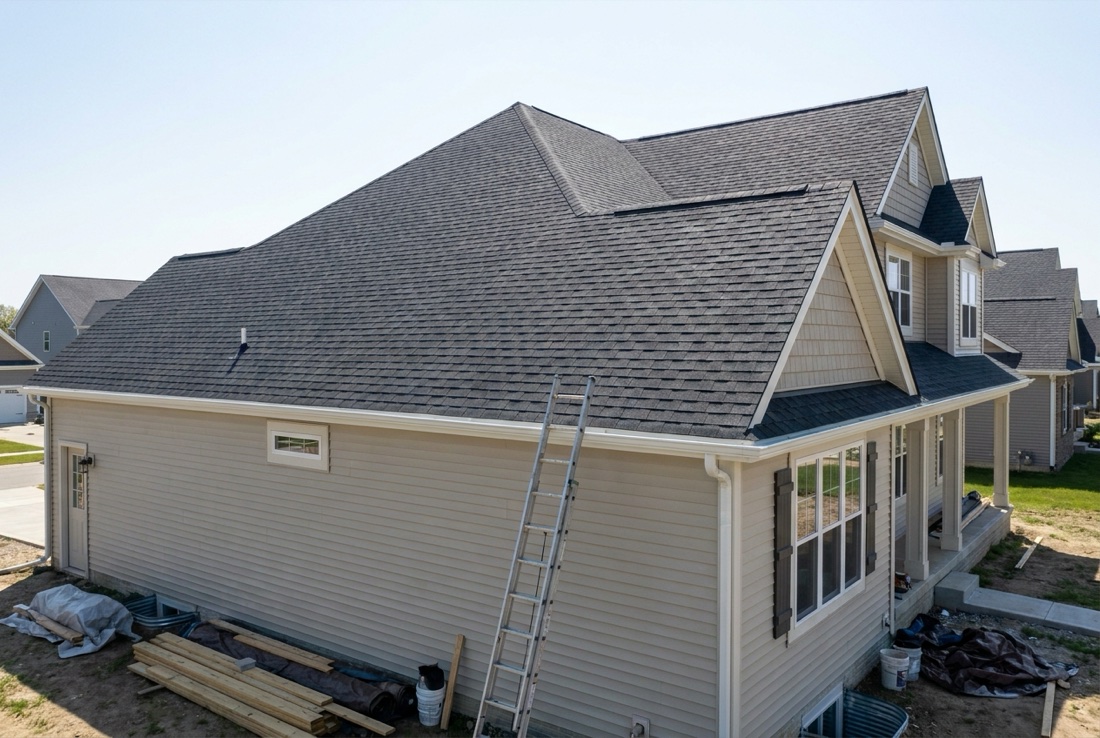
St. Clair Shores earned its name honestly. A lot of what we see up close reads as older lake cottages that were expanded and reroofed over decades into year-round bungalows and ranches, sitting on lots that were platted back when a weekend place on the water was the whole point. That housing pattern matters for roofing in a specific way: additions and dormers added over the years create more flashing seams, more valleys, and more places where two different roof ages meet, all clustered on homes that already take the hardest wind in the county.
We covered the physics of that wind exposure in a companion note on why wind hits harder near Lake St. Clair. The short version: open water is smooth, smooth surfaces do not slow wind down the way rooftops and tree lines do, and the first row of homes off the shoreline meets that wind at close to full strength. St. Clair Shores sits in that first row for a long stretch of its western Macomb County frontage.
02 /What we keep finding on lakefront roofs
A few patterns repeat often enough on St. Clair Shores inspections that we consider them the signature of the address, not a coincidence.
- Perimeter tabs lifting first. Wind uplift concentrates at eaves, rakes, and ridges before it touches the field of the roof. On a lakefront home that perimeter stress arrives more often and harder, so the edge courses are usually the oldest-looking part of an otherwise sound roof.
- Sealant giving out ahead of schedule. The factory adhesive strip that bonds each shingle course depends on heat and pressure to set. Repeated flexing from gusts breaks that bond faster near open water, and once broken it rarely reseals on its own.
- Flashing fatigue at additions. Where a cottage-era roof meets a later addition, the flashing detail is often decades old and was never designed for the wind loads the code assumes today. Those transition points are where we find the first active leaks.
- Faster granule loss on exposed slopes. Wind scouring strips a shingle's granule coat ahead of its rated life, and the bald patches show up first on the slopes that face the open water directly.
03 /Why the pattern matters more here than elsewhere
None of these findings are unique to St. Clair Shores in kind, only in frequency. A ranch three miles inland can have the same lifted tab or the same tired flashing seam. What is different on the lakefront is how fast the clock runs. A fastening detail that would hold for years in a sheltered subdivision gets tested by lake wind on a much shorter interval, and a flashing seam that would age gracefully inland gets flexed harder and more often here. The result is a roof that can look fine from the street while wearing out from the edges in.
That is also why we do not treat a lakefront roof inspection like an inland one. We spend more time at the eaves and rakes, we check every addition seam by hand, and we look for the specific fastening upgrades covered in our note on what wind speed local roofs are actually built for. The goal is catching the early signature before it becomes the ceiling stain.
A roof that has not visibly failed is not the same as a roof that has not been stressed. On lakefront homes, the honest way to know the difference is a close inspection of the perimeter courses and every addition seam, not a look from the curb.
04 /What we recommend for St. Clair Shores homes
If you own a home on or near the water, start with a free inspection. There is no cost and no obligation, and we photograph what we find so you have a record either way. Most of what we catch early on lakefront roofs is repair work rather than replacement, and repairs run $350 to $3,200, with larger or complex repairs running higher. If a roof is old enough that it needs a full replacement, exposure is the argument for doing the fastening schedule right the first time, and the 60 second cost calculator puts real Macomb County numbers on that before anyone visits.
If a specific storm is behind the damage, our storm damage and insurance claims guide walks the process, and we can meet your adjuster on site to walk the roof together; we never promise what a carrier may approve, only that the file will be complete. Start at the storm damage service page, browse the rest of our roofing services, and if water is actively coming in tonight, we answer 24/7 for emergency tarping.
- ASCE 7, minimum design loads: wind exposure category D for open water sites