
Why Wind Hits Harder Near Lake St. Clair: A Weather Note
Ask an inland homeowner and a lakeshore homeowner about the same windstorm and you will hear two different storms. Both are telling the truth. The difference is written into the geography, and it is the reason a roof near the water needs to be fastened differently than the same roof ten miles inland.
Macomb County has a long eastern edge made of open water. Lake St. Clair fronts the county from St. Clair Shores up through Harrison Township, Chesterfield Township, and New Baltimore. A gust that has spent miles grinding across subdivisions and tree canopy arrives tired. A gust that has crossed open water arrives with its speed intact, and the first thing it meets is a row of lakeshore roofs. This note is about why, what the weather stations show, and what it should change about how a roof near the water is built.
01 /Fetch: what open water does to wind
Wind slows down by friction. Every tree, rooftop, and fence line it crosses drags on the airflow near the ground, which is why the strongest winds in any storm live a few hundred feet up and only mix down in gusts. Suburban terrain is rough and bleeds speed out of the surface wind constantly. Open water is the opposite: a lake surface is one of the smoothest things wind ever crosses, and meteorologists call the uninterrupted distance it travels over that surface the fetch. The longer the fetch, the less speed the wind surrenders on the way.
Lake St. Clair gives an east or northeast wind miles of low friction runway. When that flow reaches the Macomb County shoreline, the lakeshore roofs are the first roughness it has met, so they take the wind at close to its over water speed. The homes behind them get progressively calmer air because the shoreline row already paid the toll. Wind engineering formalizes this: the ASCE 7 standard behind building codes sorts sites into exposure categories, with sheltered suburban terrain rated Exposure B and sites fronting large open water rated Exposure D, the most severe category. Same storm, same county, different design problem.
02 /What the stations show
Exposure science predicts that shoreline anemometers should log higher gusts than inland ones in the same events. The closest long running station to the Macomb County lakefront is the airfield instrument at Selfridge Air National Guard Base in Harrison Township, sitting nearly on the water, while the National Weather Service stations at the Detroit area airports read the same storms from well inland. Comparing those logs event by event is the honest way to put a number on the lakeshore penalty, and we hold this page to the same rule as a damage report: no figure goes in without a station observation behind it. See the National Weather Service Detroit/Pontiac office records.
One context line makes the comparison meaningful: the National Weather Service classifies a thunderstorm as severe once it produces a gust of 58 mph, roughly where structural damage begins, and the strongest gusts in the area record have run well past that line. We keep the full logbook of those peak events in our companion note on the strongest winds ever recorded around Macomb County. A roof in St. Clair Shores lives closer to those readings than a roof in Romeo ever will.
03 /What exposure means for the fastening schedule
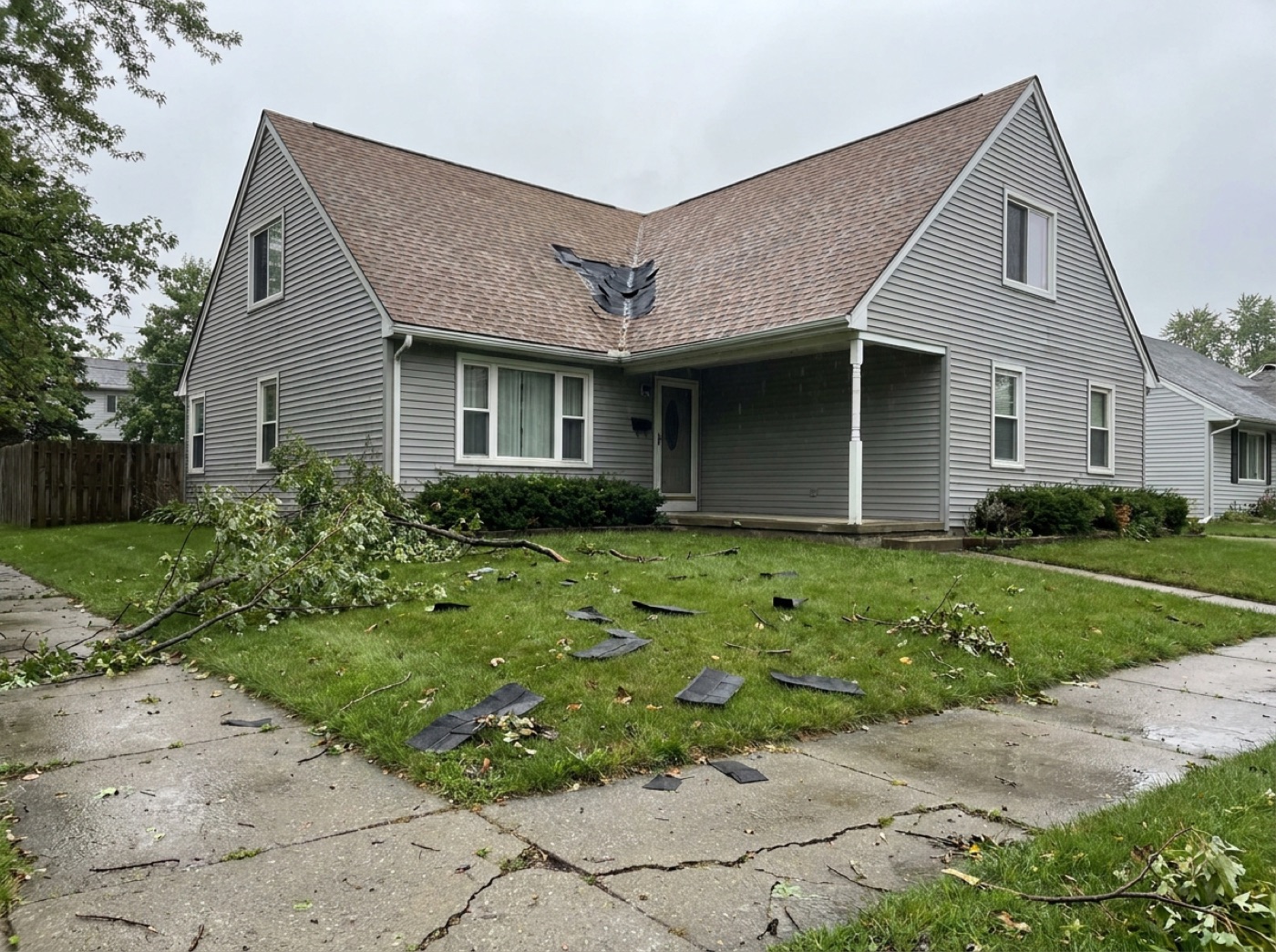
Building codes translate exposure into design pressure, and design pressure into how a roof must be attached. What wind speed the code actually asks Michigan roofs to withstand is covered in our note on the design wind speed local roofs are built for. The practical translation on a lakeshore install is a stricter fastening schedule than the same house would get inland: six nails per shingle instead of four, every nail driven on the manufacturer's nail line, a proper starter course cemented at both eaves and rakes, and hand sealing of the perimeter shingles where uplift concentrates. The shingle wind classes graded under ASTM D7158 also matter more near the water, and for homes that front the lake we specify the higher classes as the default rather than the upgrade.
A fastening pattern that is perfectly adequate in a sheltered inland subdivision can be the bare minimum three blocks from open water. Shingle wind ratings also assume a correct install with every sealant strip bonded. On lakeshore roofs the installation details are not fine print. They are the difference between a rating that holds and one that fails years early.
04 /What to do if you live near the water
If your home fronts the lake or sits within the first few streets of it, treat exposure as part of your roof's maintenance reality. Our running log of lakefront inspections lives in the St. Clair Shores field notes, and the pattern is consistent: sealant bonds broken early, perimeter tabs lifting first, wear arriving seasons ahead of the inland schedule. An inspection is free, no cost and no obligation, and you get photos either way. Most shoreline findings are fasten and reseal work, not replacements, and repairs run $350 to $3,200, with larger or complex repairs running higher.
If the roof is at the end of its life, replacement is the one chance to buy the fastening schedule the exposure deserves, and the 60 second cost calculator puts honest numbers on it before anyone visits. If a specific storm did the damage, our storm damage and insurance claims guide walks the process and we can meet your adjuster on site; we never promise what a carrier may approve, only that the file will be complete. Start at the storm damage service page, browse the rest of our roofing services, and if lake wind has water coming in tonight, we answer 24/7 for emergency tarping.
- National Weather Service, severe thunderstorm criteria: damaging wind threshold of 58 mph
- National Weather Service, Detroit/Pontiac forecast office: southeast Michigan forecasts, warnings, and event records. weather.gov/dtx
- ASCE 7, minimum design loads: wind exposure categories B, C, and D
- ASTM D7158, standard test method for wind resistance of asphalt shingles