
Four Nails or Six? What Code and Wind Maps Say in Michigan
A shingle bundle is rated for wind in a lab. Whether it holds that rating on your roof comes down to a detail almost nobody asks about: how many nails went into each shingle, and where. Here is what the code and the manufacturers actually require, and why this quiet detail is the cause of so many blow-offs.
Ask a homeowner how a shingle is attached and most will say nails, and stop there. Ask how many, and where, and the answer gets fuzzy fast. That gap matters, because a shingle's wind rating is only true under one condition: correct fastening, at the specified count, in the specified zone. Get the pattern wrong and the letter on the wrapper stops describing the roof over your head. This note covers what the code requires, when four nails is enough and when six becomes mandatory, and why nail placement misses are, in our experience, the quiet cause behind a surprising share of blow-offs.
01 /What the code actually requires
Asphalt shingle fastening in Michigan is governed by the Michigan Residential Code, and the code does not leave nail count to the installer's judgment. It sets a baseline fastening schedule and then requires the manufacturer's own installation instructions to be followed wherever those instructions call for more. The starting point is four nails per shingle, driven through the nailing zone the manufacturer prints on the shingle itself, not high into the tab and not low enough to miss the course below. See Michigan Residential Code 2015, section R905.2 (asphalt shingle application).
That baseline is a floor, not a ceiling. The code defers to the manufacturer's published installation instructions whenever those instructions specify a higher fastener count for the site's mapped wind conditions. Whichever number is higher, the code baseline or the manufacturer's high wind instruction, governs the roof. Our companion note on what wind speed Michigan roofs are actually built for covers where that governing number comes from, and which code edition applies to your permit is its own question, covered in our note on which building code covers your roof in Michigan.
02 /When four nails is enough, and when six becomes mandatory
Four nails per shingle is the standard pattern most Macomb County roofs are built to, and for many installs it is genuinely sufficient. It stops being sufficient the moment either of two things is true: the mapped wind criteria for the site exceed the threshold the manufacturer sets for its standard pattern, or the roof pitch is steep enough that the manufacturer's instructions require added fastening regardless of wind zone. See Michigan Residential Code 2015, section R905.2 (asphalt shingle application).
Manufacturers publish this as a plain rule on the wrapper and installation guide, typically framed as a jump from four fasteners to six once the design wind speed crosses a stated line, or roof pitch passes a stated steepness. Where a home sits relative to that line is not a judgment call. It is read off the same wind speed map that sets the shingle's required wind resistance class, the subject of our note on what wind speed actually lifts shingles.
Homeowners sometimes hear six nail patterns pitched as a premium option worth paying extra for. Where code or manufacturer instructions require it for the site's wind mapping or pitch, it is not optional. A four nail install that should have six is a code gap before it is ever a storm claim.
03 /Why nail placement misses cause blow-offs
Here is the part that does not make it onto a wrapper or a code page: a shingle can be nailed with the correct count and still fail, if the nails land in the wrong place. Wind resistance depends on the nails holding the shingle to the deck and the factory sealant strip bonding each course to the one beneath it. A nail driven above the printed zone misses the reinforced strip, so the shingle can work loose even though the count was right. A nail driven too low can miss the course below, or sit exposed as its own leak path. Either miss quietly subtracts from the wind performance the code assumed, and the roof gives no warning until a gust finds it.
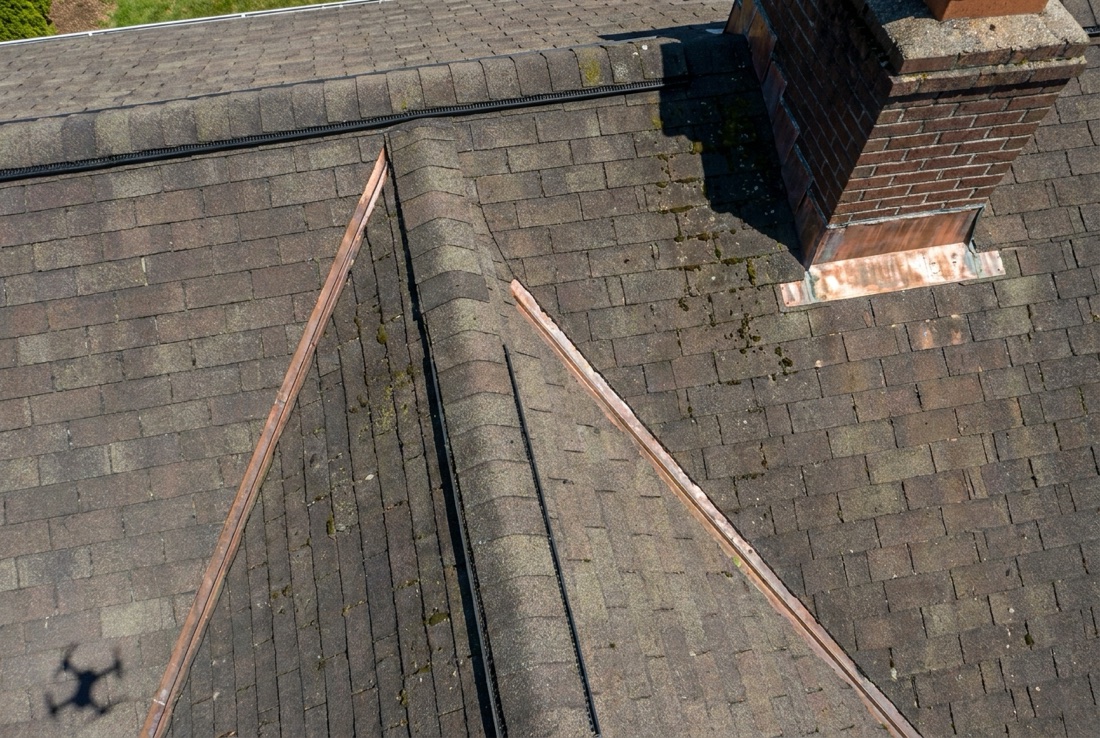
Overdriving is a second, quieter version of the same problem. A nail gun set too aggressively can sink the head through the mat instead of flush against it, fracturing the fiberglass around the fastener. The count is right, but the hole is already compromised before the first windstorm arrives. None of this is visible from the ground, or even from a ladder without pulling a tab back to check the bond underneath.
04 /What we check, and what to do about it
When we inspect a roof after wind, we are not just looking for missing shingles. We check whether the fastening pattern present matches what the site's wind mapping and pitch require, and where sealant bonds have already broken along shingles still sitting in place. That distinction, a storm that exceeded design versus a roof never fastened to meet it, matters for the repair plan and, if a claim is on the table, for how the damage gets documented. We never promise what a carrier will approve, but we can meet your adjuster on site so the fastening we found gets seen firsthand.
Most nailing pattern findings show up as repairs, and repairs run $350 to $3,200, with larger or more complex repairs running higher. Where an entire roof was under nailed for its wind zone, replacement to the correct pattern is the honest fix, and the 60 second cost calculator frames those numbers first. If wind has already found the weak point and water is coming in, we answer 24/7 for emergency tarping. Otherwise, start with a free inspection, no cost and no obligation.
- Michigan Residential Code 2015, section R905.2 Asphalt Shingles: fastening, slope, and underlayment application requirements. up.codes: MRC chapter 9
- Manufacturer technical and warranty literature for the major asphalt shingle lines: GAF (gaf.com), Owens Corning (owenscorning.com), and CertainTeed (certainteed.com).
- FEMA, Disaster DR-4757-MI, Michigan severe storms (August 2023)