
TPO vs EPDM: Choosing a Flat Roof Membrane in Michigan
Two single-ply membranes, one flat roof canon. Here is the honest side by side so you spend the same $9,000 to $16,000 on the system that actually fits your building.
Both systems live inside the same $9,000 to $16,000 flat and commercial canon, so the real decision is not price, it is fit. A sun-baked roof carrying rooftop units and heavy foot traffic usually favors TPO's reflective surface and robust heat-welded seams. A simpler roof where the owner values decades of field history and a flexible membrane that tolerates movement usually favors EPDM. A free inspection puts real numbers on your specific deck, penetrations, and drainage before you choose either one.
Ask three roofers about a flat roof replacement in Macomb County and you will get the same two names back: TPO and EPDM. Both are single-ply membranes, both live inside the same $9,000 to $16,000 flat and commercial canon, and both will keep a low-slope roof dry for decades when installed correctly. The comparison that actually matters is not which membrane is objectively better. It is which membrane is better for your roof: how much sun it takes, how much foot traffic it carries, how your building handles heat, and how you weigh a proven track record against a newer, faster-installing system. That is the ledger this page runs, line by line.
01 /What each membrane actually is
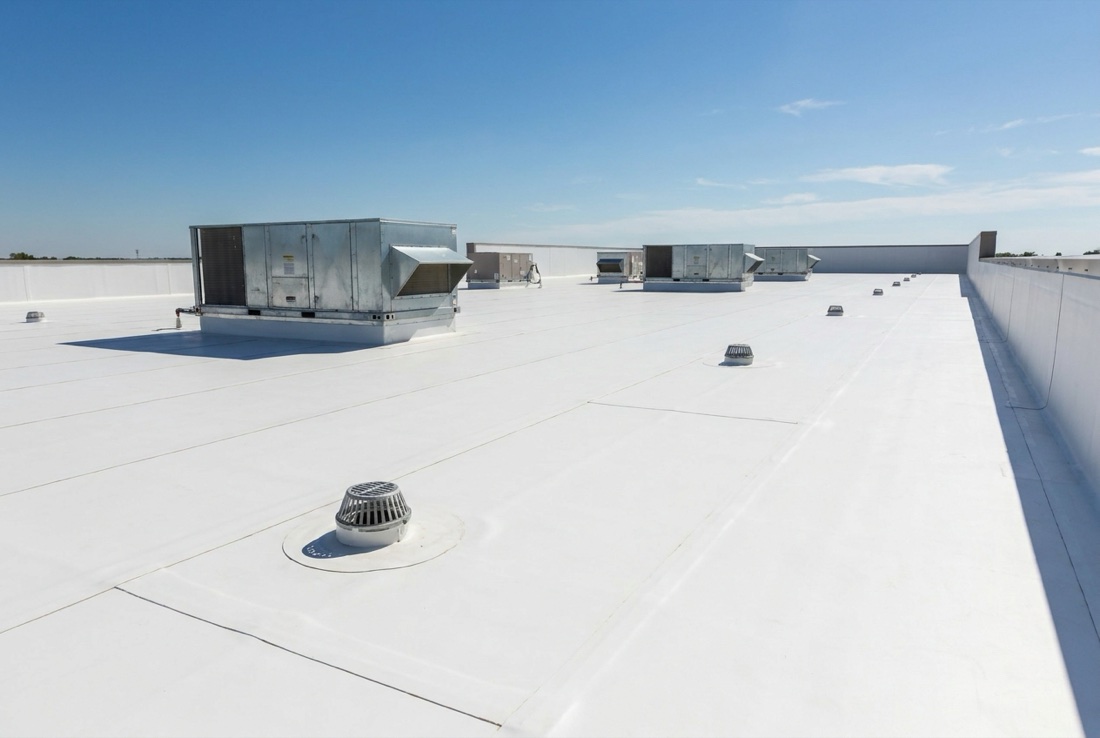
TPO stands for thermoplastic polyolefin, a single-ply sheet reinforced with polyester and rolled out in wide sheets, usually white or gray on top. Seams are joined with hot-air welding equipment, either a handheld welder for detail work or a robotic welder for long straight runs, which fuses the overlapping sheets into one continuous plane rather than gluing them together. TPO can be mechanically attached with fasteners and plates, fully adhered with bonding adhesive, or ballasted under stone, depending on the deck and the wind exposure at your building.
EPDM is a synthetic rubber, ethylene propylene diene terpolymer, that has been on American commercial roofs since the 1960s. Traditional EPDM is black, though white EPDM exists at a premium. Seams are joined with liquid adhesive or, on newer installs, factory-applied seam tape, bonding two sheet edges together rather than welding them into one. EPDM is prized for its flexibility, since the membrane stretches and recovers as the deck below expands and contracts with Michigan's temperature swings.
Both materials sit on a similar assembly underneath: rigid insulation board, often tapered to build in slope toward drains, over a structural deck, with the membrane fully adhered, mechanically fastened, or ballasted on top. That underlying system, the insulation, the slope, and the drainage, decides how a flat roof survives Michigan winters as much as the membrane brand does. You can see how we handle that assembly on our commercial and flat roofing page.
02 /Upfront cost: the real numbers
Here is the honest starting point: in Macomb County, flat and commercial roofing, TPO, EPDM, or modified bitumen, runs $9,000 to $16,000 installed. Unlike the metal versus asphalt question, choosing TPO over EPDM on the same roof rarely moves the price by a meaningful amount on its own. What moves the number inside that range is square footage, deck condition, how many curbs and penetrations your rooftop units create, whether tapered insulation is needed to fix a drainage problem, and whether the old roof has to be torn off or can be recovered.
TPO and EPDM both fall inside the $9,000 to $16,000 flat and commercial range. The membrane choice rarely swings your quote by itself; insulation, drainage design, and the number of roof penetrations do most of that work. See the full breakdown on our pricing sheet.
For context, here is the full canon of what roofs cost across every system we install in Macomb County:
| System | Typical Installed Range |
|---|---|
| Asphalt shingle replacement (most homes $12,000 to $16,000) | $9,000 to $18,000 |
| Metal replacement (standing seam, stone-coated steel) | $18,000 to $30,000 |
| Tile and slate replacement | $20,000 to $36,000 |
| Flat and commercial (TPO, EPDM, modified bitumen) | $9,000 to $16,000 |
| Roof repairs (larger or complex repairs can run higher) | $350 to $3,200 |
Tear off versus recover is usually the bigger cost lever than the membrane choice. If your existing roof is a single layer, dry, and reasonably flat, a new TPO or EPDM membrane can sometimes go directly over it, which saves disposal cost and shortens the job. If the deck is wet, has more than one existing layer, or is holding water, a full tear off is the honest answer regardless of which membrane goes back on. We walk through that decision in more depth in our recover versus tear off guide.
Run the back of the envelope math using the midpoint of the flat and commercial canon and typical service life, and the picture looks like this. This is an illustration, not a quote, and it only holds if the roof is maintained and the drainage was designed correctly:
03 /Seams and how each system actually fails
A flat roof rarely fails in the field of the membrane. It fails at a seam, a flashing, or a penetration, which is why seam technology is worth understanding before you pick a side. TPO seams are heat-welded, meaning the two sheet edges are melted and fused into a single piece of plastic. Done correctly, with clean sheets, the right temperature, and steady technique, a TPO weld is often stronger than the membrane itself. Done poorly, in cold or wet conditions or by a rushed crew, a weld can look sealed and still leak years later, which is why installer experience with TPO specifically matters more than the brand on the roll.
EPDM seams rely on adhesive bonding or factory seam tape rather than a weld. Older cold-applied liquid adhesive seams were the most common failure point on EPDM roofs for decades: the bond degrades with age and UV exposure, and a compromised seam does not always show itself until you are chasing a leak inside the building. Modern tape systems have closed much of that gap and are considerably more consistent than the old glue and roller method, but the seam is still a bonded lap rather than a fused piece.
We cover exactly how each seam type ages and what a failing seam looks like in our flat roof seam failure guide, and if you want the fundamentals on either material by itself, our TPO roofing guide and EPDM roofing guide both go deeper than we have room for here.
04 /Ponding water, freeze-thaw, and Michigan winters
Every flat roof in Michigan will hold some water after a storm; the question is how long it sits and what it does while it is there. Prolonged ponding stresses any membrane over years, softening some sealants, accelerating breakdown where water evaporates and re-concentrates, and adding dead weight in a hard freeze. Tapered insulation that routes water to drains within about 48 hours is the actual fix for ponding, on either membrane, and it matters more than which material sits on top.
Freeze-thaw cycling works on the details more than the field: parapet flashings, curb flashings around rooftop units, and drain bowls all move slightly as temperatures swing, and that movement is where leaks start. TPO's welded seams and EPDM's bonded seams both need correctly detailed flashing at those transitions, full stop, or the membrane choice underneath is irrelevant.
Wind is the other Michigan factor on a flat roof. Macomb County was part of federal disaster DR-4757 after the August 2023 wind event, and uplift at roof edges and corners, where wind pressure is highest, is one of the most common things we find on flat roof storm inspections. Both TPO and EPDM need correct fastening patterns and edge metal rated for the wind zone; neither material is inherently more wind resistant than the other when installed to spec.
Snow load is a related concern on flat and low-slope sections tucked behind a taller roofline or parapet, where drifting can pile snow several times deeper than what fell on an open roof. That is a structural and drainage question first, and a membrane question second: both TPO and EPDM handle sustained snow weight the same way, by relying on the deck and framing underneath to carry it and the drains to clear the meltwater once it lets go.
05 /Sun exposure, reflectivity, and rooftop heat
This is the one place the two materials genuinely diverge. TPO's white or light gray surface reflects a large share of summer sun instead of absorbing it, which keeps the membrane cooler and can reduce how hard rooftop air conditioning units work on the floor below. Reflective roofs are a common default for buildings with heavy summer cooling loads.
EPDM's traditional black surface does the opposite: it absorbs heat, which can help shed snow and ice a little faster in winter but pushes the membrane surface temperature meaningfully higher on a July afternoon. Higher sustained surface temperature is one contributor to faster long-term aging under UV exposure, though membrane thickness and manufacturing quality matter as much as color. White EPDM closes most of that gap if reflectivity matters to you, at a modest premium over black.
06 /Rooftop traffic, equipment, and puncture resistance
If your roof carries HVAC units, a satellite array, or maintenance staff walking it regularly, puncture resistance belongs in the decision. Both membranes are sold in multiple thicknesses, commonly 45, 60, and 80 mil, and thickness matters more than material family for puncture resistance. A thin membrane of either type is more vulnerable around ladder feet, dropped tools, and foot traffic paths than a thick one.
TPO's slightly stiffer sheet tends to resist point punctures a little better in side by side testing, while EPDM's rubber flexibility tolerates the building's thermal movement and minor deck settling without splitting. Neither advantage is large enough to override the sun exposure and cost factors above on its own. Walkway pads at doors, ladders, and equipment service paths extend the life of either membrane and are worth specifying on any roof with regular foot traffic.
07 /Repairs and long-term maintenance
Both membranes are repairable, and the same rule applies to either one: a small membrane problem caught early is a $350 to $3,200 repair, with larger or complex repairs running higher, and a small problem ignored for a few winters can turn into a full roof replacement conversation. TPO patches are heat-welded using the same equipment as the original install, and a properly welded patch bonds as securely as the field seams around it. EPDM patches use liquid adhesive or tape systems with careful surface prep, and the patch is only as reliable as that prep work.
An annual inspection is the cheapest maintenance either roof will ever need: walking the field, checking seams and flashings, clearing drains, and catching a lifted lap before a winter storm turns it into a ceiling stain. We include that walk in every free inspection, on any flat roof system, whether we installed it or not.
08 /How to decide
Strip away the marketing and the decision usually comes down to four questions. How much direct summer sun does this roof take, and does cooling cost matter to whoever pays the utility bill? How much rooftop equipment and foot traffic will this membrane carry over its life? Do you want the newer, faster-installing, heat-welded system, or the material with the longest track record in American commercial roofing? And what does your actual roof, its drainage, its penetrations, its deck condition, look like once someone puts eyes on it?
Contractor experience with the specific membrane you choose matters as much as the material itself. A crew that welds TPO seams every week will outperform a generalist crew on a TPO roof, and the same is true of a crew that lives in EPDM adhesive and tape systems. When you compare quotes, ask how many roofs of that exact system the crew has installed in Macomb County, not just how many roofs of any kind.
- Both TPO and EPDM fall inside the same $9,000 to $16,000 flat and commercial canon.
- TPO's reflective surface and welded seams suit sun-heavy roofs with rooftop equipment.
- EPDM's flexible rubber and decades of field history suit simpler, lower-traffic roofs.
- Repairs run $350 to $3,200 either way; larger or complex repairs run higher.
- Insulation, drainage, and flashing details decide survival more than the membrane brand.
If you want the deeper technical comparison, including how each membrane is specified and maintained over its full service life, our TPO vs EPDM roofing guide goes further than this ledger has room for, and our flat roof lifespan guide covers how modified bitumen fits into the same conversation. Or skip the reading: price both systems for your roof in under a minute, or call for a free inspection and we will hand you honest numbers for both.
Questions we hear most
Neither one moves the price by itself. Flat and commercial roofing, TPO, EPDM, or modified bitumen, runs $9,000 to $16,000 installed in Macomb County. What changes the number more than the membrane is square footage, deck condition, and how much tapered insulation or drainage work your roof needs. A free inspection gives you a real number for your building on either system.
Both are commonly rated for a similar range of service life, generally 20 to 30 years for TPO and 25 to 30 or more years for EPDM with regular maintenance. In practice, installation quality, seam integrity, and how well drainage is designed matter more to actual lifespan than the material family. An annual inspection that catches a lifted seam early does more for either roof's lifespan than the brand on the roll.
Usually, yes. Roof repairs in Macomb County run $350 to $3,200, and larger or complex repairs can run higher. TPO patches are heat-welded like the original seams, and EPDM patches use adhesive or tape systems with careful surface preparation. Whether a repair still makes sense or the roof has reached the point where replacement is the better spend depends on its age and how much of the membrane is affected, which a free inspection can tell you honestly.