
JUMP TO A SECTION
Search for the best flat roof material and you will find a dozen pages that all end the same way: it depends. That is technically true and completely useless if you own a building with a leaking roof and a budget meeting on Thursday. So this guide does the opposite. It names names, it ranks options by the kind of building you actually have, and it is honest about the one thing every other page buries, which is that best is a moving target set by drainage, foot traffic, and how long you plan to keep the building. Every flat and commercial roof we install in Macomb County falls inside the same published range on our honest pricing sheet, and the material you pick moves you around inside that range rather than blowing past it.
01 / THE SHORT ANSWERThe honest answer: there is no single best
If someone tells you one membrane is simply the best flat roof material, they are either selling that one product or they have never had to warranty a roof through a Michigan winter. The four systems that actually compete for low-slope buildings here, thermoplastic like TPO, rubber like EPDM, multi-ply modified bitumen, and coating restorations, each win decisively in some situations and lose badly in others. A membrane that is perfect on a sun-baked retail box can be the wrong call on a shaded roof that ponds, and a system that shrugs off forklift traffic on a warehouse is overkill on a small detached addition.
The best flat roof material is the one matched to three things about your building: how well it drains, how much foot and equipment traffic the roof takes, and how many years you plan to own it. Get those three right and every one of the systems below can be an excellent roof. Get them wrong and even the priciest membrane fails early.
So the useful question is not which membrane is best in the abstract. It is which membrane is best for a low-slope roof in a freeze-thaw climate, on your specific building, at a price that fits the plan. The rest of this guide answers exactly that. If you want the full technical menu of every low-slope system before you narrow it down, our plain-English guide to commercial roofing systems lays them all out; this page is the shorter road to a decision.
02 / THE CANDIDATESThe four options actually worth considering
Before we rank them by scenario, here is the honest one-line character sketch of each system as it behaves in Michigan. None of this is marketing; it is how these roofs age when the temperature swings sixty degrees between a January night and an April afternoon.
TPO: the white heat-welded sheet
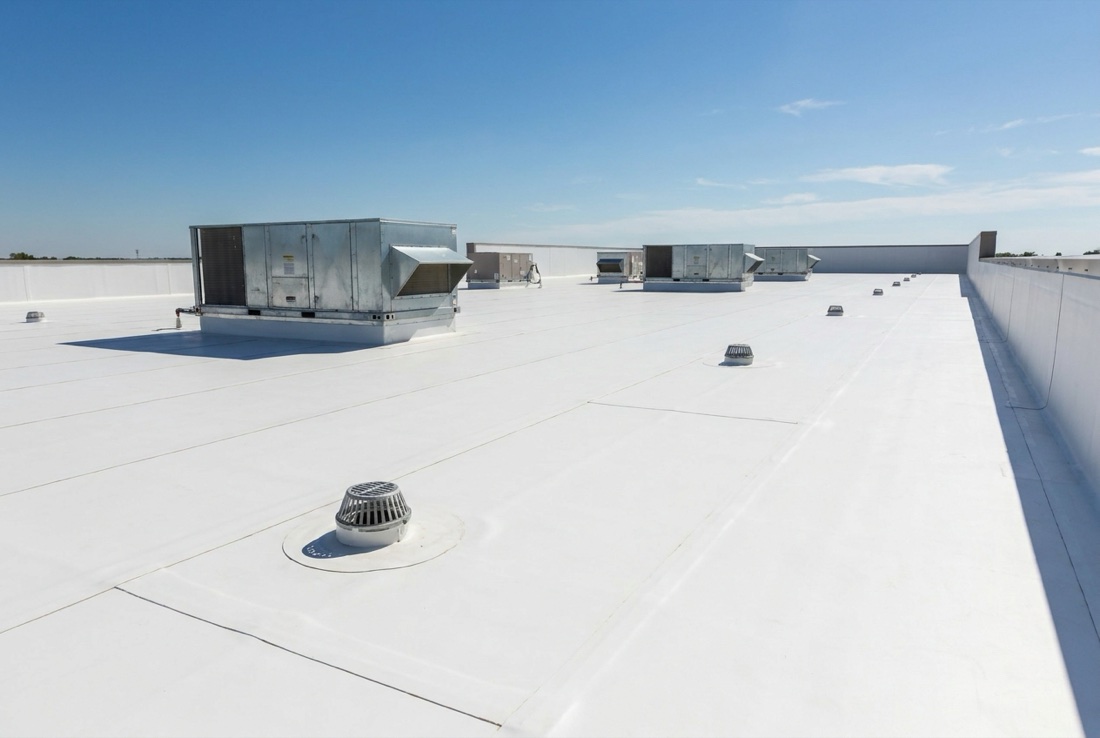
TPO is a thermoplastic single-ply membrane whose seams are hot-air welded into one continuous surface, and it is the most-installed commercial membrane in the country right now. Its white surface reflects summer heat, its welded seams are strong when they are done right, and it handles ponding better than a glued seam does. The catch is that the weld is only as good as the installer and the sheet is only as durable as its mil thickness, so TPO rewards a skilled crew and punishes a cheap one. It is a strong default for many Michigan buildings, and it is exactly why it dominates our TPO versus EPDM comparison.
EPDM: the black rubber roof
EPDM is a synthetic rubber membrane with the longest cold-climate track record of any single-ply, which matters enormously in a state that spends a third of the year below freezing. It stays flexible when it is cold instead of getting brittle, it is forgiving to install, and small repairs are the most DIY-friendly of any membrane. Its historic weakness is seams: older glued seams are the first thing to let go, and black membrane absorbs summer heat rather than reflecting it. Modern taped seams have closed most of that gap, and for a shaded or ponding-prone roof the black surface is a non-issue.
Modified bitumen: the multi-ply successor to built-up
Modified bitumen, or mod-bit, is the evolution of the old tar-and-gravel built-up roof into a factory-made rolled sheet, usually installed in two plies for redundancy. That second ply is the whole pitch: a roof that takes real foot traffic, or one where a single puncture cannot be allowed to become a leak, benefits from having a backup layer built in. A granulated cap sheet adds surface toughness. It is heavier and more labor-intensive to install than single-ply, which is why it tends to win on smaller, high-traffic, or detail-heavy roofs rather than wide-open fields.
Coating restoration: the lifecycle option, not a membrane
A fluid-applied coating, most often silicone or acrylic, is not a way to build a new roof; it is a way to extend a roof that is still structurally dry and sound. Sprayed or rolled over an existing membrane, it seals aging seams and reflects heat, and on the right candidate it can add years for a fraction of a tear-off. But it disqualifies itself the moment the insulation underneath is saturated, because sealing wet material inside the assembly just rots the deck. Treat coating as a stage between repair and replacement, not a cheaper substitute for either.
| SYSTEM | MICHIGAN STRENGTH | WATCH ITEM |
|---|---|---|
| TPO | Reflective, welded seams, sheds ponding well | Weld quality and mil thickness |
| EPDM | Best cold-weather flexibility, easy repairs | Older glued seams; black absorbs heat |
| Modified bitumen | Two-ply redundancy for traffic | Heavier, more install labor |
| Coating restoration | Extends a dry, sound roof | Fails on saturated insulation |
03 / BY SCENARIOThe best material for your kind of building
Here is the part every other article skips. Instead of a generic pros and cons dump, this is which system tends to win for the buildings we actually reroof across Macomb County, and why. Read the one that matches yours.
A small residential addition or detached garage
On a small low-slope roof over an addition, porch, or garage, the deciding factors are usually simplicity, repairability, and cost. EPDM is often the sweet spot here: it goes down cleanly on a small area, a homeowner can maintain and patch it, and it has decades of cold-climate history behind it. Modified bitumen is a fine second choice where the roof takes foot traffic or ties into a wall in a way that wants a redundant ply. TPO works too, but its advantages, the reflective surface and welded seams, matter less on a tiny shaded roof, and the welding equipment is harder to justify on a job this size.
A retail strip or sun-exposed box
For a retail strip, a standalone store, or any wide-open roof that bakes in full sun all summer, reflectivity starts paying for itself. A white TPO surface reflects heat instead of absorbing it, which eases the cooling load below and slows the heat aging that punishes dark membranes. The welded seams also handle the light ponding that flat retail roofs almost always develop. TPO is the strong default for the sun-baked box. If the roof already has a sound membrane and just needs life extended, a reflective silicone coating restoration is the lower-cost move to consider before a full replacement.
An office or mixed-use building with rooftop equipment
Offices and mixed-use buildings tend to be defined by their rooftop clutter: HVAC units, exhaust fans, and the service technicians who walk to them. That means two things drive the choice. First, every curb and penetration is hand-flashed, so the system has to detail cleanly, which all four do in skilled hands. Second, the traffic paths to equipment take a beating, which is where modified bitumen's second ply, or a walkway-pad strategy over a single-ply, earns its place. TPO and EPDM both serve well here; the real decision is less about the field membrane and more about protecting the traffic lanes and detailing the equipment curbs.
A warehouse or wide-open industrial roof
On a large, open industrial roof, economics and coverage speed dominate. Single-ply systems, TPO and EPDM, cover big areas efficiently, and the reflective white surface of TPO can meaningfully cut summer cooling costs on a building with a lot of conditioned floor below. EPDM comes in very wide sheets that reduce the number of field seams on a huge roof, which is a real advantage where labor is the biggest line. Either is a defensible warehouse choice; the tiebreaker is usually whether the interior is cooled enough to reward a reflective roof, and how the insulation package is specced.
A shaded or ponding-prone roof
This is the scenario that flips the usual advice. On a roof that sits in shade, drains poorly, and holds standing water after every rain, the reflective advantage of white TPO barely matters, and the enemy becomes standing water that freezes into ice lenses all winter and grinds at every seam. EPDM's flexibility and TPO's welded seams both help, but no membrane is a substitute for fixing why the water stands. The honest answer for a ponding roof is that the material choice is secondary to correcting the drainage, and our flat roof drainage systems guide covers the drains, scuppers, crickets, and tapered insulation that actually solve it. Put a premium membrane over a pond and you have bought an expensive future leak.
The membrane is the last decision, not the first. Fix the drainage, size the insulation to code, then pick the sheet. Do it in the other order and the best material on the market still fails early.
04 / THE DECIDERSThe three questions that actually decide it
Strip away the brand loyalty and every good flat-roof decision comes down to the same three questions. Answer them honestly and the material almost picks itself.
1. How does the roof drain?
Drainage is the first question because it overrides the others. A roof that sheds water cleanly can wear almost any membrane for its full service life. A roof that ponds will punish every system, and in Michigan the standing water does not just sit there, it freezes and thaws through the whole winter, stressing seams and flashings until one lets go. Before you compare membranes, find out whether your roof drains, and if it does not, budget for the correction. Standing water is also the fastest way to void a membrane warranty, so it is not a corner you can quietly cut.
2. How much traffic does the roof take?
A roof that nobody walks on except for a once-a-year inspection has very different needs from one with technicians servicing rooftop units every week. Foot traffic and dropped tools are how single-ply membranes get punctured, so a high-traffic roof argues for the redundancy of modified bitumen, a thicker single-ply mil, or protective walkway pads along the service routes. Match the toughness to the use. Paying for a heavy multi-ply system on a roof no one ever touches is money that would have been better spent on insulation or drainage.
3. How long will you own the building?
Your ownership horizon changes the math completely. If you plan to hold the building for decades, spending more up front on a thicker membrane, a better insulation package, and drainage done right is buying years you will actually use. If you expect to sell within a few years, a sound restoration or a mid-grade system that keeps the building dry and shows a clean maintenance file may serve the plan better than the most expensive roof on the market. Neither is wrong; they are answers to different questions. Winter exposure sits underneath all three, because a freeze-thaw climate is unforgiving of thin assemblies and standing water no matter which membrane is on top.
05 / THE NUMBERWhat the best material costs, and getting a real number
Owners always want a price tag stapled to the word best, and on flat roofs that is where honesty matters most. A full flat or commercial roof replacement in Macomb County runs $9,000 to $16,000 installed, and the membrane you choose moves you around inside that range rather than setting it by itself. The sheet is often one of the cheaper ingredients; the insulation package, the drainage corrections, and the linear feet of flashing usually cost more than the membrane on top of them. That is why our flat roof replacement cost guide spends more time on the assembly than on the brand name, and why the best material is rarely the most expensive one.
is where most Macomb County flat roof replacements land, whichever membrane wins for your building. Larger or unusual roofs can run higher, and the only way to price yours is to get on it. Run a ballpark in about 60 seconds with the instant estimator or the cost calculator.
If your roof is only leaking in a spot or two and the assembly under it is dry, you may not be choosing a new membrane at all. Flat roof repairs run $350 to $3,200, and larger or complex repairs can run higher, so the first honest step is finding out which conversation you are in. For owners spreading the cost of a full replacement, financing is available subject to approval. As an illustration only, a $13,500 project financed over a 10 year term at 9.9% APR works out to about $178 per month. That example is not an offer of credit; your rate, term, and approval depend on the lender and your credit profile.
There is only one way to know which material is genuinely best for your building, and it is not a brochure or an online chart. It is someone on the roof, checking how it drains, how much traffic it takes, whether the insulation is dry, and how the details are built, then matching the membrane to what they find. Our inspection is $0 with no obligation, and if the roof needs a repair or a restoration instead of a replacement, that is what we will tell you. When you are weighing it against another quote, our three-way membrane chooser is a fair framework for reading the options side by side, and you can browse the rest of the guides library or head back to the roofing services hub to see how flat work fits the full lineup. Active leaks in the meantime are held off with 24/7 emergency tarping until a real repair can be scheduled.
- There is no single best flat roof material; the best one is matched to your building's drainage, traffic, and ownership horizon.
- TPO wins on sun-baked open roofs, EPDM on small and shaded roofs, modified bitumen on high-traffic roofs, and coating restores a dry sound roof.
- On a ponding or shaded roof, correcting the drainage matters more than which membrane you choose.
- The membrane is often the cheaper part; the insulation package and detail work usually cost more than the sheet.
- Flat and commercial replacements run $9,000 to $16,000 installed; repairs run $350 to $3,200, and the honest way to choose is a free inspection.
Questions we hear most
There is no single best material, because the right choice depends on how your roof drains, how much traffic it takes, and how long you plan to own the building. As a rough guide, TPO suits sun-exposed open roofs, EPDM suits small and shaded roofs, modified bitumen suits high-traffic roofs, and a coating restores a roof that is still dry and sound. A free inspection is the only way to match the material to your actual building.
Both perform well in Michigan, and the tiebreaker is usually the roof itself. EPDM has the longest cold-climate track record and stays flexible in deep cold, which suits shaded and ponding-prone roofs. TPO's reflective white surface and welded seams suit sun-exposed roofs and light ponding. Neither is universally better; the roof's drainage and sun exposure decide it, and our TPO versus EPDM guide walks the full tradeoff.
A full flat or commercial roof replacement in Macomb County runs $9,000 to $16,000 installed, whichever membrane wins for your building, and larger or unusual roofs can run higher. The membrane choice moves you around inside that range rather than setting it, because the insulation package and detail work often cost more than the sheet. The only way to get an exact number is an on-site inspection, which we provide free with no obligation.
- FEMA, disaster declaration DR-4757-MI, Michigan severe storms of August 2023 (Macomb County designated). fema.gov/disaster/4757
- SPRI, single-ply and low-slope roofing industry standards. spri.org
- Michigan Uniform Energy Code (state adoption of the International Energy Conservation Code), LARA Bureau of Construction Codes. michigan.gov/lara: code books