
JUMP TO A SECTION
A homeowner calls about "black mold on the roof" more often than almost any other single complaint we get, and it is almost never mold. What is actually growing up there is usually one of three organisms, each with its own look, its own cause, and its own consequence for the shingle underneath. Confusing them leads to bad decisions in both directions: replacing a roof over a cosmetic stain, or ignoring a growth pattern that is quietly shortening the shingle's life. This guide is the same read we use on a free roof inspection, the vocabulary and the judgment calls behind it, so you know what you are looking at before anyone gives you a verdict.
01 / THE FRAMEThree different organisms, one dark roof
Algae, moss, and lichen are not the same thing biologically and they do not behave the same way on an asphalt shingle. Algae stains the surface. Moss grows a cushion on top of it. Lichen bonds directly to the granules themselves. An inspector separates the three first, because the questions that matter next, is this getting worse, is it holding moisture, is it lifting anything, have different answers for each one.
None of the three organisms below are automatically a repair or replacement trigger on their own. What matters is the pattern: how much of the roof is affected, which slope it is on, and whether the shingle underneath is still lying flat and holding its granules. Use this as a field guide, then get an actual inspection for the verdict. Ours is $0 with no obligation.
02 / THE STAINBlack streaks: algae staining, mostly cosmetic
The dark, streaky discoloration that runs down a roof slope, usually starting near the ridge and trailing toward the eaves, is almost always a colony of blue-green algae, most commonly the species gloeocapsa magma. The algae is not eating the asphalt underneath; it is feeding on the limestone filler compounded into many shingle products, and its dark pigment is a protective shield the organism grows to block UV light, the same reason the streaks tend to darken over several years rather than appearing overnight.
Where it shows up and why
Algae staining favors roofs that stay damp longer between rains: north-facing slopes that get less direct sun, areas shaded by trees, and roofs in humid regions generally. Macomb County's lake-effect humidity and tree canopy give algae plenty of opportunity, which is why streaking on an otherwise sound 8 to 12 year old roof is one of the most common cosmetic findings we document. It also spreads; airborne spores travel from an infected roof to neighboring homes, which is part of why streaking often shows up on one side of a street before the rest catches up.
On its own, algae staining is a cosmetic finding. It does not lift the shingle, does not hold standing water against the deck, and does not accelerate granule loss the way moss can. Many newer architectural shingles carry algae-resistant granules specifically to slow this process, though no coating stops it permanently. The reason it still belongs in an inspection report is that heavy staining can mask the surface underneath it, and a granule count or a check for curling is harder to read through a dark colony, so a thorough inspector notes it and looks past it rather than skipping the area.
03 / THE ONE THAT MATTERSMoss: the growth that actually causes damage
Moss is a different problem, and it is the one an inspector treats with more urgency. Where algae stains the surface, moss grows a small, rooted cushion on top of the shingle, and that cushion behaves like a sponge. It holds rainwater and snowmelt against the shingle and the deck below far longer than an uncovered surface ever would, and in a freeze-thaw climate like Macomb County's, that trapped moisture repeatedly freezes and expands through the winter, working under shingle edges and tabs a little further each cycle.
How moss lifts a shingle
As a moss patch grows, its rhizoids work into the gaps between granules and along the shingle's exposed edge, and the cushion itself physically lifts the tab slightly off the roof plane. A lifted edge is a mechanical problem on top of a moisture problem: it gives wind something to grab, and it opens a path for wind-driven rain to get underneath the shingle course above. Moss patches concentrated near a shingle's butt edge or clustered where two courses overlap are the pattern an inspector is checking for, more than the mere presence of green on the roof.
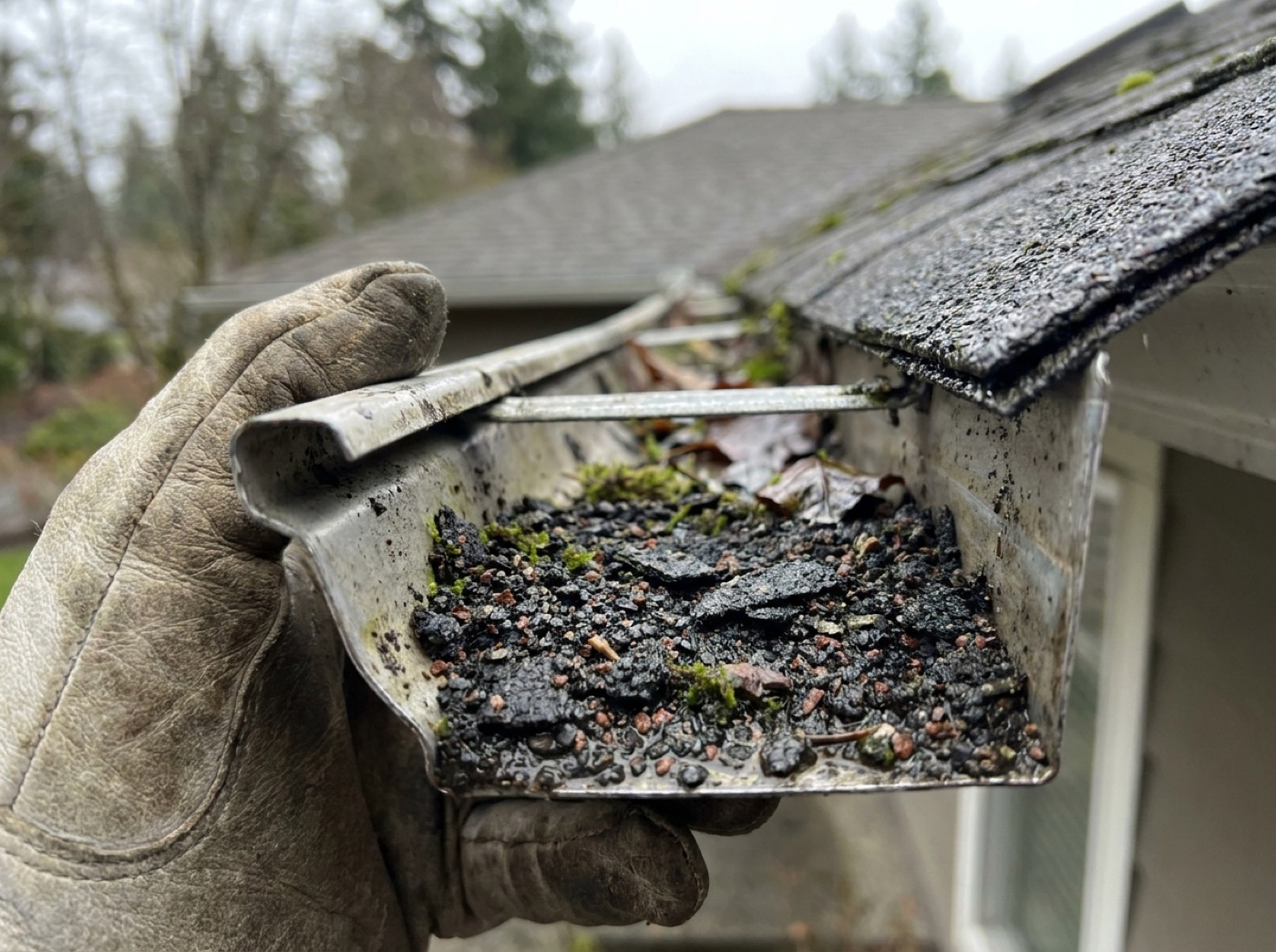
Moss also tends to concentrate where it has the best conditions to establish: heavily shaded north slopes, areas under overhanging branches that drop debris and hold humidity, and valleys or low spots where water is slower to drain. That pattern matters for the fix as much as the finding, because treating the moss without addressing the shade and moisture that let it grow usually means it comes back within a season or two.
04 / THE BONDED ONELichen: fused to the granule surface
Lichen looks similar to moss at a glance, often gray-green or crusty rather than the deeper green of moss, and it is easy to lump the two together. Biologically, lichen is a partnership between a fungus and an algae, and it grows differently than either of its neighbors: instead of a soft cushion sitting on the surface, lichen bonds tightly and flatly to the granule coating itself, more like a crust than a mat.
That bonding is the detail that matters on an inspection. Lichen does not lift a shingle edge the way moss does, so it is less directly linked to the wind and water-entry risks moss creates. But because it fuses to the granules rather than sitting on top of them, removing lichen by scraping or aggressive washing very often pulls the granule coating away with it, which trades one cosmetic problem for a bald patch that ages faster than the rest of the roof. An inspector notes lichen as a monitoring item and a reminder not to attack it with force, rather than as an active damage finding on its own.
05 / THE JUDGMENT CALLCosmetic or chronic: how an inspection tells the difference
The question that actually matters for your roof is not which organism you have, it is whether what you have is a cosmetic surface issue or a sign of chronic moisture and shading that is shortening the shingle's usable life. An inspector works through the same short list of checks on every growth finding, whether it is algae, moss, or lichen.
Location and light exposure
Growth concentrated on a shaded, north-facing slope or under a tree canopy is expected and, on its own, not alarming. The same growth pattern spread evenly across a sun-exposed south slope is a stronger signal that moisture is being trapped by something other than shade, such as poor attic ventilation pushing warm, humid air up against the underside of the deck.
Whether the shingle is still lying flat
This is the single most important check for moss specifically. If the shingle edges under and around the growth are still tight to the roof plane, the finding is largely surface-level. If tabs are visibly lifted, spongy underfoot, or show granule loss concentrated right at the moss line, the growth has moved from a cosmetic issue to an active contributor to shingle wear, and it belongs in the same conversation as the shingle-condition findings covered in our shingle inspection guide.
Roof age and how much life is left to protect
The same moss patch means something different on a 5 year old roof than it does on an 18 year old one. On a younger roof, the priority is usually stopping the moisture source, trimming back branches, improving drainage, so the growth does not shorten a roof that should have a decade or more left. On an older roof already showing granule loss or curling elsewhere, moss lifting shingle edges can be the tipping detail that moves the recommendation from repair to replacement, a distinction our signs you need an inspection guide covers from the homeowner's side.
Growth findings rarely stand alone in a report. An inspector reads them alongside granule condition, shingle flexibility, and attic-side signs of moisture, the same factors covered in our guide on how inspectors estimate remaining roof life. Black streaks on an otherwise healthy roof rarely change that estimate. Moss lifting shingles on a roof already past mid-life often does.
06 / THE UPSELL TO AVOIDWhy we do not push pressure washing
It is common in this industry to treat black streaks and moss as a cleaning problem and to sell a pressure-washing service as the fix. We are direct about why we do not lead with that. High-pressure washing can strip the granule coating right along with the algae or lichen sitting on it, and losing that coating exposes bare asphalt to UV light years ahead of schedule. It can also force water up under shingle tabs and lap joints that were never designed to take a direct pressurized spray, which creates the exact moisture-entry problem the growth itself was accused of causing.
Most shingle manufacturers are explicit about this in their warranty documentation: pressure washing a shingle roof is a common and well-documented way to void coverage outright. A soft wash with the correct low-pressure technique and an appropriate cleaning solution is a reasonable option for algae staining a homeowner wants gone for appearance's sake, but it treats the symptom, not the cause. If a roof keeps growing moss or algae season after season, the more durable fix is almost always addressing what let it establish in the first place: overhanging branches trimmed back for airflow and sunlight, gutters cleared so water is not sitting at the eaves, and attic ventilation confirmed to be moving air the way it should.
Ask what pressure they are using and whether the shingle manufacturer's warranty allows it. If the answer is vague, or the pitch is that washing alone will "fix" recurring moss, get a second opinion. An honest inspection separates a cosmetic cleaning job from an actual shingle-condition finding, and treats them differently.
07 / THE NEXT STEPWhat a growth finding becomes after the inspection
Because our roof inspections are free with no obligation, there is no cost pressure pushing a finding one direction or the other. If what is on your roof is algae staining on an otherwise sound shingle field, we tell you exactly that, note it in the photos, and move on to the rest of the checklist. If moss has lifted shingles or the pattern points to a chronic moisture source, we document where and how badly, and the conversation shifts to whether the fix is a targeted repair, addressed in our roof repair guide, or a sign the roof's remaining life is shorter than its age alone suggests.
Either way, you get photographs of what we actually found, not a sales pitch dressed as a diagnosis. If you want a ballpark on what a repair or a full replacement runs before anyone sets foot on your roof, the 60-second cost calculator uses the same published ranges on our pricing page, and you can book the free inspection itself from the estimator whenever you are ready.
- Black streaks are usually algae (gloeocapsa magma) feeding on limestone filler; mostly cosmetic, though heavy staining can mask other findings.
- Moss is the growth that actually causes damage: it holds moisture against the shingle and deck and can physically lift shingle edges, worse in Michigan's freeze-thaw winters.
- Lichen bonds directly to the granule coating rather than lifting the shingle; scraping or aggressive washing often pulls granules away with it.
- The key inspection question is location, exposure, and whether the shingle is still lying flat, not just whether growth is present.
- Pressure washing can void a shingle manufacturer's warranty and strip granules; a free inspection tells you whether your roof needs cleaning, repair, or nothing at all.
Questions we hear most
Not by themselves. Black streaking is most often algae staining, which is a cosmetic issue on an otherwise sound roof rather than a structural or leak risk. It is still worth having inspected, since heavy staining can make other findings, like granule loss or curling, harder to spot underneath it. Our inspections are free and note the difference clearly.
We generally advise against high-pressure washing a shingle roof, because it can strip granules and is a common way to void a shingle manufacturer's warranty outright. A soft, low-pressure wash can be a reasonable cosmetic option for algae staining, but it does not address why moss or algae keeps coming back, which is usually shade, moisture, or debris that a repair or a bit of tree trimming can fix.
Moss can cause real damage. It holds moisture against the shingle and deck longer than a bare surface, and in Macomb County's freeze-thaw winters that trapped water can work shingle edges loose over time. Whether your moss is a cosmetic patch or an active problem depends on whether the shingles underneath are still lying flat, which is exactly what a free inspection checks.
- Manufacturer technical and warranty literature for the major asphalt shingle lines: GAF (gaf.com), Owens Corning (owenscorning.com), and CertainTeed (certainteed.com).
- National Roofing Contractors Association, technical guidance for steep-slope roof systems. nrca.net
- Asphalt Roofing Manufacturers Association, industry technical bulletins. asphaltroofing.org