
JUMP TO A SECTION
Most nail heads on a finished roof are invisible on purpose, tucked under the shingle course above so weather never touches them directly. When a nail head is sitting out in the open instead, on a ridge cap, along a rake edge, or scattered through the field of a slope, that is either a detail the manufacturer specifically designed to be exposed and sealed, or it is a nail that missed its mark during installation. Telling those two apart, and understanding what happens to the second kind over a few Michigan winters, is the whole point of this guide.
01 / THE SHORT ANSWERWhat exposed nails mean, and what fixing them costs
An exposed nail head is not automatically a problem. Some fastening details are built to sit in the open, always paired with a sealant or a washer that is meant to take the weather. The problem is the nail head that was never supposed to show, driven too high on the shingle, into a spot with no solid framing underneath, or through a course that should have covered it. That kind of exposed nail is a slow leak on a timer, and it is a common, inexpensive fix inside our published repair range of $350 to $3,200. A handful of misplaced nails on one slope is typically one of the least expensive jobs in that range; the price only climbs if the water has already reached the deck underneath.
covers exposed and misplaced nail repairs alongside our other common roof fixes. An isolated cluster of bad nails is usually a small job inside that range. Get a written price with a free inspection, no obligation.
02 / THE LEGITIMATE KINDWhere exposed nails actually belong
A handful of details on a roof are designed with a fastener head in the open air, and none of them are accidents. Ridge and hip cap shingles are one example: the cap pieces are lapped and nailed high enough on each piece that the head sits inside the reveal, and on many systems the final cap at the end of a run is hand-sealed rather than nailed at all. Certain flashing pieces, drip edge clips, and some vent or pipe boot collars are fastened with a screw or ring-shank nail paired with a rubber washer, built to be weathered on purpose.
What separates a legitimate exposed fastener from a defect is that it was engineered to be there. The head sits inside a manufacturer's sealed reveal, or it is paired with a washer and sealant applied at the factory or by a careful installer, and it holds up for the life of the material around it. That is a different animal from a nail that is simply naked in the middle of a shingle where no course ever covers it.
03 / THE PROBLEM KINDShiners and face-nails: the exposed nails that should not be there
Two installation mistakes account for most of the exposed nails we get called out to fix. The first is a "shiner," attic slang for a nail driven at the correct height but missing the rafter or truss chord underneath, so it only bites into the roof deck sheathing and often backs partway out under its own tension. The name comes from what it looks like from inside the attic: a bright metal point catching a flashlight instead of being buried in wood. The second is a face-nail, a nail driven too low on the shingle so the head lands in the weather-exposed "butt" portion of the course below, in the open, instead of the hidden nailing zone under the next course up.
Both usually trace back to the same handful of causes: a nail gun set to the wrong depth or pressure, a crew working fast across a cut-up roof where the nailing line is harder to hold consistently, hand-nailing that drifts off the marked line near a valley or hip, or a batch of shingles installed slightly out of alignment so the nailing zone printed on the shingle no longer matches where the course above actually lands. None of it is visible from the ground on the day the roof is finished, which is exactly why it tends to surface as a leak instead of a callback.
04 / THE FAILURE PATHHow one exposed nail turns into a leak
An exposed nail head does not fail all at once. Galvanizing on the head wears fastest at the point of direct sun and rain exposure, and once that coating is gone the bare steel starts a rust ring that slowly grows around the shank. Michigan's freeze-thaw cycle accelerates the next stage: water that sits against the head freezes and expands, working the nail a fraction looser each winter, and the hole around the shank slowly enlarges instead of staying tight.
A loosened, rusting nail does two things at once. It tents the shingle immediately around it just enough to catch wind, which is how a single bad nail becomes a lifted or torn shingle a season or two later. And it gives water a straight path down the shank itself, through the enlarged hole, into the decking below, where it can travel along the wood grain and show up on a ceiling well away from the actual nail. That combination, wind vulnerability plus a direct water channel, is why a problem this small is worth fixing before it is doing visible damage.
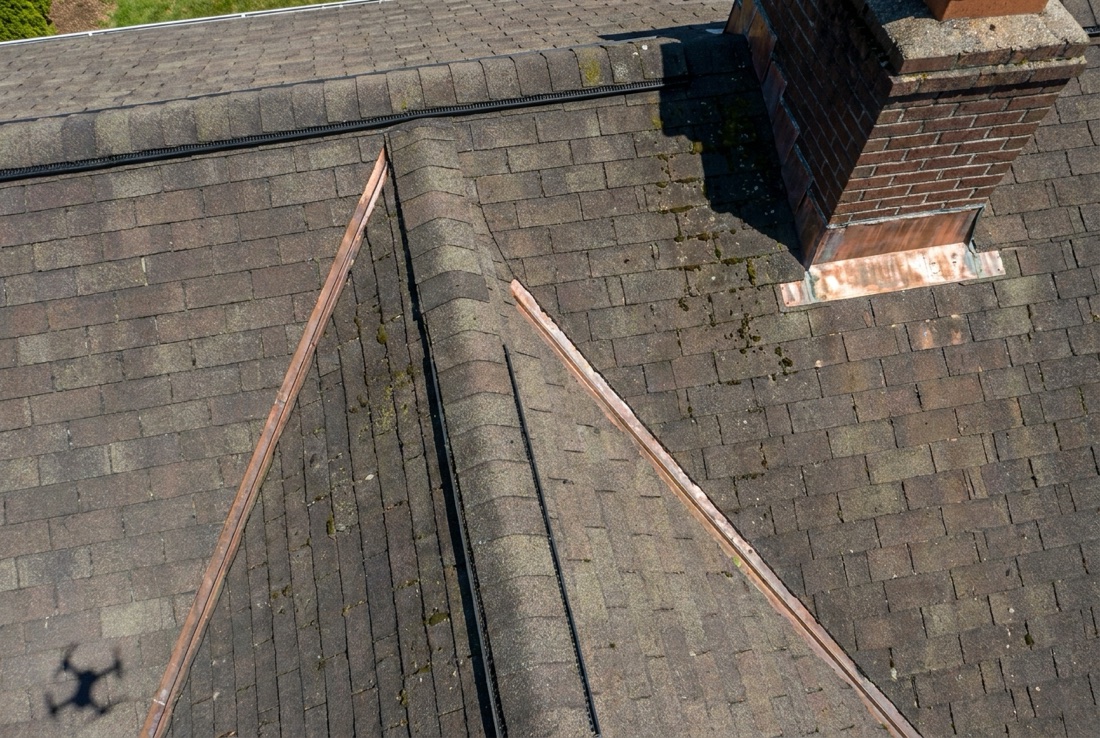
05 / THE DIAGNOSTICSpotting exposed nails without getting on a ladder
You do not need to climb a roof to get a reasonable first read. Zoom in with a phone camera or a pair of binoculars from the driveway or the yard, and look along the ridge and rake edges for small bright or rust-ringed dots that break the pattern of the shingle color. A pair of binoculars pointed at one slope at a time in good daylight will usually show a face-nail as a small dark or rust-colored fleck sitting where the shingle color should be uniform.
- Rust-colored specks or tiny raised bumps scattered through an otherwise flat field of shingles, especially near a ridge, hip, or rake edge
- Fine metallic granules or small rust flecks collecting in the gutter below a specific section of roof
- A ceiling stain that traces back to a straight line rather than a random spot, which can point to a row of nails along one course
- Shingles that look slightly cupped or raised in a short run, a sign a nail underneath is tenting the material
None of that replaces an actual inspection. A ladder-free look is a reasonable way to decide whether to call someone, not a way to diagnose the roof yourself, since a shiner missing the framing entirely is invisible from the ground and often only confirmed from the attic side of the deck.
06 / THE SHORTCUT THAT FAILSWhy a dab of sealant over a bad nail does not hold
The fastest fix anyone can apply to an exposed nail head is a small dot of roofing cement or caulk pressed over it, and it is genuinely one of the most common patch jobs we see on older Macomb County roofs. It also tends to fail within a season or two, for a predictable reason: the sealant bonds to the surface of the nail head and the shingle around it, but it does nothing about the loose fit between the shank and the hole it sits in. The nail keeps working with every freeze-thaw cycle underneath a sealant cap that was never asked to hold anything structural.
A dab of caulk over a bad nail treats the symptom you can see and ignores the loose hole you cannot. The water finds the gap at the edge of the sealant the same way it found the gap at the edge of the nail.
Sealant also ages faster than the roof around it. Sun and Michigan's temperature swings dry out a small surface patch of caulk well before the shingles it is stuck to are due for replacement, and once it cracks at the edge, the seal it briefly provided is gone while the underlying nail is often looser than it was before anyone touched it.
07 / THE REAL FIXThe correct repair sequence, and the price
A repair that actually holds starts by pulling the bad nail rather than sealing over it. From there the fix depends on why the original nail failed: a shiner that missed the framing gets pulled and replaced with a properly placed nail driven into solid rafter or truss chord nearby, in the correct nailing zone; a face-nail driven too low gets pulled, and the vacated hole and the shingle around it get sealed and the course re-lapped so the replacement fastener lands where the design intended, hidden under the next course up.
Where a specific job lands in that range depends mostly on how many nails are involved and whether water has already reached the deck. A cluster of a few misplaced nails on one slope, caught before any leak shows inside, is a quick, inexpensive visit. The price moves up once the repair has to include replacing wet or delaminated decking under the affected area, which our roof repair services page covers as part of the full repair lineup, and the same pattern of loosening fasteners shows up in a related way in our guide to nail pops on a roof, where the nail backs out rather than simply sitting exposed.
If you are not sure whether what you are seeing is a legitimate sealed detail or a defect, the honest answer requires eyes on the roof, and often the attic side of the deck as well. Our inspection is $0 with no obligation, and if the fix is a small nail repair rather than anything bigger, that is exactly what we will tell you. Our broader guide to signs of a bad roof repair covers other shortcuts worth watching for, and our roof sealant guide goes deeper on where sealant is the right tool and where it is a stall tactic. For a ballpark before anyone visits, the cost calculator runs the published ranges against your roof, or start the instant estimator and pick repair as the job type.
- Some exposed nail heads are a designed, sealed detail (ridge caps, certain flashing fasteners); shiners and face-nails are installation defects that should never be in the open.
- A shiner misses the rafter and only bites the deck; a face-nail lands in the exposed part of the shingle instead of the hidden nailing zone under the next course.
- Exposed nails rust, loosen with Michigan's freeze-thaw cycle, and channel water straight down the shank into the deck while tenting the shingle into a wind risk.
- A dot of caulk over a bad nail head treats the surface, not the loose hole underneath, and typically fails within a season or two.
- The correct fix pulls the bad nail, relocates it to solid framing in the proper nailing zone, and reseals and re-laps the shingle; isolated jobs sit at the low end of our $350 to $3,200 repair range.
Questions we hear most
Yes, in a few specific places. Ridge and hip caps, some flashing pieces, and certain washered fasteners are designed to sit in the open and are sealed or gasketed on purpose. A nail head scattered through the middle of a plain shingle course is a different situation and usually means an installation defect, not a design feature.
A shiner is a nail that missed the rafter or truss chord underneath the deck, so it only bites into the sheathing and often backs partway out. It gets its name from how it looks in a flashlight beam from inside the attic. Shiners loosen faster than properly placed nails and are a common source of small leaks.
You can, and it may hold for a season, but it is rarely a lasting fix. Sealant bonds to the surface of the nail and shingle, not the loose hole where the shank sits, so the nail keeps working underneath it, and the caulk itself dries and cracks well before the surrounding shingles are due for attention. A proper repair pulls the nail and relocates it rather than sealing over it.
- Michigan Residential Code 2015, section R905.2 Asphalt Shingles: fastening, slope, and underlayment application requirements. up.codes: MRC chapter 9
- Manufacturer technical and warranty literature for the major asphalt shingle lines: GAF (gaf.com), Owens Corning (owenscorning.com), and CertainTeed (certainteed.com).
- Asphalt Roofing Manufacturers Association, industry technical bulletins. asphaltroofing.org