
JUMP TO A SECTION
Somewhere between the adjuster's visit and the first check, a document lands in your inbox: ten or twenty pages of codes, quantities, unit prices, and columns with three-letter headings. Most homeowners skim to the number on the last page, react to it, and file the rest unread. That is a mistake, because the last-page number is only the output. The pages before it are the reasoning, and the reasoning is where claims are underpaid, corrected, and supplemented. A full asphalt replacement in Macomb County runs $9,000 to $18,000 installed, with most homes landing at $12,000 to $16,000, so a scope error of a few line items is real money. You do not need to become an estimator to protect yourself. You need to know what each part of the document claims to be true about your roof, and how to check it. That is what this guide teaches, with the standing caveat that every carrier's paperwork differs in layout, every policy differs in terms, and nothing here is legal or insurance advice.
01 / THE DOCUMENTWhat the adjuster's estimate actually is
The estimate is the carrier's written position on two questions: what work the covered damage requires, and what that work costs. It is usually produced in estimating software, most commonly the Xactimate platform, which builds the total from a regional price list and a database of line-item codes. We unpack the software itself in our Xactimate guide; for reading purposes, what matters is that every number on the page is the product of a quantity, a unit price, and a scope decision, and each of those three can be right or wrong independently.
Most estimates share the same skeleton regardless of carrier. A header block identifies the claim number, the date of loss, and the adjuster. A sketch or diagram section shows the roof as measured, often from aerial imagery, with areas and pitches noted. The body lists the line items, grouped by area of the property. And a summary page rolls everything up: the replacement cost total, the depreciation taken out, the actual cash value, your deductible, and the net payment. Reading it in that order, rather than jumping to the end, tells you what the carrier believes about your roof before it tells you what they will pay.
The adjuster's estimate is a scope of work with prices attached. If the scope is incomplete, every number downstream of it is wrong, no matter how accurate the unit prices are.
One reframe makes the whole document less intimidating: the estimate is a first draft, not a verdict. Carriers revise estimates routinely when documentation supports a change, through supplements, corrected measurements, and reinspections. Treating the document as the opening entry in a paper conversation, rather than a final ruling, is both more accurate and more useful.
02 / THE LINE ITEMSLine items and quantities: the scope in code
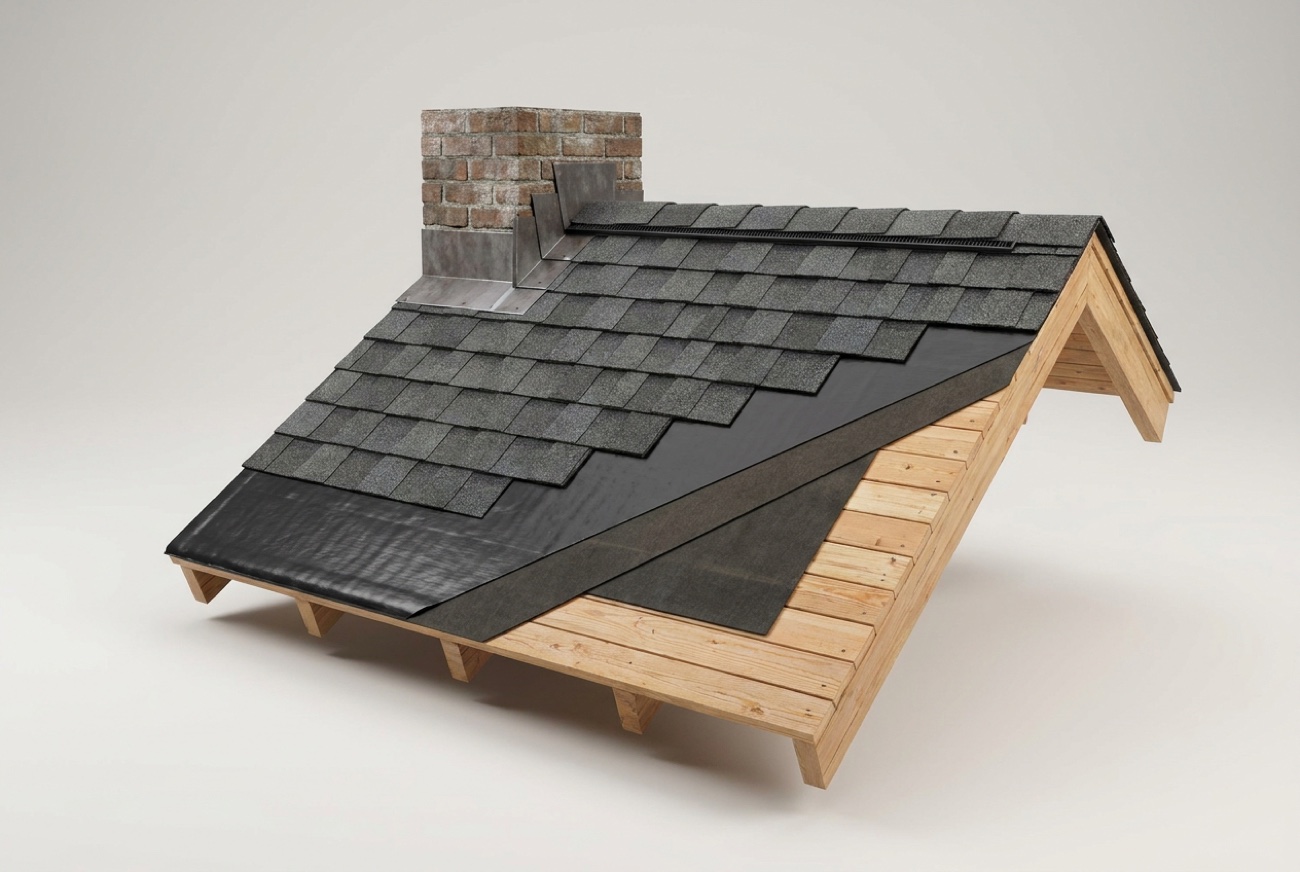
The body of the estimate is a list of operations, each with a description, a quantity, a unit, a unit price, and a line total. A roof section might include tear-off of the existing shingles, the replacement shingles themselves, felt or synthetic underlayment, ice and water barrier at the eaves, drip edge, starter course, ridge cap, flashing details, vents, and debris disposal. Each line is a claim that this operation, in this amount, is what restoring your roof requires.
The sketch page: check the roof they measured
Before the line items, most estimates include a diagram of the roof with each plane labeled, its area noted, and its pitch recorded. Give this page thirty seconds, because it is the foundation everything else stands on. Aerial measurement is good, but it is not infallible: a rear addition, an attached porch roof, a detached garage covered under the same policy, or a steep section read as a shallower pitch can all drop out of the sketch, and anything missing from the sketch is missing from every quantity that follows. If the drawing does not look like your house, say so early and in writing.
Squares, and why the quantity column matters
Roofing quantities are stated in squares, one square being 100 square feet of roof surface. A typical single family roof might run 20 to 35 squares depending on the footprint and pitch. Check the estimate's total squares against your contractor's measurement, because everything scales from it: shingles, underlayment, tear-off, and disposal all key off the same area. A measurement that is two squares light quietly shrinks half the lines on the page. Aerial measurement reports are usually close, but complex rooflines, overhangs, and steep sections are where the discrepancies tend to live.
Waste factor
Shingles are cut at hips, valleys, edges, and penetrations, and the offcuts are waste that still had to be purchased. Estimates account for this with a waste percentage added to the field area. A simple gable roof needs less waste than a cut-up roof with multiple valleys and dormers, so a low waste factor on a complex roof is a common and legitimate point of correction. If your roof has hips and valleys everywhere and the estimate carries a minimal waste factor, that is worth flagging.
Unit prices and the price list
Each unit price comes from a regional price list updated on a cycle. Prices can lag a fast-moving market, and a contractor's real-world number can differ from the list. Arguing individual unit prices is usually the least productive route; documenting scope that is missing entirely is far more productive, which is why the checklist in section 05 matters more than any single rate.
03 / THE MONEY COLUMNSRCV, ACV, and the depreciation between them
To the right of the line items sit the columns that turn a scope into a settlement. The three headings that matter are RCV, depreciation, and ACV, and the relationship between them is one subtraction. RCV, replacement cost value, is what the work costs new at the estimate's prices. Depreciation is the deduction for the age and condition of what was damaged, typically calculated against the material's expected service life. ACV, actual cash value, is what remains: RCV minus depreciation. How carriers build that deduction, and what a fifteen-year-old shingle field does to it, is the full subject of our roof depreciation guide.
| COLUMN | WHAT IT MEANS ON YOUR ESTIMATE |
|---|---|
| RCV | The cost to do the work new, at the estimate's quantities and unit prices. |
| DEPRECIATION | The age and condition deduction, usually keyed to expected service life. |
| ACV | RCV minus depreciation; commonly the basis of the first check. |
Whether the depreciation ever comes back to you depends on your policy, not on the estimate. Under a typical replacement cost policy, depreciation is recoverable: the carrier holds it back until the work is complete and releases it when the final invoice is submitted, subject to the policy's conditions and deadlines. Under an actual cash value policy or an ACV roof endorsement, the depreciation is non-recoverable: the ACV figure is the settlement, full stop. The estimate usually notes which kind you are looking at, often marking non-recoverable amounts separately, but your declarations page is the document that decides it. If the depreciation number on your estimate is large and marked non-recoverable, that is a policy conversation, not an estimate error.
One more column note: sales tax and permit costs may appear as their own lines or be folded into others, and overhead and profit may or may not appear depending on the job's complexity and the carrier's position. If a general contractor style coordination fee is absent on a multi-trade loss, that is a known area of industry dispute, and it is worth a documented question rather than an assumption in either direction.
04 / THE NET CLAIMThe math at the bottom of the last page
The summary page runs one arithmetic sequence, and once you can follow it, no settlement letter will confuse you again. Start with the RCV total for the covered scope. Subtract depreciation to get ACV. Subtract your deductible. What remains is the net first payment. Here is the shape of it on a worked hypothetical, using a replacement in the middle of the local range.
Every figure above is an illustration, not a quote and not a promise of how any claim settles; your roof, policy, and adjuster produce your own numbers. But the structure is nearly universal. The first check is commonly the ACV figure minus the deductible. The held-back depreciation, when the policy makes it recoverable, is released after completion paperwork. And the deductible is never mailed to anyone; it is simply the share of the loss the policy assigns to you, which is why the checks add up to less than the RCV total.
Two readings of the same page trip people up. First, a small first check does not necessarily mean a denied or hopeless claim; it can mean heavy depreciation on an older roof with the balance recoverable after the work. Second, an RCV total that looks close to a contractor's quote can still be thousands short once you notice the depreciation is marked non-recoverable. Read the columns, not just the totals. If the gap between the carrier's number and your contractor's number is the problem, our guide on what to do when the contractor estimate is higher walks the resolution paths in order.
A practical note about the checks themselves. If you carry a mortgage, claim payments above your servicer's threshold are commonly made out jointly to you and the lender, which adds an endorsement step before the funds move. That is normal loss-payee procedure, not a problem with the claim, but it does add days or weeks, so it belongs in your timeline. Keep the estimate, every revision of it, every check stub, and every piece of completion paperwork in one folder; the release of recoverable depreciation is a paperwork event, and homeowners who can produce the final invoice and completion certificate on request get to the second check with far less friction.
The last page of the estimate is arithmetic. The pages before it are judgment. Homeowners argue with the arithmetic; the money is almost always in the judgment.
05 / THE GAPSWhere missing scope usually hides
First estimates are written quickly, often from aerial measurements and a brief site visit, and certain items go missing far more often than others. Missing scope is not an accusation of bad faith; it is the predictable result of estimating a roof before it is opened up. It is also the single most common reason a carrier's total and a contractor's total disagree. Compare your estimate against this short list, and see our full missing line items checklist for the complete version with the reasoning behind each item.
- Ice and water barrier. Michigan's climate makes an eave membrane a standard part of a code-compliant reroof, and it is a separate material with a separate line.
- Drip edge, starter course, and ridge cap. Each is its own material and labor; estimates sometimes fold them into the field shingle line or omit them.
- Decking replacement. Nobody can see the deck until tear-off, so a per-sheet allowance or a supplement path should exist for it.
- Ventilation components. Ridge vents, box vents, and intake are part of the system being replaced, not extras.
- Flashing details. Step flashing, chimney flashing, and pipe boots are hand work that a quick scope can undercount.
- Steep, high, or access charges. A roof the crew cannot walk changes labor cost, and the estimate has specific charges for it.
- Debris disposal and haul-off. Several tons of old shingles do not remove themselves.
When an item is genuinely missing, the correction mechanism is a documented supplement: photos, measurements, and an itemized request submitted to the carrier for review. Carriers evaluate supplements on their documentation, and approval is never automatic, but a complete reroof scope in Michigan has a recognizable shape, and a request that shows exactly what is absent tends to get a serious read. This is also where a contractor who documents thoroughly earns their keep during the build, because tear-off discoveries only turn into paid scope when someone photographs them and writes them up.
06 / THE NEXT MOVEWhat to do with what you find
Reading the estimate produces one of three situations, and each has a calm next move. If the scope matches what your roof needs and the math checks out, proceed: schedule the work, keep every invoice, and follow the completion paperwork so any recoverable depreciation is released. If the scope is close but missing items, get a line-by-line comparison from your contractor and submit a supplement with documentation. If the gap is fundamental, a disagreement about what was damaged or what the loss requires, the escalation ladder runs from reinspection through the formal dispute options in your policy, and our storm and insurance claims playbook maps that ladder from first photos to final invoice.
This is also the moment to sanity-check the carrier's total against published local reality. Our pricing page lists the same ranges we quote in person, asphalt replacements at $9,000 to $18,000 with repairs at $350 to $3,200, and the cost calculator runs those ranges against your roof size in about a minute. The deeper breakdown of what drives the number lives in the roof replacement cost guide. An estimate that lands far below any realistic local figure for the scope it describes is telling you something is missing, and now you know how to find out what.
Macomb County homeowners have been through this at scale before. After the severe storms of August 2023, the county was included in federal disaster declaration DR-4757, and thousands of local claims produced exactly this document, read at exactly this kitchen table. Our role in that process is documentation and craft: we photograph the damage, write an itemized scope, can meet your adjuster on site to walk the roof together, and do the covered work correctly if the claim is approved. No contractor can promise how a claim settles, and anyone who does is telling you something about themselves. What we can promise is a free, photo-documented inspection and a written scope you can lay next to the adjuster's estimate, line by line. Start from the estimator whenever you are ready, and the rest of our insurance library lives in the guides index.
- The adjuster's estimate is a scope of work with prices attached; read the line items before the last-page total, because scope errors drive everything downstream.
- Verify the total squares and the waste factor first, since every quantity on the page scales from the measurement.
- RCV minus depreciation equals ACV; whether the depreciation comes back depends on your policy, and the first check is commonly ACV minus the deductible.
- Missing scope, ice and water barrier, drip edge, decking, ventilation, flashing, steep charges, is the most common gap, and a documented supplement is the correction path.
- Against a Macomb County asphalt replacement of $9,000 to $18,000, a few missing lines are real money; a free contractor scope gives you the comparison document.
Questions we hear most
RCV, replacement cost value, is what the covered work costs new at the estimate's prices. ACV, actual cash value, is RCV minus depreciation for the roof's age and condition. Under a typical replacement cost policy the depreciation is recoverable after the work is completed and documented, while under an ACV policy or endorsement it is not. Your declarations page, not the estimate, decides which applies.
The first payment is commonly the actual cash value minus your deductible, not the full replacement cost. Depreciation is often held back and released only after the work is complete and the final invoice is submitted, subject to the policy's terms and deadlines. A small first check can still be part of a claim that ultimately funds the roof, so read the columns before drawing conclusions.
The standard correction path is a supplement: a documented request with photos, measurements, and itemized pricing for the missing scope, submitted to the carrier for review. Commonly missed items include ice and water barrier, drip edge, decking replacement, ventilation, and steep charges. Approval is never guaranteed, but well-documented requests get a serious read. We prepare that documentation as part of a free inspection and can meet your adjuster on site.
- FEMA, disaster declaration DR-4757-MI, Michigan severe storms of August 2023 (Macomb County designated). fema.gov/disaster/4757
- Insurance Information Institute, consumer explainers on homeowners policy coverage, deductibles, and the claims process. iii.org
- Michigan Department of Insurance and Financial Services (DIFS), consumer insurance resources and complaint process. michigan.gov/difs
- Michigan Residential Code 2015, section R905.1.2 Ice Barriers: membrane required from the eave edge to not less than 24 inches inside the exterior wall line. up.codes: MRC chapter 9