
JUMP TO A SECTION
Ask a Macomb County homeowner when their roof is most at risk from wind and most will say summer, picturing a fast-moving thunderstorm cell and a scramble to bring the patio furniture in. That instinct is not wrong, but it is only part of the calendar. Meteorologists who study this region generally describe damaging wind here as arriving in two different flavors: broad, sustained gradient wind events tied to strong low-pressure systems moving through in the shoulder seasons, and shorter, harder convective gusts, downbursts, and the occasional derecho riding along with summer thunderstorms. Each type stresses a roof in its own way, and knowing which one is coming changes what is worth checking afterward.
This guide walks the year in order: the spring gradient wind window, the summer thunderstorm stretch, the fall gradient wind window, and the one local event that belongs in every Macomb County conversation about wind and roofs, federal disaster declaration DR-4757 from August 2023. It closes with a simple habit worth building into every wind season: a quick roof check after any event that was named, warned, or simply loud enough to notice from inside the house. For the companion piece on reading hail risk through the same lens, see our hail season guide.
01 / THE SHORT ANSWERTwo wind seasons, not one
In broad strokes, the wind risk calendar for lower Michigan runs in three overlapping stretches. Late winter into spring brings strong area-wide low-pressure systems that generate sustained, gradient-driven wind over many hours. Summer shifts the risk to shorter, harder convective bursts tied to individual thunderstorm cells, including downbursts and occasionally a derecho track. Autumn brings a second round of the spring pattern as storm systems strengthen again with the changing season. The National Weather Service publishes the detailed seasonal climatology for southeast Michigan that this general pattern is drawn from, cited in our sources below, and it is worth reading in full if you want the underlying data rather than the summary.
Spring and fall bring long, steady wind from big weather systems. Summer brings short, hard gusts from individual storms. Both can damage a roof, and neither one should be assumed to be the only season worth watching.
02 / THE SPRING PATTERNSpring: gradient wind arrives while the roof is still winter-brittle
As winter breaks up, strong low-pressure systems track through the Great Lakes region with enough size and intensity to drive wind over a wide area for an extended stretch, sometimes the better part of a day rather than a few violent minutes. That kind of gradient wind does not need a thunderstorm to do damage. Steady pressure applied for hours can work a marginal shingle loose in a way a brief gust often cannot, especially on a roof that is already carrying winter wear.
Why a roof is at its most vulnerable right after winter
A roof coming out of a Michigan winter has usually been through repeated freeze and thaw cycles, and asphalt shingles get more brittle in cold weather, which means seal strips that would normally hold under a gust can crack or let go instead of flexing. Ice dam activity earlier in the season can also leave water sitting under shingles near the eaves, loosening the bond before spring wind ever arrives. The practical result is that the same wind speed that a roof shrugs off in August can lift shingles in March, simply because the material and the adhesive underneath are behaving differently.
Spring gradient wind events are also the kind that can arrive with less obvious warning than a summer severe thunderstorm watch. A strong low-pressure system might be forecast well in advance for rain and temperature swings, with the wind component treated as secondary in casual conversation, even though it is doing the most damage to roofs. That is one good reason to build a wind-check habit around any strong spring storm system, not just the ones the news specifically frames as a wind event.
What gradient wind actually means
The term gradient wind describes air moving in response to the pressure difference between a strong low and the higher pressure around it, rather than the localized updrafts and downdrafts that drive a thunderstorm gust. Because the pressure difference covers hundreds of miles, the resulting wind is broad and sustained rather than a brief burst, and it can keep blowing at a damaging speed for hours after the front itself has passed a given location. That duration is the whole story for a roof: a shingle that could absorb a five-second gust may still fail under the same peak speed sustained for an afternoon, simply because the sealant and fasteners are being worked continuously rather than tested once.
Homeowners sometimes assume that because a spring storm is mostly a rain event on the forecast, the wind riding along with it is an afterthought. In practice the wind component of a strong spring system is frequently the part doing the roof damage, while the rain gets the headline. Reading the full forecast discussion rather than the one-line summary, and treating any strong spring low-pressure system as a wind event worth a post-storm check, closes that gap.
03 / THE SUMMER PATTERNSummer: thunderstorm gusts, downbursts, and the occasional derecho
Summer flips the mechanism. Instead of one large system pushing wind steadily for hours, individual thunderstorm cells generate short, intense gusts, sometimes through a downburst, where a column of rain-cooled air plunges out of the storm and spreads out hard at the surface, and occasionally through a longer-track derecho that carries damaging straight-line wind across a wide swath in a single afternoon or evening. Our companion guide on straight-line wind versus tornado damage covers how to read the difference between these events and a genuine tornado track, which matters most in this exact season.
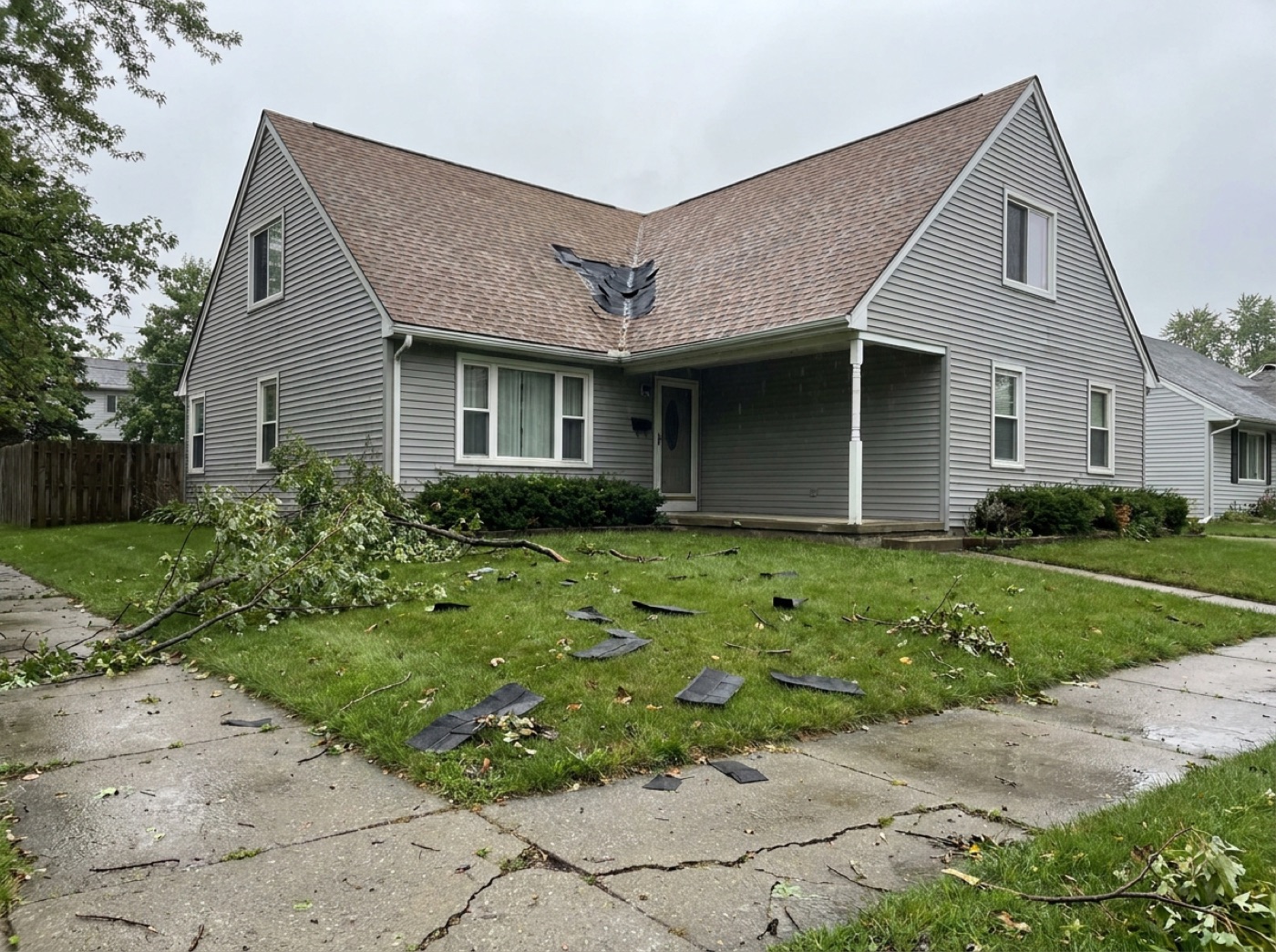
On a roof, summer convective wind tends to concentrate its worst effect on whichever slope faced the gust at the moment it hit, creasing and lifting shingles along that face while the opposite slope may show nothing at all. Because these events are short, the damage can also be easy to miss if nobody happens to be watching the roof itself during the ten or fifteen minutes the worst wind is blowing. A homeowner who was in the basement during a bad summer storm may not connect a leak that shows up weeks later back to that one specific evening. The back half of that summer window is the stretch homeowners forget entirely, and the late summer severe season is where we set down what late August has actually done to roofs in this county.
Why summer wind is harder to predict than a spring or fall system
A gradient wind system is forecast days out because it is a large, slow-moving feature that meteorologists can track on a map well before it arrives. An individual summer thunderstorm cell is a different animal: the broad watch area might be known hours ahead, but which specific neighborhood gets the strongest downburst, and at what exact wind speed, often is not knowable until the cell is already overhead. That unpredictability is exactly why a habit of checking the roof after any summer severe thunderstorm warning matters more than trying to guess in advance which storms will actually produce damaging wind and which will pass with nothing worse than heavy rain.
It also means summer wind damage tends to arrive without the days of advance notice a spring or fall system offers, so there is less opportunity to do anything preventive beforehand beyond the basics: trimming branches that hang over the roofline, securing loose gutters, and knowing where the attic access is if a fast post-storm check turns up something that needs a closer look inside.
04 / THE FALL PATTERNFall: the second gradient wind window, arriving with the leaves
As summer's thunderstorm pattern fades, the atmosphere sets up again for the kind of strong, wide-reaching low-pressure systems that dominate spring, and Michigan sees a second gradient wind window through autumn. The mechanism is the same steady, sustained wind over a broad area rather than a short convective gust, but the surrounding conditions differ in one important way: trees are still carrying a full canopy of leaves later into fall than most people expect, and a leaf-covered branch catches far more wind load than a bare one, which is part of why fall wind events bring down limbs onto roofs more often than the wind speed alone would suggest.
Gutters are also more likely to be full of leaf debris heading into a fall wind event, which matters less for the roof surface itself but can turn a routine wind day into a water problem if the gutters cannot shed the rain a storm system typically brings along with its wind. A fall roof check after a windy system is worth pairing with a gutter check for exactly this reason.
Fall wind events also arrive at a point in the calendar when a roof has had a full summer to accumulate small wear that has not yet caused a visible problem: a sealant strip that softened and shifted slightly in summer heat, a ridge cap fastener that backed out a fraction under repeated thermal cycling, granule loss from the season's UV exposure. None of those on their own is usually enough to cause a leak, but a sustained fall wind event is exactly the kind of load that can turn several small, unnoticed weaknesses into one active problem before winter sets back in. That is part of why a fall inspection, even absent any specific wind event, is a reasonable habit on its own, and why checking after any fall wind system specifically is worth doing before the first hard freeze locks any damage in place for the winter.
05 / THE LOCAL BENCHMARKDR-4757: the modern reference storm for Macomb County
Every general seasonal pattern is more useful with one concrete local example to anchor it, and Macomb County has a recent one. The severe wind storm of August 2023 led to the county's inclusion in federal disaster declaration DR-4757, and the event itself, and what it demonstrated about wind damage on local roofs, has its own full writeup in our DR-4757 guide. What matters for this seasonal picture is simpler: that storm arrived during the summer convective window this guide describes, and it is the clearest local proof that Macomb County roofs are not exempt from the wind categories covered above.
Wind damage from an event like the DR-4757 storm does not always announce itself immediately. Lifted shingles and broken seal strips can sit quietly for one or two more seasons of freeze and thaw before a leak actually shows up inside. If your roof has not had a close look since that event, or since any strong wind event, a free inspection is a fast way to know where you stand.
06 / THE HABITThe one habit worth building: check after every named or warned event
None of the seasonal detail above requires a homeowner to become an amateur meteorologist. It requires one habit: after any wind event that gets a name, a warning, or is simply loud enough to notice, walk the yard and look up. The table below matches each season's wind pattern to the first thing worth checking.
| SEASON | WIND PATTERN | CHECK FIRST |
|---|---|---|
| Spring | Sustained gradient wind from large systems | Winter-brittle shingles and eaves, especially after any ice dam activity |
| Summer | Short convective gusts, downbursts, occasional derecho | The slope that faced the gust, plus any downed limbs or debris |
| Fall | A second sustained gradient wind window | Gutters full of leaf debris and any overhanging branches |
The check itself is simple and safe to do from the ground: look for shingles that are missing, curled, or a different shade than the surrounding field, check gutters and downspouts for granule buildup or damage, and look for any new gaps around vents, flashing, or the chimney. Nothing about this requires getting on a ladder. If anything looks off, or if the wind event was strong enough that you would rather have a trained eye confirm it, that is exactly what a free inspection is for.
You do not need to know whether it was a gradient wind system or a summer downburst. You need someone who checks the roof after either one and tells you honestly what they find.
If wind has already opened the roof to the weather, that is the one scenario here that should not wait for a scheduled visit. Our 24/7 emergency tarping stops water intrusion the same day, with the permanent repair scheduled once conditions allow. Repairs from a wind event of the kind covered here typically run $350 to $3,200, and larger or complex repairs can run higher; a full replacement, when the roof is past the point a repair can reasonably fix, runs $9,000 to $18,000 for most asphalt shingle homes. Insurance coverage depends entirely on your specific policy, and every policy is different. We document what we find with photos and can meet your adjuster on site, but no contractor can promise how a carrier will decide a claim. The full playbook is in our storm and insurance claims guide, and every published range on this page is also on our honest pricing sheet. If you want a ballpark on your own roof before anyone visits, the cost calculator runs the same numbers against your roof size, and you can start a free storm damage estimate whenever you are ready.
- Southeast Michigan runs through two gradient wind windows, spring and fall, plus a separate summer thunderstorm and downburst pattern in between.
- Spring wind is riskiest because winter-brittle shingles and lingering ice dam damage meet sustained wind at the same time.
- Summer wind arrives as short, hard convective gusts, sometimes a downburst or derecho, that can crease one slope and leave the rest of the roof untouched.
- Fall brings a second gradient wind window along with leaf-loaded branches and leaf-clogged gutters.
- Macomb County's clearest local benchmark is federal disaster declaration DR-4757 from August 2023, and any roof never checked since deserves a free look.
Questions we hear most
Southeast Michigan sees damaging wind in three overlapping stretches: sustained gradient wind from large low-pressure systems in spring and again in fall, and shorter convective gusts and downbursts tied to individual thunderstorms through summer. Each pattern stresses a roof differently, so a wind check habit is worth keeping through all three, not just one season.
DR-4757 is the federal disaster declaration that included Macomb County after the severe wind storm of August 2023. It is the modern local benchmark for what a serious wind event can do to a roof here. If your roof has not had a close inspection since that storm, or since any strong wind event, a free inspection is the fastest way to know whether it took damage.
Most wind damage repairs run $350 to $3,200, covering things like lifted or missing shingles, damaged flashing, and reseating ridge caps, and larger or complex repairs can run higher. If the damage is extensive enough that a repair no longer makes sense, replacement for most asphalt shingle homes runs $9,000 to $18,000. A free inspection tells you honestly which category your roof falls into.
- FEMA, disaster declaration DR-4757-MI, Michigan severe storms of August 2023 (Macomb County designated). fema.gov/disaster/4757
- National Weather Service, Detroit/Pontiac forecast office: southeast Michigan forecasts, warnings, and event records. weather.gov/dtx
- Manufacturer technical and warranty literature for the major asphalt shingle lines: GAF (gaf.com), Owens Corning (owenscorning.com), and CertainTeed (certainteed.com).