
JUMP TO A SECTION
Ask around Macomb County long enough and someone will mention DR-4757, usually with a little uncertainty about what it actually means. It is a real federal record: a major disaster declaration issued after severe wind storms hit Michigan in August 2023, with Macomb County among the designated counties. That is the one fact on this page you should take as settled, and everything else follows from it. We are not going to guess at wind speeds, exact dates, or damage totals that belong in an official record rather than a contractor's memory. Instead, this guide points you to where those specifics actually live, walks through what a declaration like DR-4757 is and is not, and spends most of its time on the part that still matters on your roof today: what that kind of wind event does to a shingle system, and how to tell whether yours took a hit. The claim process itself, including how insurance and any federal backstop interact, is a separate conversation we cover in full in our storm and insurance claims guide. This page stops before that and stays on the event and the roof.
01 / THE SHORT ANSWERDR-4757 in three sentences
FEMA DR-4757 is the disaster declaration number assigned to the August 2023 severe storms in Michigan, and Macomb County was one of the counties designated within it. A declaration of that kind is issued only after local and state officials document damage severe enough to justify a federal response, so its existence is itself a signal that the event was significant, not routine summer weather. For a homeowner, the declaration is context and a documented date to point to, not a payment, a guarantee, or a substitute for your own insurance policy.
This is the storm record and what it showed on roofs, told straight, with specifics traced to the actual FEMA and NWS records rather than invented. It is not a claims walkthrough. If you already know you have damage and want the insurance playbook, notice, adjusters, documentation, that lives on our storm and insurance claims page.
02 / THE RECORDWhat the declaration actually documents
A federal major disaster declaration is not issued lightly. It follows a preliminary damage assessment by local and state agencies, a governor's formal request, and a presidential decision, and FEMA catalogs the result with a number, in this case DR-4757. The declaration record specifies an incident period, the counties designated within it, and the assistance categories it opens, and Macomb County appears among the designated areas for the August 2023 event. Those exact details, the incident period dates, the full list of designated counties, and the assistance types made available, are published on FEMA's own declaration page, and that is the source to read rather than a paraphrase, because declaration language is precise and changes what it authorizes from one disaster to the next.
The storm itself is a separate record from the declaration. Severe wind events of the kind that trigger a declaration are typically documented by the National Weather Service through storm surveys or event summaries that describe what moved through the region, the general character of the wind, and the areas most affected. We are intentionally not inventing a wind speed or a minute-by-minute timeline here. If you want the meteorological detail, the sourced NWS event summary for the August 2023 southeast Michigan wind event, cited below, is the place to get it, and it is a better source than any secondhand account, including ours.
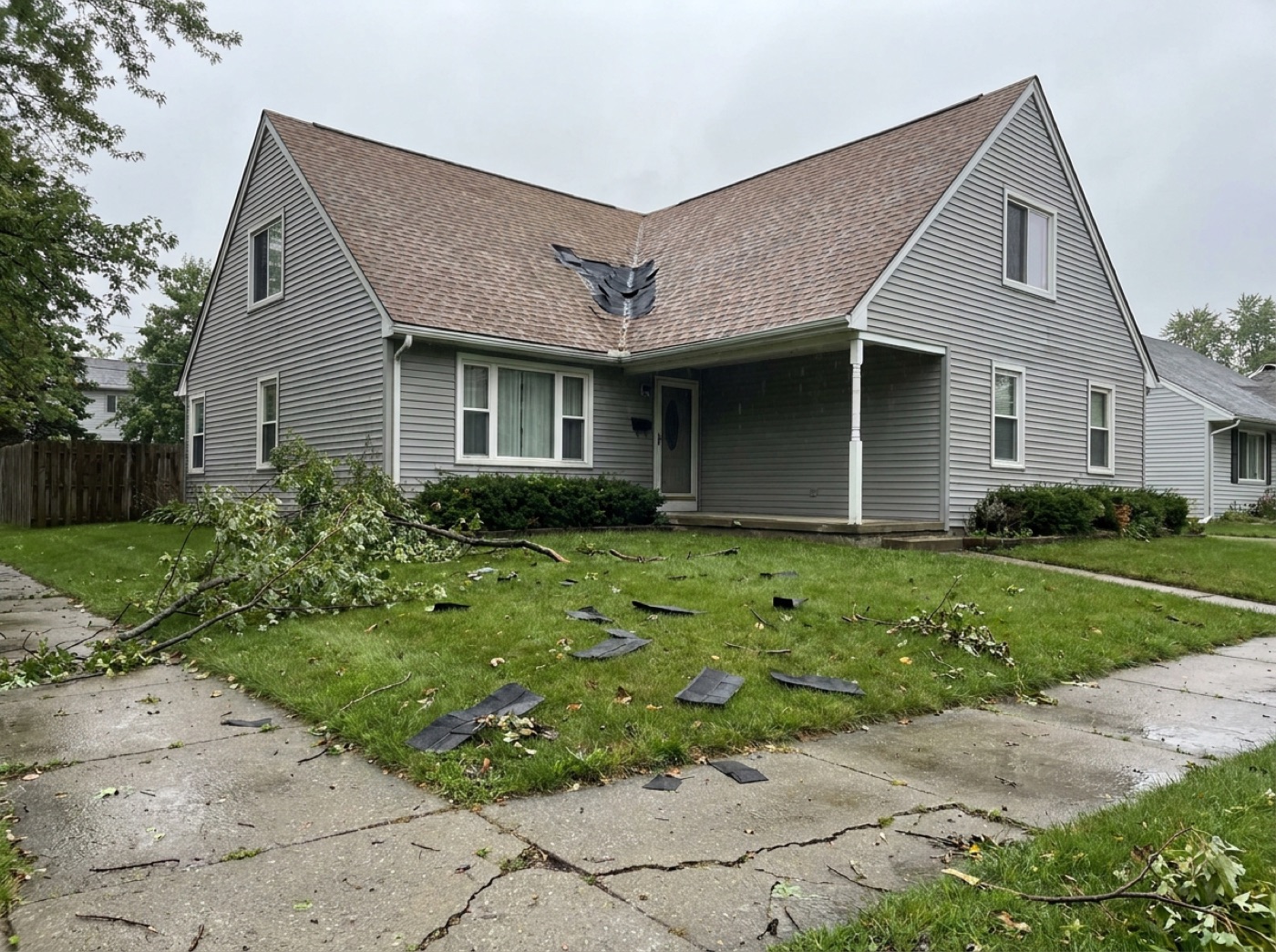
Why does the distinction between the declaration and the storm record matter to a homeowner? Because the declaration tells you the event was officially serious enough to warrant a federal response, which is useful context when you are deciding whether a roof problem you are seeing now is worth a closer look. But the declaration alone cannot tell you what happened on your specific street, on your specific roof. For that, the actual weather record and, more usefully, your own roof are the sources that matter.
It is also worth understanding why a wind event has to clear a fairly high bar before it produces a federal declaration at all. Most summer thunderstorm wind gusts in southeast Michigan, even the ones that peel a few shingles off a marginal roof, never rise anywhere near that threshold; they are handled entirely at the homeowner and insurer level, as they should be. A declaration means the damage assessment process found losses widespread and severe enough, across enough of the county, that state resources alone were not expected to be sufficient. That is a meaningfully different category of event than an ordinary seasonal storm, which is part of why DR-4757 still gets referenced years later instead of fading into the general background of Michigan weather.
03 / THE MECHANICSHow wind like this attacks a roof
Wind does not damage a roof the way most people picture it. It rarely rips shingles off in dramatic sheets, at least not everywhere. More often, a strong gust gets underneath the leading edge of a shingle, usually where the factory seal strip has not fully bonded or has aged, and it flexes the shingle upward. One flex might do nothing visible. Repeated flexing over a sustained wind event fatigues the asphalt mat, cracks the seal, and can crease or curl the shingle permanently, even if it never actually blows off. That is why a roof can look intact from the ground the day after a wind event and still have taken real damage: the failure is in the seal and the mat, not in a missing shingle you could spot from the driveway.
The specific mechanics differ depending on whether the wind was a sustained straight-line event or something more rotational, and the difference matters enough that we wrote a dedicated comparison in our guide on straight-line winds versus tornado roof damage. In general terms, sustained straight-line wind tends to produce a more uniform pattern across a roof face, uplift concentrated at edges, ridges, and any loose course, while more rotational or gust-front wind can produce scattered, patchy damage that looks almost random from house to house. Either way, the roof's actual wind rating matters: our guide on what wind speed damages a roof breaks down how shingle wind ratings work and why two roofs a block apart can respond very differently to the same gust.
Age and installation quality change the equation as much as the wind itself does. A shingle installed with a full, properly bonded seal strip on a roof under roughly ten years old resists uplift far better than an older roof where sun and freeze-thaw cycles have already dried and cracked the sealant. That is part of why a single wind event produces such uneven results across a neighborhood: it is not just about which roofs got hit hardest, it is about which roofs were already weaker going in.
Wind also rarely acts alone. A strong summer wind event is often paired with heavy rain, and sometimes with hail or airborne debris, and each of those adds its own damage on top of what the wind did by itself. A shingle already flexed loose by wind is far more vulnerable to a branch strike or a hail stone than one that is still fully sealed, and rain driven sideways by strong gusts can find its way under a shingle edge that would otherwise have shed water fine. Granule loss is a related side effect worth watching for on its own: even where a shingle never lifts or cracks, the friction of flexing under sustained wind can strip surface granules, and a shingle missing enough of its granule coat ages faster afterward regardless of what caused the initial wear. None of that shows up as a single dramatic failure. It shows up as a roof that simply does not last as long as it should have, which is exactly why an inspection after a severe event is worth doing even when nothing looks obviously wrong.
04 / THE PATTERNWhat the August 2023 event demonstrated locally
Setting aside any specific damage count, which we are not going to invent, the general pattern that a severe, declaration-triggering wind event demonstrates is a consistent one across Macomb County roofs: uneven damage that does not respect property lines. Two houses on the same block, built the same year, can come through a wind event in very different shape depending on roof orientation relative to the wind, how well the original installation sealed, whether trees or debris added impact damage on top of the wind itself, and simple luck in where a gust concentrated. That is the honest reason a homeowner should not assume their roof is fine just because the house next door clearly took visible damage, or assume the opposite either. Our guide on signs of wind damage on a roof walks through the specific visual and physical cues worth checking for, whether the trigger was this event or any future one.
The other pattern worth understanding is timing. Wind damage from a severe event is not always a same-day discovery. A broken seal strip that does not fully release the shingle can sit invisible for months or years, holding until a subsequent storm, a freeze-thaw cycle, or simple aging finishes the job and the shingle finally lifts or the leak finally shows. That delayed-discovery pattern is one reason a documented severe wind event like the one behind DR-4757 stays relevant years later: it gives a homeowner finding new damage today a real, dated event to consider as a possible origin, evaluated against the roof's actual condition rather than assumed.
A federal disaster declaration tells you the storm was real. It does not tell you what your roof did in it. Only an inspection tells you that.
05 / YOUR ROOFChecking your own roof for wind damage
You can do a first pass safely from the ground, and it is worth doing after any severe wind event, whether it happened in 2023 or last week. Walk the perimeter of the house and look up at each roof face in good light: watch for shingles that look lifted, curled, or a different shade than the surrounding field, since a shingle that has lost its granules or its seal often looks lighter or duller than the shingles around it. Check the gutters and the ground below the eaves for a scatter of granules, which is a sign of accelerated wear even without a visibly missing shingle. Look at ridge caps and any valley for anything that appears displaced. None of this replaces a real inspection, and none of it should involve getting on a ladder or the roof itself.
Inside the house, an attic check with a flashlight is the other half of the picture, since wind-driven water often shows up as a stain on the underside of the deck or on a rafter long before it reaches a ceiling below. Look for new water staining, damp insulation, or daylight coming through anywhere it should not. If you find anything concerning in either pass, or simply have not had the roof looked at since 2023, a professional inspection covers the shingle field, the flashing, the ventilation, and the attic side of the deck with photos of everything found, and ours is $0 with no obligation. If water is actively coming through right now, that changes the priority: we offer 24/7 emergency tarping to stop the damage from spreading while the rest of the plan comes together.
Whatever you find during your own ground and attic pass, photograph it, with a date, even if you are not yet sure it means anything. A phone photo of a lifted shingle or a gutter full of granules taken today costs nothing and may be useful later, whether that turns out to be for your own comparison over time or as a starting point for a professional inspection. That habit matters more after a severe, dated event like this one, because the more time that passes, the harder it becomes to tell whether a given patch of wear traces back to the storm or simply to ordinary aging in the years since.
Severe wind events and federal disaster declarations attract a predictable second wave: contractors who lead with the FEMA name, claim the declaration means a free roof, and push a signature before anyone from your own insurance company has looked at the roof. A declaration guarantees nobody a roof. Take your own photos, verify any contractor's Michigan license, and get a local inspection before signing anything.
06 / NEXT STEPSWhere this leads: identification, then the claim, then the number
This page has stayed deliberately on the event and the roof, not the paperwork, because that is the piece most homeowners actually need clarified first. If your inspection turns up damage that looks storm-related, the next step is the claim itself, and our full storm and insurance claims guide walks through documentation, notifying your insurer, meeting an adjuster, and what a contractor can and cannot honestly promise about a claim outcome. Our Michigan wind storm season guide is also worth a read if you want the broader seasonal pattern behind events like this one, so you know when to be watching most closely going forward.
And whether the answer turns out to be repair or replacement, the cost picture stays the same regardless of the cause. Wind damage caught early is usually a repair, and roof repairs in Macomb County run $350 to $3,200, with larger or more complex repairs able to run higher. Damage that went unnoticed for a while, or a roof that was already near the end of its life when the wind hit, can point to replacement instead, and a full asphalt shingle replacement here runs $9,000 to $18,000 installed, with most homes landing $12,000 to $16,000. Those are the same ranges published on our honest pricing page. If a claim does not cover the full cost, financing can turn the project into a monthly line item: as an illustration only, a $13,500 roof financed over a 10 year term at 9.9% APR works out to about $178 per month, not an offer of credit, subject to approval, with your actual rate and terms depending on the lender and your credit profile.
The fastest way to turn any of this from a question into an answer is the free inspection. It costs nothing, it produces the same photo documentation a claim would need anyway, and it tells you plainly whether what you are seeing is storm damage, ordinary age, or nothing at all. You can start there through the storm damage estimator, get a ballpark first with the 60-second cost calculator, or call directly. The wider set of storm and cost guides lives in our roofing guides index whenever you want to go deeper on a related question.
- FEMA DR-4757 is a real federal major disaster declaration for the August 2023 Michigan storms, with Macomb County among the designated counties, a matter of public record.
- Specific storm details, incident period, wind speeds, and full designated-area lists live in the official FEMA and NWS records, not in secondhand retellings, including this one.
- Wind damages a roof mainly by fatiguing and cracking the seal strip and mat under repeated gusts, which can leave a roof looking fine from the ground while it has genuinely weakened.
- Damage from a severe wind event is often uneven house to house and can surface months or years later, which is why a documented event date still matters well after the fact.
- A ground and attic check is a reasonable first look; a free inspection with photos is the only way to know for certain, and repairs run $350 to $3,200 while full replacements run $9,000 to $18,000.
Questions we hear most
DR-4757 is the federal major disaster declaration issued after the severe Michigan storms of August 2023, and Macomb County was among the counties designated within it. It is a matter of public record on FEMA's declaration page, which also documents the incident period and the assistance categories the declaration opened.
No. A disaster declaration is a documentation and assistance mechanism, not a guarantee of a paid roof for anyone. Any door-knocking contractor who suggests the declaration alone entitles you to a free replacement is misrepresenting what it means. Roof damage still runs through your own homeowners insurance, and our storm and insurance claims guide covers that process.
Yes, it can. A broken shingle seal or a stressed mat from a severe wind event does not always fail immediately; it can hold for months or years before a subsequent storm, a freeze-thaw cycle, or ordinary aging finally causes a visible lift or a leak. If your roof has not been inspected since 2023, a free inspection can tell you whether what you are seeing now traces back that far or is unrelated.
- FEMA, disaster declaration DR-4757-MI, Michigan severe storms of August 2023 (Macomb County designated). fema.gov/disaster/4757
- FEMA, disaster declaration DR-4757-MI, Michigan severe storms, tornadoes, and flooding of August 24 to 26, 2023 (Macomb County designated; declared February 8, 2024). fema.gov/disaster/4757