
JUMP TO A SECTION
After a bad night of wind, most homeowners describe whatever hit them as a tornado, because that is the word for destructive wind that most people know. National Weather Service damage surveyors almost never assume that. Instead they walk the debris field and read a pattern: which way the shingles landed, which trees fell in what direction, whether the same side of every roof on a street failed or whether the damage jumps around unpredictably from house to house. That pattern, not the volume of damage, is what tells a trained eye whether straight-line wind or a tornado actually passed through, and the same reading skill is genuinely useful for a homeowner standing in their own yard the morning after.
This is not just a naming exercise. The two patterns point a roofer toward different places to look first, and they carry a different practical meaning for insurance conversations later. Straight-line wind damage tends to be broadly distributed and shares a common cause, which usually means an entire street took a version of the same hit. Tornado damage can leave one house gutted and the neighbor's roof untouched, which is its own kind of evidence when a claim gets filed. This guide sticks to what the pattern itself shows: how each type of wind forms, what it leaves behind on a roof, and why Macomb County homeowners are far more likely to be reading a straight-line event than a tornado track, even after a night that sounded apocalyptic.
01 / THE SHORT ANSWEROne direction versus every direction
The short version surveyors use: straight-line wind damage is uniform and directional. Debris, downed limbs, and displaced shingles all point roughly the same way, because the wind that caused them was moving roughly the same way across a wide area. Tornado damage is rotational and scattered. Debris paths converge, cross, and reverse within a short distance, and severity can swing from total loss to untouched within a few hundred feet, because the wind field itself is a tight, spinning vortex rather than a broad moving mass of air.
If every damaged roof, tree, and fence on the block fell the same way, that is a straight-line wind event. If damage is severe in one yard and absent two doors down, with debris scattered in several directions, that is the signature of a tornado. Reading which one happened tells you where to look on your own roof first.
02 / THE BROAD FRONTWhat a straight-line wind event actually is
Straight-line wind is the umbrella term meteorologists use for any damaging wind that is not associated with the rotation of a tornado. It covers a wide range of sources, from a single strong thunderstorm gust to organized wind events that travel for hours across several counties, and the defining feature is the same in every case: the moving air is traveling in essentially one direction at a given location, not spinning. The National Weather Service publishes the formal definitions and thresholds it uses to classify these events, cited in our sources below, and those definitions are the basis a damage survey works from rather than a guess made from the street.
Downbursts: a sudden, concentrated straight-line punch
A downburst forms when a column of rain-cooled air inside a thunderstorm plunges toward the ground and then spreads outward in every direction once it hits the surface, briefly mimicking the look of a small tornado from a distance. The key difference is what the debris shows afterward: a downburst's outward-spreading wind still lays damage in a divergent, fan-like pattern radiating from a central point, not a rotational, converging one. Downbursts are usually compact, often doing their worst work across a few blocks or a single subdivision, which is why one neighborhood can take real roof damage while a town five miles away sees nothing from the same storm system.
Derechos: straight-line damage stretched across a long track
A derecho is the long-track cousin of the downburst, a widespread and often long-lived line of thunderstorm wind that travels in essentially one direction for a great distance, sometimes hundreds of miles, and does damage rated at or above specific wind-speed and swath-length thresholds that the National Weather Service defines and tracks. Where a single downburst might affect a neighborhood, a derecho's damage swath can run the length of several counties in one afternoon, and the directional signature stays consistent along its whole path, which is exactly how survey teams distinguish it from a series of unrelated local storms.
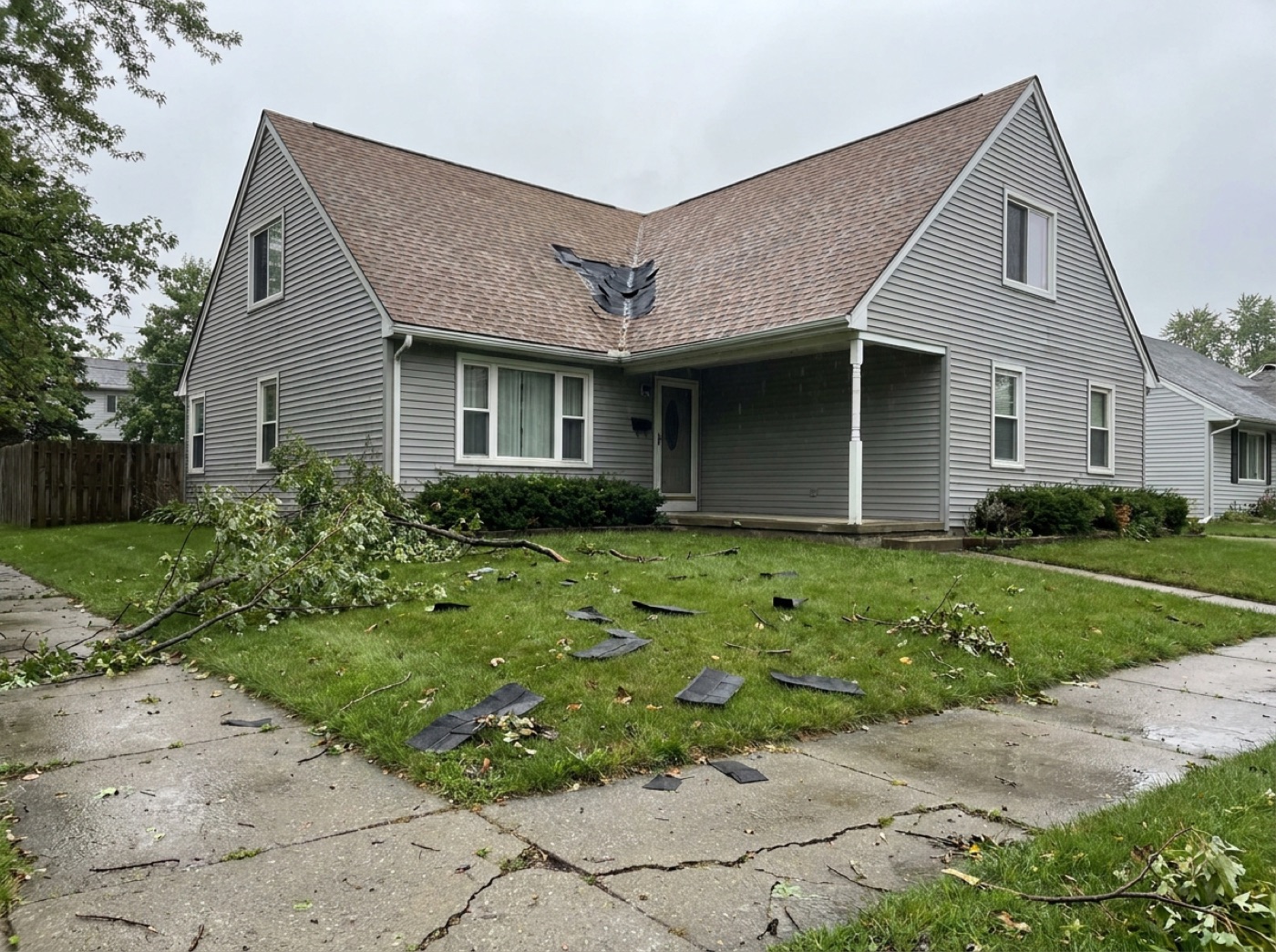
On an actual roof, straight-line wind damage tends to concentrate on the slope directly facing the wind at the time of the event, since that is the surface catching the most direct pressure. Shingles crease and lift in a consistent direction along that slope, ridge caps on the windward side fail before the leeward side, and any downed trees or branches in the yard point the same way the roof damage does. Our companion guide on what wind speed actually damages a roof covers how age, install quality, and exposure change the threshold at which any of this starts, straight-line or otherwise.
Survey teams also weigh how the damage compares across a stretch of properties, not just one roof in isolation. A straight-line event rarely singles out one house; if it took shingles off one roof, it likely stressed the identical slope on the house next door and the one after that, even if the visible outcome differs because of age or prior condition. That consistency across a neighborhood, more than the severity at any single address, is one of the clearest tells that the source was a broad-moving wind mass and not a rotating one. It is also why comparing notes with neighbors after a big wind night is genuinely useful, not just a curiosity: a shared, directional story across several houses points toward straight-line wind almost every time.
03 / THE TIGHT VORTEXWhat tornado damage looks like, and why it scatters
A tornado is a rotating column of air in contact with both the ground and a thunderstorm cloud base, and its wind field behaves nothing like a broad-moving front. Instead of pushing air one direction across a wide area, a tornado's winds circle a tight, mobile center, which means the same house can take wind from multiple directions within seconds as the vortex passes, and a house one lot over may barely feel it at all. That is the physical reason tornado damage reads as scattered and inconsistent rather than uniform, and it is the single clearest identifying feature survey teams look for.
Why tornado damage looks random from the ground
Debris paths under a tornado converge toward the vortex and then fling outward as it passes, producing crossing and reversed patterns rather than everything falling one way. Damage severity can vary enormously across a very short distance, a hallmark that has nothing to do with construction quality and everything to do with how close a given structure sat to the tightest part of the rotating column. A garage stripped to the studs next to an untouched house is not evidence of shoddy building on one side; it is evidence of how narrow and violent a tornado's core actually is. The National Weather Service uses exactly this kind of scattered, non-uniform damage indicator, alongside the Enhanced Fujita damage scale, to confirm a tornado occurred and to estimate how strong it was after the fact.
A survey team does not need to see the funnel to know a tornado was there. The debris tells them. Wind that spins leaves a signature that wind moving in one direction never does.
One more distinguishing detail matters for homeowners specifically: tornado damage often includes structural failure, not just roof-surface damage, because the wind loads involved can exceed what typical residential framing and fastening are designed to resist. Roof decking lifted whole, walls displaced, or a structure moved on its foundation are tornado-level indicators that go well beyond the shingle and flashing damage a straight-line event typically produces. If any of that describes what you are looking at, the conversation moves past roofing into structural and safety territory before anything else.
04 / THE LOCAL PICTUREWhy most Macomb County wind damage is straight line, not tornado
Michigan sits in a region that sees organized straight-line wind events, including derechos and strong downburst clusters, multiple times in a typical year, while confirmed tornadoes are comparatively rare and, when they do occur, are more often on the weaker end of the damage scale. That is not a guess; it reflects the same climatology the National Weather Service tracks and publishes in its severe weather records for the region, cited in our sources below. Practically, it means the large majority of wind damage calls we take across Macomb County, including the loud, dramatic ones, trace back to a straight-line event rather than a tornado, even when the aftermath looks severe enough that a homeowner assumes otherwise.
Macomb County has recent, documented history here. The severe wind event of August 2023 led to the county's inclusion in federal disaster declaration DR-4757, and it produced exactly the kind of broad, directional roof damage this guide describes: creased and lifted shingles, broken seal bonds, and displaced ridge caps concentrated on wind-facing slopes across a wide area, rather than the scattered, house-by-house severity swings that mark a tornado track. If your roof went through that event, or any notable straight-line wind event since, and was never inspected up close, the open question is not whether wind like that can damage a roof; that is documented. The open question is only whether yours took any.
Timing matters too, and it is another reason straight-line events dominate the local record. Southeast Michigan's most active severe weather stretch runs from late spring through summer, when the atmospheric setup that produces strong thunderstorm clusters, downbursts, and the occasional derecho is most common, and it is the same window when a single afternoon storm cell can spin up damaging straight-line wind with little warning. Confirmed tornadoes can occur in that same window, but they remain the less frequent outcome of any given severe thunderstorm here, which is part of why the pattern-reading skill in this guide earns its keep on an ordinary summer storm night far more often than it does on a rare tornado day.
05 / WHAT IT MEANSReading the pattern tells you where to check first
The practical value of all this is a checklist, not trivia. A straight-line event points you toward one consistent slope and one consistent set of edge components; a tornado, or anything that behaves like one, points you toward a much wider, less predictable inspection and a real possibility of structural damage that a roofer alone cannot fully assess.
| CLUE | STRAIGHT LINE WIND | TORNADO |
|---|---|---|
| Debris direction | One consistent direction across the property | Scattered, crossing, or reversed within a short distance |
| Neighboring houses | Similar damage across the street or subdivision | Severity swings wildly house to house |
| Which roof slope fails | The slope facing the wind at the time | No consistent slope; any side can take the worst hit |
| Tree fall pattern | Trees down in the same direction | Trees down in multiple, sometimes opposing directions |
| Structural involvement | Rare; mostly shingle, flashing, and edge damage | Possible; decking, framing, or wall displacement can occur |
A few components fail more often no matter which pattern you are reading, and the reasons overlap with the exposure and wind-loading factors covered in our wind speed thresholds guide: ridge caps, gable ends, and the shingles closest to eaves and rakes take the highest local wind load in either scenario, because that is simply where wind pressure concentrates on any roof shape. What differs is scope. A straight-line event usually means a clean, focused repair on the wind-facing slope and edges; if the damage is instead scattered across every slope with no directional logic, or paired with any sign of movement in the framing itself, that scope question needs an inspection before anyone estimates a price. Roof repairs in Macomb County generally run $350 to $3,200 when the damage is the shingle and flashing kind this guide covers, and larger or complex repairs can run higher.
06 / WHAT TO DOGet your specific pattern read for free
You do not need to correctly identify straight-line wind versus a tornado to know what to do next; you need someone who checks the roof, the flashing, and the attic side of the deck and tells you honestly what pattern the damage actually shows. That is exactly the kind of read our storm and wind damage service is built around, and a free inspection covers it: if the reading points to something beyond roofing, structural movement, foundation shift, or anything a roofer should not be the last word on, we will tell you that too rather than quoting a roof repair over a bigger problem.
If wind has already stripped shingles or opened the deck to the weather, that is the one scenario here that should not wait for a scheduled visit. Our 24/7 emergency tarping stops water intrusion the same day, with the permanent repair scheduled once the roof is safe to work. Insurance coverage for either pattern depends on your specific policy, and every policy is different; we document what we find with photos and can meet your adjuster on site, but no contractor can promise how a carrier decides a claim. The full playbook from first photos to final invoice lives in our storm and insurance claims guide, and the honest repair and replacement ranges for whatever the roof needs are on our pricing page. If the pattern points to a repair, you can start the free storm damage estimate right now and pick storm damage as the reason for the visit.
- Straight-line wind damage is uniform and directional: debris, trees, and roof creases all point roughly one way.
- Tornado damage is scattered and rotational: severity can swing from total loss to untouched within a few hundred feet.
- Downbursts and derechos are both straight-line events; the difference is scale, from a few blocks to hundreds of miles.
- Michigan sees organized straight-line wind events far more often than confirmed tornadoes, including the August 2023 event behind FEMA DR-4757 in Macomb County.
- Scattered damage with no directional logic, or any sign of structural movement, needs an inspection before anyone estimates a roof-only price.
Questions we hear most
Look at the pattern, not the severity. Straight-line wind lays debris, downed trees, and roof damage in one consistent direction, and neighboring houses usually show a similar version of the same damage. Tornado damage scatters in multiple directions and can vary enormously between one house and the next just a few hundred feet away. A free inspection can confirm which pattern your roof actually shows.
Straight-line wind, including downbursts and derechos, is far more common here than confirmed tornadoes. Macomb County's most significant recent event, the severe wind storm of August 2023 that led to federal disaster declaration DR-4757, produced the broad, directional damage pattern typical of straight-line wind rather than a tornado track.
It matters for where to look first and how wide the inspection needs to be. Straight-line wind typically concentrates damage on one wind-facing slope and the edges, while damage that scatters across every slope with no consistent direction, or shows any sign of structural movement, needs a wider inspection before anyone treats it as a simple roof repair.
- FEMA, disaster declaration DR-4757-MI, Michigan severe storms of August 2023 (Macomb County designated). fema.gov/disaster/4757
- National Weather Service, Detroit/Pontiac forecast office: southeast Michigan forecasts, warnings, and event records. weather.gov/dtx